
|
ANOTHER CHOICE By Samuel Green |
|---|
The first to present his case seems right,
till another comes forward and questions him.
(Proverbs 18:17, NIV)
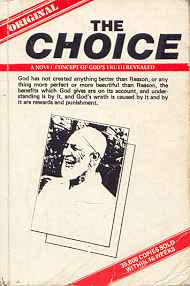
Ahmed Deedat (d. 2005) wrote many books, gave talks and was involved in public debates. His material continues to be widely used by Muslims to promote Islam and attack Christianity. For many Muslims, what they understand of Christianity comes from Ahmed Deedat. This article examines the main ideas that Deedat taught.
CONTENTSIn the Beginning
In the beginning was the Word, and the Word
was with
God, and the Word was God. (John 1:1, NIV)
Ahmed Deedat, claims to have had the following conversation with a Christian minister.

I asked the Reverend whether he knew Greek? "Yes", he said, He had studied Greek for five years before qualifications. I asked him what the Greek word was for "God" the first time it occurs in the translation - "and the Word was with God"? He kept staring, but did not answer. So I said, the word was HOTHEOS, which literally means "THE GOD" ... which in turn is rendered - God. "Now tell me, what is the Greek word for God in the second occurrence in your quotation - "and the Word was God"? The Reverend still kept silent ... the game was up. I said the word was TONTHEOS, which means a god. (Ahmed Deedat, Christ in Islam, ch. 7, pp. 40-41)
In this conversation Deedat claims to understand the original language of the Bible. He claims that through this knowledge he was able to defeat this Christian minister. The problem is that everything he says about the Greek language is wrong.
Firstly, he says that the first reference to God is HOTHEOS. This is wrong. Here is the Scripture:

The first occurrence is TON THEON and not HOTHEOS. Deedat is wrong.
Next, Deedat says that the second occurrence for God is TONTHEOS.
Again this is wrong:

The second occurrence is THEOS and not TONTHEOS as Deedat claims. Again, he is wrong. Deedat claims to understand the original language of the Bible but he does not; he cannot even get the letters right!
The Witnesses of Jesus
In his booklet, Crucifixion or Cruci-Fiction?, Ahmed Deedat quotes Mark 14:50 to prove that Jesus' disciples were not eye-witnesses to his crucifixion:

... one of the alleged witnesses, St. Mark, tells us that at the most critical juncture in the life of Jesus - "All his disciples forsook him and fled" - (Mark 14:50). Please ask your Christian friend, "Does all mean all in your language ...?" ... So the so-called "eye-witnesses" are not really eye-witnesses to the happenings ... The reason the disciples of Jesus were afraid was that they had learned by hearsay that their Master was killed by being fastened to the cross - that he was crucified. They had learned by hearsay ... that he had died. (Ahmed Deedat, Crucifixion or Cruci-Fiction?, ch. 3, pp. 7-8 & ch. 13, p. 55)
Christians and Muslims both agree that it is important to read a verse in its context. When Mark 14:50 is read in context it actually says the opposite of what Deedat claims.
Then everyone deserted him and fled. A young man, wearing nothing but a linen garment, was following Jesus. When they seized him, he fled naked, leaving his garment behind. They took Jesus to the high priest, and all the chief priests, elders and teachers of the law came together. Peter followed him at a distance, right into the courtyard of the high priest. There he sat with the guards and warmed himself at the fire. (Mark 14:50-54, NIV)
The verse in context says that Peter followed Jesus, and thus witnessed the final events of his life. If Deedat cannot read a verse in context then he is not qualified to teach the Bible.
Peter was not the only disciple who witnessed these events. Many of his disciples and his mother witnessed them too.
Finally Pilate handed him over to them to be crucified. So the soldiers took charge of Jesus. Carrying his own cross, he went out to the place of the Skull ... Here they crucified him, ... Near the cross of Jesus stood his mother, his mother's sister, Mary the wife of Clopas, and Mary Magdalene. When Jesus saw his mother there, and the disciple whom he loved standing nearby, he said to his mother, "Dear woman, here is your son," and to the disciple, "Here is your mother." From that time on, this disciple took her into his home (to care for her). (John 19:16-27, NIV)
When they came to the place called the Skull, there they crucified him ... Jesus called out with a loud voice, "Father, into your hands I commit my spirit." When he had said this, he breathed his last ... When all the people who had gathered to witness this sight saw what took place, they beat their breasts and went away. But all those who knew him, including the women who had followed him from Galilee, stood at a distance, watching these things. (Luke 23:33-49, NIV)
Deedat claimed that Mark 14:50 proved that the disciples of Jesus were not witnesses to his crucifixion. However, reading the verse in context shows that what Deedat says is false. The disciples of Jesus were eye-witnesses to the events of Jesus' life, including his crucifixion and resurrection, and it is their inspired testimony that we have in the Bible. The Bible contains not just one witness, but many witnesses to the life of Jesus.
A matter must be established by the testimony of two or three witnesses. (Deuteronomy 19:15, NIV)
This is one of the reasons why the Bible has four gospels and not just one. God appointed and inspired many eye-witnesses to the life of Jesus.
The Testimony of the Qur'an
Instead of listening to the many testimonies to Jesus' life in the Bible, Deedat urges his readers to listen to the testimony of the Qur'an. He says that this is the truth about Jesus, but is the Qur'an a reliable testimony? Consider the following three points.
1. It is claimed that the Qur'an is the testimony of God. Yet we see God changing his testimony and improving it.
Narrated Al-Bara: There was revealed: “Not equal are those believers who sit (at home) and those who strive and fight in the Cause of Allah.” (Qur’an 4.95) The Prophet said, "Call Zaid for me and let him bring the board, the inkpot and the scapula bone ..." Then he said, "Write: ‘Not equal are those Believers who sit...’", and at that time 'Amr bin Um Maktum, the blind man, was sitting behind the Prophet. He said, "O Allah's Apostle! What is your order for me (as regards the above Verse) as I am a blind man?" So, instead of the above Verse, the following Verse was revealed: “Not equal are those believers who sit (at home) except those who are disabled (by injury or are blind or lame etc.) and those who strive and fight in the cause of Allah.” (Qur’an 4.95) (Bukhari: vol. 6, bk. 61, no. 512, Khan)
Here we see Muhammad's God change his testimony. Initially it was:
Not equal are those believers who sit (at home) and those who strive and fight in the Cause of Allah.
But this was found to be unsatifactory, so the verse was changed to:
Not equal are those believers who sit (at home) except those who are disabled (by injury or are blind or lame etc.) and those who strive and fight in the cause of Allah. (Qur’an 4.95)
Surely God would get his testimony right the first time and not need to change it? If the Qur'an truly is the testimony of God then why did it need to be changed?
2. Deedat tells us that Muhammad received the testimony of God from the angel Gabriel. This sounds very simple, but what actually happened is more disturbing, for when Muhammmad received this testimony he would:
These are the symptoms that Muhammad had when he was inspired by his God. Why does Deedat not tell us about them? These symptoms suggest that there is a medical explanation for what was happening to Muhammad. This is particularly the case since Muhammad also suffered from a period of delusion in which he imagined he was doing things that he was not actually doing.
Narrated Aisha: Magic was worked on the Prophet so that he began to fancy (imagine) that he was doing a thing which he was not actually doing. ... (Bukhari: vol. 4, bk. 54, no. 490, Khan)
These symptoms and Muhammad's period of delusion strongly suggest that Muhammad's inspiration was not from God but was a medical condition that was not understood at the time.
3. Finally, Muhammad lived 600 years after Jesus and was not an eye-witness to anything he says about Jesus in the Qur'an. From a purely historical point of view we should seek to listen to the earliest accounts that are available, and these are the eye-witness accounts in the Bible.
In view of these three facts about the Qur'an and Muhammad, there is no reason to believe their testimony about Jesus.
Crucifixion or Cruci-fiction?
From the title of his book, Crucifixion or Cruci-fiction?, it appears that Deedat is casting doubt over whether Jesus was crucified. But surprisingly this is not the case, for in this book Deedat taught that:
Below are the quotes where he teaches these things and the picture he gives of what Jesus' crucifixion really looked like.

Contrary to common belief, Jesus was not nailed to the cross, but bound, if at all, like the other two (being crucified). (ch. 7, p. 31)
When John (in the Bible) says that the soldiers "saw" (that Jesus was dead), he means that they surmised. For no modern-day stethoscope was used to verify death; nor did anyone touch his body or feel his pulse before concluding that "he was dead already". (ch. 8, p. 36)
God works in a mysterious way. He inspires the soldiers to think that the victim is "dead already" so as not to break his legs, but at the same time inspires another to lance him on the side with a spear, and ...
"... FORTHWITH came there out blood and water." (HOLY BIBLE, John 19:34).It is a Blessing of God that when the human body cannot endure further pain or agony, unconsciousness supervenes. But immobility, fatigue and the un-natural stance on the cross must have slowed down the blood-circulation. The lancing came to the rescue. By "blood-letting", the circulation could regain its rhythm. (ch. 10, p. 39)
We must not suppose that Jesus was buried 6 feet underground. The sepulchre was a big, airy chamber and not a grave. (ch. 11, p. 42)
(T)he "secret" disciples of Jesus (came) to render help to the wounded man. (ch. 11, p. 43)
The removal of the stone and the unwinding of the winding (burial) sheets was the need of a physically resuscitated body, not that of a resurrected body! (Crucifixion or Cruci-fiction?, ch. 11, p. 45)
In reply to Deedat, three points need to be made. Firstly, what Deedat teaches here is against the Qur'an. Deedat teaches that Jesus was crucified, but survived, while the Qur'an teaches that Jesus was not crucified at all, but that he only appeared to be.
(Y)et they did not slay him, neither crucified him, only a likeness of that was shown to them. (Qur'an 4:157, Arberry)
The idea that Jesus survived his crucifixion is called the "swoon theory". Swoon means to faint. This theory was promoted by 18th and 19th century rationalist Western scholars who sought to give a non-miraculous rational explanation for the life of Jesus. The swoon theory is also held by the Ahmadiyya Muslim Movement (p. 4). It seems that Deedat is more influenced by these groups than he is by the Qur'an.
Secondly, Deedat tries to re-read the gospel accounts to show that they actually teach that Jesus did not die but only fainted. But his attempt is not successful because he ignores the plain meaning of the accounts. For instance he says that the Roman soldier pierced Jesus' side with a spear and that his was actually, "'blood-letting', (so that) the circulation (of Jesus' blood) could regain its rhythm (ch. 10, p. 39)." This is medical nonsense and the accounts cannot be re-read this way. Spearing someone in the side is how you kill them not assist their recovery.
All of the gospels testify to the fact that Jesus said he would die and that he did die.
From that time on Jesus began to explain to his disciples that he must go to Jerusalem and suffer many things at the hands of the elders, chief priests and teachers of the law, and that he must be killed and on the third day be raised to life. (Matthew 16:21, NIV; also Matthew 17:23, 20:28, 21:33-39, Mark 8:31, 10:45, 12:1-8, Luke 9:22, 20:9-15, John 6:51, 12:33, 18:32)
And when Jesus had cried out again in a loud voice, he gave up his spirit. (Matthew 27:50, NIV)
With a loud cry, Jesus breathed his last. (Mark 15:37, NIV)
Jesus called out with a loud voice, "Father, into your hands I commit my spirit." When he had said this, he breathed his last. (Luke 23:46, NIV)
But when they (the soldiers) came to Jesus and found that he was already dead, they did not break his legs. Instead, one of the soldiers pierced Jesus' side with a spear, bringing a sudden flow of blood and water. (John 19:33-34, NIV)
Finally, Deedat called his booklet, Crucifixion or Cruci-fiction?, and in doing so he has accused the Bible of being fiction when it speaks of Jesus' death. What is fiction? Fiction is where someone invents a story that in fact never happened. The irony is that in the Qur'an the death of Jesus is a fiction, a fiction that Muhammad's God has created.
(Y)et they did not slay him, neither crucified him, only a likeness of that was shown to them. (Qur'an 4:157, Arberry)
The Qur'an says that God made it seem that Jesus was crucified: "a likeness of that was shown to them", when in fact he was not. That is, to the people present it did look like Jesus was being crucified but God was just tricking everyone. Thus the death of Jesus in the Qur'an is said to be a fictional event God made up. The Bible is very different to this, it is based on many testimonies to real events and not fictional ones.
Incest and Pornography in the Bible
Deedat is critical of the Bible for recording how Judah had sexual relations with his daughter-in-law.

INCEST HONOURED
... Under what category ... will you place the incest of Judah, and his illegitimate progeny? All of these characters are honoured in the "Book of God" for their bastardy. ... But what about the moral (of this story)? God blesses Judah for his incestuous crime! (Ahmed Deedat, Is the Bible God's Word, ch. 8, pp. 48-49)
Firstly, Deedat does not tell his reader that Judah was deceived into sexually relations with his daughter-in-law.
Not realizing that she was his daughter-in-law, he went over to her by the roadside ... (Genesis 13:16, NIV)
Thus Judah did not do this knowingly. And Judah is never "honoured" for this action as Deedat claims. But the main problem with Deedat's criticism is that Muhammad had sexual relations with his daughter-in-law too! This is a well known event in Muhammad's life. Muhammad had an adopted son called Zayd bin Muhammad. Zayd had a beautiful wife was called Zaynab.
One day the Messenger of God went out looking for Zayd. Now there was a covering of haircloth over the doorway, but the wind had lifted the covering so that the doorway was uncovered. Zaynab was in her chamber, undressed, and admiration for her entered the heart of the Prophet. (Al-Tabari, The History of al-Tabari, vol. viii, p. 4)
Muhammad looked into another person's house and saw his daughter-in-law undressed. "Admiration for her entered (his) heart", but there was a terrible problem, she was his daughter-in-law, the wife of his adopted son. Then Muhammad claimed that God had saved him from this problem. First he said that God had cancelled all adoptions.
(N)either has He made your adopted sons your sons in fact. (Qur'an 33:4, Arberry)
This meant that Zayd was no longer Muhammad's son and that Zaynab was no longer his daughter-in-law. Then he said that God had given Zaynab to him.
So when Zaid had accomplished what he would of her (divorced her), then We gave her in marriage to you (Muhammad). (Qur'an 33:37, Arberry)
Judah was deceived into sexual relations with his daughter-in-law, Muhammad was not. The fact that Muhammad and Zaynab eventually got married does not justify this event, and adoption is not an evil institution that needs to be abolished. The fact is Muhammad looked into another person's house and saw a woman undressed. This lead to "revelations" that allowed him to fulfil his desire and take her to be his wife. Be honest, Muhammad is making up revelations to suit his own desires. If anyone else had such revelations we would rightly reject them as false, but when Muhammad has these revelations Islamic leaders tell us it is a miracle of God.
DAUGHTERS SEDUCE THEIR FATHER
Read Genesis 19, verses 30 to the end and mark again in "red" the words and phrases deserving this honour (of being censored). Do not hesitate and procrastinate. ... To continue: the "history" has it that, night after night, the daughters of Lot seduced their drunken father with the noble (?) motive of preserving their father's "seed". ... No decent reader can read the seduction of Lot to his mother, sister or daughter, not even to his fiancee if she is a chaste and moral woman. Yet you will come across perverted people who will gorge this filth. Tastes can be cultivated! (Ahmed Deedat, Is the Bible God's Word, ch. 8, p. 50)
Deedat refers to the incident of Lot's daughters having sexual relations with their father. His conclusion is that the Bible is a filthy book, a bad example, and unworthy to be called the Word of God. Deedat's comments are wrong for the following reasons.
The Bible records what humans are like - and we are sinful. Lot and his daughters sinned and it is not wrong to record that this happened. The Bible is clear that Lot's actions are not an example for us to follow.
No one is to approach any close relative to have sexual relations. (Leviticus 18:6, NIV)
Do not have sexual relations with both a woman and her daughter. (Leviticus 18:17, NIV)
However, for many Muslims there is another problem with what the Bible says. Muslims consider Lot to be a prophet and that prophets do not sin. Therefore to say that a prophet behaved this way is unacceptable. However, the Qur'an and Sunnah also record that the prophets sinned seriously. For instance, it says that Adam was the first idolater.
It is He who created you out of one living soul (Adam), and made of him his spouse that he might rest in her. Then, when he covered her, she bore a light burden and passed by with it; but when it became heavy they cried to God their Lord, "If Thou givest us a righteous son, we indeed shall be of the thankful." Thereafter, when He gave them a righteous son, they assigned Him associates in that He had given them; but God is high exalted above that they associate. (Qur'an 7:189-190, Arberry)
Muhammad also sinned this way in the famous event of the Satanic Verses. One day when Muhammad was reciting Sura 53 he recited these words to his tribe:
Have you thought of al-Lat and al-Uzza and Manat, the third ... these are the exalted Gharaniq (a high flying bird) whose intercession is approved. (Ibn Ishaq, Sirat Rasul Allah, pp. 165-166)
Al-Lat, al-Uzza and Manat were some of the local idols worshiped in Mecca. Previously Muhammad had spoken against them in his monotheist preaching but now he recited that their "intercession is approved". When Muhammad's tribe heard what he had said they accepted him as a prophet.
Then Gabriel came to the apostle and said, "What have you done, Muhammad? You have read to these people something I did not bring you from God and you have said what He did not say to you." (Ibn Ishaq, Sirat Rasul Allah, p. 166)
Then Muhammad confessed his sin.
I ascribed to Allah, what He had not said. (Ibn Sa'd, Kitab Al-Tabaqat Al-Kabir, vol. 1, p. 237)
I have fabricated things against God and have imputed to Him words which He has not spoken. (Al-Tabari, The History of Al-Tabari, vol. vi, p. 111)
Accepting polytheism and speaking false words in God's name is serious sin, and for a short period of time, while he was claiming to be a prophet, Muhammad did this. It is true that Muhammad confessed and repented, and this is to his credit, but this event still shows a very serious failing in his life. This event must not be ignored because it is inconvenient for it shows that all people are affected by sin.
(Muhammad prayed) O Allah! Forgive my mistakes and my ignorance and my exceeding the limit (boundaries) of righteousness in my deeds; and forgive whatever You know better than I. O Allah! Forgive the wrong I have done jokingly or seriously, and forgive my accidental and intentional errors, all that is present in me. (Bukhari: vol. 8, bk. 75, no. 408, Khan)
So know (O Muhammad) that there is no God save Allah, and ask forgiveness for thy sin and for believing men and women (Qur'an 47:19, Pickthall)
Therefore, the Qur'an and the Sunnah both agree with the Bible that even prophets sin. Deedat does not know the Qur'an or even the history of his own prophet. This is why the message of Jesus is so important because Jesus never sinned. God sent Jesus for this reason and he is our only hope.
An angel of the Lord appeared to him (Joseph) in a dream and said, "Joseph son of David, do not be afraid to take Mary home as your wife, because what is conceived in her is from the Holy Spirit. She will give birth to a son, and you are to give him the name Jesus, because he will save his people from their sins." (Matthew 2:20-21, NIV)
He committed no sin, and no deceit was found in his mouth. (1 Peter 2:22, NIV)
Esau - The True Name of Jesus
The Holy Qur'an refers to Jesus as "Eesa", ... Actually his proper name was "Eesa" (Arabic), or "Esau" (Hebrew); classical "Yeheshua" ... The word is very simply - "ESAU" - a very common Jewish name, used more than sixty times in the very first booklet alone of the Bible, in the part called "Genesis". (Ahmed Deedat, Christ in Islam, ch. 2, p. 6)
Deedat is correct to say that the Qur'an calls Jesus, Eesa, and that Eesa corresponds closest to the Hebrew name, Esau. But the rest of the information Deedat gives is incorrect:
1. Yeheshua should be spelt Yehoshua.
2. Jesus' classical Hebrew name is Yeshua not Yehoshua. Yeshua and Yehoshua are related names, and both are classical Hebrew names, but Jesus' name is Yeshua.
3. Esau is not "a very common Jewish name" as Deedat claims. It is a very rare name and only used for one person in the Bible.
4. Deedat is completely wrong to say that Esau is the common form of the name Yehoshua, and that Jesus' common name is Esau. Esau and Yehoshua are two completely different names, with different letters and two different meanings. When the name Yehoshua is shortened it becomes Yeshua and not Esau. Jesus' name in Hebrew is Yeshua not Esau.
5. In Arabic Jesus' name is Yasua. This is similar to the Hebrew name, Yeshua, because they are closely related languages.
| SUMMARY | |||
| Hebrew Name | Arabic Name | English Name | |
| Yeshua |
 Yasua Yasua |
Jesus | |
| Esau |  Eesau Eesau |
Esau | |
 Eesa Eesa |
? | ||
This exposes a significant error in the Qur'an because the Qur'an calls Jesus, Eesa, when his name in Arabic should be Yasua. As you can see, the Arabic for Eesa is very close to Esau and this is why Deedat thinks that Jesus' name should be Esau, but Esau is the wrong name. This means the Qur'an has the wrong name for Jesus or that it uses a very corrupted version of his name. Either way the Qur'an fails to get Jesus' name right.
Three Grades of Evidence
We Muslims have no hesitation in acknowledging that in the Bible, there are three different kinds of witnessing recognizable without any need of specialized training. These are:
- You will be able to recognize in the Bible what may be described as "The Word of God".
- You will also be able to discern what can be described as the "Words of a Prophet of God."
- And you will most readily observe that the bulk of the Bible is the records of eye witnesses or ear witnesses, or people writing from hearsay. As such they are the "Words of a Historian."
... The following quotations will make the position crystal clear:
The FIRST Type:
- "I will raise them up a prophet ... and I will put my words in ... and he shall speak unto them all that I shall command him." (Deuteronomy 18:18)
- "I, even I, am the Lord, and beside me there is no saviour." (Isaiah 43:11)
- "Look unto me, and be ye saved, all the end of the earth: for I am God, and there is non else." (Isaiah 45:22)
Note the first person pronoun singular (in bold) in the above references, and without any difficulty you will agree that the statements seem to have the sound of being GOD'S WORD.
The SECOND Type:
- "Jesus cried with a loud voice, saying Eli, Eli, lama sabachtani? ..." (Matthew 27:46)
- "And Jesus answered him, The first of all the commandments is, Hear, O Israel; the Lord our God is one Lord:" (Mark 12:29)
- "And Jesus said unto him, Why callest thou me good? There is none good but one, that is God." (Mark 10:18)
Even a child will be able to affirm that Jesus "cried," Jesus "answered," and Jesus "said" are the words of the one to whom they are attributed, i.e. the WORDS OF A PROPHET OF GOD.
The THIRD Type:
"And seeing a fig tree afar off having leaves, he, (JESUS) came, if haply he (JESUS) might find anything thereon; and when he (JESUS) came to it, he (JESUS) found nothing but leaves..." (Mark 11:13)The bulk of the Bible is a witnessing of this THIRD kind. These are the words of a third person. Note the underlined pronouns. They are not the Words of God or of his prophet, but the WORDS OF A HISTORIAN.
For the Muslim it is quite easy to distinguish the above types of evidence, because he also has them in his own faith. But of the followers of the different religions, he is the most fortunate in this that his various records are contained in separate Books!
ONE: The first kind - THE WORD OF GOD - is found in a Book called The Holy Qur'an.
TWO: The second kind - THE WORDS OF THE PROPHET OF GOD ... are recorded in the Books of Tradition called The Hadith.
THREE: Evidence of the third kind abound in different volumes of Islamic history ...
The Muslim keeps the above three types of evidence jealously apart, in their proper gradations of authority. He never equates them. On the other hand, the "Holy Bible" contains a motley type of literature ... (Ahmed Deedat, Is the Bible God's Word?, ch. 1, pp. 4-6)
What Deedat says about the Bible and the Qur'an is false. Consider the Qur'an first.
The Qur'an - Deedat says that the Qur'an is the "type 1" witness. That is, it is where God says, "I" and "me", but this is false as any reader of the Qur'an knows. Consider these examples.
In the Name of God, the Merciful, the Compassionate.
Praise be to God, Lord of the Universe,
The Compassionate, the Merciful,
Sovereign of the Day of Judgement!
You alone we worship, and to You alone
we turn for help.
Guide us to the straight path,
The path of those whom You have favoured,
Not of those who have incurred Your wrath,
Nor of those who have gone astray.
(Qur'an 1, Dawood)
... Our Lord! Condemn us not if we forget, or miss the mark!
Our Lord! Lay not on us such a burden as thou didst lay on those before us!
Our Lord! Impose not on us that which we have not the strength to bear!
Pardon us, absolve us and have mercy on us, Thou, our Protector,
and give us victory over the disbelieving folk. (Qur'an 2:286, Pickthall)
The whole first sura and 2:286 are prayers directed to God. There is no "I" or "me" of God speaking in them. By Deedat's own standard these are "type 2" witness, not "type 1".
Consider another example.
We descend only at the bidding of your Lord. To Him belongs what is before us and behind us, and all that lies between. Your Lord does not forget. He is the Lord of the heavens and the earth and all that is between them. Worship Him, then and be patient in His service. (Qur'an 19:64-64, Dawood)
Again we see there is no "I" or "me" of God speaking ("type 1"). Instead there are spirits or angels, "we", speaking about God, "him". This is the voice of the majority of the Qur'an. By Deedat's own standard this is a mixture of "type 2 & 3" witness, which according to him not the word of God.
There are also several parts of the Qur'an in which it is Muhammad speaking.
'Serve you none but God' (I am to you a warner from Him and a bearer of good tidings) and: 'Ask forgiveness of your Lord, then repent to Him, and He will give you fair enjoyment unto a term stated, and He will give of His bounty to every man of grace. But if you should turn your backs I fear for you the chastisement of a mighty day; to God shall you return; He is powerful over everything.' (Qur'an 11:2-4, Arberry)
O my people, let not the breach with me move you, so that there smite you the like of what smote the people of Noah, or the people of Hood, or the people of Salih; and the people of Lot are not far away from you. And ask forgiveness of your Lord, then repent to Him; surely my Lord is All-compassionate, All-loving.' (Qur'an 11:89-90, Arberry)
I have only been commanded to serve the Lord of this territory which He has made sacred; to Him belongs everything. And I have been commanded to be of those that surrender. (Qur'an 27:91, Arberry)
The Qur'an does have a small amount of "type 1" witness.
I created the jinn and mankind only that they might worship Me. I demand no livelihood of them, nor do I ask that they should feed Me. (Qur'an 51:57, 2:152, 7:183,Dawood)
Thus the Qur'an has many voices in it. It has the voice of the angels/spirits speaking about God, the voice of the Muslim community praying to God, the voice of Muhammad addressing his people and the voice of God speaking directly. It is not a "type 1" witness as Deedat claims.
The Bible - Deedat mocks the Bible and calls it a "motley type of literature", and thus inferior to the Qur'an. It is true that the Bible has many types of literature. It is a collection of the writings of about 40 prophets and apostles over a 1500 year period. It has:
God has inspired his word in many ways.
In the past God spoke to our forefathers through the prophets at many times and in various ways (Hebrews 1:1, NIV).
God is not limited to one type of witness. He has inspired people with his word in many different ways. In fact a revelation from God must have many types of inspiration and witness for it to be complete. Consider the Bible, since it contains history, it provides all of its own context and chronology. This means that all of its commands, prophecies and the gospel can be understood in their proper context, which the Bible itself provides. The Bible is complete and the only essential book in Christianity.
The Qur'an is very different. Muhammad spoke the Qur'an in response to different situations in his life, but what these situations were (the context) is not recorded in the Qur'an. It is essential to know this context in order to rightly understand and apply the Qur'an but this essential context comes from other books called the Hadith and Sira.
The Qur'an also does not contain the Sunnah (practices of Muhammad). Yet the Sunnah is essential in Islam. How, when and what to pray, what to do on Hajj, circumcision, in fact most of the essential Islamic practices come from the Sunnah and this too comes from the Hadith and Sira.
Since the Qur'an does not contain its own context or the Sunnah, it is an incomplete book. The essential books of Islam are the Qur'an, Hadith and Sira and not the Qur'an alone. The essential book of Christianity is the Bible. Therefore it is wrong to compare the Bible to the Qur'an in the way that Deedat has. A fair comparison will compare the essential books of both religions.
For more information read, Comparing the Bible and the Qur'an
Charge of "The Sword"

How can the enemies of Islam account for Muhummed's phenomenal achievements except to decry that he spread his religion at the point of the sword? He forced Islam down people's throats!?
6a. "HISTORY MAKES IT CLEAR HOWEVER, THAT THE LEGEND OF FANATICAL MUSLIMS SWEEPING THROUGH THE WORLD AND FORCING ISLAM AT THE POINT OF THE SWORD UPON CONQUERED RACES IS ONE OF THE MOST FANTASTICALLY ABSURD MYTHS THAT HISTORIANS HAVE EVER REPEATED." (De Lacy O'Leary). (Ahmed Deedat, Muhammed (p.b.u.h.) the Greatest, ch. 2, pp. 30-31)
Deedat claims that Muhammad did not spread Islam by the sword. To know whether this claim is true or not a person must know early Islamic history, however, most people don't know it. Here is a very brief selection from the early Islamic histories that show that Muhammad did use the sword to spread Islam.
Assassinations - Muhammad had people assassinated in order to spread Islam. The following account records how Muhammad had two people assassinated, and how these assassinations caused the tribe of Khatma to convert to Islam.
Abu `Afak ... showed his disaffection when the apostle (Muhammad) killed al-Harith b. Samit ... The apostle said, "Who will deal with this rascal for me?" Whereupon Salim b. `Umayr, ... went forth and killed him. ... (`Asma d. Marwan) was of (the tribe) B. Umayya b. Zayd. When Abu `Afak had been killed she displayed disaffection. ... When the apostle heard what she had said, he said, "Who will rid me of Marwan's daughter?" `Umayr b. `Adiy al-Khatmi who was with him heard him, and that very night he went to her house and killed her. In the morning he came to the apostle and told him what he had done and he (Muhammad) said, "You have helped God and His apostle, O `Umayr!" When he asked if he would have to bear any evil consequences the apostle said, "Two goats won't butt their heads about her," ... The day after Bint Marwan was killed the men of (tribe of) Khatma became Muslims because they saw the power of Islam. (Ibn Ishaq, Sirat Rasul Allah, pp. 675-676)
Offensive Warfare - Muhammad did fight some battles in self-defence, but when he grew in military power he began to attack others. He sought to conquer all those around him and bring them under Islamic rule.
Narrated Sulaiman bin Surd: When the clans were driven away, I heard the Prophet saying, "From now onwards we will go to attack them (i.e. the infidels) and they will not come to attack us, but we will go to them." (Bukhari: vol. 5, bk. 59, no. 436, Khan)
Narrated Ibn 'Umar: Allah's Apostle said: "I have been ordered (by Allah) to fight against the people until they testify that none has the right to be worshipped but Allah and that Muhammad is Allah's Apostle ..." (Bukhari: vol. 1, bk. 2, no. 24, Khan)
The Apostle of Allah, sent Khalid Ibn al-Walid with four hundred Muslims to Banu al-Harith ... He ordered him to invite them to Islam three times before fighting. ... They accepted what he had called them to. He stayed among them to teach them Islam, its regulations, the Book of Allah and the sunnah of His Prophet. (Ibn Sa'd, Kitab Al-Tabaqat Al-Kabir, vol. 1, p. 399)
Anas b. Malik reported: The Messenger of Allah used to attack the enemy when it was dawn. He would listen to the Adhan (Islamic call to prayer); so if he heard an Adhan, he stopped, otherwise made an attack. (Muslim: bk. 4, no. 745, Siddiqui)
Abu Bakr said: "You asked me for the best advice that I could give you, and I will tell you. God sent Muhammad with this religion and he strove for it until men accepted it voluntary or by force." (Ibn Ishaq, Sirat Rasul Allah, pp. 668-669)
The early Islamic history shows that Muhammad spread his religion by the sword. For more information read, A Survey of How Muhammad Spread Islam
Next, Deedat claims that Islam spread throughout the world not by the sword but by peaceful Islamic traders who took Islam with them as they traded throughout the world.
But what can the enemy (of Islam) say about countries where no single Muslim soldier had set foot?
- INDONESIA: It is a fact that over a hundred million Indonesians are Muslim, yet no conquering Muslim army every landed on any of its over two thousand islands.
- MALAYSIA: The overwhelming number of its people in this country are Muslims yet no Muslim soldier had landed on there either.
- AFRICA: The majority of people on the East coast of Africa as far down as Mozambique, as well as the bulk of the in habitants of the West coast of the continent are Muslims, but history does not record any invading hoards of Muslims from anywhere. What sword? Where was the sword? The Muslim trader did the job. His good conduct and moral recititude achieved the miracle of conversion. (Ahmed Deedat, Muhammed (p.b.u.h.) the Greatest, ch. 2, pp. 32-33)
Deedat claims that it was the Islamic traders, and not Islamic soldiers, who brought Islam to countries like Indonesia, Malaysia and East Africa. This is true, but this does not mean it was peaceful or without coercion, for Islamic traders were slave traders. Most of us have a romantic view of traders. We think that they traded in oil, spices, pottery and silk. They did, but they also gathered and traded in slaves.
The Islamic empire conquered all of the Middle East, North Africa, Spain, Persia and across to India. From all of these regions Islamic traders took millions of slaves, but most of their slaves came from the non-conquered regions bordering the Islamic empire. These traders made excursions into these unconquered regions gathering slaves for sale in the Islamic and other empires. Islamic traders gathered millions of slaves from Africa, Europe, Persia, India, Indonesia, Malaysia and possibly even as far as Australia. Slaves of an Islamic master would be treated better if they converted to Islam, and if a tribe converted to Islam then they could not be enslaved. Some tribes converted and then worked with the Islamic traders to help enslave other nearby tribes.
It must be remembered that the Islamic empires never abolished slavery. It was the Christian Western empires that did this after their shameful involvement in it. Instead, Islam seemed to encourage the expansion of slavery, for Muhammad, who is regarded as the perfect model Muslim, kept slaves.
... a black slave of Allah's Apostle was (sitting) on the first step (of Muhammad's house). ... (Bukhari: vol. 6, bk. 60, no. 435, Khan)
And Muhammad traded in slaves.
... (Muhammad said) Sell him (a slave) to me. And he (Muhammad) bought him for two black slaves ... (Muslim: bk. 10, no. 3901, Siddique)
And in the Qur'an he promised slaves as a reward in paradise for faithful Muslims.
In the Gardens of delight (Paradise). ... (They will be) on thrones woven with gold and precious stones, Reclining thereon, face to face. They will be served by immortal boys, With cups, and jugs, and a glass from the flowing wine. (Qur'an 56:12-18, Hilali-Khan. Also 76:19.)
And the Hadith records that Muslims were to use slavery to convert people to Islam.
Narrated Abu Huraira: The Verse:--"You (true Muslims) are the best of peoples ever raised up for mankind."(3:110) means, the best of peoples for the people, as you bring them with chains on their necks till they embrace Islam. (Bukhari: vol. 6, bk. 60, no. 80, Khan)
The Islamic traders did spread Islam, but the slave trade was part of the way they did this. Islamic traders enslaved millions of people from Spain to South East Asia and down into Africa for over a 1000 years, and this is part of the way that Islam spread.
For more information and references read, Islam and Slavery. View a short video on Islam and Slavery.
The Real Founder of Christianity
Every knowledgeable Christian concedes that the real founder of Christianity is St. Paul and not Jesus Christ (peace be upon him). In any event, if there is any division between a Muslim and a Christian on the grounds of dogma, belief, ethics or morality, then the cause of such conflict could be traced to an utterance of Paul found in his books ... in the Bible. (Ahmed Deedat, Crucifixion or Cruci-Fiction?, ch. 1, pp. 1-2)
Deedat claims that modern Christianity is the product of Paul and not Jesus, and that any division between Christians and Muslims is because of Paul. However, Deedat's rejection of Paul is wrong for three reasons.
1. Christians read all of the prophets. The Bible is not just one book but a collection of all the prophets. In contains the Torah the law of Moses, the Psalms of David, the Wisdom of Solomon, the prophetic books of Isaiah, Jeremiah, Ezekiel, Daniel, Hosea, Joel, Amos, Obadiah, Jonah, Micah, Nahum, Habakkuk, Zephaniah, Haggai, Zechariah and Malachi. It has the gospel of Jesus from Matthew, Mark, Luke and John, and the writings of the apostles of the Messiah. Paul's writings are about 6% of the Bible.
What Christians believe about God comes from all of the prophets and not just Paul. Christians believe in all the prophets and so they read all the prophets and not just Paul. Any division between Christians and Muslims is because Muslims do not read all the prophets. Muslims say they believe all the prophets but in practice they only listen to what Muhammad said in the Qur'an and Hadith. Christians, however, read all the prophets.
2. Paul agrees with the earlier prophets.
Jesus came to fulfil and confirm the teaching of the prophets who were before him.
Do not think that I (Jesus) have come to abolish the Law (of Moses) or the Prophets; I have not come to abolish them but to fulfil them. (Matthew 5:17, NIV)
This means that anyone who is sent by Jesus must teach what is consistent with the Law and the prophets. Paul says that he was sent by Jesus (Galatians 1:1). If this is true then the gospel he taught must agree with the Law and the Prophets. Here are seven key areas in which Paul agrees with the earlier prophets.
a. One God
The prophets before Paul taught that there is only one God (Isaiah 45:5). Paul also taught that there is only one God.
(W)e know that an idol is nothing at all in the world and that there is no God but one. (1 Corinthians 8:4, NIV)
For there is one God ... (1 Timothy 2:5, NIV)
b. God is the creator
The prophets before Paul taught that God is the creator.
In the beginning God created the heavens and the earth. (Moses, Genesis 1:1, NIV)
It is I who made the earth and created mankind upon it. My own hands stretched out the heavens. (Isaiah 45:12, NIV)
Paul also preached that God is the creator.
The God who made the world and everything in it is the Lord of heaven and earth and does not live in temples built by hands. And he is not served by human hands, as if he needed anything, because he himself gives all men life and breath and everything else. (Acts 17:24-25, NIV)
c. The Image and Likeness of God
The prophets before Paul taught that God made humanity in his image.
Then God said, "Let us make man in our image, in our likeness ..." So God created man in his own image, in the image of God he created him; male and female he created them. (Moses, Genesis 1:26-27, NIV)
Since we are in God's image God calls us to be like him.
Be holy because I, the LORD your God, am holy. (Moses, Exodus 19:2, NIV)
Paul too teaches that we are made in the image of God and are to be like him.
(We are) being renewed in knowledge in the image of (our) Creator. (Colossians 3:10, NIV)
However, the Qur'an never teaches that we are created in the image of God, in fact it says that nothing is like God (112:4).
d. The Sons of God
The prophets before Paul said that God's people are called the sons of God.
This is what the LORD says: Israel is my firstborn son, and I told you (Pharaoh), "Let my son go, so he may worship me." (Moses, Exodus 4:22, NIV)
In the place where it was said to them, "You are not my people," they will be called "sons of the living God." (Hosea 1:10, NIV)
(Jesus said) Blessed are the peacemakers, for they will be called sons of God. (Matthew 5:10)
Paul also taught that God's people are called the sons of God.
You are all sons of God through faith in Christ Jesus. (Galatians 3:26, NIV)
Muhammad, however, denied that anyone could be called a son of God.
Say the Jews and Christians, "We are the sons of God, and His beloved ones." Say: "Why then does He chastise you for your sins? No; you are mortals, of His creating ..." (Qur'an 5:18, Arberry)
e. The Son of God
The prophets before Paul taught the Messiah (or Christ) in particular was the son of God.
I (God) will be his father, and he shall be my son ... (2 Samuel 7:14, NIV)
I will proclaim the decree of the LORD: He said to me, "You are my Son; today I have become your Father." (David, Psalm 2:7, NIV)
The high priest said to him, "I charge you under oath by the living God: Tell us if you are the Messiah, the Son of God." "Yes, it is as you say," Jesus replied. (Matthew 26:63-64, NIV)
Paul also taught that the Messiah was God's son.
Paul, a servant of Christ Jesus, called to be an apostle and set apart for the gospel of God - the gospel he promised beforehand through his prophets in the Holy Scriptures regarding his Son, who as to his human nature was a descendant of David, and who through the Spirit of holiness was declared with power to be the Son of God by his resurrection from the dead: Jesus Christ our Lord. (Romans 1:1-4, NIV)
Muhammad, however, denied that the Messiah is the son of God.
(T)he Christians say, "The Messiah is the Son of God." That is the utterance of their mouths, conforming with the unbelievers before them. God assail them! How they are perverted! (Qur'an 9:30, Arberry)
f. The Rule of the Messiah
The prophets before Paul taught that the Messiah is the Lord who rules from God's right hand.
I will proclaim the decree of the LORD: He said to me, "You are my Son; today I have become your Father. Ask of me, and I will make the nations your inheritance, the ends of the earth your possession." (David, Psalm 2:7-8, NIV)
The LORD says to my Lord: "Sit at my right hand until I make your enemies a footstool for your feet." (David, Psalm 110:1, NIV)
For to us a child is born, to us a son is given, and the government will be on his shoulders. And he will be called Wonderful Counsellor, Mighty God, Everlasting Father, Prince of Peace. Of the increase of his government and peace there will be no end. He will reign on David's throne and over his kingdom. (Isaiah 9:6-7, NIV)
In my vision at night I looked, and there before me was one like a son of man, coming with the clouds of heaven. He approached the Ancient of Days (God) and was led into his presence. He was given authority, glory and sovereign power; all peoples, nations and men of every language worshipped him. His dominion is an everlasting dominion that will not pass away, and his kingdom is one that will never be destroyed. (Daniel 7:13-14, NIV)
Then Jesus came to them and said, "All authority in heaven and on earth has been given to me." (Matthew 28:18, NIV)
Paul also taught that the Messiah is the Lord who rules from God's right hand.
(God) raised him (Jesus) from the dead and seated him at his right hand in the heavenly realms, far above all rule and authority, power and dominion, and every title that can be given, not only in the present age but also in the one to come. (Ephesians 1:19-21, NIV)
However, Muhammad taught that the Messiah is not Lord but only a prophet.
The Messiah, son of Mary, was only a Messenger; Messengers before him passed away; his mother was a just woman; they both ate food. (Qur'an 5:75, Arberry)
g. The Sacrifice for Sin
The prophets before Paul taught that there was a sacrifice for sin.
He (the priest) shall then slaughter the goat for the sin offering for the people ... (then) He is to lay both hands on the head of the live goat and confess over it all the wickedness and rebellion of the Israelites - all their sins - and put them on the goat's head. He shall send the goat away into the desert in the care of a man appointed for the task. The goat will carry on itself all their sins to a solitary place. (Moses, Leviticus 16:15-21, NIV)
The prophet Isaiah prophesied that God would provide the true sacrifice for sin. It would be the servant of the Lord.
But he was pierced for our transgressions, he was crushed for our iniquities; the punishment that brought us peace was upon him, and by his wounds we are healed. We all, like sheep, have gone astray, each of us has turned to his own way; and the LORD has laid on him the iniquity of us all. ... For he bore the sin of many, and made intercession for the transgressors. (Isaiah 53:4-6, 12b, NIV)
John the Baptist identified Jesus as this sacrifice.
The next day John saw Jesus coming toward him and said, "Look, the Lamb of God, who takes away the sin of the world!" (John 1:29, NIV)
Jesus identified himself as this sacrifice.
Then he took the cup, gave thanks and offered it to them, saying, "Drink from it, all of you. This is my blood of the covenant, which is poured out for many for the forgiveness of sins." (Matthew 26:27-28, NIV)
Paul agrees with the earlier prophets when he says:
God presented him (Jesus) as a sacrifice of atonement. (Romans 3:25, NIV)
Muhammad contradicts the earlier prophets because he denies that God has provided a sacrifice for our sins. Muhammad taught that Jesus never died on the cross.
(Some Jews say) "We slew the Messiah, Jesus son of Mary, the Messenger of God" - yet they did not slay him, neither crucified him, only a likeness of that was shown to them. ... and they slew him not of a certainty. (Qur'an 4:157, Arberry)
h. Circumcision
The prophets before Paul spoke about circumcision. Circumcision was the sign of God's covenant.
This is my covenant with you (Abraham) and your descendants after you, the covenant you are to keep: Every male among you shall be circumcised. You are to undergo circumcision, and it will be the sign of the covenant between me and you. (Genesis 17:10-11, NIV)
God commanded the Israelites to keep this sign of the covenant (Leviticus 12:3). However, the Israelites rejected God's covenant.
Both the house of Israel and the house of Judah have broken the covenant I made with their forefathers. (Jeremiah 11:10, NIV)
For this reason God promised to bring a new circumcision. It was to be a circumcision that he would perform on all this people so that they would truly keep his covenant.
The LORD your God will circumcise your hearts and the hearts of your descendants, so that you may love him with all your heart and with all your soul, and live. (Deuteronomy 30:6, NIV)
Jesus brings the fulfilment of this promise and Paul faithfully explains this.
In him (Jesus) you were also circumcised, in the putting off of the sinful nature, not with a circumcision done by the hands of men but with the circumcision done by Christ. (Colossians 2:11, NIV)
... circumcision is circumcision of the heart, by the Spirit, not by the written code. Such a man's praise is not from men, but from God. (Romans 2:29, NIV)
What Paul teaches about circumcision is in line with the message of the prophets before him. However, the Qur'an never mentions circumcision even though it is such an important message of the prophets.
i. The Gift of the Spirit
The prophets before Paul prophesied that God would give his Spirit to his people.
I will pour out my Spirit on all people. (Joel 2:28, NIV)
(T)ill the Spirit is poured upon us from on high. (Isaiah 32:15, NIV)
I will give you a new heart and put a new spirit in you; I will remove from you your heart of stone and give you a heart of flesh. And I will put my Spirit in you ... (Exekiel 36:26-27, NIV)
I (John) baptize you with water for repentance. But after me will come one who is more powerful than I, whose sandals I am not fit to carry. He will baptize you with the Holy Spirit and with fire. (John the Baptist, Matthew 3:11, NIV)
And with that he (Jesus) breathed on them and said, "Receive the Holy Spirit." (Jesus, John 20:22, NIV)
Paul agrees with the earlier prophets when he says:
We have not received the spirit of the world but the Spirit who is from God. (1 Corinthians 2:12, NIV)
Against the earlier prophets, Muhammad gave no promise of the Spirit to his followers. Instead he recited:
They will question you concerning the Spirit. Say: 'The Spirit is of the bidding of my Lord. You have been given of knowledge nothing except a little.' (Qur'an 17:85, Arberry)
The gospel that Paul taught agrees with the prophets who were before him. This is why Paul said,
I am saying nothing beyond what the prophets and Moses said would happen - that the Christ would suffer and, as the first to rise from the dead, would proclaim light to his own people and to the Gentiles. (Acts 26:22-23)
Muhammad teaches some things that agree with the earlier prophets but he disagrees with them at many significant points. It is not Paul who is the source of disagreement between Christians and Muslims; it is Muhammad. If you say that you believe all the prophets then please read them and not just believe what Muhammad says about them.
3. Early Islamic authorities accept Paul. - The Qur'an and Hadith never speak against Paul, and Islamic scholars accept that he was truly sent by Jesus.
Ibn Ishaq accepted Paul.
Those whom Jesus son of Mary sent, both disciples and those who came after them, in the land were: Peter the disciple and Paul with him ... (Ibn Ishaq, Sirat Rasul Allah, p. 653)
Al-Tabari accepted Paul.
Among the apostles, and the followers who came after them were the Apostle Peter and Paul who was a follower and not an apostle; they went to Rome. (Al-Tabari, The History of al-Tabari, vol. iv, p. 123)
When referring to Qur'an 36:14, Ibn Kathir quotes early Muslims who had no problem in viewing Paul as an apostle/messenger.
(so We reinforced them with a third,) means, "We supported and strengthened them with a third Messenger." Ibn Jurayj narrated from Wahb bin Sulayman, from Shu`ayb Al-Jaba'i, "The names of the first two Messengers were Sham`un and Yuhanna, and the name of the third was Bulus (Paul), and the city was Antioch (Antakiyah)." (Ibn Kathir, Tafsir Ibn Kathir, vol. 8, p. 179)
Ibn Kathir is never critical of Paul. Therefore, Deedat's rejection of Paul is at odds with major early Islamic scholars.
Deedat continues his argument againt Paul by saying that Paul teaches the opposite of what Jesus taught.
As against the teaching of the Master (Jesus) that salvation only comes through keeping of the commandments (Matthew 19:16-17), Paul nails the law and the commandments to the cross (Colossians 2:14), and claims that salvation can only be obtained through the death and resurrection of Jesus Christ. (Ahmed Deedat, Crucifixion or Cruci-Fiction?, ch. 1, p. 2)
Deedat does not understand the teaching of Jesus, Paul or even Muhammad. He says that Paul teaches salvation by faith in Christ, while Jesus taught salvation by keeping the law. The truth is that Jesus and Paul teach both these ideas.
Both Jesus and Paul taught that if you obey God then you will be saved.
If you want to enter life, obey the commandments." (Matthew 19:17, NIV)
(I)t is not those who hear the law who are righteous in God's sight, but it is those who obey the law who will be declared righteous. (Romans 2:13, NIV)
However, nobody keeps God's law. Jesus, Paul and even Muhammad make it very clear that we all fail to obey God.
(the disciples asked) "Who then can be saved?" Jesus looked at them and said, "With man this is impossible, but with God all things are possible." (Matthew 19:25-26, NIV)
Therefore no one will be declared righteous in his (God's) sight by observing the law; rather, through the law we become conscious of sin. ... for all have sinned and fall short of the glory of God. (Romans 3:20-23, NIV)
If Allah were to take mankind to task for their wrong-doing, he would not leave hereon a living creature ... (Qur'an 16:61, Pickthall)
Therefore we cannot save ourselves by obeying God. We all fail to obey God. We need God to have mercy and save us. This is the message of the prophets: we need God's mercy and this is what Paul and Jesus both teach.
God foretold through the prophet Isaiah 700 years before Jesus how he would act to save us. He told us of his special servant.
But he was pierced for our transgressions, he was crushed for our iniquities; the punishment that brought us peace was upon him, and by his wounds we are healed. We all, like sheep, have gone astray, each of us has turned to his own way; and the LORD has laid on him the iniquity of us all. ... For he bore the sin of many, and made intercession for the transgressors. (Isaiah 53:4-6, 12b, NIV)
And this is what Jesus came to fulfil and what the Apostle Paul taught.
(Jesus said of himself) The Son of Man did not come to be served, but to serve, and to give his life as a ransom for many. (Matthew 20:28, NIV)
But God demonstrates his own love for us in this: While we were still sinners, Christ died for us. (Romans 5:8, NIV)
Jesus and Paul teach the same thing because they continue the message of God's prophets. Paul is a faithful apostle.
The Sign of the Prophet Jonah
Then some of the Pharisees and teachers of the law said to him (Jesus), "Teacher, we want to see a miraculous sign from you." He answered, "A wicked and adulterous generation asks for a miraculous sign! But none will be given it except the sign of the prophet Jonah. For as Jonah was three days and three nights in the belly of a huge fish, so the Son of Man (Jesus) will be three days and three nights in the heart of the earth. (Matthew 12:38-40, NIV)
Ahmed Deedat made the following comments about this teaching of Jesus.
How was Jonah in the whale's belly for three days and three nights- Dead or Alive? The Muslims, the Christians and the Jews again give a unanimous verdict of A-L-I-V-E! How was Jesus in the tomb for the same period of time- Dead or Alive? Over a thousand million Christians, of every church or Denomination give a unanimous verdict of D-E-A-D! Is that like Jonah or un-like Jonah in your language? And everyone whose mind is not confused, says that, that is very UN-LIKE Jonah. Jesus said he would be "LIKE JONAH" and his infatuated followers say that he was "UN-LIKE JONAH!". Who is lying - Jesus or his followers? I leave the answer to you! (Ahmed Deedat, Crucifixion or Cruci-Fiction, ch. 15, pp. 68-69)
Deedat's comments are false for the following reasons.
Firstly, Deedat says that everyone agrees that Jonah was alive in the fish. This is not the case. In the book of Jonah, God commands Jonah to go to the city of Nineveh and warn it of God's judgement. Jonah refuses. Therefore, God sends the fish but the fish is much more than transport; it is a place of revelation. In the fish Jonah has an experience and revelation of death. Listen to what Jonah actually says.
In my distress I called to the LORD, and he answered me. From the depths of the grave I called for help, and you listened to my cry. ... But you brought my life up from the pit, O LORD my God. (Jonah 2:2-6, NIV)
Jonah is taken to the place of death. This revelation of death teaches Jonah that those who die without God are lost.
Those who cling to worthless idols forfeit the grace that could be theirs. (Jonah 2:8, NIV)
Thus, God used the fish to show Jonah that if he does not speak to the Ninevites then they will be lost forever. This is the story of Jonah in context. Therefore, Jonah was not alive or dead in the fish. In the fish he was taken alive into death so that he could learn God's lesson, that those who die without God have no hope. Deedat does not understand the story of Jonah.
Secondly, Deedat just has not listened to what Jesus actually said, for in these verses Jesus said he would die. Jesus said that he would be "in the heart of the earth", and this phrase is a common way to speak about being dead in the grave. We see this in the Psalms.
They who seek my life will be destroyed; they will go down to the depths of the earth . (Psalms 63:9, NIV)
To go into the "heart/depths of the earth" means to be dead in the grave. Jesus is saying that he will die as a result of his crucifixion.
Thirdly, again Deedat fails to read the Bible properly. Christians and Muslims agree that their holy books should be read carefully. This means that to properly understand a subject in the Bible or Qur'an a person should consider all that is said about that subject in that book. For instance, the Qur'an says that there will be rivers of wine in paradise.
This is the similitude of Paradise which the godfearing have been promised: therein are rivers of water unstaling, rivers of milk unchanging in flavour, and rivers of wine - a delight to the drinkers ... (Qur'an 47:15, Arberry)
If we were to just read this verse alone we may conclude that the Islamic paradise is a drunken party. But if you read other verses in the Qur'an it explains that this wine does not lead to drunkenness.
In the Gardens of delight (Paradise). ... They will be served by immortal boys, With cups, and jugs, and a glass from the flowing wine, Wherefrom they will get neither any aching of the head, nor any intoxication. (Qur'an 56:12-19, Hilali-Khan)
Thus, it is important to consider all that the Qur'an says about a subject if we wish to understand it properly. It is the same with the Bible. To properly understand what Jesus taught we should consider all that he said. The following verses are were Jesus explains more about what was to happen to him.
From that time on Jesus began to explain to his disciples that he must go to Jerusalem and suffer many things at the hands of the elders, chief priests and teachers of the law, and that he must be killed and on the third day be raised to life. (Matthew 16:21, NIV)
When they came together in Galilee, he said to them, "The Son of Man is going to be betrayed into the hands of men. They will kill him, and on the third day he will be raised to life." (Matthew 17:22-23, NIV)
Now as Jesus was going up to Jerusalem, he took the twelve disciples aside and said to them, "We are going up to Jerusalem, and the Son of Man will be betrayed to the chief priests and the teachers of the law. They will condemn him to death and will turn him over to the Gentiles to be mocked and flogged and crucified. On the third day he will be raised to life!" (Matthew 20:17-19, NIV)
It is very important to consider all that the Bible and Qur'an teach on a subject if you want to understand them properly. Ahmed Deedat has failed to do this. He has taken just one part of the Bible and ignored the other parts. This is very poor scholarship and as a result he does not understand what Jesus taught. Jesus clearly taught that he would die as a result of his crucifixion.
Deedat also says that Jesus was not in the tomb for the length of time that he said he would be.
Jesus said that he would be in the tomb for THREE days and THREE nights, whereas the Christians say that he was in the tomb for only ONE day and TWO nights. Who is lying, Jesus for the Christians? Let them answer. (Ahmed Deedat, Crucifixion or Cruci-Fiction, ch. 16, pp. 72)
In this case Deedat is just ignorant of an ancient Jewish figure of speech that Jesus is using. For the Jewish people, "three days and three nights" was an expression for any part of three days. We see this in the book of Esther.
(Esther said) "Go, gather together all the Jews who are in Susa, and fast for me. Do not eat or drink for three days, night or day. I and my maids will fast as you do. When this is done, I will go to the king ... On the third day Esther put on her royal robes and stood in the inner court of the palace, in front of the king's hall. (Esther 4:16-5:1, NIV)
You will notice that it was not after the three days and nights that Esther went to stand before the king but "on the third day". Jesus uses the same expression,
... (Jesus said) They will condemn him to death and will turn him over to the Gentiles to be mocked and flogged and crucified. On the third day he will be raised to life!" (Matthew 20:17-19, NIV)
If we want to understand the Gospel then we must understand the figures of speech that were used at the time. Deedat refuses to do this and so misunderstands the message of the Gospel.
What the Bible says about Muhammad

Deedat wrote a booklet called, What the Bible Says About Muhammad. In this booklet he seeks to show that the Bible predicted the coming of Muhammad. The main verse that he considers is Deuteronomy 18:18 which is part of the Torah of Moses.
I (God) will raise up for them a prophet like you (Moses) from among their brothers; I will put my words in his mouth, and he will tell them everything I command him. (Deuteronomy 18:18, NIV)
Deedat claims that this verse predicts the coming of Muhammad (p. 5) and not the coming of Jesus, as Christians claim. His reason is that Muhammad is like Moses while Jesus is unlike Moses. He gives the following comparison between Moses, Jesus and Muhammad to prove this.
There are three reasons why Deedat's identification of Muhammad as the prophet like Moses is false.
Reason 1: A Selective Comparison
Deedat's comparison is very selective. He is very careful to only compare Moses, Jesus and Muhammad at points which prove his case. However, if we compare them at other points Jesus is more like Moses.
To compare Moses, Jesus and Muhammad at these points would make Jesus more like Moses than Muhammad. Deedat has deliberately avoided considering these facts, therefore his comparison proves nothing.
Reason 2: Deuteronomy 18:10-20
Christians and Muslims agree that it is important to read a verse in its context. Therefore we should read Deuteronomy 18:18 in context to see what else is said about the prophet like Moses.
Let no one be found among you who sacrifices his son or daughter in the fire, who practices divination or sorcery, interprets omens, engages in witchcraft, or casts spells, or who is a medium or spiritist or who consults the dead. ... (instead) I will raise up for them a prophet like you from among their brothers; I will put my words in his mouth, and he will tell them everything I command him. ... But a prophet who presumes to speak in my name anything I have not commanded him to say, or a prophet who speaks in the name of other gods, must be put to death."(Deuteronomy 18:10-20, NIV)
When Deuteronomy 18:18 is read in context we also learn that a prophet like Moses:
However, Muhammad did both of these. Muhammad accepted spells (incantations) as long as they were Islamized.
'Auf b. Malik Ashja'i reported: We practised incantation in the pre-Islamic days and we said: Allah's Messenger, what is your opinion about it? He said: Let me know your incantation and said: There is no harm in the incantation which does not smack of polytheism. (Muslim: book 26, number 5457, Siddiqui)
Therefore Muhammad is not a prophet like Moses.
Secondly, Muhammad confessed to speaking words in God's name that God had not commanded him.
I ascribed to Allah, what He had not said. (Ibn Sa'd, Kitab Al-Tabaqat Al-Kabir, vol. 1, p. 237)
I have fabricated things against God and have imputed to Him words which He has not spoken. (Al-Tabari, The History of al-Tabari, vol. vi, p. 111) Read the full account.
Therefore Muhammad is not a prophet like Moses.
Reason 3: A prophet like Moses must agree With Moses.
The message of the prophets may vary in terms of external ceremonies and regulations. For instance, before the flood some animals were unclean (Genesis 8:20) but after the flood God declared all animals clean.
Everything that lives and moves will be food for you. Just as I gave you the green plants, I now give you everything. (Genesis 9:3, NIV)
But while ceremonies may change, other aspects of the prophets' message never changes. For instance, there is only one God. A genuine prophet must agree with this truth. Regarding idolatry, this practice is always wrong and never changes throughout the prophets. When the Law of Moses forbids idolatry, this includes the use of sacred stones as part of our worship of God.
Do not make idols or set up an image or a sacred stone for yourselves (Leviticus 26:1, NIV)
... and do not erect a sacred stone, for these the LORD your God hates. (Deuteronomy 16:22, NIV)
However, Muhammad continued the pre-Islamic practice of honouring the sacred Black Stone and it is now an essential part of Islamic worship in Mecca.
Bukhari, Muslim and Abu Daw'ud reported that 'Umar approached the Black Stone and kissed it. Then he said: "I know that you are a mere stone that can neither harm nor do any good. If I had not seen the Prophet (peace be upon him) kissing you, I would have never kissed you." Al-Khatabi said: "This shows that abiding by the Sunnah of the Prophet (peace be upon him) is binding, regardless of whether or not we understand its reason or the wisdom behind it." Such information devolves obligation on all those whom it reaches, even if they may not fully comprehend its significance. It is known, however, that kissing the Black Stone signifies respect for it, recognition of our obligation toward it, and using it as a means of seeking Allah's blessings. ... The underlying spirit of all this is unquestioning submission to Allah. (As-Sayyid Sabiq, Fiqh us-Sunnah, Hajj and 'Umrah, vol. 5, p. 75)
Muhammad teaches the exact opposite of Moses regarding our worship of God and sacred stones. For Moses this was idolatry but for Muhammad it was worship. This is not a ceremonial difference but a fundamental difference, therefore Muhammad is not a prophet like Moses.
For more information read, evaluating Muhammad.
The Multiple Bible Versions
In chapter 3 of, Is the Bible God's Word?, Ahmed Deedat seeks to show that there are many versions of the Bible while there is only one Qur'an. He begins this section by talking about the Qur'an first.
Before we scrutinize the various versions, let us clarify our own belief regarding the Books of God. ... We already know that the Holy Qur'an is the infallible Word of God, revealed to our Holy Prophet Hazrat Muhummed Mustapha (Peace be upon him) word for word, through the agency of the Archangel Jibraeel, (known as Gabriel in English), and perfectly preserved and protected from human tampering for the past fourteen hundred years! (Ahmed Deedat, Is the Bible God's Word? ch. 3, p. 7)
What Deedat says about the Qur'an is false. Here is a very brief history of the Qur'an according to the Islamic sources.
Muhammad never collected the Qur'an into one volume.
Narrated Zaid bin Thabit: ...I suggest, you (Abu Bakr) order that the Qur'an be collected." I said to 'Umar, "How can you do something which Allah's Apostle did not do?" ... (Bukhari: vol. 6, bk. 61, no. 509, Khan)
It was his companions who collected the Qur'an into one book. But they had memorised the Qur'an differently and so these collections were different versions. The following hadith shows the followers of Abdullah bin Mas'ud arguing with other Muslims as to which version was correct.
Narrated Ibrahim: The companions of 'Abdullah (bin Mas'ud) came to Abi Darda', (and before they arrived at his home), he looked for them and found them. Then he asked them,: "Who among you can recite (Qur'an) as 'Abdullah recites it?" They replied, "All of us." He asked, "Who among you knows it by heart?" They pointed at 'Alqama. Then he asked Alqama. "How did you hear 'Abdullah bin Mas'ud reciting Surat Al-Lail (The Night)?" Alqama recited:
'By the male and the female.'
Abu Ad-Darda said, "I testify that I heard me Prophet reciting it likewise, but these people want me to recite it:--
'And by Him Who created male and female.' But by Allah, I will not follow them." (Bukhari: vol. 6, bk. 60, no. 468, Khan, agreed.)
These different versions of the Qur'an began to cause trouble among the Muslims, and so the third Caliph, Uthman, solved this problem by burning all other versions and making his version the only acceptable one.
... 'Uthman sent to every Muslim province one copy of what they had copied, and ordered that all the other Qur'anic materials, whether written in fragmentary manuscripts or whole copies, be burnt. (Bukhari: vol. 6, bk. 61, no. 510, Khan)
Some of Muhammad's companions did not accept Uthman's version of the Qur'an and would not surrender their versions to be burnt.
'Abdullah (b. Mas'ud) reported that he said to his companions to conceal their copies of the Qur'an ... (Muslim: bk. 31, no. 6022, Siddiqui)
The differences between these different versions of the Qur'an was the subject of many books in Islam's early history. Abi Ya`qub al-Nadim was a librarian who made a catalogue of these books in the year 377 A.H./987 A.D. Here is his list.
Books Composed about Discrepancies of the [Qur'anic] Manuscripts
- "The Discrepancies between the Manuscripts of the People of al-Madinah, al-Kufah, and al-Basrah" according to al-Kisa'i.
- Book of Khalaf, "Discrepancies of the Manuscripts".
- "Discrepancies of the People of al-Kufah, al-Basrah, and Syria concerning the Manuscripts", by al-Farra.
- "Discrepancies between the Manuscripts" by Abu Da'ud al-Sijistani.
- Book of al-Mada'ini about the discrepancies between the manuscripts and the compiling of the Qur'an.
- "Discrepancies between the Manuscripts of Syria, al-Hijaz, and al-Iraq", by Ibn `Amir al-Yahsubi.
- Book of Muhammad ibn `Abd al-Rahman al-Isbahani about discrepancies of the manuscripts.
(Al-Nadim, The Fihrist of al-Nadim - A Tenth Century survey of Muslim Culture, p. 79)
These Islamic scholars record the following differences between these versions of the Qur'an.
Deedat also seems to be unaware that there are slightly different Arabic versions (qira'at) of the Qur'an used around the world today. These are all authorised yet slightly different. The four main printed versions are in the table below.
 The Warsh version.
Used in Algeria, Morocco, parts of Tunisia, West Africa and Sudan. |
 The Hafs version.
 Used throughout the Muslim world. |
 The Qalun version.
Used in Libya, Tunisia and parts of Qatar. |
 The al-Duri version.
 Used in parts of Sudan and West Africa. |
Here is one example of a difference between two of these Qur'ans.
| HAFS VERSION | WARSH VERSION |
 qaala qaalaHe said (qaala), "My lord knows ..." (21:4) |
 qul qulSay (qul): My lord knows ... (21:4) |
| These words are spelt differently and mean different things. This difference changes the subject of the verb. In the Hafs version the subject is Muhammad, "He (Muhammad) said, 'My lord knows ...'", but in the Warsh version the subject is God, "Say: My lord knows ..." as in a command. | |
Deedat assures his reader that there is only one Qur'an and that it is perfectly preserved, but what he says is false. Islamic history records that there were many versions of the Qur'an and that one of these versions became the standard while the rest were burnt, and that even today there are slightly different Arabic versions in use. For more information on this subject read The Preservation of the Qur'an and The Different Arabic Versions of the Qur'an.
Deedat continues this section by saying that Muslims do accept the Torah, Psalms and Gospel but not those found in the Bible.
The Tauraat we Muslims believe in is not the "Torah" of the Jews and the Christians ... Likewise, we believe that the Zaboor (Psalms) was the revelation of God granted to Hazrat Dawood (David) (Peace be upon him), but that the present Psalms associated with his name are not that revelation. ... What about the Injeel (Gospel)? ... In his life-time Jesus never wrote a single word, nor did he instruct anyone to do so. What passes off as the "GOSPELS" today are the works of anonymous hands! (Ahmed Deedat, Is the Bible God's Word?, ch. 3, pp. 7-8)
Deedat is trying to balance his rejection of the Torah, Psalms, Gospel and other prophets found in the Bible, with the Qur'an's command that Muslims are to believe in these books.
Say: "We believe in God, and in what has been revealed to us and what was revealed to Abraham, Isma'il, Isaac, Jacob, and the Tribes, and in (the Books) given to Moses, Jesus, and the prophets, from their Lord: We make no distinction between one and another among them." ... .' (Qur'an 3:84, Yusuf Ali)
Deedat's solution is a common one among Islamic teachers. He says that he does believe in these books but that these books are not the ones found in the Bible. That is, when the Qur'an speaks of the Torah, Psalms and Gospel it is referring to other books than those found in the Bible. This theory of Deedat's is false for the following reasons.
Firstly, the Qur'an never says this. When the Qur'an talks about the Torah, Psalms, Gospel and Prophets it is referring to books that the Christians and Jews have in their possession at the time of Muhammad (7th century A.D.).
And when there comes to them a Book from God, confirming what is with them. (Qur'an 2:89, Yusuf Ali)
Those who follow the messenger, the Prophet who can neither read nor write, whom they will find described in the Torah and the Gospel (which are) with them. (Qur'an 7:157, Pickthall)
Thus, the Qur'an is not referring to a Torah, Psalms, Gospel and Prophets that Jews and Christians used to possess in the past, but now are lost and only a corrupted version remains. Rather the Qur'an sees that the Torah given to Moses, the Psalms given to David, and the Gospel given to Jesus are the scriptures that the Christians and Jews in their possession at the time of Muhammad. We see that Muhammad respected the Torah in this way.
Narrated Abdullah Ibn Umar: A group of Jews came and invited the Apostle of Allah (peace_be_upon_him) to Quff. So he visited them in their school. ... They placed a cushion for the Apostle of Allah (peace_be_upon_him) who sat on it and said: Bring the Torah. It was then brought. He then withdrew the cushion from beneath him and placed the Torah on it saying: I believed in thee and in Him Who revealed thee. (Abu Dawud: bk. 38, no. 4434, Hasan)
The Qur'an and Muhammad both accept the holy books of the Christians and Jews at the time of Muhammad, and it is these same books that are in the Bible today. The modern editions of the Bible are based on manuscripts from before, during and after the time of Muhammad. These manuscripts show that the Bible has not changed. Thankfully there are Islamic scholars who understand this.
Since the "authorized" scriptures of Jews and Christians remain very much today as they existed at the time of the Prophet, it is difficult to argue that the Qur'anic references to Tawrat and Injil were only to the "pure" Tawrat and Injil as existed at the time of Moses and Jesus, respectively. If the texts have remained more or less as they were in the seventh century CE, the reverence the Qur'an has shown them at the time should be retained even today. ... The wholesale dismissive attitude held by many Muslims in the modern period towards the scriptures of Judaism and Christianity do not seem have the support of either the Qur'an or the major figures of tafsir. (Abdullah Saeed, "The Charge of Distortion of Jewish and Christian Scriptures", Muslim World, Fall 2002, vol. 92, issue 3/4, p. 419)
The Bible contains the books of the prophets. If you say that you believe the prophets then show that you do by reading them.
Next Deedat compares the Catholic version of the Bible to the Protestant Bible.
Holding the ... Roman Catholic Version of the Bible aloft in my hand, I ask, "Do YOU accept THIS Bible as the Word of God?" ... The Christian questioner is taken aback. "What Bible is that?" he asks. "Why, I thought you said that there was only ONE Bible!" I remind him. "Y-e-s," he murmurs hesitantly, "but what Version is that?" "Why, would that make any difference?" I enquire. Of course it does, and the professional preacher knows that it does. He is only bluffing with his "ONE Bible" claim.
The Roman Catholic Bible ... contains seven extra "books" which they (Protestants) contemptuously refer to as the "apocrypha" i.e. of DOUBTFUL AUTHORITY. ... The Protestants have bravely expunged seven whole books from their Book of God! The outcasts are:
The Book of Judith
The Book of Tobias
The Book of Baruch
The Book of Esther, etc. (Ahmed Deedat, Is the Bible God's Word?, ch. 3, pp. 8-9)
What Deedat says here is true for both the Bible and the Qur'an. As was shown earlier some collections of the Qur'an had 110 surahs while others had 116, and there are also the different readings (qira'at) of the Qur'an, some of which are accepted while others rejected.
Regarding the seven books that Deedat refers to, the Protestant churches do not include them in the Bible because they were not included in the Palestinian Jewish canon (list of books), commonly called the "Old Testament", and Jesus and his apostles' seem to use the Palestinian canon. But while Protestants do not include these seven books they do not reject them as heretical either.
And the other Books (as Jerome says) the Church does read for example of life and instruction of manners; but yet does not apply them to establish any doctrine. (Church of England, The Articles of Religion, Article 6)
The church may certainly read these books and learn from them as far as they agree with the canonical books. (Reformed Church, The Belgic Confession, Article 6)
The Roman Catholic church does include these books because they follow the Alexandrian canon and church tradition. (Protestant Christians and Judaism maintain that the evidence for the Alexandrian canon is weak.) But while they do include them they call them "Deuterocanonical", that is, the "second canon", acknowledging that these books have been contested.
As Deedat points out, most Christians have no problem using the Protestant canon of the Bible.
The overwhelming majority of Christians - both Catholic and Protestant - use the Authorised (AV) or the King James Version (KJV) as it is alternatively called. (Ahmed Deedat, Is the Bible God's Word?, chap. 3, p. 9)
And so the difference between the Catholic and Protestant canons must not be exaggerated into a problem. Recognising authentic prophetic material is the responsibility of both the Christian and Muslim communities. History shows that both the Bible and Qur'an have had contested sections, but it is wrong to exaggerate this into a problem as Deedat does.
Fifty Thousand Errors?
The Jehovah's Witnesses in their "AWAKE!" Magazine dated 8 September, 1957, carried this startling headline - "50 000 ERRORS IN THE BIBLE?" ... We do not have the time and space to go into the tens of thousands of - grave or minor - defects that the authors of the Revised Standard Version (RSV) have attempted to revise. We leave that privilege to the Christian scholars of the Bible. Here I will endeavour to cast just a cursory glance at a "half-a-dozen" or so of those "minor" changes. (Ahmed Deedat, Is the Bible God's Word?, ch. 4, pp. 12-14)
Deedat refers to an article in the Awake magazine to prove that the Bible is full of errors, and that Christians themselves admit this. In his book Deedat has reproduced the headline of the article (see below). However, the original headline does not have the words, "Christians Admit", Deedat has added this himself.
| The original headline as it was printed in the Awake magazine. |
The headline as reproduced by Deedat in his book, with the addition of "Christians Admit". |
 |
 |
Is this article really admitting that there are 50,000 errors in the Bible? The answer is no, for the title of the article is, "50,000 Errors in the Bible?", with a question mark. It is not saying that there are 50,000 errors, but is asking the question, are there 50,000 errors? And the answer it gives is no.
... the impression that 50,000 such serious errors occur in the Bible ... is not true. (Awake, September 8, 1957, p. 25)
Therefore, the article is not admitting that the Bible has 50,000 errors at all. The article deals with the most ancient manuscripts of the Bible and the variants between them and the King James translation (KJV/AV). It explains how modern translations, like the Revised Standard Version (RSV), take into account these variants. Deedat has completely twisted the meaning of the article.
Next, Deedat puts forward a series of examples to demonstrate the errors in the Bible. This first is from Isaiah 7:14.
1. "Therefore the Lord himself shall give you a sign: Behold, a VIRGIN shall conceive, and bear a son, and shall call his name Immanuel." (Isaiah 7:14 - AV (KJV))
The indispensable "VIRGIN" in the above verse has now been replaced in the RSV with the phrase "a young woman," which is the correct translation of the Hebrew word almah. Almah is the word which has occurred all along in the Hebrew text and NOT bethulah which means VIRGIN. (Ahmed Deedat, Is the Bible God's Word?, ch. 4, p. 14)
The first error that Deedat presents is from Isaiah 7:14. He shows that in the King James translation (AV/KJV) of the Bible the Hebrew word, almah, is translated as, virgin, while in the Revised Standard translation (RSV) the word is translated as, young woman. Deedat says that this is one of the many errors in the Bible.
However, this is not an error at all. It is just a difference in translation. There are many different translations of the Bible. Each of these translates the original language slightly differently, and each needs to be checked for accuracy. The differences between these translations are not errors in the Bible but just differences in translation. Therefore, the first "error" that Deedat presents is not an error at all.
The next example of an error that Deedat presents is from John 3:16.
2. BEGOTTEN, NOT MADE
"Jesus is the only begotten son of God, begotten not made," is an adjunct of the orthodox catechism, leaning for support on the following:
"For God so loved the world, that he gave his only BEGOTTEN son, that whosoever believeth in him should not perish, but have everlasting life." (John 3:16 - AV (KJV))No priest worth his cloth would fail to quote "the only BEGOTTEN of the Father!" when preaching to a prospective convert. But this fabrication — "BEGOTTEN" — has now been unceremoniously excised by the Bible Revisers (of the RSV), without a word of excuse. (Ahmed Deedat, Is the Bible God's Word?, ch. 4, p. 15)
Again, Deedat is comparing two different translations of the Bible and how they translate the Greek word, monogene. The King James translation translates it as, "only begotten".
For God so loved the world, that he gave his only begotten Son, that whosoever believeth in him should not perish, but have everlasting life. (John 3:16, JKV)
While the Revised Standard translation translates monogene as, "only".
For God so loved the world that he gave his only Son, that whoever believes in him should not perish but have eternal life. (John 3:16, RSV)
Again Deedat has failed to see that this is not an error in the Bible but just a difference in translation. Both of these translations reflect an aspect of the original word, and like all translations need to be checked with the original language. Therefore, like Deedat's first example, this is not an error in the Bible but just a difference in translation.
The third example that Deedat gives is from 1 John 5:7.
3. "CHRISTIAN MES-A-MATHICS"
"For there are three that bear record in heaven, the FATHER, the WORD, and the HOLY GHOST: and these three are one." (1st Epistle of John 5:7 - AV (JKV))This verse is the closest approximation to what the Christians call their Holy Trinity in the encyclopaedia called the BIBLE. This key-stone of the Christian faith has also been scrapped from the RSV without even a semblance of explanation. (Ahmed Deedat, Is the Bible God's Word?, ch. 4, p. 16)
Here Deedat points out that part of a particular verse (1 John 5:7) in the King James translation of the Bible is not present in modern translations like the Revised Standard Version. What he says here is true. So why is there this difference? The answer is that modern Biblical scholarship has not just accepted the integrity of the text of the Bible, but has sought to prove it. To do this scholars have consulted all of the archaeological and historical evidence to see how well the Bible has been preserved. The evidence they consider are the ancient manuscripts of the Bible in the original language, the ancient translations, and quotes of the Bible in the early Christian writers. From this evidence the integrity of the text of the Bible can be determined.
What this evidence shows is that the Bible has been very well preserved, and that there are only a few occasions where a change like 1 John 5:7 has occurred. In the case of 1 John 5:7, the oldest manuscripts in the original language and the quotes from the early Christian writers do not have this verse. Therefore, in view of this evidence, the modern translations of the Bible do not include it. The King James translation however, was not translated from the oldest manuscripts and so does include it.
Christian scholars are very open about these facts and most of these textual variants are openly recorded in the footnotes of modern editions and translations of the Bible. This is where Christian scholars are very different to Islamic scholars. Christian scholars publish these variants in the footnotes of the common editions of the Bible, while Islamic scholars do not publish the variants of the Qur'an in the footnotes of the common editions of the Qur'an. Instead, at the popular level, Islamic scholars continue to teach that the Qur'an has no variants. But the Qur'an does have many variants. Even after Uthman burned all the different versions of the early Qur'ans there are still many variants that could be listed in the footnotes of modern editions of the Qur'an. Here are the three main sources for these variants.

1. The oldest manuscripts of the Qur'an have differences between them and the modern editions of the Qur'an. One of the most famous old manuscripts is the Samarqand manuscript. Scholars have compared it to the modern editions of the Qur'an and shown that they are not identical. There are approximately 100 textual differences between the ancient Samarqand manuscript the modern edition of the Qur'an. These differences could easily be listed in the footnotes of the modern editions of the Qur'an but Islamic scholars refuse to do this. The result is that this information is hidden from the general public. Until the modern Qur'an is subjected to the evidence of the ancient manuscripts it has no integrity.
2. Early Islamic literature records many variants in the ancient Qur'ans. This is in books like the Hadith and The Fihrist of al-Nadim. In the previous chapter it was show that these books record the following differences in the ancient Qur'ans:
These variants could easily be listed in the footnotes of the modern editions of the Qur'an but Islamic scholars refuse to do this. The result is that this information is hidden from the general public. Until the modern Qur'an is subjected to the evidence of the variants recorded in the early Islamic literature it has no integrity.
3. The final source of variants are they many different Readings (qira'at) of the Qur'an. These different Readings come from the fact that the original Arabic script of the Qur'an did not include vowels or diacritical points to distinguish between consonants. The result was that for this script to be read the vowels and diacritical points had to be added to it to complete the words. This was done by memory or to conform to the rules of Arabic grammar or according to tradition, but the result was that there were many different readings of the Qur'an. These differences could easily be listed in the footnotes of the modern editions of the Qur'an but Islamic scholars refuse to do this. The result is that this information is hidden from the general public, and until the modern Qur'an is subjected to the evidence of the various readings it has no integrity.
To conclude, Deedat put forward the textual variant of 1 John 5:7 to proof that the Bible is full of errors. Christians scholars are very open about these types of textual variants and have consulted the oldest manuscripts to determine the authentic reading. This is not an error, but just part of the process of ensuring the integrity of the Biblical text.
The Qur'an, like the Bible, has textual variants. The difference is that Islamic scholars do not acknowledge them in the modern editions of the Qur'an. The result is that the modern editions of the Qur'an have no integrity because they are not based on the oldest manuscripts or take into account the many textual variants that exist for the Qur'an.
The fourth example that Deedat gives is from Mark 16:9-20.
4. THE ASCENSION
One of the most serious of those "grave defects" which the authors of the RSV had tried to rectify concerned the Ascension of Christ. There have been only two references in the Canonical Gospels of Matthew, Mark, Luke and of John to the most stupendous event in Christianity — OF JESUS BEING TAKEN UP INTO HEAVEN. These two references were obtained in every Bible in every language, prior to 1952, when the RSV first appeared. These were:
4a. "So then the Lord Jesus, after he had spoken to them, was TAKEN UP INTO HEAVEN, and sat down at the right hand of God." (Mark 16:19)
4b. "While he blessed them, he parted from them, and was CARRIED UP INTO HEAVEN." (Luke 24:51)
Now please look at the image below, which is a photo copy where the quotation 4a above ought to appear. You will be shocked to note that Mark 16 ends at verse 8, and ... the missing verses appear in "small print" as a footnote at the bottom of the page.
... The above facts are a staggering confession by Christendom that the "inspired" authors of the Canonical Gospels did not record a single word about the ASCENSION of Jesus. (Ahmed Deedat, Is the Bible God's Word?, ch. 4, pp. 17-18)
Firstly, Deedat claims that, "There have been only two references (to the ascension) in the Canonical Gospels". This is false and Deedat has no excuse for such an error. The ascension is where Jesus rises (ascends) to the right hand of God, and there are many references to this event.
(Jesus said) for David himself says in the book of Psalms, "The Lord said to my Lord, 'Sit at My right hand, Until I make Your enemies a footstool for Your feet.'" (Luke 20:42, NASB; also Matthew 22:43-44, Mark 12:36)
(Jesus said) But from now on the Son of Man will be seated at the right hand of the power of God. (Luke 22:69, NASB; also Matthew 26:64, Mark 14:62)
I (Jesus) will remain in the world no longer ... and I am coming to you. Holy Father ... I am coming to you now. (John 17:11, 13, NIV)
Secondly, Deedat points out that verses 9-16 of Mark 16 appear as a footnote. This issue was dealt with in the previous example of 1 John 5:7. Christians scholars are very open about these types of textual variants and have consulted the oldest manuscripts to determine the authentic reading. This is not an error, but just part of the process of ensuring the integrity of the Biblical text. The Qur'an has textual variants like this too but Islamic scholars do not acknowledge them in the modern editions of the Qur'an. The Qur'an is in no way superior to the Bible in this regard.
The fifth example that Deedat gives is regarding the word "Allah" in the Christian Bible. He claims that in the original language, Allah, is the word for God in the Bible.
5. ALLAH IN THE CHRISTIAN BIBLE
The Rev. C. I. Scofield, D. D. with a team of 8 Consulting Editors, also all D.D.’s in the "Scofield Reference Bible" thought it appropriate to spell the Hebrew word "Elah" (meaning God) alternatively as "Alah" The Christians had thus swallowed the camel — they seemed to have accepted at last that the name of God is Allah — but were still straining at the gnat by spelling Allah with one "L"! (Photographic reproduction of the Bible page showing the word "ALAH" is preserved here for posterity below). ...
(Ahmed Deedat, Is the Bible God's Word?, ch. 4, pp. 21-22)
I am glad that Deedat has provided a photographic reproduction of the Scofield Reference Bible because now you can read it for yourself. Please check that I have typed it out correctly below.
Elohim (sometimes El or Elah), English form "God", the first of the three primary names of Deity, is a uni-plural noun formed from El - strength, or the strong one, and Alah, to swear, to bind oneself by an oath, so implying faithfulness.
You can see that the Scofield Reference Bible does not say that the Biblical word for God is Alah, but that the word, Alah, means "to swear, to bind oneself by an oath". Deedat has completely twisted this reference. This is appalling scholarship and deliberate deceit.
Deedat claimed that there were 50, 000 errors in the Bible, and put forward these five examples to prove this. However, when examined, these examples show that the Bible is not in error but that Deedat is a man who deliberately twists his references and is not even aware of the history of the Qur'an.
Other Errors in the Bible
God or the Devil?
In the Bible we read the following verses.
Again the anger of the LORD was kindled against Israel, and he incited David against them, saying, "Go, number Israel and Judah." (2 Samuel 24:1, RSV)
Satan stood up against Israel, and incited David to number Israel. (1 Chronicles 21:1, RSV)
Ahmed Deedat makes the following comments about these verses.
You will observe that the authors of the books of "Chronicles" and of "Samuel" are telling the us the same story about David taking a census of the Jews. Where did David get his "inspiration" to do this novel deed? The author of 2 Samuel 24:1 says that it was the "LORD" God who MOVED (RSV: "incited") David, but the author of 1 Chronicles 21:1 says that it was "SATAN" who PROVOKED (RSV: "incited") David ... How could the Almighty God have been the source of these contradictory "INSPIRATIONS?" Is it God or Satan? (Ahmed Deedat, Is the Bible God's Word?, ch. 7, pp. 35-36)
Deedat is correct to say that in 2 Samuel 24:1 it is God who incites David, while in 1 Chronicles 21:1 it is Satan, but this is not a contradiction because God is sovereign over all things, including Satan. Satan can only do what God allows him to do, and sometimes God hands people over to Satan. Thus both verses are true; they show that God takes action against David by handing him over to Satan. The Qur'an also teaches this same idea.
(Do you not see) that We have set the devils on the disbelievers to confound them with confusion? (Qur'an 19:83, Pickthall).
This Qur'anic verse says it is God who confounds and confuses the unbelievers by sending the devils to confound and confuse them. So it is both God and the devils, each with their own role. God is sovereign over all things including the devil. This may not be easy to understand or accept but it is part of our understanding of a totally sovereign God. The Bible and the Qur'an are not in error at this point. It is Deedat who is in error because he does not understand the power of God.
Plagiarism
NOTHING LESS THAN 100%
To demonstrate the degree of plagiarism practised by the "inspired" Bible writers, I asked my audience during a symposium at the University of Cape Town ... to open chapter 37 in the "Book of Isaiah." When the audience was ready, I asked them to compare my "Isaiah 37" with their "Isaiah 37" while I read, to see whether they were identical. I began, readingly slowly. Verses 1, 2, 4, 10, 15, and so on, until the end of the chapter. I kept on asking after every verse if what I had been reading, was identical with the verses in their Bibles. Again and again they chorused — "Yeh!", "Yeh!". At the end of the chapter with the Bible still open in my hands at the place from which I had been reading, I made the Chairman to reveal to the audience that I was not reading from Isaiah 37 at all but from 2 KINGS 19! There was a terrible consternation in the audience! I had thus established 100% plagiarism in the "Holy Bible." ... In other words, Isaiah 37 and 2 Kings 19 are identical word for word. Yet they have been attributed to two different authors, centuries apart, whom the Christians claim have been inspired by God. (Ahmed Deedat, Is the Bible God's Word?, ch. 6, p. 31)
It is true that Isaiah 37 and 2 Kings 19 are the same and were written at different times but this is not plagiarism. Plagiarism is where you take the work of another and claim that it is yours, and neither of the prophets who wrote Isaiah 37 or 2 Kings 19 have claimed this. One of these prophets has been inspired to faithfully pass on the word of God given to a previous prophet. Prophets often tell the story and pass on the words that God gave to earlier prophets. This is not an error or a problem but rather a reliable testimony.
However, if Deedat is really worried about people copying from others then he should be very worried about Muhammad.
Narrated Ibn 'Abbas: The Prophet used to copy the people of the Scriptures in matters in which there was no order from Allah. ... (Bukhari: vol. 7, bk. 72, no. 799, Khan, agreed)
Narrated Abdullah ibn Amr ibn al-'As: The Prophet (peace_be_upon_him) used to relate to us traditions from the children of Isra'il till morning came; he would not get up except for obligatory prayer. (Abu Dawud: bk. 25, no. 3655, Hasan)
How Old Was Jehoiachin - 8 or 18?
Deedat gives a series of examples of what he believes to be contradictions in the Bible.
Between Eight and Eighteen years, there is a gap or difference at a full 10 years. Can we say (God forbid!) that the all-knowing Almighty could not count, and thus did not know the difference between 8 and 18? ...II CHRONICLES 36
9. Jehoiachin was eight years old when he began to reign, and he reigned three months and ten days in Jerusalem: and he did that which was evil in the sight of the LORD.II KINGS 24
8. Jehoiachin was eighteen years old when he began to reign, and he reigned in Jerusalem three months. And his mothers name was Nehushta, the daughter of Elnathan of Jerusalem. (Ahmed Deedat, Is the Bible God's Word?, ch. 7, p. 39)
It is correct that there are two different numbers given for the age of Jehoiachin when he began to rule. We find a similar situation with the Qur'an regarding how to redeem oneself when failing to fast. In the Hafs version of the Arabic Qur'an it says:
a redemption by feeding a poor man (miskeenin, singular). (Qur'an 2:184, Aberry)
While in the Warsh version of the Arabic Qur'an it says:
a redemption by feeding poor men (masakiina, plural). (Qur'an 2:183)
What are we to do when faced with such a situation in the Bible and Qur'an? We should seek to understand them carefully before we rush to make accusations like Deedat does.
Regarding these Bible verses, it may be that both are true. That is, that Jehoiachin was appointed co-ruler with this father when he was eight and then ruled on his own when he was eighteen after his father died. Or it may be a copying error with the number eighteen. Christian scholars seek to solve this situation by consulting the oldest manuscripts of the Bible. When this is done for 2 Kings 24:8 all of the manuscripts say eighteen. However, for 2 Chronicles 36:9 some say eight and while others eighteen. Thus a copying error may have occurred in 2 Chronicles 36:9 and eighteen seems to be the correct reading. This information is included in the footnotes of modern editions of the Bible and is open for all to consider.
Regarding the difference in the Qur'an, in this case it is the result of the incomplete nature of the original Arabic script that could be read as either singular or plural. The main difference though is that Islamic scholars do not include these differences in the footnotes of their editions of the Qur'an. They falsely lead people to believe that there are no differences.
The Genealogy of Jesus
Of the four Gospel writers, God "inspired" only two of them to record the genealogy of His "son." (see Matthew 1:1-17 and Luke 3:23-38) ... Between David and Jesus, God "inspired" Matthew to record only 26 ancestors for His "son." But Luke, also "inspired," gathered up 41 forefathers for Jesus. The only name common to these two lists between David and Jesus is JOSEPH and that, too, a "supposed" father according to Luke 3:23 (AV). ... You will also easily observe that the lists are grossly contradictory. Could both the lists have emanated from the same source, i.e. God? (Ahmed Deedat, Is the Bible God's Word?, ch. 9, pp. 52ff)
Deedat claims that the two genealogies for Jesus in the Bible are contradictory and could not have come from God. However the genealogies are not contradictory for the following reason.
Jesus was not conceived by an earthly father. Instead, God by his Spirit brought about the conception of Jesus in the virgin Mary. This means that in one sense Jesus no genealogy. The gospel writers understand this and so at the beginning of the genealogy in Luke it says:
He was the son, so it was thought, of Joseph. (Luke 3:23, NIV)
Yet at the same time, Jesus was born into a family and so took on the genealogy of that family. In this way Jesus is very different to us and so his genealogy is not simply the same as ours.
In the gospels the genealogy of Jesus is used as a way to teach us about him. For instance, the genealogy in Matthew begins with Abraham and goes to Jesus. It is structured into three sections around Abraham, David and the Exile. This shows how the coming of the Christ is the fulfilment of God's promises to these three stages of history. It also includes many women which is unusual. It shows how these often rejected women were in fact integral to God's plan for the world. They illustrate how the coming of Jesus will be for the rejected, and how the rejected will be included as God's people.
The genealogy in Luke is quite different. It goes the other direction. It begins with Jesus and follows a different path to Adam. At the end Adam is called the son of God. This may be because he has no earthly father like Jesus, and so the genealogy is showing that Jesus is the second Adam.
Both of these genealogies are true and each one gives us a unique understanding of Jesus. Our role is to carefully study them and to learn the great things that God is saying to us.
Conclusion
When Ahmed Deedat's arguments are checked they are found to be false and exaggerated. He claims to understand the original Biblical language but cannot even get the letters right. When he quotes from an article he completely twists its original meaning. When he reads the Bible he does not do it sincerely but deliberately quotes it out of context. He attacks the Bible for its variant readings yet says nothing about the variant readings of the Qur'an and its multiple versions. He hides Muhammad's morality and use of the sword, and Islam's long history of slave trading. There are significant parts of Islamic theology that he doesn't understand. But worse still, Deedat incites hatred and distrust between Muslims and Christians. He actually stops Muslims and Christians having meaningful dialogue.
Christians and Muslims believe very different things about God. We need to be able to debate and challenge each other about this. But the way we do this should not be like Deedat. Instead we should understand each other's book, history and religion properly. If we wish to challenge a point we should quote in context, not exaggerate and not twist references. We should listen to each other carefully and be prepared to learn and change. By doing this we will be sincere and engage with each other properly, and it is my prayer that this is how we will behave.
May God's grace and peace be with you.
Samuel Green
REFERENCES
Sulaiman Abu Dawud, Sunan Abu-Dawud (translator: Prof. Ahmad Hasan).
Dr. Muhammad Taqi-ud-Din Al-Hilali & Dr Muhammad Muhsin Khan, Translation of the meanings of the Noble Qur'an in the English Language Madinah: King Fahd Complex. 1419 A.H.
Al-Nadim, The Fihrist of al-Nadim - A Tenth Century survey of Muslim Culture, New York: Columbia University Press, 1970.
Al-Tabari, The History of Al-Tabari, vol. iv, "The Ancient Kingdoms", (trans: Moshe Perlmann), Albany: State University of New York Press, 1987.
_______, The History of al-Tabari, vol. vi, "Muhammad at Mecca" (trans. W. Montgomery Watt & M.V. McDonald), Albany, N.Y.: State University of New York Press, 1988.
_______, The History of Al-Tabari, vol. viii, "The Victory of Islam", (trans: Michael Fishbein), Albany: State University of New York Press, 1997.
Arthur J. Arberry, The Koran Interpreted, Oxford: Oxford University Press, 1955.
Muhammad ibn Ismail al-Bukhari, Sahih al-Bukhari (translator: Dr. Muhammad Muhsin Khan).
Church of England (Anglican), Book of Common Prayer - Articles of Religion
N.J. Dawood, The Koran, London: Penguin Books, 1997.
Ahmed Deedat, Christ in Islam, Saudi Arabia: Abdul-Qasim Publishing House, no date.
____________, Crucifixion or Cruci-Fiction? Durban, RSA: IPIC, no date.
____________, Is the Bible God's Word, Saudi Arabia: Abdul-Qasim Publishing House, not date.
____________, Muhammed (p.b.u.h.) the Greatest, Dubai: Dr. Rida A. Kolthoum, 2006.
____________, Resurrection or Resuscitation?, Dubai: Dr. Rida A. Kolthoum, 2006.
____________, The Choice, Vol. 1, Durban, RSA: IPCI, 26th ed., 1996.
____________, What the Bible Says About Muhammed (p.b.u.h.), Durdan, RSA: IPCI, 1993.
Matthew Elton, 101 Contradictions in the Bible, 2007.
John Gilchrist, The Textual History of the Qur'an and the Bible, RSA: Jesus to the Muslims, 1987.
Ibn Ishaq, Sirat Rasul Allah, translated as, The Life of Muhammad, (translator: A. Guillaume), Karachi: Oxford University Press, 1998.
Ibn Kathir, Tafsir Ibn Kathir (abridged), Riyadh: Darussalam, 2000, 10 volumes.
Ibn Sa'd, Kitab Al-Tabaqat Al-Kabir, (translator: S. Moinul Haq) New Delhi: Kitab Bhavan, 2 volumes, no date.
Brother Mark, A "Perfect" Qur'an
Josh McDowell & John Gilchrist, The Islam Debate, San Bernardino, CA: Here's Life Publishers, 1983.
Muslim ibn al-Hajjaj, Sahih Muslim (translator: Abdul Hamid Siddique).
New American Standard Bible (NASB), US, Iowa: World Bible Publishers, 1977.
Jacob Neusner, Genesis Rabbah: The Judaic Commentary To The Book of Genesis, Atlanta, Georgia: Scholars Press, 1985.
Holy Bible, New International Version (NIV), London: Hodder & Stoughton, 1997.
Mohammed Marmaduke Pickthall, The Meaning of the Holy Qur'an, Delhi: Crescent Publishing House, 1985.
Reformed Church, The Belgic Confession - Articles of Religion
Revised Standard Version (RSV), New York: Thomas Nelson, 1957.
Abdullah Saeed, "The Charge of Distortion of Jewish and Christian Scriptures", Muslim World, Fall 2002, vol. 92, issue 3/4.
As-Sayyid Sabiq, Fiqh us-Sunnah, Hajj and 'Umrah, (trans. Muhammad Sa'eed Dabas, M.S. Kayani); Indianapolis, Indiana: American Trust Publications, 1992.
Prof. Masud-ul-Hasan, The History of Islam, Delhi: Adam Publishers and Distributors, 2002, 2 volumes.
Abdullah Yusuf Ali, The Meaning Of The Holy Quran, Maryland, U.S: Amana Publications, 2004.
Deedat Rebuttal Page
Answering Islam Home Page

