 or SUWA'
  A certain measure used for measuring corn, and upon which depend the decisions of Muslims relating to measures of capacity. It occurs in the Qur'an, Surah xii. 72, for the drinking-cup placed by Joseph in his brother's pack.
SA'.
or SUWA' A certain measure used for measuring corn, and upon which depend the decisions of Muslims relating to measures of capacity. It occurs in the Qur'an, Surah xii. 72, for the drinking-cup placed by Joseph in his brother's pack.
The compiler of the Taju 'l-'Arus, says that according to five different. readers of the Qur'an, it is given suwa' in that verse! but in the majority of texts it is sa'.
The Qamus explains suwa' as a certain vessel from which one drinks a and sa', a measure of capacity. Its invariable measure being, according to ancient authorities, four times the quantity of corn that fills two hands of a man of moderate size.
Al-Baizawi records, besides suwa' and sa' the reading saw and suwagh.
SABA'.
 A tribe of Yaman, whose dwelling-placed are called
Ma rib, mentioned in the xxxxvth Surah of the Qur'an (entitled the Suratu Saba), verse
14:—
A tribe of Yaman, whose dwelling-placed are called
Ma rib, mentioned in the xxxxvth Surah of the Qur'an (entitled the Suratu Saba), verse
14:—
"A sign there was to Saba' in their dwelling places:-—two gardens, the one on the right hand and the other on the left: Eat ye of your Lord's supplies, and give thanks to him: Goodly is the country. and gracious is the Lord!'
"But they turned aside: an we sent upon., them the flood of Iram: and we changed them their gardens into two gardens of bitter fruit and tamarisk and some few jujube trees
Such was our retribution on them for their ingratitude."
M. Caussin de Perceval. Hist. des Arabes, vol. iii., as well as M. de Sacy, fix this event in the second century of the Christian era.
(2) Also the name of a province referred to in the Qur'an, Surah xxvii. 21, where it seems to be identical with the Sheba ~ of the Bible, is the country of the Queen
of Sheba :—
of the Bible, is the country of the Queen
of Sheba :—
"Nor tarried it (the lapwing) long ere it came and said, 'I have gained the knowledge that thou knowest not, and with sure tidings have I come to thee from Saba':
"'I found. a woman reigning over them, gifted with everything, and she hath a splendid throne; "And I found her and her people worshipping the Sun instead of God; and Satan hath made their works fair seeming to them, so that he hath turned them from the Way: wherefore they are not guided,
"To the worship of God, who bringeth to light the secret things of heaven and earth, and knoweth what men conceal and what they manifest:
"God: there is no god but He! the lord of the glorious throne!"
For a discussion of the identity of the Saba' of Arabia with the Sheba of the Bible, refer to the word Sheba in Smith's Dictionary of the Bible.
SAB'ATU-AHRUF.
 .
.
[SEVEN DIALECTS.]
SABA'U 'L-MASANI.
 Lit. "The Seven Repetitions." A
title given to the Introductory Chapter of the Qur'an by Muhammad himself. (Mishkat book viii. ch. i.). There are three reasons assigned for this title:-
Lit. "The Seven Repetitions." A
title given to the Introductory Chapter of the Qur'an by Muhammad himself. (Mishkat book viii. ch. i.). There are three reasons assigned for this title:-
1. Because it is a chapter of seven verses, which is said to have been revealed twice over.
2. Because it contains seven words twice repeated, namely, Allah, God, Rahman, Compassionate; Rahim, Merciful; Iyaka, Thee and to Thee; Sirat, Way; 'Akihim, to whom and with whom; Ghair, Not, and La, Not.
(3) Because the seven verses are generally recited twice during an ordinary prayer. (See Majma'u'l-Bihar, in loco; and Abdu 'l-Haqq.)
SABBATH.
The term used in the Qur'an for the Jewish Sabbath is Sabt  a corruption of the Hebrew
  Shabbath.
It occurs five times in the Qur'an:-
Surah ii. 61: "Ye know, too, those of you who transgressed on the Sabbath., and to whom We (God) said, Become scouted apes."
Surah iv. 50: "Or curse you as We (God) cursed the Sabbath breakers."
Surah iv. 158: "We (God) said to them (Israel), Break not the Sabbath."
Surah vii. 168: "And ask them (the Jews) about the city that stood by the sea when it's inhabitants broke the Sabbath; when their fish came to them appearing openly on their Sabbath-day, but not to them en the day when they kept no Sabbath."
Surah xvi. 125: "The Sabbath was only ordained for those who differed about it."
In explanation of these verses, the commentator, al-Baizawi relates the following traditions. Moses gave orders for the observance of the Day of Rest on Friday; but the Jews would not obey, and declared that they would observe Saturdays as it was on that day that God rested from creation, so it came to pass that "the Sabbath' was ordained for those who differed about it." But in the time of King David, certain people began to break the Sabbath by fishing in the Red Sea near the town of Ailah (Elath), and as a punishment they were turned into apes.
For an account of the Muhammadan Sabbath, see [FRIDAY.]
SABEANS.
Arabic Sabi'  pl. Sabi'un. Probably from the Hebrew
  "a host." Gen. ii. 1 i.e. "Those who worship the hosts of heaven. According to some Arabic writers, the Sabi'un were a certain sect of unbelievers who worshipped the stars secretly, and openly professed to be Christians. According to others, they are of the religion of Sabi', the son of Seth, the son of Adam; whilst others say their religion resembled that of the Christians, except that their qiblah was towards the south, from whence the wind blows. In the Qamus it is said they were of the religion of Noah. The word sabi' also means one who has departed from one religion to another religion, and the Arabs used to call the Prophet as-Sabi' because he departed from the religion of the Quraish to al-Islam. (See Lane's Dict. in loco.) Al-Baizawi says some assert they were worshippers of angels, others that they were the worshippers of the stars.
They are mentioned three times in the Qur'an, and from the following verses it would appear that. Muhammad regarded them as believers in the true God.
Surah ii. 50: "They who believe and they who are Jews, and the Christians, and the Sabeans—whoever believeth in God and the Last Day, and doeth that which is right, shall have their reward with their Lord."
Surah v. 73: ' They who believe, and the Jews and the Sabeans, and the Christians—whoever of them believeth in God. and in the Last Day; and doeth what is right, on them shall no fear come; neither shall they be put to grief."
Surah vi 73: "They who believe, and' the Jews, and the ~abeans, and the ('hri~-dana, and the Magians, 'and those who em other gods with God. verily God shall decide between them on the Day of Resurrection."
SABI'.
 .[SABAIANS.]
SABILU 'LLAH.
 . "The road of God." A term used for religions warfare and other meritorious deeds; e.g. Qur'an, Surah ii.:-
Verse 149: "And say not, of those who are slain in the road of God that they are dead, but rather that they are living."
Verse 263: "Those who expend their wealth in the road of God." [JIHAD.]
SABT.  [SABBATH.]
SACRAMENTS, CHRISTIAN.
[EUCHARIST, BAPTISM.]
SACRIFICE.
There are six words used In the Muhammadan religion to express the idea of sacrifice.
(1)  zabh, Hebrew
  zebach. Like the Hebrew word (Gen. xxxi. 54), the Arabic is used generally for slaughtering animals, whether on the Great Festival of Sacrifice ['IDU 'L-AZHA], or ordinary times, for foods
in the Qamus the word zabh is defined "to split or pierce, to cut the throat of any creature". In the Qur'an, the word a used for the slaughtering of the heifer by Moses (Surah ii. 63). For the slaying of the sons of Israel by Pharaoh (Surah ii 46), for sacrificing to idols (Surah v. 4); and for the intention of Abraham to sacrifice his son (Surah xxxvii. 101).
zebach. Like the Hebrew word (Gen. xxxi. 54), the Arabic is used generally for slaughtering animals, whether on the Great Festival of Sacrifice ['IDU 'L-AZHA], or ordinary times, for foods
in the Qamus the word zabh is defined "to split or pierce, to cut the throat of any creature". In the Qur'an, the word a used for the slaughtering of the heifer by Moses (Surah ii. 63). For the slaying of the sons of Israel by Pharaoh (Surah ii 46), for sacrificing to idols (Surah v. 4); and for the intention of Abraham to sacrifice his son (Surah xxxvii. 101).
(2)  qurban, Hebrew
  korban, (Lev. Ii. 14) Lit. "Approaching near." 'It occurs twice in the Qur'an, for the sacrifice to be devoured by fire from heaven, which the Jews demanded of Muhammad (Surah iii. 179), and for the offering of the sons of Adam (Surah v. 30). It is a word frequently employed in Islam to express the ordinary sacrifice, and the great festival is called in Persia the 'Id-i- Qurban, or "Feast of Sacrifice."
(3)  nahr. Lit. "To injure the jugular vein." Used for stabbing the breast of a camel, as in sacrifice, hence the sacrifice itself. It occurs once in the Qur'an, Surah cviii. 1, 2 "Verily we have given thee al-Kausar so pray to thy Lord and sacrifice which ,al-Baizawi says means to sacrifice a camel, the most costly victim of the Arabians. The 'Idu 'i-Azha is called the Yaumu n-Nahr. [IDU L-AZHA.]
(4)  uzhiyah. A. word which does not occur in the Qur'an, but in the Traditions it is the subject of a Chapter in Mishkatu 'l-Masabih (book iv. ch. xlix.). According to the Qamis, it is derived from zahw, zuha, a word which expresses that time of the day when the sun has risen to a considerable height, about 10 A.M. (Salatu 'z-Zuha, being a voluntary prayer am that hour). Uzhiyah is therefore the sacrifice offered about 10' o'clock on the day of the Great Festival.
(5)  Hady. or, according to another reading, Hadi occurs four times in the Qur'an, Surahs ii. 198, v. 2. 90, 98, for offering of an animal for sacrifice sent to the temple at Makkah, when the pilgrim is not able to reach in time. The Qamus defines it as that "which is presented." At-Baizawi (Tafsir, p. 100) gives Hady as the plural form of Hadyah and Hadi as that of Hadiyah. The latter occurs in the Qur'an, Surah xxvii. 85, for an offering or gift, and seems to have the same meaning as the Hebrew
  minchah, which is used in the Old Testament for a gift or tribute (Gen. iv. 3), and also for the unbloody sacrifice or "meat oftering" (Lev. ii. 1).
(6)  mansak. Occurs in the Qur'an, Surah xxii. 35 :" We have appointed to every nation a rite (mansak)." Surah ii. 122: "Show us our rites (manasik): also verse 196. Al-Baizawi (Tafsir, p. .91), to the first passage, says the word means a. place of devotion, or a sacrifice which draws a man near to God, and mentions another reading, mansik, a place of worship of which manasik is like-wise the plural form, is translated by the late Professor Palmer "rite." [RITES.]
II. There are only two occasions upon which Muhammadans sacrifice, namely, on the Great Festival held on the 10th day of Zu l-Hijjah ['IDU 'L-AZHA] and on the birth of a child [AQIQAH.]
(1) The great sacrifice recognised by the Muslim faith is that on the Great Festival, called the 'Idu 'l-Azha, or "Feast of Sacrifice." This sacrifice is not only offered by the pilgrims at Makkah, but in all parts of Islam, upon the day of sacrifice. In the first place, this sacrifice is said to have been established in commemoration of Abraham having consented to sacrifice his son (most Muslims say it was Ishmael), as recorded in the Qur'an, when it is said God "ransomed his (Abraham's) son with a costly victim" (Surah xxxvii. 107); but Shaikh 'Abdu 'l-Haqq, in his commentary on the Mishkat. also says that al-Uziyjah, "the sacrifice," is that which at the special time (i.e. on the festival) is slaughtered with the object of obtaining nearness to God.
(2) The teaching of the Qur'an on the subject of sacrifice is conveyed in the following verses (Surah xiii. 37) :—
"The bulky (camels) we made for you one of the symbols of God (Sha'a'iri 'llahi), therein have ye good. So mention the name of God over them as they stand in a row (for sacrifice), and when they fall down (dead), eat of them and feed the easily contented and him who begs. Thus have we subjected them to you; haply ye may give thanks. Their flesh will never reach to God, nor yet their blood, but the 'piety from you will reach Him."
Al-Baizawi on this verse says, "It, the flesh of the sacrifice, does not reach unto God, nor its blood, but the piety (taqwa) that is the sincerity and intention of your heart." (Tafsiru 'l-Baizawi, vol. ii. p. 52.)
(3) In the Traditions (Mishkat, book iv. ch. xlix.) we have the following:-
Anas says : "The prophet sacrificed two rams, one was black, and the other was white, and he put his foot on their sides as he killed them, and cried out, 'Bi'-smi 'llahi, Allahu akbar! In the name of God! God is most great!'" <> 'Ayishah says: "The Prophet ordered a ram with horns to be brought to him, and one that should walk in blankness, sleep in blackness, and look in blackness (by which he meant with black legs, black breast, and belly, and black eyes), "and he said, 'O 'Ayishah, give me a knife and sharpen it!' And I did so. Then the Prophet took hold of the ram and threw him on his side and slew it. And when he was killing it be said, 'In the name of God'! O God accept this from Muhammad, and from his children, and from his tribe!' Afterwards he gave to the people their morning meal from, the slaughtered ram."
Jabir says: " The Prophet sacrificed two rams on the day of the Festival of Sacrifice, which were black or white, and had horns, and were castrated; and when he turned their heads towards the Qiblah, he said, 'Verily I have turned my face to Him who brought the heavens and the earth Into existence from nothing, according to the religion of Abraham, and I am not of the polytheists. Verily my prayers my worshipping my life, and my death, are for God, the Lord of the universe, who hath no partner; and I have been ordered to believe in one God, and to abandon associating any other god with Him; and I am one of the Muslims, O God! This sacrifice is of Thee, and for Thee; accept it then from Muhammad and his people!" And he added, 'In the name of God! the Great God!' and then killed them."
'Ali said: "The Prophet. has ordered me to see that there be no blemish in the animal to be sacrificed; and not to sacrifice one with the ears cut, either at. the top or the bottom, or split lengthways, or with holes made in them. The Prophet prohibited sacrificing a ram with broken horns, or slit ears."
Ayishah relates that the Prophet said: "Man hath not done anything, on the day of sacrifice, more pleasing to God then spilling blood; for verily the animal sacrificed will come on the Day of Resurrection, with its horns, its hair; its hoofs, and will make the scales of his actions heavy and verily its blood reacheth the acceptance of God before it falleth upon the ground; therefore be joyful in it."
Zaid lbn Arqam relates: "The Companions said, 'O messenger of God! what are these sacrifices, and whence is their origin?' He said, 'These sacrifices are conformable to the laws of your father Abrabam.' They said, O Prophet! what are our rewards therefrom?' He said, 'There is a reward annexed to every hair.' The Companions then said, 'O Prophet! what are the rewards from the sacrifices of camels and sheep that have wool?' He said, 'There is a good reward also for every hair of their wool.'"
(4) The following is the teaching of the Hidayah regarding the nature and conditions of the sacrifice:-
It is the duty of every free Muslim arrived at the age of maturity to offer a sacrifice, on the 'Idu 'l-Azha, or "Festival of the Sacrifice," provided he be then possessed of a Nisab (i.e. sufficient property), and be not a traveller. This is the opinion of Abu Hanifah, Muhammad, Zufar, and Hasan, and likewise of Abu Yusuf, according to one tradition. According to another tradition, and also according to ash-Shafi'i, sacrifice Is not an indispensable duty, but only laudable. At-Tahawi reports that, in the opinion of Abu Hanifah, it is indispensable, whilst the disciples hold It to be in a strong degree laudable. The offering of a sacrifice is Incumbent on a man on account of himself, and on account of his infant child. This is the opinion of Abu Hanifah in one tradition. In another he has said that it is not incumbent on a man to offer a sacrifice for his child. In fact, according to Abu Hanifah and Abu Yusuf, a father or guardian is to offer a sacrifice at the expense of the child (when he is possessed of property), eating what parts of it are eatable, and
selling the remaining, parts that are valuable in their substance, such as the skin, &c. Muhammad, Zufar, and ash-Shafl'i have said that a father is to sacrifice on account of his child at his own expense, and not at that of the child. The sacrifice established for one person is a goat; and that for seven, a cow or a camel. If a cow be sacrificed for any number of people fewer than seven, it is lawful; but it is otherwise if sacrificed on account of eight. If for a party of seven people the contribution of any one of them should be less than a seventh share, the sacrifice is not, valid on the part of any one of them. If a camel that is jointly and in an equal degree the property of two men should be sacrificed by them on their own account, it is lawful; and in this case they must divide the flesh by weight, as. flesh is an article of weight. If, on the contrary, they distribute it from conjectural estimation, it is not lawful, unless they add to each share of the flesh part of the head, neck, and joints. If a person purchase a cow, with an intent to sacrifice it on his own account, and he afterwards admit six others to join with him in the sacrifice, it is lawful. It is, however most advisable that he associate with the others at the time of purchase, in order that the sacrifice may be valid in the opinion of all our doctors, as otherwise there is a difference of opinion. it is related from Abu Hanifah that it is abominable to admit others to share in a sacrifice after purchasing the animal, for, as the purchase was made with a view, to devotion the sale of it is therefore an abomination.
The time of offering the sacrifice is on the morning of the day of the festival, but It is not lawful for the inhabitants of a city to begin the sacrifice until their Imam shall have finished the stated prayers for the day. Villagers, however, may begin after break of day. The place, in fact, must regulate the time. Thus, where the place of celebration is in the country, and the performers of it reside in the city, it is lawful to begin in the morning; but if otherwise, it must be deferred until the stated prayers be ended if the victim be slain after the prayers of the Mosque, and prior to those offered at the place of sacrifice [IDGAH), it is lawful, as is likewise the reverse of this. Sacrifice is lawful during three days — that is, on the day of the festival, and on the two ensuing days. Ash-Shafi'i is of opinion that it is lawful on the three ensuing days. The sacrifice of the day of the festival is far superior to any of the others. It Is also lawful to sacrifice on the nights of those days, although it be considered as undesirable. Moreover, the offering of sacrifices on these days is more laudable than the custom of emitting them, and afterwards bestowing an adequate sum of money upon the poor. If a person neglect the performance of a sacrifice during the stated days, and have previously determined upon the offering of any particular goat, for instance; or, being poor, have purchased a goat for that purpose, - in either of these cases, it is incumbent on him to bestow it alive in charity. But if he be rich, it is in that case incumbent on him to bestow in charity a sum adequate to the price, whether he have purchased a goat with an intent to sacrifice it, or not. It is not lawful to sacrifice animals that are blemished, such as those that are blind, or lame, or so lean as to have no marrow in their bones, or having a great part of their ears or tail cut off. Such, however, as have a great part of their ears or tail remaining may lawfully be sacrificed. Concerning the determination of a great part of any member, there are, indeed, various opinions reported from Abu Hanifah. In some animals he has determined it to be the third; in others more than the third; and in others, again, only the fourth. In the opinion of the two disciples, if more than the half should remain, the sacrifice is valid, and this opinion has been adopted by the learned Abu 'l-Lais. If an Animal have lost the third of its tail, or the third of its ears or eye-sight, it may he lawfully sacrificed: but if in either of these cases, it should have lost more than a third, the offering of it is not lawful. The rule which our doctors have laid down to discover in what degree the eye-sight is impaired is as follows. The animal must first be deprived of its food for a day or two that it may be rendered hungry, and having then covered the eye that is impaired, food must be gradually brought towards it from a distance, until it indicate by some emotion hat it has discovered it. Having marked the particular spot at which it observed the food, and uncovered the weak eye, the perfect eye must then be bound, and the same process carried on until it indicate that it has observed it with the defective eye. If, then, the particular distance from those parts to where the animal stood be measured, it may be known, from the proportion they bear to each other, in what degree the sight is impaired.
It is not lawful to offer a sacrifice of any animal except a camel, a cow, or a goat for it is not recorded that the Prophet, or any of his companions, ever sacrificed others. Buffaloes, however, are lawful as being of the species of a cow. Every animal of a mixed breed, moreover, is considered as of the same species with the mother.
If a Christian or any person whose object is the flesh, and not the sacrifice, be a sharer with six others, the sacrifice is not lawful on the part of any. It is lawful for a. person who offers a sacrifice either to eat the flesh or to bestow it on whomsoever he pleases, whether rich or poor, and he may also lay it up In store. It is most advisable that the third part of the flesh of a sacrifice be bestowed in charity. It is not lawful to give a part of the sacrifice in payment to the butcher. It is abominable to take the wool of the victim and sell it before the sacrifice be performed, but not after the sacrifice. In the same manner, it is abominable to milk the victim and sell the milk. It is most advisable that the person who offers the
Sacrifice should himself perform it, provided he be well acquainted with the method, but if he should not be expert at it, it is then advisable that he take the assistance of another, and be present at the operation. It is abominable to commit the slaying of the victim to a Kitabi (a Jew or Christian). if, however, a person order a Kitabi to stay his victim, it is lawful. It is otherwise where a person orders a M' an, or worshipper of fire, to slay his victim, for this is inadmissible. (Hamilton's Hidiyah, vol. iv.. 76.)
(5) From the foregoing references to the Qur'an, the Traditions, 'Abdu 'l-Haqq, al Baizawi, it will appear that whilst the Muhammadan sacrifice is (1) Commemorative, having been instituted in commemoration of Abraham's willingness to offer his son (2) Self Dedicatory, as expressed in the Traditional sayings of Muhammad; and (3) Eucharistic, according to the verse in the Qur'an already quoted, "Haply ye may give thanks"; that the expiatory character of the sacrifice is not clearly established, for there is no offering for, or acknowledgment of, sin, connected with the institution. Muhammadanism, true to its anti-Christian character, ignores the doctrine that "without shedding of blood there is no remission." (Lev. xvii. 11; Heb ix. 22.)
(6) At the birth of a child ,it is incumbent upon the Muhammadan father to sacrifice a goat (one for a girl and two for a boy) at the ceremony called 'Aqiqah, which is celebrated on either the seventh, fourteenth, twenty-first, twenty-eighth, or thirty-fifth day after birth, when the hair is first shaved and its weight in silver given to the poor. 'Abdu 'l-Haqq says 'Aqiqah comes from 'aqq, "To cut," and refers to cutting the throat of the animal. Others refer it to cutting the hair. The idea of the sacrifice on this occasion is dedicatory and Eucharistic. Buraidah says, "We used, in the time of ignorance, when children were born to us, to slay sheep and rub the child's head with the blood; but when Islam came we sacrificed a sheep on the seventh day, and shaved the child's head and rubbed saffron on it."
SAD.
 The fourteenth letter of the Arabic alphabet.. The title of the xxxviiith Surah of the Qur'an, which begins with the letter.
SADAQAH.
 pI. sadaqat. From sadq, "to be righteous, truthful"; Hebrew
  tsedek. A term used In the Qur'an for "almsgiving," . e.g. Surah ii. 265: "Kind speech and pardon are better than almsgiving (sadaqah) followed by annoyance, for God is rich and clement."
Sadqatu 'l-Fitr is the alms given on the lesser Festival, called the 'Idu 'l-Fitr, which consists of half a sa' of wheat, flour, or fruits, or one sa' of barley. This shouId be distributed to the poor before the prayers of the festival are said. (Hidiyah, vol. i. p. 62.) ['IDU 'L-FITR.]
SA'D IBN ABI WAQQAS.

 Called also Sa'd ibn
Malik ibn Wahb az-Zubri. He was the seventh person who embraced Islam, and was present with Muhammad in all his battles. He died at 'Atiq .A.H. 55, at the age of 79, and was buried at al-Madinah.
Called also Sa'd ibn
Malik ibn Wahb az-Zubri. He was the seventh person who embraced Islam, and was present with Muhammad in all his battles. He died at 'Atiq .A.H. 55, at the age of 79, and was buried at al-Madinah.
SA'D IBN MU'AZ.
 The chief of the Banu Aus. He embraced Islam at al-Madinah after the first pledge at 'Aqabah. He died of wounds received at the battle of the Ditch, A.H. 5. (See Muir's Life of Mahomet,. vol iii. 282.)
SA'D IBN 'UBADAH.
One of the Companions and an Ansari of great reputation. He carried the standard at the conquest of Makkah. Died A.H. 15.
SADR.
 , or Sadru 's-Sudur. The chief judge. Under Muhammadan rule, he was especially charged with the appointment of religious grants and the appointment of law officers.
SADUM.
 [SODOM.]
AS-SAFA.
 A hill near Makkah. One of the sacred places visited by the pilgrims during the Hajj. [PILGRIMAGE.]
SAFAR.  Lit. "The void month.' The second month of the Muhammadan year. So called because in it the ancient Arabs went forth on their predatory expeditions and left their houses sifr, or empty; or, according to some, because when it was first named it occurred in the autumn, when the leaves of the trees were sifr, or "yellow." (Ghiyasu 'l-Lughah, in loco.) [MONTHES.]
SAFF.  An even row or line of things.
(1) A. term used for a row of persons standing up for prayers.
(2) As-Saff, the title of the LXIth Surah of the Qur'an, in the 6th verse of which the word occurs for the close unbroken line of an army.
AS-SAFFAT.  pl. of saffah, "Ranged in ranks". The title of the xxxviith Surah of the Qur'an, in the first verse of which the angels are mentioned as being ranged in ranks.
SAFIYAH.  One of the wives of Muhammad. She was the widow of Kininah, the Jewish chief of Khaibar, who was cruelly put to death. In after years it is said Muhammad wished to divorce her, but she begged to continue his wife, and requested that her turn might be given to 'Aylshah, as she wished to be one of the Prophet's "pure wives" in Paradise.
SAFIYU 'LLAH.  Lit. "The Chosen of God." A title given in the Traditions to Adam, the father of mankind. [ADAM.]
SAFIYU 'LLAH.  . The Zipporah of the Bible. The wife of Moses. According to Muslim Lexicons, she was the daughter of ,Shu'aib. [MOSES.]
SAFWAN IBN UMAIYAH.  A Sahabi of reputation. A native of Makkah. He was slain the same day as the Khalifah 'Usman.
SAHABI.  fem. Sahabiyah. "An associate." One of the Companions of Muhammad. The number of persons entitled to this distinction at the time of Muhammad's death is said to have boon 144,000, the number Including all persons who had ever served as followers of the Prophet, and who had actually seen him. The general opinion being that one who embraced Islam, saw the Prophet and accompanied him, even for a short time, is a Sahabi, or "associate." [ASHAB.]
SAHIBU 'N-NISAB.  A legal term for one possessed of a certain estate upon which zakat, or "legal alms," must be paid. Also for one who has sufficient means to enable him to offer the sacrifice on the great festival, or to make the pilgrimage to Makkah. The possessor of 200 dirhems, or five camels, is held to be a Sahibu 'n-Nisab, as regards zakat.
SAHIBU 'Z-ZAMAN.  "Lord of the Age." A title given by the Shi'ahs to the Imam Mahdi. (Ghiyusu 'l-Lughah, in loco.)
SAHIFAH.  , pl. suhuf. Lit. "A small book or pamphlet," A term generally used for the one hundred portions of scripture and said to have been given to Adam, Seth, Enoch, and Abraham, although It is used in the Qur'an (Surah lxxxvii. 19) for the books of Abraham and Moses: "This is truly written in the books (suhuf) of old, the books (suhuf) of Abraham amid Moses.
SAHIFATU 'L - A'MAL. 
 . The "Book of Actions," which is said to be made by the recording angels (Kiramu 'l-Katibin) of the deeds of men, and kept until the Day of Judgment, when the books are opened. See Qur'an :—
Surah 1. 16: "When two (angels) charged with taking account shall take it, one sitting on the right hand and another on the left."
Surah xvii. 14, 15: "And every man's fate have We (God) fastened about his neck; and on the Day of Resurrection will We bring forth to him a book, which shall be proffered to him wide open Read thy Book: There needeth none but thyself to make out an account against thee this day." [KIRAMU 'L-KATIBIN, RESURRECTION.]
SAHIHU 'L-BUKHARI. 
 The title of the first of the Kutubu 's-Sittah, or "six correct" books of traditions received by the Sunnis. It was complied by Abu 'Abd 'llah Muhammad ibn Isma'il Bukhari, who was born at Bukhrah, A.H. 194, and died at Khartang, near Samarkand, A.H. 256. It contains 9,882 traditions, of which 2,628 are held to be of undisputed authority. They are arranged Into 160 books and 3,450 chapters. [TRADITIONS.]
SAHIHU MUSLIM.  The title of the second of the Kutubu 's-Sittah, or" six correct" books of the traditions received by the Sunnis. It was compiled by Abu 'l-Husain Muslim ibn al-Hajjaj al-Qushairi, who was born at Naishapur, A.H. 204, and died A.H. 261. The collection con-tame 7,275 traditions, of which, it is said 4,000 are of undisputed authority. The books and chapters of the work were not arranged by the compiler, but by his disciples. The most celebrated edition of this work is that with a commentary by Muhylyu 'd-din Yahya an-Nawawi, who died A.H. 676. [TRADITIONS.]
SAHM.  Lit. "An arrow used for drawing lots." A term in Muhammadan law for a portion of an estate allotted to an heir. (Hamilton's Hidiyah, vol. iv. p. 487.)
SAHUR.  The meal which is taken before the dawn of day during the Ramazan. It is called in Persian Ta'am-i-Sahari. In Hindustani, Saharqahi. In Pushto Peshmani. [RAMAZAN.]
SAILBAH.  Anything set at liberty, as a slave, or she-camel, and devoted to an idol. Mentioned once In the Qur'an, Surah v. 102: "God hath not ordained anything on the subject of sa'ibah, but the unbelievers have invented it."
SA'ID IBN ZAID.  A Sahabi who embraced Islam in his youth. He was present with Muhammad in all his engagements except at Badr. He is held to be one of the 'Asharah Mubashsharah, or ten patriarchs of the Muslim faith. Died at 'Aqiq, A.H. 51, aged 79.
SAIFU 'LLAH.  "The Sword of God." A title given by Muhammad to the celebrated General Khalid ibn aI-Walid. (Mishkat, book xxiv. ch. viii.)
SAIHUN.  The river Jaxartes. Said to have been one of the rivers of Eden.
SAINTS. In Muhammadan countries, reputed saints are very numerous. Very many religious leaders obtain a great reputation for sanctity even before their deaths, but after death it is usual for the followers of any well-known religious teacher to erect a shrine over his grave, to light it up on Thursdays, and thus establish a saintly reputation for their departed guide. Very disreputable persons are thus often reckoned to have died in the "odor of sanctity." At Hasan Abdal in the Punjab (celebrated in
The story of Lala Rookh), there is a shrine erected over a departed cook ,who for many years lived on his peculations as keeper of the staging bungalow. When he died, about ten years ago, his family erected over his remains a shrine of some pretensions, which even in the present generation is an object of devout reverence, but which, in the next, will be the scene of reputed miracles. This is but an example of many thousands of shrines and saintly reputations easily gained throughout Islam.
It is generally asserted that according to the teachings of Islam, the Prophets (ambiya') were without sin, but there is a tradition, related by Anas, which distinctly asserts the contrary, and states that Muhammad not only admitted his own sinfulness, but also the fall of Adam, the murder committed by Moses, and the three lies told by Abraham. (See Mishkat, book xxiii. ch. xii.) But it is very remarkable that, according to this Hadis, Muhammad does not charge Jesus Christ with having committed sin. The immaculate conception and the sinlessness of Chriat are admitted doctrine of Islam. [JESUS. CHRIST.]
The terms pir and wali are common titles for those who by reputed miracles and an ascetic life, have established a reputation for sanctity, for whom in Persian the title buzurg is generally used,. The titles qutb and ghaus are very high orders of sanctity, whilst zahid and 'abid are employed for persons who devote their lives to religious contemplation and worship.
The Sufis use the word salik,"pilgrim" or "traveller," for one who has renounced the world for the "path" of mysticism, whilst faqir is a title of more general application to one who is poor in the sight of God. Shaik and mir, used for old men, also express a degree of reputation in the religious world: shaik (in India) being a title generally conferred on a convert from Hinduism to Islam. Saiyid or "lord," is a. title always given to the descendants of Muhammad, mir being sometimes used for the same. Miyan, "master" or "friend," is generally used for the descendants of celebrated saints, or as a mere title of respect.
SA'IR.  "A flaming fire." The special place of torment appointed for the Sabeans. (See aI-Baghawi's Commentary on the Qur'an) It. occurs sixteen times in the Qur'an (Surah iv. 11, and fifteen other places), where it does not seem to be applied to any special class.
SAIYIBAH.  A legal term for a woman who departs from her husband, whether through divorce or the death of her husband, after the first connection.
SAIYID.  A term used for the descendants of Muhammad from his daughter Fatimah by 'Ali. The word only occurs twice in the Qur'an – in Surah iii. 34, where it is used for John Baptist; and in Surah xii. 25, where it stands for the husband
of Zalikhah. According to the Majmu 'l-Bihar, p. 151, it means "lord, king, exalted,
saint, merciful, meek, husband," &c.
A term used for the descendants of Muhammad from his daughter Fatimah by 'Ali. The word only occurs twice in the Qur'an – in Surah iii. 34, where it is used for John Baptist; and in Surah xii. 25, where it stands for the husband
of Zalikhah. According to the Majmu 'l-Bihar, p. 151, it means "lord, king, exalted,
saint, merciful, meek, husband," &c.
There are two branches of Saiyids - those descended from al-Hasan and those descended from al-Hussin (both the sons of 'Ali.)
These descendants of Muhammad are prayed for at every period of the daily prayers [PRAYERS], and they are held in all Muhammadan countries in the highest respect, however poor or degraded their position may be.
The term Saiyid is also given as a name to persons who are not descended from Muhammad, e.g. Saiyid Shah, Saiyid Amin, &e., although it is a mere assumption, in addition to the term Saiyid, the term Badshah, Shah, Mir, and Sharif, are applied to those descended from Bibi Fatimah.
The author of the Akhlaq-i-Jalali estimated in his day the descendants of Muhammad to be not less than 200,000.
SAJDAH.  vulg. sijdah. Lit.
"Prostration,"
vulg. sijdah. Lit.
"Prostration,"
(1), The act of worship in which the person's forehead touches the ground in prostration. [PRAYER.]
(2) As-Safdah, the title of the xxxiind Surah of the Qur'an, in the 15th verse of which the word occurs: "They only believe in our signs who, when they are reminded of them, fall down adoring and celebrate the praises of their Lord."

SAJDATU 'S-SAHW.  "The prostrations of forgetfulness." Two prostrations made on account of forgetfulness or inattention in prayer. Muhammad said, "When any of you stand up for prayer, and the devil comes to you and casts doubt and perplexity into your mind, so that you do not know bow many rak'ahs you have recited, then prostrate yourself twice.
SAJDATU 'SH-SHUKR. 
 "A prostration of thanksgiving." When a Muslim has received some benefit or blessing, he is enjoined to make a prostration in the direction of Makkah, and say, "Holiness to God! and Praise be to God, There is no deity but God! God is most Great!" (Raddu 'l-Muhtar, vol i. p. 816.)
SAJJADAH.  The small carpet, mat, or cloth, on which the Muslim prays. [JAI-NAMAZ, MUSALLA.]
SAKHR.  The jinn or devil who is said to have obtained possession of
Solomon's magic ring, and to have personated the King for forty days, when Sakhr flew away and threw the ring into the sea, where it was swallowed by a fish, which was afterwards caught and brought to Solomon, who by this means recovered his kingdom.
AS-SAKHRAH.  "The Rock." The sacred rock at Jerusalem on which the Temple was erected, and on which now stands the Qubbata 's-Sakhrah, the "Dome of the Rock," known to English readers as the Mosque of 'Umar. This rock is said to have come from Paradise, and to be the foundation stone of the world, to have been the place of prayer of all prophets, and, next to the Ka'bah, the most sacred spot in the universe. Imam Jalalu 'd-din as Suyuti, in his history of the Temple of Jerusalem (Reynold's edition, p. 44), gives the following traditional account of the glorious Sakhrah.
"We are informed by lbn al-Mansar that the Rock of the Baitu 'l-Muqaddas, in the days of Solomon, was of the height. of twelve thousand cubits; each cubit at that time being the full cubit, viz, one modern cubit, one span and one hand-breadth. Upon it also was a chapel, formed of aloes (or sandal) wood, in height twelve miles (sic); also above this was a network of gold, between two eyelet-beads of pearl and ruby, netted by the women of Balka in the night, which net was to serve for three days; also the people of Emmaus were under the shadow of' the chapel when the sun rose and the people of
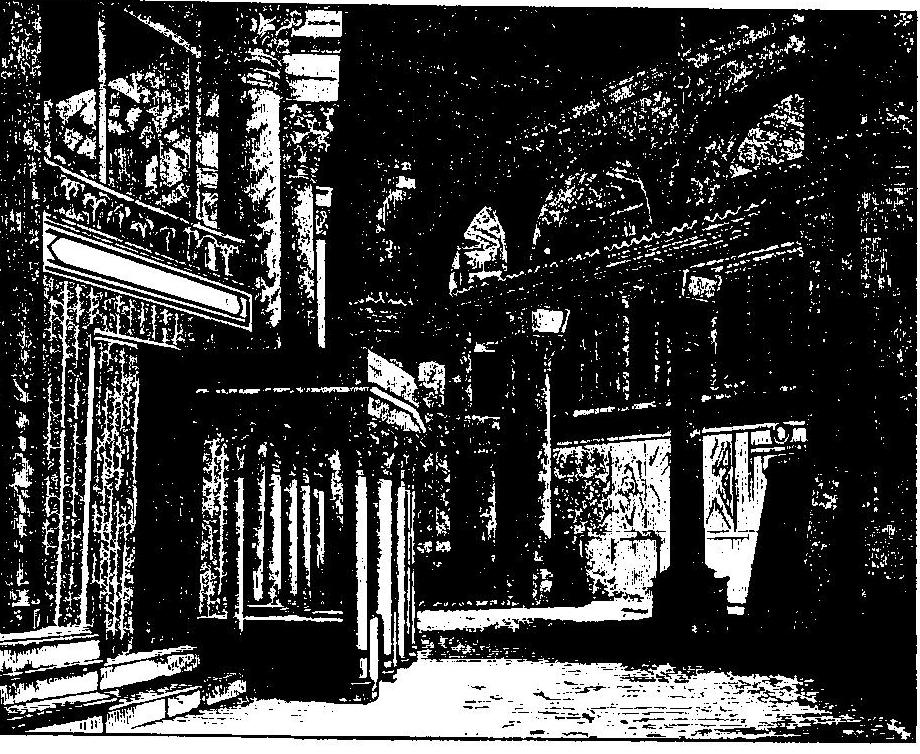
Baitu 'r-Rahmah when it set, and even others of the valleys were under its shadow; also upon it was a jacinth (or ruby), which shone in the night like the light of the sun ; but when the light began to dawn its brilliancy was obscured; nor did all these cease until Nebuchadnezzar laid all waste, and seized whatever he found there, and carried it into Greece.
"Again, by a tradition we learn that the Sakhrah of Baitu 'l-Muqaddas was raised aloft into the sky, to the height of twelve miles, and. the space between it and heaven was no more than twelve miles. All this remained in the same state until Greece (or Rome) obtained the mastery over it, subsequent to its devastation by Nebuchadnezzar. But when the Greeks obtained possession of it, they said, "Let us build thereupon a building far excelling that which was there before." Therefore they built upon it a building as- broad at the base as it was high in the sky, and gilded it with gold and silvered it with silver. Then, entering
therein, they began to practise their associating paganism, upon which it turned upside-down over them, so that not one of them came out.
"Therefore, when the Grecian (king) saw this, be summoned the Patriarch and his ministers (deacons), and the chiefs of Greece, and said, 'What think ye?' who replied, 'we are of opinion that our idol-gods are not well pleased, and therefore will not receive us favourably.' Hereupon he commanded a second temple to be built, which they did, spending a great sum thereon, and having finished the second building, seventy-thousand entered it as they had entered the first. But it happened to them as it had happened to the first; when they began their Paganism it turned over upon them.' Now their king was not with them. Therefore, when he saw this, he assembled them a third time, and said unto them, "What think ye?' who said, 'We think that our Lord is not well pleased with us, because we have not offered unto him abundantly; therefore he has destroyed what we have done, therefore we should greatly wish to build a third.' They then built a. third, until they thought they had carried it to the greatest possible height, which having done, he assembled the Christians, and said unto them, 'Do ye observe any defect?' who said, 'None, except that we must surround it with crosses of gold and silver.' Then all the people entered it, to read and cite (sacred things) having bathed and perfumed themselves, and having entered it, they began to practise their associating Paganism, as the others had done before them;- whereupon down fell the third building upon them. Hereupon the king again summoned them together, and asked their counsel about what he should do. But their dread was very great; and whilst they were deliberating, there came up to them a very old man, in a white robe and a black turban; his back was bent double and he was leaning upon a staff. So he said, 'O, Christian people, listen to me! listen to me! for I am - the oldest of any of you in years, and have now come forth from among the retired votaries of religion, in order to inform you that, with respect to this place, all its possessors are accursed, and all holiness hath departed from it, and hath been transferred to this (other) place. I will therefore point out this as the place wherein to build the Church of the Resurrection. I will show you the spot, but you will never see me after this day, for ever. Do, therefore, with a good will that which I shall tell you.' Thus he cheated them, and augmented their accursed state, and commanded them to cut up the rock, and to build with its stones upon the place which he commended them.
" So whilst he was talking with them he became concealed; and they saw him no more. Thereupon they increased in their infidelity, and said, 'This is the Great Word. Then they demolished the Mosques, and carried away the columns and the stones, and all the rest, and built therewith the Church of the Resurrection, and the church which is in the valley of Hinnon. Moreover, this cursed old man commanded them, 'When ye have finished their building upon this place, then, take that place whose owners are accursed, and, whence all holiness hath departed, to be a common sewer to receive your dung.' By this they gratified their Lord. Also they did this, as follows: At certain seasons, all the filth and excrement was sent in vessels - from Constantinople, and was at a certain time all thrown upon the Rock, until God awoke our Prophet Muhammad (the peace and blessing of God be with him!), and, brought him by night thereunto; which he did on account of its peculiar consecration, and on account of the greatness of its super-excellence. We learn, also, that God, on the Day of Judgment, will change the Sakrah into white coral, enlarging it to extend over heaven and earth. Then shall men go from that Rook to heaven or hell, according to that great word, 'There shall be a time when this earth shall change into another earth, and the heaven shall turn white; the soil shall be of silver; no pollution shall ever dwell thereon.' - Now from 'A'ish (may the satisfying favour of God rest upon him!), I said, 'O apostle of God, on that day when this earth shall become another earth, and this sky shall change, where shall men be on that day?' He replied, 'Upon the bridge as-Sirat.' Again, a certain divine says, 'that in the Law, God says to the Rock of the Holy Abode, "Thou art my seat; thou art near to me; from thy foundation have I raised up the heavens, and from beneath thee have I stretched forth the earth and all the distant inaccessible mountains are beneath thee. Who dies with thee is as if he died within the world of heaven, and who dies around thee is as if he died within thee. Days and nights shall not cease to succeed, until I send down upon thee a Light of Heaven, which shall obliterate all the (traces) of the infidels of the sons of Adam, and all their footsteps. Also I will send upon thee the hierarchy of angels and prophets; and I will wash thee until I leave thee like milk; and I will fix upon thee a wall - twelve miles above the thick-gathering clouds of earth, and also a hedge, of light. By my hand will I insure to thee thy support and thy virtue; upon thee will I cause to descend my spirits and my angels, to worship within thee; nor shall any one of the sons of Adam enter within thee until the Day of Judgment. And whosoever shall look upon this chapel from afar shall say, 'Blessed be the face of him who devoutly worships and adores in thee!' Upon thee will I place walls of light and a hedge of thick clouds — five walls of ruby and pearl." Also from the Book of Psalms, 'Great and glorious art thou, thou threshing-floor! Unto thee shall be the general assemblage: from thee shall all men rise from death.' Moreover, from the same author, God says to the Rock of Holy Abode, 'who loveth thee, him will
I love; who loveth thee, loveth me, who hateth thee, him will I hate. From year to year my eyes are upon thee, nor will I forget thee until I forget my eyes. Whoso prayeth within thee two rak'ahs, him will I cause to cast off all his sins, and to be as guiltless as I brought him from his mother's womb, unless he return to his sins, beginning them, afresh.' This is also a tradition of old standing: I solemnly engage and promise to everyone who dwells therein, that: all the days of his life the bread of corn and olive-oil never shall fail him; nor shall the days and the nights fail to bring that time, when, out of the supremacy of my bounty, I will cause to descend upon thee the assemblage of man for judgment — the whole company of then mortals.' There is a tradition that 'Muqatil ibn Sulaiman came to this Temple to pray, and sat by the gate looking towards the Rock; and we had assembled there in great numbers; he was reading and we were listening. Then came forward 'Ali ibn al-Baidawi, stamping terribly with his slippers upon the pavement. This greatly afflicted him, and he said to those around him, "Make an opening for me." Then the people opened on each side, and be made a threatening motion with his hand to warn him and prevent this stamping, saying,, "Tread more gently! That place at which Muqatil is "—pointing with his hand —"and on which thou art stamping, is the very place redolent of heaven's breezes; and there is not a spot all around it — not a spot within its precincts a hand's-breadth square — "wherein some commissioned prophet, some near angel, hath not prayed." Now from the mother of 'Abdu 'llah, daughter of Khalid, from her mother, 'the moment is surely fixed, when the Ka'bah shall be led as a bride to the Sakhrah, and shall hang upon her all her pilgrimage merits, and become her turban.' Also it is said that the Sakhrah is the middle of the Mosque; it is cut off from every touching substance on all sides. No one supports it but He who supports and holds up the sky; so that nothing falls thence but by His good permission ; also upon the upper part of the west side stood the Prophet (the blessing and peace of God be with him!) on the night when he rode al-Baraq. This side began to shake about, from veneration of him; and upon the other side are the marks of the angels' fingers, who held it up when it shook; beneath it is a deep hole cut out on each side, over which is the gate opened to men for prayer and devotion 'I resolved,' says a certain author, ' one day to enter, it, in great fear lest I should fall upon me, on account of the sins I had contracted; Then however, looked, and saw its darkness, and some holy pilgrims entering it at the darkest part, who came forth therefrom quite free from sin. Then I began to reflect upon entering. Then I said, "Perhaps they entered very slowly and leisurely, and I was too much in a hurry, a little delay may facilitate the matter." So I made up my mind to enter, and entering, I saw the Wonder of Wonders, the Rock supported in its position or course on every sides for I saw it separated from the earth, so that no point of the earth touched it. Some of the sides were separated by a wider interval than others; also, the mark of the glorious Foot is at present in a stone divided from the Rock, right over against it, on the other side, west of the Qiblah, it is upon a pillar. Also the Rock is now almost abutting upon the side of the crypt, only divided from it by that space which allows room for the gate of the crypt on the side of the Qiblah. This gate, also, is disjointed from the base of the Qiblah; it is between the two. Below the gate of the crypt is stone staircase, whereby one may descend into the crypt In the midst of this crypt Is a dark-brown loather carpet, upon which pilgrims stand when they visit the foundation of the Rock, it is upon the eastern side. There are also columns of marble abutting on the lower side upon the path of the rows of trees upon the side of the Qiblah, and on the other side forming buttresses to the extremity of the Rock; these are to hinder it from shaking on the side of the Qiblah. There are buildings besides these. There is a buiding in the Chapel of the Rock. Beneath the chapel, the spot marked by the angels' fingers is in the Rook, on the western side, divided from the print of the glorious Foot above mentioned, very near to it, over against the western gate, at the end.' (Hist Jerusalem, from the Arabic MS. of Jalalu 'd-din as-Suyuti, Reynolds' ed. 1885)
Dr Robinson (Biblical Researches, vol. 1 p. 297) says the followers of Muhammad under 'Umar took possession of the Holy City in 636, and the Khalifah determined to erect a mosque upon the site of the Jewish Temple. An account of this undertaking, as given by Muslim historians, will be found in the article on JERUSALEM. The historians of the crusades all speak of this great Sakhrab as the Templum Domini, and describe its form and the rook within it (Will. Ttyr, 8,2tb 12,7 Jac.deVitriac,c 82.)
Lieut E. R. Conder, R.E, remarks that the Dome of the Rock belongs to that obscure period of Sarscenic art, when the Arabs had not yet created an architectural style of their own, and when they were in the habit of employing Byzantine architects to build their mosques. The Dome of the Rock, Lient. Conder says, is not a mosque, as it is sometimes wrongly called, but a "station" in the outer court of the Masjidu 'l-Aqsa.
We are indebted to this writer for the following account of the gradual growth of the present budding (Tent Work in Palestine, vol ii p. 820):-
"In A.D. 881 the Caliph El Mamun restored the Dome of the Rock, and, if I am correct, enclosed it with an outer wall, and gave it its present appearance. The beams in the roof of the arcade bear, as above stated, the date 913 A.D. a well-carved wooden cornice, hidden by the present ceiling, must then have be invisible beneath them.
"In 1016 A.D. the building was partly destroyed by earthquake. To this date
belong restorations of the original mosaics in the dome, as evidenced by inscriptions. The present wood-work of the cupola was erected by Husein, son of the Sultan Hakem, as shown by an inscription, dated 1022 A.D.
"The place next fell into the hands of the Crusaders, who christened it Templum Domini, and established in 1112 AD. a chapter of Canons.
"The Holy Rock was, then cut into its present shape and covered with marble slabs, an altar being erected on it. The works were carried on from 1115 A.D. to I 1136 A. D. The beautiful iron grille between the pillars of the dome and various fragments of carved work are of this date, including small altars with sculptured capitals, having heads upon them - abominations to the Moslem, yet still preserved within its' precincts. The interior of the outer wall was decorated in the twelfth century with frescoes, traces of which still remain. The exterior of the same wall is surmounted by a parapet, with dwarf pillars and arches, which is first mentioned by John of Wurtzburg, but must he as old as the round arches of the windows below. The Crusaders would seem to have filled up the parapet arches, and to have ornamented the whole with glass mosaic, as at Bethlehem.
"In 1187 A.D. Saladin won the city, tore up the altar, and once more exposed the bare rock covered up the frescoes with marble slabs and restored and regilded the dome, as evidenced by an inscription in it dating 1189 A.D.
"In 1318 A.D.. the lead outside and the gilding within were restored by Nakr ed Din, as evidenced by an inscription.
"In I520 A.D. the Sultan Soliman cased the bases and upper blocks of the columns with marble. The wooden cornice, attached to the beam between the pillars, seems to be of this period, and the slightly-pointed marble casing of the arches under the dome is probably of the same date. The windows bear inscriptions of 1528 A.D.. The whole exterior was at this time covered with Eishani tiles, attached by copper hooks, as evidenced by inscriptions dated 1561 A.D. The doors were restored in 1564 A.D,, as also shown by inscriptions.
"The date of the beautiful wooden ceding of the cloisters is not known but it partly covers the Cufic inscription, and this dates 72 A.H. (688 A.D.), and it hides the wooden Cornice, dating probably 913 A.D. The ceiling is therefore probably of the time of Soilman.
"In 1830 A.D. the Sultan Mahmud, and in 1873-75 A.D. the late Abdu 'I Aziz, repaired the Dome, and the latter period was one specially valuable for those who wished to Study the history of the place.
"Such is a plain statement of the gradual growth of the building. The dates of the various inscriptions on the walls fully agree with the circumstantial accounts of the Arab writers who describe the Dome of the Rock." [JERUSALEM.]
SAKINAH.
 A word which occurs in the Qur'an five times. (1) For that which was in the Ark of the Covenant, Surah ii. 249: "The sign of his (Saul's) kingdom is that there shall come to you the Ark (Tabut) with the sakinah in it from your Lord, and the relics that the family of Moses and the family of Aaron left, and the angels bear it." With reference to this verse, al-Baizawi, the great Muslim commentator. says: "The ark here mentioned is the box containing the Books of Moses (Arabic Taurat, namely, the Torah, or Law), which was made of box-wood and gilded over with gold, and was three cubits long and two wide; and in it was the sakinah from your Lord. The meaning of which is, that with the Ark there was tranquility and peace, namely. the Taurat (Books of Moses), because when Moses went forth to war he always took the Ark with him, which gave repose to the hearts of the children of Israel. But, some say that within that Ark there was an idol made either of emerald or sapphire, with the head and tail of a cat, and with two wings; and that this creature made a noise when the Ark was carried forth to war. But others say that the Ark contained images of the prophets, from Adam to Moses. Others assert that the meaning of sakinah is knowledge and sincerity.' Others, that the Ark contained the tables of the Law, the rod of Moses, and Aaron's turban." (Tafsiru 'I-Baizawi, Fleischer's ed., vol. ii p. 128.)
(2) ft is also used in the Qur'an for help and confidence or trace. Surah xlviii 26: "When those who misbelieved put in their hearts pique — the pique of ignorance — and God sent down His Sakinah upon His Apostle and upon the believers, and obliged them to keep to the word of piety." Al-Baizawi says that in this verse the word sakinah means the tranquility and repose of soul, which is the meaning given in all Arabic dictionaries.
The word occurs in three other places in a similar sense:-
Surah ix. 26: "God sent down His Sakinah upon His Apostle and upon the believers, and sent down armies which ye could not see, and punished those who did not believe."
Surah ix. 40: "God sent down His Sakinah upon him, and aided him with hosts."
Surah xlviii. 2: "It is He who sent down the sakinah into the hearts of believers, that they might have faith added to faith."
None of the Muslim commentators seem to understand that the Arabic Sakinah is identical with the Hebrew
  Shechinuh, a term which, although not found in the Bible, has been used by the latter Jews, and borrowed by the Christians from them, to express the visible Majesty of the Divine Presence, especially when resting or dwelling between the Cherubin on the Mercy Seat in the Tabernacle, and in the Temple of Solomon. Rabbinical writers identify the
Shechinah with the Holy Spirit and some Christian writers have thought that the three-fold expression for the Deity — the Lord, the Word of the Lord, and the Shechinah - indicates the knowledge of a trinity of persons in the God-head.
For the Talmudic views regarding the Shechinah, the English reader can refer to Dr. Hershon's Talmudic Miscellany (Trübner & Co., London).
SALAF.  Ancestors; men of repute for piety arid faith in past generations.
(2) Money lent without interest. [SALAM.]
SALAM.  . A contract involving an immediate payment of the price, and admitting a delay in the delivery of the articles purchased. The word used in the Hadis is generally salaf. In a sale of this kind, the seller is called musallam ilai-hi; the purchaser, rabbu 's-salam, and the goods purchased, musallam-fi-hi. (Kitabu 't- Ta'rifat.)
AS-SALAM.  . "The Peace(ful) one. (1) One of the ninety-nine names or attributes of God. It occurs once in the Qur'an, Surah lix. 20: "He is God, than whom there is no other . . . the Peaceful." Al-Baizawi explains the word as "He who is free from all loss or harm"
  .
.
(2) As-Salaum 'alai-kum  "The peace be on you," the common salutation amongst Muslims. [SALUTATION.]
AS-SALAT.  in construction frequently spelled
  pl. salawat. The term used in the Qur'an, as well as amongst all Muslims in every part of the world, for the liturgical form or prayer, which is recited five times a day, an account of which is given in the article on PRAAYER. Its equivalent in Persian and Urdu is namaz, which has been corrupted into nmuz by the Afghans. The word occurs with this meaning in the Qur'an, Surah ii. 239: "Observe the prayers," and in very many other places. It has also the meaning of prayer or supplication in its general sense, e.g. Surah ix. 104: "Pray for them, of a truth thy prayers shall assure their minds.." Also blessing, e.g. Surah xxxiii. 56: "Verily God and His Angels bless (not "pray for," as rendered by Palmer) the Prophet." (See Lane's Dictionary, in loco.)
The word salat occurs with various combinations used to express different periods, and also special occasions of prayer.
The five stated liturgical prayers which are held to be of divine institution:—
(1) Salatu 'l-Zuhr, the meridian prayer.
(2) Salatu 'l-Asr, the afternoon prayer.
(3) Salatu 'l-.Maghrib the sunset prayer.
(4) Salatu 'l-'Isha', the night prayer.
(5) Salatu 'l-Fajr, the prayer at dawn.
(Obs. The midday prayer is reckoned the first in order.)
Also for the three voluntary daily liturgical prayers:-
1. Salatu 'l-Ishraq, when the sun has well risen.
2. Salatu 'l-Zuha, about 11 A.M.
3. Salatu 'l-Zahahud, after midnight.
Liturgical prayers said on special occasion are given below. [PRAYER.]
SALATU 'L-HAJAH.  " Prayer of necessity." Four rak'ah prayers, or, according to some twelve rak'ahs recited after the night prayer in times of necessity, or trouble. (Raddu 'l-Muhtar, vol. i. p. 719.)
SALATU 'L-'IDAIN.
 ."Prayers of the two festivals. The two rak'ah prayers recited on the two Muhammadan festivals, the 'Idu 'l-Fitr and the 'Ida 'l-Azha.
SALATU 'L-ISTIKHARAH. 
 Lit. " Prayer for conciliating favor." Two rak'ahs recited for success in an undertaking. Jabir relates that Muhammad taught him Istikharah, and that after reciting two rak'ahs he should thus supplicate God . "O God, I seek Thy good help in Thy great wisdom. I pray for ability to act through Thy power. I ask this things of thy goodness. Thou knowes, but I know not. Thou art powerful, but I am not. Thou art knower of secrets. O God, if Thou knowest, that, the matter which I am about to undertake is good for my religion, for my life, for my future, then make it easy, and prosper me in it. But if it is bad for my religion, my life, and my future, then put it away from me, and show me what is good. (Mishkat, book iv. 40.)
SALATU 'L-ISTISQA'. 
 from saqy, "Watering." Two rak'ah prayers recited in the time of dearth.
SALATU 'L-JINAZAII. 
 The funeral service. [BURIAL OF THE DEAD, JINAZAH.]
SALATU 'L-JUM'AH.
 Lit. "The prayer of assembly." The Friday Prayer. It consists of two rak'ahs recited at the time of zuhr, or midday prayer on Friday. [FRIDAY, KHUTBAH.]
SALATU 'L-KHAUF.  The "Prayers of Fear." Two rak'ahs of prayers recited first by one regiment and then by another in time of war, when the usual prayers cannot be recited for fear of the enemy. These prayers are founded upon an injunction in the Qur'ani, Surah iv. 102: "And when ye go to war in the land, it shall be no sin for you to curtail your prayers, if ye fear that the enemy come upon you?" This was also the Talmudic law (Tr. Beraehoth iv. 4); "He that goeth in a dangerous place may pray a short prayer."
SALATU 'L-KHUSUF.

 . Prayers said at an eclipse of the moon, consisting of two rak'ahs of
Prayer. (Mishkat.)
. Prayers said at an eclipse of the moon, consisting of two rak'ahs of
Prayer. (Mishkat.)
SALATU 'L-KUSUF.
 Prayers at an eclipse of the sun, consisting of two rak'ahs of prayer. (Mishkat, book jy ch. ii)
SALATU 'L-MARIZ.
 "Prayer of the sick." When a person is too sick to stand up in the usual prayers, is allowed to recite them either in a reclining or sitting posture, provided he performs the usual ablutions. It is ruled that he shall in such a case make the prostrations. &c mentally. (Raddu 'l Muhtar. vol i. p. 891.)
SALATU L-WITR.
 The Witr prayers. The word witr means either a unit, or an odd number and as used for either a single or odd number of rack'ah prayers recited after the evening prayer ('isha). Mishkat, book iv. Ch. xxxvi.)
There is considerable controversy amongst the learned doctors as to whether it is farz, wajib, of sunnah, but it is generally held to be sunnah, i.e. founded on the example of the Prophet, but with no divine command. Amongst the Hanafi sect, it is also known as Qunutu 'l-Witr, but the Shafi'is recite the Qunut separately.
SALATU 'R-RAQHA'IB.

 "A prayer for things desired." Two rak'ah prayers recited by one
who desires some object In this world. According to the orthodox, it is forbidden in Islam. (Raddu 'l-Muthar, vol. i. p 717.) it is recited by some persons in the first week of the month Rajab.
"A prayer for things desired." Two rak'ah prayers recited by one
who desires some object In this world. According to the orthodox, it is forbidden in Islam. (Raddu 'l-Muthar, vol. i. p 717.) it is recited by some persons in the first week of the month Rajab.
SALATU 'S-SAFAR.
 "Prayers of travel." A shortened recital of prayer allowed to travellers. It is founded on a tradition by Ya'la ibn Umaiyah who says, "I said to Umar, 'God hath said; "When ye go so war in the land it shall be no sin for you to shorten your prayers it ye fear that the infidels way attack you"; but now verily we are safe in this journey, and yet we shorten our prayers.' Umar replied, I also wondered at the thing that astonished you but the Prophet said, God hath done you a kindness in curtailing your prayers, therefore accept it, Ibn 'Umar says, 'I traveled with the Prophet, and he did not say more than two rak'ahs of prayer, and Abu Bakr and 'Urnar and Usman did the same.' lbn 'Abbas says, 'The Prophet used to say on a journey the noon and afternoon prayer together, and the sunset and evening prayer together'" (Mishkat, book iv. Ch. xlii.)
The established prayers for a traveller are, therefore two rak'ahs instead of the four farz rak'ahs at the noon and afternoon and evening prayers, and the usual two form at the morning and the usual three farz at the sunset prayers, all voluntary prayers being omitted (Raddu 'l-Muhtar, vol. i. p. 821.)
SALATU 'T-TARAWIH.

 "Prayer of rest." So called because of the pause or rest made for ejaculations
between every four rak'ahs. ('Abaa l'-Haqq.)
"Prayer of rest." So called because of the pause or rest made for ejaculations
between every four rak'ahs. ('Abaa l'-Haqq.)
Twenty rak'ah prayers recited after the night prayer during the month of Ramazan. They are often followed with recitations known as zitkrs [ZIKR.], and form an exciting service of devotion. The Imam recite the Tarawik prayers with a loud voice.
Abu Hurairah says "The Prophet used to encourage people to say night prayers in Ramazan without ordering them positively, and would say. He who stands up in prayer at night for the purpose of obtaining reward, will have all his sins pardoned'; then the Prophet died, leaving the prayers of Ramazan in this way." It is said 'Umar instituted the present custom of reciting the twenty rak'ahs. (Mishkat, book iv ch. xxxviii.) [RAMAZAN.]
SALATU T-TASBIH.  "Prayer of praise." A form of prayer founded on the following tradition related by lbn Abbas who says:—
"Verily the Prophet said to my father, 'O Abbas! O my uncle! shall I not give to you shall I not present unto you, shall I not inform you of a thing which covers acts of sin? When you perform it, God will forgive your sins, your former sins, and your latter sins, and those sins which you did unknowingly, and those which you did knowingly, your great sins, and your small sins, your disclosed sins and your concealed sins? It is this namely, that you recite four rak'ahs of prayer, and in each rak'ah recite the Falihhim 'l-Kitab, (i.e. the Introductory chapter of the Qur'an). and some other Surah of the Qur'an; and when you have recited these portions of the Qur'an in the position of Qiyam, then say, " Holiness to God! (Sub hana 'llahi), and Praise be to God ! " (Wa hana 'llahi), and "There is no deity but God!" (Wa la Ilaha 'illa huwa), and "God is most great!" (Wa 'llahu Akbar), fifteen times. Then perform a ruku and recite it ten times; then raise up your head and say it ten times, then make the sajdah and say it ten times; then raise your head and say it ten times, then make another sajdah and say it ten times, then raise your head again and say it ten times: altogether seventy-five times to every rak'ah; and do thus in each of the rak'ah. If you are able to say this form of prayer every day, then do so, but If not, do it once every Friday, and if not each week then say it once a month, and it not once a month, then say it once a year, and if not once a year, than do it once in your sometime.'" (Mishkat, book iv. ch. xl.)
The foregoing is a striking illustration of the mechanical character of the Muslim religion as regards its system of devotion [ZIRR.]
SALE, The Law of. [BAJ'.]
SALIB.  "A crucifix; a cross." [CROSS.]
SALIH.  A prophet mentioned in the Qur'an (Surah vii. 71). who was sent to the tribes of 'Ad and Samud. Al-
Baizawi say he was the son of 'Ubaid, the sun of Asaf, the soni of Masih the son of ~ 'Ubaid, the son of Hazir, the son of Samud. Bochant thinks he must be the Pileg of Genesis xi 16. D'Herbelot,makes him the Salah of Genesis xi.
The following is the account of him in the Qur'an with the commentator's remarks in In italics (see Lane's Selections 2nd ed by Mr. Stanley Lane Poole):—
And We sent unto the tribe of Thamud their brother Salih. He said, O my people worship God. Ye have no other deity but Him. A miraculous proof of my veracityshall come unto you from your Lord, this camel of God being a sign unto you [He had caused her at her demand to cohns forth from the heart of a rock]. Therefore let her feed, in God's earth and do herein no harm lest a painful punishment seize you vicregent in the earth. after [the tribe off] given you a habitation in the earth ye make yourselves, on its plains, pavilions therein ye dyed in summer, and cut the mountains into houses wherein ye dwell in winter. Remember then the benefits of God, and do not evil in the earth acting corruptly - The chiefs who were elated with pride among his people, said unto those who were esteemed weak, namely, to those who had believed among them. Do ye know that Salih hath been sent unto this? And they hamstrung the she-camel (Kuddr [the son of Salih] ,doing so by their order and slaying her with the sword) and they impiously transgressed the command of their Lord, and said, O Salih, bring upon us that punishment with which that treatment us for killing her, if thou be [one] of the apostles. And the violent convulsion (a year earthquake and a cry from heaven) assailed them, and In the morning they were in their dwellings prostrate and dead. So he turned away from them, and said, O my people I have brought unto you the message of my Lord and given you faithful counsel but ye loved not faithful conssellors." Surah vii 71- 77)
SALIK.
Lit. "A traveler." A term used by the mystics for
devotee, or one who has started on the heavenly journey. [SUFI.]
SALSABIL. Lit. The softly flowing. A fountain in Paradise, mentioned in the 'Qur an in Surah lxxvi. 10 and from which the Muslims in heaven are said to drink. "A spring therein named Salsabit, and there shall go round about them immortal boys"
SALUTATIONS. Arabic as-salam , "peace" Taslim , Heb. shalom, the act of giving the prayer-of peace pl. taslimat. The duty of giving and returning a salutation is founded or ex-press injunctions in the Qur'an.
Surah xxix. 61 "When ye enter houses then greet each other with a salutation from God the Blessed and the good."
Surah iv. 88 "When ye are saluted with a salutation, salute ye with a better than it, or return the same salutation.
'Ali says that Muhammad established it as an incumbent duty that one Muslim should salute another. [FITRAH.] 'The ordinary salutation of the Muslim is "as-Salamu 'alaskum," i.e. The peace upon you" And, the usual reply is Wo 'Alai kum as salam or And upon you also be the peace.
The supposes origin of the salutation is given in a tradition by Abu Hurariah and relates that the Prophet said.
God created Adam, and his stature was sixty cubits; and God said to Adam, Go and salute that party of angels who are sitting down, and listen to their answers for verily it shall be the salacious and reply for you and your children! Adam then went and said to the angels 'as Salamu alai-kum, i.e. 'The peace be on you,'" and the angels replied, 'as-Salamu 'alsika wa rahmatu 'llah,' - i.e. 'The peace be on thee, and the mercy of God.'"
This form is now usually given in reply by devout persons (Sahihu ' Bukhari p. 919)
Muhammad instructed his people as follows regarding he use of the salutation;—
The person riding must salute one on foot, and he who is walking must salute those who are sitting, and the small must salute the larger, and the person of higher degree the lesser. It is therefore a religious duty for the person of high degree, when meeting one of a lower degree; the giving of the Salam being regarded as a benediction. For," says Mohammad, "the nearest people to God are those who salute first. When a party is passing, it is sufficient if one of them give the salutation and, in like manner, it is sufficient one of the party return it of those sitting down."
The Jews in the time of Muhammad seem to have made the salutation a annoyance to Muhammad for it is related when they went to the Prophet they used to say, "'As sammu 'alai-ka, "On you be poison." to which the Prophet always replied," Wa alai ko," 'And on you."
Uramah ibn Zaid says: "The Prophet once praised a mixed assembly of Muslims, polytheists, idolaters, and Jews, and, he gave the salutation; but he meant it only for the Muslims."
Jarir relates that on one occasion the Prophet met a party of women, and gave them the salutation, But this is contrary to the usual practice of Muhammadans; and 'Abdu l-Haqq, in his commentary on this tradition, says This practice was peculiar to the Prophet, for the laws of Islam forbid a man saluting a woman unless she is old."
In the East it is usual to raise the right hand (the raising of the left hand being disrespectful, as it is the hand used for legal ablutions) when giving the Salam, but this custom, common though it be is not an
cordance with the traditions. For 'Amr ibn Shu'aib relates, from his fore-fathers, that the Prophet said, "He is not of us who likens himself to another. Do not copy the Jews or the Christians in your salutation. For a Jew's salutation is by raising his fingers, and the Christians salute with the palm of the hand. (Mishkat, book xxxi. ch. 1.)
In Central Asia, the salutation is generally given without any motion of the body, in accordance with the above tradition.
SALVATION. The Arabic word najat  , "salvation," only occurs once in the Qur'an, namely, Surah xl. 44:
"O my people! how is it that I bid you to salvation, but that ye bid me to the fire?" Nor is the word generally used in Muslim works of divinity, although the orthodox sect of Muslims claims for itself the title of Naji-yah, or those who are being saved.
, "salvation," only occurs once in the Qur'an, namely, Surah xl. 44:
"O my people! how is it that I bid you to salvation, but that ye bid me to the fire?" Nor is the word generally used in Muslim works of divinity, although the orthodox sect of Muslims claims for itself the title of Naji-yah, or those who are being saved.
The word maghfirah, "forgiveness," is frequently used in the Qur'an to express that Christians understand by "salvation"; also Islam, Iman, and Din, words which express the idea of a state of salvation.
According to Islam, a man obtains salvation by a recital of the Kalimah, or creed; but if he be an evil doer, he will suffer the pains of a purgatorial fire until his sins are atoned for; whilst he who has not accepted the Muslim creed will endure the pains of everlasting punishment. [HELL.]
AS-SAMAD.  . "The Eternal." One of the ninety-nine names or attributes of God. It occurs once in the Qur'an, Surah cxii.; God the Eternal."
In its original meaning, it implies a lord, because one repairs to him, in exigencies; or when applied, to God, because affairs are stayed or rested on Him. Hence, according to al-Mukham, in loco, and the Lisanu 'l-'Arab, it signifies the Being that continues for ever— the Eternal One.
SAMARAH.  [BENEFICENCE.]
SAMARITAN. [AS-SAMIRI.]
AS-SAMI'.
 . "The Hearer." ,One of the ninety-nine names or attributes of God, The word frequently occurs in the Qur'an.
AS-SAMIRI.  . Mentioned in the Qur'an (Surah xx. 87: "As-Samiri has led them astray") as the person who made the golden calf for the Children of Israel. In Professor Palmer's translation, it is tendered "the Samaritan," which. is according. to al-Baizawi, who says his name was Musa ibn Zafar, of the tribe of Samaritans. [MOSES.]
SAMUEL. Arabic Ishmawil  or Shamwil, Heb.
  referred to in the Qur'an (surah ii. 247) as "the prophet" to whom the Children of
Israel said, "Raise for us a King, and we will fight for him in God's way."
referred to in the Qur'an (surah ii. 247) as "the prophet" to whom the Children of
Israel said, "Raise for us a King, and we will fight for him in God's way."
Husain, the commentator, says it is not quite certain who he was. He was either Yusha' ibn Nun, or Sham'an ibn Safiya, or Ishmawil. (Tafsir-i-Husaini, p. 65.)
The Kamalan give his name as Shamwil, but say it was originally Isma'il, and that the meaning is the same.
SAN'A'.  . A city in al-Yaman, the Viceroy of which, Abrahatu 'l- Ashram, an Abyssinian Christian, marched with a large army and some elephants upon Makkah, with the intention of destroying the Temple (see Qur'an, Surah cv.) in the year Muhammad was born. Hence the year was known as that of the Elephant.
SANAD.  . Lit. "That on which one rests, as a pillar or cushion." An authority; a document; a warrant. A term used in Muslim law.
SANAM.  pl. asnam. The word used in the Qur'an for an idol, e.g. Surah xiv. 38: "Turn me and my sons away from serving idols." [IDOLS.]
SANCTUARY. The Prophet forbade putting a murderer to death in a mosque, but he may be taken by force from the mosque and slain outside the building. The same rule applies to persons guilty of theft. (Mishkat, book iv. ch. viii.)
The custom of sanctuary was derived from the Levitical law of refuge. The six cities being established as cities of refuge for the involuntary manslayer. - The altar of burnt offerings was also a place of refuge for those who bad undesignedly committed smaller offences. (Deut. xix,. 11,. 12; Joshua xx.) According to Leeky (Europian Morals, vol, ii. p. 42), the right of sanctuary was possessed. by the imperial statues and by the Pagan temples. Bingham (Antiquities, vol. ii. p. 554) says it seems to have been introduced into the Christian Church by Constantine.
SANDALS. [SHOES.]
SAQAR.  "A. scorching heat." According to the commentator, al-Baghawi it is the special division of hell set apart for the Magi. It is mentioned thus in the Qur'an Surah liv. 48: ." Taste ye the touch of saqar."
Surah lxxiv. 26: "I will broil him in saqar! And what shall make thee know what saqar is?" it leaveth nought and spareth nought, blackening the skin of man.
SARACEN. A term used by Christian writers for the followers of Muhammad, and applied not only to the Arabs, but to the Turks and other Muslim nations.
There is much uncertainty as to the origin of this word. The word  was used by Ptolemy and Pliny, and also by Ammianus and Precopius, for certain Oriental tribes, long before the death of Muhammad
(see Gibbon). Some etymologists derive it from the Arabic sharq," the rising sun, the East" (see Wedgwood's Diet). Others from sahra' "a desert,"— the people of the desert (see Webster). Gibbon thinks it may be from the Arabic saraqah, "theft," denoting the thievish character of the nation; whilst some have even thought it may be derived from Sarah the wife of the Patriarch Abraham.
SARAH. Arabic Sarah  , Heb.
  , Greek
  Abraham's wife.
Not mentioned by name in the Qur'an, but referred to in Surah xi. 74: "And his wife was standing by laughing, and We gave her the glad tidings of Isaac, and of Jacob after Isaac."
Abraham's wife.
Not mentioned by name in the Qur'an, but referred to in Surah xi. 74: "And his wife was standing by laughing, and We gave her the glad tidings of Isaac, and of Jacob after Isaac."
SARAQAH.  [THEFT.]
SARF.  . (1) A term used for a special kind of sale or exchange. According to the Hidayah, bai'u 's-sarf, or ; sarf sale, means a pure sale, of which the articles opposed to each other in exchange are both representatives of price, as gold for gold or silver for silver. (See Hamilton's Hidayah, vol. ii. p. 551.)
2. That part of grammar which relates to the declining of nouns and the conjugating of verbs.
SARIH.
 Explicit or clear.
A term used in Muslim law for that which is express in contradistinction to that which is kinayah, or implied. For example, the Talaqu 's-sarih, is an explicit form of divorce, whilst Talaqu 'l-kinayah is an implied form of divorce, as when a man says to his wife, "Thou art free."
SARIQ.  . A thief. [THEFT.]
SATAN. Arabic Shaitan  [DEVIL.]
SATR.  A curtain or veil. A term used for the seclusion of women, called also Hijab. In the Traditions it is used for necessary and decent attire, babu 'a-satr being a special chapter in the Mishkatu 'l-Masabih (book iv. ch. ix.). The satr for a man being from the waist to the knee, and for a free woman from the neck to the feet; but for a slave girl from the waist to the knee as in the case of a man. That part of the body which must be so covered is called 'aurah or 'aurat, "shame or modesty," from which the Hindstani word, 'aurat, "a woman," is derived. [HARIM, WOMEN.]
SATTUQAH.
 . Base coin. The term is used for a coin which is current amongst merchants, but is not received at the public treasury. Coins in which the pure metal predominates are not considered base, (see Hamilton's Hidayah, vol. ii. p. 560.)
SAUDAH.
 . One of the wives of Muhammad. She was the widow of Sakran, a Quraish, and one of the early companions of the Prophet. Muhammed married her within two months of the death of Khadijah. (Muir's Life of Mahomet, new ed. p. 117.) She died A.H. 55.
 , Heb.
  Shaool. King of Israel. Mentioned in the Qur'an as a king raised up of God to reign over Israel, to whom was given an excellent degree of knowledge and personal appearance.
The following is the account given of Saul in the Qur'an, with Mr. Lanes rendering of the commentator's remarks in italics. (Mr. Stanley Lane Poole's 2nd Ed.)
"Hast thou not considered the assembly of the children of Israel after the death of Moses, when they said unto a prophet of theirs, namely Samuel, set up for us a king. under whom we will fight in the way of God? He said unto them, if fighting be prescribed as incumbent on you, will ye, peradventure, abstain from fighting? They replied, And wherefore should we not fight in the way of God, since we have been expelled from our habitations and our children by their having been taken prisoners and slain? — The people of Goliath [Jaloot] had done thus unto them.— But when fighting was commanded them,. they turned back, excepting a few of them, who crossed the river with Saul. And God knoweth the offenders. And the prophet begged his Lord to send a king; whereupon he consented to send Saul. And their prophet said unto them. Verily God hath set up Saul as your king. They said, How shall he have the dominion over us, when we are more worthy of the dominion than he, (for he was not of the royal lineage, nor of the prophetic, and lie was a tanner, or a tender of flocks or herds,) and he hath not been endowed with ample wealth?' He replied, Verily God hath chosen him as king over you. and increased him in largeness of knowledge and of body, (for he was the wisest of the children of Israel at that time, and the most comely of them, and the most perfect of them in make,) and God giveth his kingdom unto whom He pleaseth; and God is ample in His beneficence, knowing with respect to him who is worthy of the kingdom— And their prophet said unto them, when they demanded of him a sign in proof of his kingship, Verily the sign of his kingship the sign of his kingship shall be that the ark shall come unto you (in it were the images of the prophets: God sent it down unto Adam, and it passed into their possession; but the Amalekites took it from them by force: and. they used to seek victory thereby over their enemy, and to advance it in the fight , and to trust in it, as He whose name be exalted! — hath said); therein is tranquility [SAKINAH] from your Lord, and relics of what the family of Moses and the family of Aaron have left: namely, the two shoes (or sandals) of Moses, and his rod, and the turban of Aaron, and a measure of the manna that used to descend upon them, and the fragments of the tables [of the Law]: the angels shall bear it. Verily in this shall be a sign unto you of his kingship, if ye be believers. Accord
ingly the angels bore it between heaven and earth, while they looked at it until they placed it by Saul; whereupon they acknowledged his kingship and hastened to the holy war and he chose of their young men seventy thousand.
"And when Saul went forth with the troops from Jerusalem, and it was violently hot weather and they demanded of him water he said. Verily God will try you by a fever, that the obedient among you and the disobedient may appear (and it was between the Jordan and Palestine), and whoso drinketh thereof he is not of my party but he who tasteth not thereof the is of my party), excepting him who takes forth a draught in his hand, and is satisfied therewith, not adding to it, for he is of my party; — then they drank thereof abundantly excepting a few of them who were content only with a handful of water. It is related that it sufficed them for their own drinking and for their beasts and they were Three hundred and some who mote than ten. And when he had passed over it he and, those who believed with, they said, we have no power to today to contend against Goliath and his troops in, And they were cowardly, and passed nod over it. They who held it as certain that they should meet God at the resurrection (and they were those who had passed over it) said How manv a small body of men hath overcome a great body by the permission (or will) of God! And God is with the patient, to defend and aid. - And when they went, forth in battle against Goliath and his troops they said, O our Lord, pour upon us patience, and make firm our feet, by strengthening our hearts for the holy war, and help us against the unbelieving people! — And they routed them by the permission (or will) of God and David who was in the army of Saul slew Goliath." (Surah ii. 247, 253)
SAUM.
 Fasting. The usual Arabic term used for this religious act whether during the Ramazan or at any other time. Its equivalent in: Persian is razah [FASTING RAMAZAN.]
SAUMU T-TATAWWU.

 A voluntary fast other than the month of Ramazan.
SAUT.
 [DIRRAH.]
SAWAB.
 "Recompense reward" e.g. Qur'an Surah iii. 195 A reward from God, for God with Him are the best rewards.
AS-SAWADU L AZAM.

 Lit., The exalted multitude. A term used in the Traditions and in Muslim theology for the Assembly of God, or the congregation of faithful men, or for a large majority.
SAWA 'IM.
 pl. of Sa'imah. Flocks and herds which are grazing and for which zakat must be collected. [ZAKAT.]
SCHOOL.
Arabic maktab  pl. makatib madrasah
  , pl. madaris. According to Muslim law, all education should be carried on in connection with religious instruction, and consequently schools are generally attached to mosques.
SCRIPTURE, HOLY.
The expression "Holy Scripture" is rendered in Persian by Pak Nawishtah  "the Holy Writing", its equivalent in Arabic being al Kitabu 'l Mipaddas
  , the Holy Book or Kalamu llah
  the Word of God. These terms, whilst they are generally understood by Muslims to refer to the Qur'an. more correctly include all books, acknowledged by Muhammadans to be the Word of God. They profess to receive all the Hebrew Scripture and the New Testament as well as the Qur'an as the revealed Word of God. [PROPHETS, INSPIRATION.]
SCULPTURE.
Arabic ansab  The making of carved, graven or sculptured figures is understood to be forbidden in the Qur'an under the term sanam
  an idol (see Surah xiv 38), also in Surah v. 92 "Verily wine and games of chance; and statues (ansab), and divining arrows are an abomination of Satan's device."
Consequently, sculpture is not allowed according to Muslim law, although ar-Raghib says a sanam is that which diverts the mind from God.
SEA.
Arabic bahr  "The sea." al bahr is a term applied in the Qur'an to the Red Sea known amongst Muhammadans as the Bahru i-Qulzum. [RED SEA.] Surahs ii. 47 vii 134 - "The ships that sail like mountains in the sea are amongst the
signs of God (See. Surah xlii. 31.) In Surah iii., 6 Muhammad, swears by "the swelling sea." In Surah vii 68; "It is the Lord who drives the ships for you in the sea that ye may seek after plenty from Him." In Surah viii 109, it occurs as an illustration of the boundless character of the Word of
God, "Were the sea ink for the words of my Lord, the sea would surely fail before the
words of my Lord, fail, aye, though we brought as much ink again."
"The sea." al bahr is a term applied in the Qur'an to the Red Sea known amongst Muhammadans as the Bahru i-Qulzum. [RED SEA.] Surahs ii. 47 vii 134 - "The ships that sail like mountains in the sea are amongst the
signs of God (See. Surah xlii. 31.) In Surah iii., 6 Muhammad, swears by "the swelling sea." In Surah vii 68; "It is the Lord who drives the ships for you in the sea that ye may seek after plenty from Him." In Surah viii 109, it occurs as an illustration of the boundless character of the Word of
God, "Were the sea ink for the words of my Lord, the sea would surely fail before the
words of my Lord, fail, aye, though we brought as much ink again."
In Muhammadan works in the Traditions and commentaries, the Arabic bahr is used for large rivers as the Euphrates and in the same sense the Hebrew  yam (but the) word nahr, Hebrew
  nahar occurs in the Qur'an for rivers.)
It is related that Muhammad said, "Let none but three classes of people cross the sea (for it has fire under it which causes its troubled motion) namely, (1) those who perform the Hajj or Pilgrimage; (2) those who make the umrah of visitation; (3) those who go forth to war." (Majma'u 'l-Bihar, vol. i. p. 76)
The following are the names of the seas as current in Muhammadan literature:-
Al-Bahru 'l-Akhzar the Green or Indian Ocean.
Al-Bahru 'l-Abyas, the White or Mediterranean Sea.
Al-Bahru 'l-Aswad, the Black, or Euxine Sea.
Al-Bahru 'l-Azraq, the Blue or Persian Sea.
Al Bahru 'I-Qulzum, or al-Bahu 'l-Ahmar, the Red Sea.
Al-Buhru 'l-Lut, the Sea of Lot or Dead Sea.
Al-Bajru 'l-Khizr, the sea of Khizr, the Caspian Sea.
SEAL OF PROPHECY. Khatimu 'n-Nubuwah  .
A mole of an unusual size on the Prophets back, which is said to have been the divine seal which,
according to the predictions of the Scriptures, marked Muhammad as the "Seal of the Prophets," Khatimu'n Nabiyin.
.
A mole of an unusual size on the Prophets back, which is said to have been the divine seal which,
according to the predictions of the Scriptures, marked Muhammad as the "Seal of the Prophets," Khatimu'n Nabiyin.
According to a tradition, recorded in the Mishkatu 'l-Masabih, book iii, ch. 7, it was the size of the knob of a bridal canopy. Others say it was the size of a pigeon's egg, or even the size of a closed fist.
Shaikh 'Abdu 'l-Haqq says "it was a piece of flesh, very brilliant in appearance, and according to some traditions it had secretly inscribed within it, 'God is one and has no Associate.
Abu Ramsa', whose family were skilled in surgery, offered to remove it, but Muhammad refused, saying, "The Physician thereof is He who placed it where it is."
According to another tradition, Muhammad said to Abu Ramsa', "Come hither and touch my back"; which he did, drawing his fingers over the prophetical seal and, behold! there was a collection of hairs upon the spot. (See Muir, new ed. P. 542.)
'Abdu 'l-Haqq also says it disappeared from the Prophet's back shortly before his death.
It is not clear how far Muhammad encouraged the belief in this supernatural sign of his prophetic mission, but from his reply to Abu Ramsa', it would not appear that he really attributed any special power to its existence. [MUHAMMAD.]
SECTS OF ISLAM. Arabic firqah  , pl. firaq. Muhammad is related to have prophesied that his followers would be divided into numerous religious sects.
'Abdu 'llah ibn Umar relates that the Prophet said Verily it will happen to my people even as it did to the Children of Israel. The Children of Israel were divided into seventy-two sects, and my people will be divided into seventy-three. Every one of these sects will go to Hell, except one sect." The Companions said, "O Prophet, which is that?" He said, "The religion which is professed by me and my Companions." (Mishkat, book i. ch. Vi. Pt. 2.)
The number has however, far exceeded the Prophet's predictions, for the sects of Islam even exceed in number and variety those of the Christian religion.
The Sunnis arrogate themselves the title of the Najiyah, or those who are "being saved" (as, indeed, do the other sects), but within the limits of the Sunni section of Muhammadans there are four which are esteemed "orthodox," their differences consisting chiefly in minor differences of ritual and in varied interpretations of Muslim law. These four orthodox sects or schools of interpretation amongst the Sunnis, are the Hanafiyah, the Shafi' iyah, the Malakiya', and the Hambaliyah.
1. The Hanafiyahs are found in Turkey, Central Asia, and North India. The founder of this sect was the Imam Abu Hanifah, who was born at al-Kufah, the capital of al-'Iraq, A.D. 702, or A.H. 80. at which time, four of the Prophet's companions were still alive. He is the great oracle of jurisprudence, and (with his two pupils. the lmams Abu Yusuf and Muhammad ) was the founder of the Hanafiyah Code of Law.
2. The Shafi' iyahs are found in South India and Egypt. The founder of this school of interpretation was Imam Muhammad ibn 'Idris as Shafi'i', who was born at Asqalon, in Palestine A.D. 767 (A.H. 150).
3. The Malaiktyahs prevail in Morocco, Barbary and other parts of Africa, and were founded by Imam Malik, who was born at al-Medinah, A.D. 714 (A.H. 95) He enjoyed the personal acquaintance of Abu Hanifah, and he was considered the most learned man of his time.
4. The Hambaltyahs were founded by Imam Abu Abdi 'llah Ahmad ibn Muhammad ibn Hambal, who was born at Baghdad A.D. 780 (A.H. 164). He attended the lectures delivered by ash-Shaifi'i, by whom he was instructed in the Traditions. His followers are found in Eastern Arabia, and in some parts of Africa but it is the least popular of the tour schools of interpretation. They have no Mufri at Makkah whiIst the other three sects are represented there. The Wahhabis rose from this sect. [WAHHAB.]
From the disciples of these four great Imams have proceeded an immense number of commentaries and other works all differing on a variety of points. In their constructions, although coinciding in their general principles.
The Ghinasu 'l-Lughat gives the following particulars of the seventy-three sects spoken of in the Traditions, arranging them in six divisions of twelve sects each, and concluding with the Najiyuh, or "Orthodox" Sunnis.
I. — The Rafiziyah, " the Separatists" who are divided into —
1 'Alawiyah, who esteem the Khalifah 'Ali to have been a prophet.
2. Abadiyah, who hold that 'Ali is divine.
3. Shu'sibiyah, who say that 'Ali was the first and best of the Khalifahs.
4. Ishaqiyah, who say the age of prophecy is not yet completed.
5. Zaidiyah, who hold that prayers can only be led by a descendent of 'Ali.
6. 'Abbasiyah, who say al-'Abbas, the uncle of Muhammad, was the only rightful Imam.
7. Imamiyah, who state that the world was never left without an lmam of the Banu Hashim to lead the prayers.
8. Narisiyah, who say it is blasphemy for one person to say he is better than another.
9. Tanasukhiyah, who believe in the transmigration of souls.
10. La'iniyah, those who curse the of names of Talhah, Zubair, and 'Ayishah.
11. Raji'iyah, who believe that 'Ali is hidden in the clouds and will return again to this earth.
12. Murtuziyah, who say It is lawful for a Muslim to fight against his Imam.
II. — The Kharifiyah, "the Aliens," who are divided into—
I. Azraqiyah, who say there is no holy vision now to be obtained by the sons of men as the days of inspiration are past.
2. Riyaziyah, who say a man is saved by good works, and not by faith.
3. Sa'labiyah, who say God is indifferent to the actions of men, as though He were in a state of sleep.
4. Jazimiyah, who hold true faith has not yet been made evident.
5. Khalfiyah, who say to run away even from double the number of infidels is a modal sin for Muslims.
6. Kuziyah, who say that the human body is not made ready for prayer unless the ablutions be such as entirely cleanse the body.
7. Kanziyah, who do not regard the giving of zakat as necessary.
8. Mu'tazilah, who maintain that evil actions are not according to the decree of God, and that the prayers of a sinful man are not acceptable to God, and that faith is of man's free will, and that the Qur'an is created, and that almsgiving and prayer do not benefit the dead, and that there is no mizun or kitab, &c., at the Day of Judgment.
9. Maimuniyah, who hold that belief in the unseen is absurd.
10. Muhkamiyah, who say God has not revealed His will to mankind.
11. Sirajiyah, who believe the example of the saints is of no importance.
12. Akhnasiyah , who hold that there is no punishment for sin.
III. - The Jabariyah, the "Deniers of Free Will," who are divided into—
1. Muztariyah, who hold that both good and evil are entirely from God, and man is not responsible for his actions.
2. Af'ahyah, who say man is responsible for his actions although the power to do and to act is alone from God.
3. Ma'iyah, who believe that man possesses an entirely free will.
4. Tariqiyah, who say faith without works will save a man. 5. Bakhtiyah, who believe that as every mortal receives according to God's special gift, it is not therefore lawful for one to give to another.
6. Mutamanniyah, who hold that good works are those front which comfort and happiness are derived In this world.
7. Kaslaniyah, they, who say punishment and reward is inflicted by God only according to the actions of man.
8. Habibiyah, who hold that as one friend never injures another, so God, who is a God of love, does not punish his own creation.
9. Khaufiyah, who say that just as a friend does not terrify his friend, so God does not terrify his people by judgments.
10. Fikriyah, who say contemplation is better than worship, and mere pleasing to God.
11. Hasabiyah, who hold that in the world there is no such a thing as fate or predestination.
12. Hujjatiyah, who say that inasmuch as God doeth everything and everything is of God, man cannot be made responsible for either good or evil.
IV. — The Qadariyah, the "Asserters of Free Will," who are divided into—
1. Ahadiyah, who accept the injunctions of God but not those of the Prophet.
2. Sanawiyah, who say there are two eternal principles, good and evil; good being of Yazdan and evil being of Ahraman.
3. Kaisaniyah, who say our actions are either the creation of God or they are not.
4. Shaitaniyah, who deny the personality of Satan.
5. Sharikiyah, who say faith is ghair makhluq, or "uncreated."
6. Wahmiyah, who say the actions of man are of no consequence, whether they be good or evil.
7. Ruwaidiyah, who maintain that the world, has an eternal existence.
8. Nakisiyah, who say it is lawful to fight against the Imam or KhaIifah.
9. Mutabarriyah, who say the repentance of sinners is not accepted by God.
10. Qasitiyah. who hold that the acquirement of wealth and learning is a religious duty ordered by God.
11. Nazamiyah, who maintain that it is lawful to speak of the Almighty as a thing (shai').
12. Mutawallif iyah, who say it is not evident whether evil is by God's decree or not.
V. — The Jahimiyah, the followers, of Jihim ibn Safwan, who are divided into—
1. Mu'attaliyah, who say the names and attributes of God are created.
2. Mutarabisiyah, who hold that the power, knowledge, and purpose of God are created.
3. Mutaraqibiyah, who say God has a place.
4. Waridiyah, who state that those who enter hell well never escape from it, and that a mu'min, or "believer" will never enter hell.
5. Hariqyah, who say the inhabitant of hell will so burn, that in time they will be annihilated.
6. Makhluqiyah, who believe that the Qur'an, the Taurat, the Injil, and the Zubur are created.
7. 'Ibariyah, who say Muhammad was a learned man, and a philosopher, but not a prophet.
8. Faniyah, who say both Paradise and Hell will be annihilated.
9. Zanadiqiyah, who say the Mi'raj, or "ascent of Muhammad to heaven, was only in the spirit, and that the world is eternal, and that there is no Day of Judgment.
10. Lafziyah, who hold' that the Qur'an is not an inspired writing, but that its instructions are of God.
11. Qabriyah, who say there is no punishment in the grave.
12. Waqfiyah, who state that it is not certain whether the Qur'an is create or un-create.
VI. — The Murjiyah, or "Procrastinators," who are divided into —
1. Tariqiyah, who say nothing is necessary but faith.
2. Sha'iyah, who maintain that when once a person has repeated the Muhammadan creed he is saved.
3. Rajiyah, who believe that the worship of God is not necessary to piety, nor are good works necessary.
4. Shakkiyah, who say a man cannot be certain if he has faith or not, for faith is spirit.
5. Nahiyah, who say faith is knowledge, and those who do not know the commandments of God have not faith.
6. 'Amaliyah, who say faith is but good works.
7. Manqusiyah, who say faith is sometimes less and sometimes, more.
8. Mustasniyah, who deprecate assurance in religion, but say, "we are believers if God wills it."
9. Ash'ariyah, who say qiyas, or "analogical reasoning", in matters of faith is unlawful.
10. Bid'iyah, who hold that it is a duty to obey a ruler, even if he give orders which are evil.
11. Mushabbihiyah, who say God did literally make Adam in his own image.
12. Hashawiyah, who consider that in Muslim law there is no difference between wajib, sunnah, and mustahab.
VII.—The Najiyah, or "Saved- Ones," make up the complete number of seventy-three.
Mr. Sale traces all the Muhammadan sects to four sources :—
I. The Mu'taziliyahs, the followers of WadiI ibn 'Ata, who may be said to have been the first inventor of scholastic divinity in Islam.
2. The Sifatiyahs, or Attributists, who hold the contrary opinions of the Mu'taziliyahs.
3. The Kharijiyahs, or Aliens. Those who revolted from 'Ali.
4. The Shi'ahs, or the followers of 'Ali.
The author of the Sharbu 'l-Muwaqif says there are eight leading divisions of the sects of Islam:-
1. The Mu'tazalah.
2. The Shi'ahs.
3. The Khawirij.
4. The Murjiyah.
5. The Najjariyah.
6. The Jabariyah.
7. The Mushabbihiyah.
8.~ The Najiyah
For an account of these leading sects, the reader is referred to the articles under their respective titles.
Shaikh 'Abdu 'l-Qadir says there are not less than 150 sects in Islam.
SERMON. The oration delivered at the, Friday midday prayer is called the khutbah  ; exhortations at any other time are termed wa'z
 . The former is at established custom in Islam, and the discourse is always delivered at the Masjidu 'I-Jami', or principal mosque, on Fridays, but sermons on other occasions although they are in accordance with the practice of Muhammad, are not common. Very few Maulawis preach except on Fridays. [KHUTBAH.]
SERPENT. Arabic haiyah  , occurs in the Qur'an once for the serpent made from Moses' rod (Surah ii. 21). The word used in another place (Surah vii. 104) is su'ban
  . The Hebrew
  tannsen is also used for a large serpent (a Muslim books, but it does not occur in the
Qur'an.
tannsen is also used for a large serpent (a Muslim books, but it does not occur in the
Qur'an.
In the Qur'an, , Surah ii. 34, it is said Satan made Adam and Eve to backslide and "drove them out from what they were in," but no mention is made of the serpent.
The commentators say that when the devil attempted to get, into Eden to tempt Adam, he was stopped by the angelic guard at the gates of Paradise, whereupon he begged of the animals to carry him in to speak to Adam and his wife, but they all refused except the serpent, who took him between his teeth and so introduced him to our first parents (Tafsiru 'l-'Azizi, p. 124.)
SETH.. Arabic Shi s  ; Heb.
  Sheth. The third son of Adam. A prophet to whom it is said God revealed fifty small portions of scripture. [PROPHETS.] In the fourth century there existed in Egypt a sect of gnostics, calling themselves Sethians, who regarded Seth as, a divine emanation. (Neander's Ch. Hist., vol. ii. p. 115), which will account for Muhammad classing him as an inspired prophet with a revelation.
SEVEN DIALECTS.. Arabic Sab'atu Ahruf  The Prophet is related to have said that the Qur'an was revealed in seven dialects (Mishkat, book ii. Ch. Ii.). The word ahruf translated "dialects," may admit of two interpretations. Some understand it to mean the
the Qur'an contains seven kinds of revelation: Commandment (amr'), prohibition (nahy), history (qissah), parable (missal), exhortation (wa'z), promises (wa'dah), and threatening (wa'id). But the more common interpretation of ahruf is "dialects," by which is understood that by changing the inflections and accentuations of words, the text of the Qur'an may he read in the then existing "seven dialects" of Arabia, namely, Quraish, Taiy, Hawazin, Yaman, Saqif, Huzail, Tamim.
SEVEN SALAMS.. Seven verses of the Qur'an in which the word salam  , "peace," occurs:—
Surah xxxvi. 58: "Peace shall be the word spoken unto the righteous by a merciful God."
Surah xxxvii. 77: "Peace be on Noah: and on all creatures."
Surah xxxvii. 109; "Peace be on Abraham."
Surah xxxvii 120: "Peace be on Moses and Aaron."
Surah xxxvii. 130: "Peace be on Elias."
Surah xxxvii. 181: "Peace be on His apostles."
Surah xxxvii. 5: "It is peace until the breaking of the morn."
These verses are recited by the religious Muslim during, sickness, or in seasons of danger or distress. In some parts of Islam it is customary to write these seven verses of the Qur'an on paper and then to wash off the ink and drink it as a charm against evil.
SHA'BAN..  Lit. "The month of separation."' The eighth month of the Muhamadan year. So-called because the Arabs used to separate themselves in search of water during this month.
SHAB-I-BARAT..  The Persian title for the fifteenth day of the month Sha'ban, which is called in Arabic Lailatu 'n-nisf min Sha'ban, or "the night of the middle of Sha'ban."
On this night, Muhammad said, God registers annually all 'the actions of mankind which they are to perform during the year; and that all the children of men, who are to be born and to die in the year, are recorded. Muhammad, it is said, enjoined his followers to keep awake the whole night, to repeat one hundred rak'ah prayers, and to last the next day; but there are generally great rejoicings instead of a fast, and large sums of money are spent in fireworks.' It is the "Guy Fawkes Day" of India, being the night for display of fireworks.
The Shab-i-Barat is said to be referred to in the xlivth Surah of the Qur'an, verse 2, as "the night on which all things are disposed in wisdom," although the commentators are not agreed as to whether the verse alludes to this night or the Shab-i-Qadr, on the 27th of the month of Ramazan.
The Shab-i-Barat is frequently confounded with the Lailatu 'l-Qadr, or, as it is called in India, the Shab-i-Qadr.
SHAB-I-QADR..  [LAILATU 'L-QADR.]
SHADI..  Persian Lit. "Festivity." The ordinary term used for weddings amongst Persian and Urdu-speaking peoples. In Arabic the term is 'urs
  [MARRIAGE.].
SHADIDU 'L-QUWA.. Lit. "One terrible in power." A title given to the agent of inspiration in the Suratu 'l-Najm (liii.), verse 5: "Verily the Qur'an is no other than a revelation revealed to him; one terrible in power (shadidu 'l-quwa) taught it him."
Commentators are unanimous in assigning this, title to the angel Gabriel.
SHAF'..  A 'term used for rak'ahs ox prayer when recited in pairs.
SHAFA'AH..  [INTERCESSION.]
ASH-SHAFI'I..  lmam Muhammad ibn Idris ash-Shifi'i, the founder of one of the four orthodox sects of Sunnis, was born at Askalon in Palestine A.H. 150. He was of the same tribe as the Prophet, and is distinguished by the appellation of
al-Imamu 'l-Muttalibi, or Quraish Muttalibi, because of his descent from the Prophet's grandfather, 'Abdu 'l-Muttalib. He derived his patronymic ash-Shifi'i from his grandfather, Shafi'i Ibn as-Sa'ib. His family were at first among the most inveterate of Muhammad's enemies. His father, carrying the standard of the tribe of Hashim at the battle of Badr, was taken prisoner by the Muslims, but released on ransom, and afterwards became a convert to Islam. Ash-Shafl'i is reported by Muslim writers to be the most accurate of all the traditionists, and, if their accounts be well founded, nature had indeed endowed him with extraordinary talents for excelling in that species of literature. It is said that at seven years of age he had got the whole Qur'an by rote; at ten he had committed to memory the Muwatta' of Malik, and at fifteen he obtained the rank of Mufti. He passed the earlier part of his life at Gaza, in Palestine (which has occasioned many to think he was born in that place); there he completed his, education and afterwards removed to Makkah. He came to Baghdad A.H. 195, where he gave lectures on the traditions, and composed his first work, entitled al-Usul. From Baghdad he went on a pilgrimage to Makkah, and from thence afterwards passed into Egypt, where he met with Imam Malik. It does not appear that he ever returned from that country, but spent the remainder of his life there, dividing his time between the exercises of religion, the instruction of the ignorant, and the composition of his later works. He died at Cairo A.H. 204. Although he was forty-seven years of age before he began to publish, and died at fifty-four, his works are more voluminous than those of any other Muslim doctor. He was a great enemy to
lmam Muhammad ibn Idris ash-Shifi'i, the founder of one of the four orthodox sects of Sunnis, was born at Askalon in Palestine A.H. 150. He was of the same tribe as the Prophet, and is distinguished by the appellation of
al-Imamu 'l-Muttalibi, or Quraish Muttalibi, because of his descent from the Prophet's grandfather, 'Abdu 'l-Muttalib. He derived his patronymic ash-Shifi'i from his grandfather, Shafi'i Ibn as-Sa'ib. His family were at first among the most inveterate of Muhammad's enemies. His father, carrying the standard of the tribe of Hashim at the battle of Badr, was taken prisoner by the Muslims, but released on ransom, and afterwards became a convert to Islam. Ash-Shafl'i is reported by Muslim writers to be the most accurate of all the traditionists, and, if their accounts be well founded, nature had indeed endowed him with extraordinary talents for excelling in that species of literature. It is said that at seven years of age he had got the whole Qur'an by rote; at ten he had committed to memory the Muwatta' of Malik, and at fifteen he obtained the rank of Mufti. He passed the earlier part of his life at Gaza, in Palestine (which has occasioned many to think he was born in that place); there he completed his, education and afterwards removed to Makkah. He came to Baghdad A.H. 195, where he gave lectures on the traditions, and composed his first work, entitled al-Usul. From Baghdad he went on a pilgrimage to Makkah, and from thence afterwards passed into Egypt, where he met with Imam Malik. It does not appear that he ever returned from that country, but spent the remainder of his life there, dividing his time between the exercises of religion, the instruction of the ignorant, and the composition of his later works. He died at Cairo A.H. 204. Although he was forty-seven years of age before he began to publish, and died at fifty-four, his works are more voluminous than those of any other Muslim doctor. He was a great enemy to
the scholastic divines, and most of his productions (especially upon theology), were written with a view to controvert their absurdities. He is said to have been the first who reduced the science of Jurisprudence into a regular system, and to have made a systematic collection of traditions. Imam Hambal remarks that until the time of ash-Shafi'i men did not know how to distinguish between the traditions that were in force and those that were cancelled. His first work was, as before-mentioned, the Usul, or" fundamentals," containing all the principles of the Muslim civil and canon law. His next literary productions were the Sunan and Masnad, both works on the traditional law, which are held in high estimation among the Sunnis. His works upon practical divinity are various, and those upon theology consist of fourteen volumes. His tomb is still to be seen at Cairo, where the famous Salahu 'd-din afterwards (A.H. 587) founded a college for the preservation of his works and the, propagation of his doctrines. The mosque at Hirah was built by Sultan Ghiyasu 'd-Din for the same purpose. Imam ash-Shafi'i is said to have been a person of acute discernment and agreeable conversation. His reverence for Gad was such that he never was heard to mention his name except in prayer. His manners were mild and ingratiating, and he reprobated all unnecessary moroseness or severity in a teacher, it being a saying of his that whoever advised his brother tenderly and in private did him a service, but that public reproof could only operate as a reproach. His principal pupils were Imam Ahmad ibn Hambal and az-Zuhairi, the former of whom afterwards founded a sect [HANBAL.]
The Shafi'i sect of Sunnis is chiefly met with in Egypt and Arabia.
SHAGHAR..  A double treaty of marriage common amongst the pagan Arabs,
viz, the man marrying the sister or daughter of another, and in return giving his sister or daughter
in order to avoid paying the usual dower. It is strictly forbidden by the Muhammadan religion
(see Mishkat. book xii. ch. 11), although it is even now practised by the people of Central Asia.
A double treaty of marriage common amongst the pagan Arabs,
viz, the man marrying the sister or daughter of another, and in return giving his sister or daughter
in order to avoid paying the usual dower. It is strictly forbidden by the Muhammadan religion
(see Mishkat. book xii. ch. 11), although it is even now practised by the people of Central Asia.
SHAH..  Persian. "A King."
A. title usually given to members of the Ascetic order, and to Saiyids, as Faqir Shah, Akbar Shah. It has, however, become a common addition to surnames, both in India and other countries, and no longer denotes a position of dignity.
Persian. "A King."
A. title usually given to members of the Ascetic order, and to Saiyids, as Faqir Shah, Akbar Shah. It has, however, become a common addition to surnames, both in India and other countries, and no longer denotes a position of dignity.
SHAHADAH..  "Evidence." [WITNESSES.] Martyrdom. [MARTYRS.]
SHAHID..  [MARTYRS, WITNESS.]
ASH-SHAHID..  "The Witness." One of the ninety-nine names or attributes of God. It frequently occurs in
The Qur'an for the Almighty (e.g. Surah iii 93) as one who seeth all things.
"The Witness." One of the ninety-nine names or attributes of God. It frequently occurs in
The Qur'an for the Almighty (e.g. Surah iii 93) as one who seeth all things.
SHAHINSHAH..  A Persian title given to the King of Persia — "King of Kings." It Is a title strictly forbidden in Traditions, in which it is related that Muhammad said "'King of Kings' is the vilest name you can call a man, for there is no other King of Kings but God."' (Mishkat, book xxii. ch. viii.)
SHAIKH..  , pl. shuyukh, ash-yakh, or mashayikh. A venerable old man. A man above fifty years of age. A man of authority. A superior of an order of Darwishes. Shaykhu 'l-Islam, a title given to the chief Maulawi or Qazi of the cities of Constantinople, Cairo, Damascus, &c.
SHAITAN..  [DEVIL.]
SHAJJAH..  , pl. shijaj [WOUNDS.]
SHAKING HANDS... Arabic musafahah  . Is enjoined in the Traditions, and is founded upon the express example of Muhammad himself.
AI-Bara' ibn 'Azib says the Prophet said, "There are no two Muslims who meet and shake hands but their sins will be forgiven them before they separate." ' (Mishkat, book xxii. ch. iii.)
ASH-SHAKUR.  "The Acknowledger of Thanksgiving." One of the ninety-nine special attributes of the A-mighty. Qur'an, Surah xxxv. 27: "Verily He (God) is forgiving, and an acknowledger of thanksgiving." When used for anyone but God it means one who is grateful, e.g. Qur'an, Sürah xxxiv.. 12: "Few of my servants are grateful."
ASH-SHAM.  Lit. "That which is on the left-hand (looking to the rising sun)," i.e. the northern country to Makkah, Syria.
ASH-SHAMS.  " The Sun." The title of the xcist Surah of the Qur'an, which begins with the word.
SHAQQU 'S-SADR.  Ljt. "The splitting open of the heart." Anas relates that "the Angel Gabriel came to the Prophet, when he was playing with boys, and took hold of him, and laid him on the ground, and split open his heart, and brought out a little bag of blood, and said to Muhammad, 'This is the devil's part of you.' After this, Gabriel washed, the Prophet's heart with zamzam water, then sewed it up and replaced it. Then the boys who were with the Prophet came running to his nurse, saying, 'Verily Muhammad is killed.!' Anas also says that he had seen the marks of the sewing in the Prophet's breast." (Mishkat, book xxiv. ch. vi.)
According to the commentators al-Baizawi, al-Kamalan, and Husain, the first verse of
the xcivth Surah of the Qur'an refers to this event: "Have we not opened thy breast for thee, and taken off from thee thy burden, which galled thy back?" But it seems probable that this simple verse of one of the earliest chapters of the Qur'an refers merely to the enlightenment of Muhammad's heart; and that his followers afterwards invented the miracle in order to give a supernatural turn to the passage. [MUHAMMAD.]
SHAR'.  [LAW.]
SHARAB.  In its original meaning, "that which is drunk." A drink. Always applied to wine and intoxicating drinks. In mystic writings, sharab, "wine," signifies the dominion of Divine love over the heart of man.
SHARH.  Lit. "Expounding." A term used for a commentary written in explanation of any book or treatise, as distinguished from tafsir, which is used only for a commentary of the Qur'an. These expositions are written either in the text, or on the side of the book or treatise they attempt to expound. The term, however generally used for marginal notes is hashiyah. For example, the Tanwiru 'l-Absur is the matn, or text, of a great work on Muhammadan laws, written by Shamsu 'd-Din Muhammad A.H. 995; the Durru 'l-Mukhtar is a sharh, or commentary written on that work by 'Ala 'd-Din Muhammad, A.H. 1088; and the Hashiyah, or marginal notes on these two works, is the Raddu 'l-Muhtar, by Muhammad Amman.
SHARI'AH.  The law including both the teaching of the Qur'an and of the traditional sayings of Muhammad.
SHART.  The conditions of marriage, of contracts, &c.
SHAVING. The shaving of the beard is forbidden in the Traditions, for Ibn 'Umar relates that the Prophet said: "Do the opposite of the polytheists: let your beards grow long and clip your mustachios." The shaving of the bead is allowed, provided the whole and not a part is shaven, for the Prophet said: "Shave off all the hair of the bead or let it alone. (Mishkat, xx. ch. iv. pt. 3.)
In Afghanistan it is the custom to shave the head, but not in other parts of Islam.
SHAVING THE HEAD. Arabic tahliq  Forbidden in the Hadis (Mishkat, book xiv. ch. iv. pt.3), although it is most common amongst the Muhammadans of India and Central Asia.
SHAWWAL.
Lit. "The month of raising the tail." The tenth month of the Muhammadan year. For a discussion of the meaning of the title of this month, see Lane's Arabic Dict. in loco).
SHA'YA. [ISAIAH.]
SHEM.  Arabic Sam. A son of Noah. Not mentioned in the Qur'an, but his name is given in commentaries.
SHI'AH.  Lit. "Followers." The followers of 'Ali, first cousin of Muhammad and the husband of his daughter Fatimah. The Shi'ahs maintain that 'Ali was the first legitimate Imam or Khalifah, or successor, to the Prophet, and therefore reject Abu Bakr, 'Umar, and 'Usman, the first three Khalifahs of the Sunni Muslims, as usurpers. They are also called the Imamiyahs, because they believe the Muslim religion consists in the true knowledge of the Imam or rightful leaders of the faithful. Also the Isna 'ashariyah, or the twelveans, as followers of the twelve Imams. The Sunni Muslims call them the Rafizi, or the forsakers of the truth. The Shi'ahs strenuously maintain that they are the "orthodox" Muslims, and arrogate to themselves (as do also the Sunnis) the title of at-Mu'minun; or the "True Believers."
The spirit of division, which appeared. among the followers of Muhammad, even before his death, broke out with greater violence after it; and the rapid strides of his successors to even imperial power, only afforded a wider sphere for ambition. The great and radical difference between the Shi'ahs and Sunnis, as we have already remarked, arises from the former maintaining the divine and indefeasible right of 'Ali to succeed to the Khalifate on the death of the Prophet. 'Ali's claims, they assert, rested on his nearness of kindred to Muhammad, of whom he was a cousin, and on his having married Fatimah, the only offspring of the Prophet which survived him. They also assert that he was expressly declared his successor by the Prophet himself, under direct guidance from God.
The text quoted in defence of the divine institution of the Khalifate in the Prophet's own family, is the 118th verse of the Suratu 'l-Baqarah, or the Second Chapter of the Qur'an, which reads : —
"And when his Lord tried Abraham with words and he fulfilled them, He said, 'I am about to make of thee an IMAM to mankind': he said, 'Of my offspring also?' 'My covenant,' said God, 'embraceth not evil doers.'"
According to the Shi'ahs, this passage shows that the Imamate, or Khalifate, as a divine institution, and the possessor thereof must be of the seed of Abraham. This the Sunnis would also admit, as they hold that the true Khalifah can only be one of the Quraish tribe [KHALIFAH.], but from the expression, a my covenant embraceth not evil doers," the Shi'ah doctors establish the super natural character of the Khalifate, and hold that the divinely appointed leader must himself be without spot or blemish or capacity to sin. The primeval creation of 'Ali is therefore a dogma of the Shi'ah faith.
The author of the Hayatu 'l-Qulub (Mer-
rick's ed., p. 4), says: "'the Prophet declared that the Most High had created him. and 'Ali and Fatimah, and Hasan and Husain before the creation of Adam, and when as yet there was neither heaven, nor earth, nor darkness, nor light, nor sun, nor moon, nor paradise, nor hell.' [HAQIQATIU'L-MUHAMMADIYAH.]
The Shi'ah traditions also give very lengthy accounts of the nomination of 'Ali by the Prophet to be his successor. The following is the account given in the Hayatu 'l-Qulub (p, 334):-
"When the ceremonies of the pilgrimage were completed, the Prophet, attended by 'Ali and the Muslims, left Makkah for at-Madinah. On reaching Ghadirkhum. the Prophet halted, although that place had never been known as a stopping-place for caravans because it had neither water nor pasturage. The reason for stopping at this place being a direct message from the Almighty. The Prophet had received divine messages on the subject before, but He had not before expressly appointed the time of 'Ali's inauguration."
"As the day was very hot, the Prophet ordered them to take shelter under some thorn trees. Having ordered all the camel-saddles to be piled up for a pulpit, he commanded a herald to summon the people around him. Most of them had bound their cloaks on their feet as a protection from the excessive heat. When all the people were assembled, the Prophet ascended the pulpit made of camel-saddles, and, calling to him the Commander of the Faithful ('Ali), placed him on his right hand. Muhammad then gave .praise to God, and foretold his own death, saying that he had been called to the gate of God. He then said, 'I leave among you the Book of God, to which, while you adhere, you will never go astray. I leave with you the members of my family who cannot be separated from the Book of God until both they and the Book join me at the fountain of al-Kausar' [KHAUSAR.] He then, with a loud voice, said,' Am I not dearer to you than your own lives?' And all the people said, 'Yes..' He then took the hands of 'Ali and raised them up so high, that the white of his armpits appeared, and said, 'Whosoever from his heart receives me as his master, then let him receive 'Ali. O Lord, befriend 'Ali.. Be the enemy of all his enemies. Help all who help him, and forsake all who forsake him."
The writer also says:-
"Certain authorities, both Shi'ah and Sunni, declare that when the Prophet died, the hypocritical Muhajirs and Ansars, such as Abu Bakr, 'Umar, and 'Abdu 'r-Rahman ibnu 'l-'Auf, instead of visiting the family of the Prophet to comfort them at the time of his death. assembled at the abode of the Banu Saudah, and plotted to seize the Khalifate. Most of them did not perform the prayers at the Prophet's burial, although 'Ali sent to call them for the purpose. This plan was to make Abu Bakr Khalifah, and for this they had plotted in the Prophet's lifetime. The hypocritical Ansara however, wished to make Sa'd ibbn 'l Ahadah Khalifah, but they were over-ruled by the Muhajirs. A certain man brought the information that Abu Bakr was constituted Khalifah, when 'Ali was in the act of filling in the earth of the Prophet's grave, and said that the hypocrites had feared that if they waited till the funeral ceremony was over, they would not succeed in their design of depriving 'Ali of his rights. . 'Ali laid his spade on the ground and recited the first verses of the xxixth Surah of the Qur'an: 'A.L.M. Do men reckon that they will be left alone who say, "We believe," and not be tried? We did try those who were before them, and God will surely know those who are truthful, and he will surely know those who are liars.'"
The Shi'ahs believe that at this time God made special revelations to Fatimah, the Prophet's daughter, and 'Ali's wife. These revelations are said to have been possessed by the last. of the Imams, al-Mahdi, and to be still in his possession. [MAHDI.]
It need scarcely be added that the Sunni writers deny every word of these traditions.
The strong hand of the Sunni Khalifah 'Umar kept the claims of 'Ali in abeyance; but when 'Umar died, the Khalifate was offered to 'Ali, on condition that he would govern according to the Qur'an, and the traditions as received by the Sunnis. The answer of 'Ali not being deemed satisfactory, the election devolved upon 'Usman (Othman). Usman was assassinated A.H. 36, and 'Ali was elected on his own terms, in spite of the opposition of 'Ayishah, the favourite wife of the Prophet, who had become a great influence in Islam.
. One of the first acts of 'Ali was to recall Mu'awiyah from Syria. Mu'awiyah refused, and then claimed the Khalifate for himself. His claims were supported by 'Ayishah. 'Ali was eventually assassinated at Kufah, A.H. 40, and upon his death his son Hasan was elected Khalifah, but he resigned it in favor of Mu'awiyah, on the condition that he should resume it on the death of the latter. Mu'awiyah consented to this arrangement, although secretly determining that his own son Yazid. should be his successor.
Upon the death of Mu'awiyah, A.H. 60, his son Yazid, "the Polluted," obtained the position of Imam or Khalifah, without the form of election, and with this event commenced the great Shi'ah schism, which has divided the forces of Islam until this day.
The leading, or "orthodox" sect of the Shi'ahs, the Imamiyahs, receive the following as the rightful Khalifahs :-
1. 'Ali, the son-in-law of the Prophet.
2. Al-Hasan, the son of 'Ali.
3. Al-Hasain, the second son of 'Ali
4. 'Ali, surnamed Zainu 'l-Abidin, the son of al-Husain.
5. Muhammad al-Baqir, son of Zainu 'l-'Abidin.
6. Ja'far as-Sadiq, son of Muhammad al-Baqir.
7. Musa al-Kazim, son of Ja'far.
8. Ar-Raza, son of Muss.'
9. Muhammad at-Taqi, son of ar-Raza.
10. 'Ali an-Naqf, son of Muhammad at-Taqi.
11. Al-Hasan al-'Askari, son of 'Ali an-Naqi.
12. Muhammad, son of al-Hasan al-Asksri. or the Imam al-Mahdi, who is supposed by the Shi'ahs to be still alive, though he has withdrawn for a time, and they say he will again appear in the last days as the Mahdi, or "director," which the Prophet prophesied would appear before the Day of Judgment. [MAHDI.]
The Imamites trace the descent of this Imam Muhammad direct from 'Ali, thus making him the twelfth lawful Imam, on which account they are called the Isna-'ashariyah, or the "Twelveans." They assert that this last Imam, whilst still a boy, being persecuted by the Abbaside Khalifahs, disappeared down a well, in the courtyard of a house at Hillah near Baghdad, and Ibn Khaldun says, so late as even in his day, devout Shi'ahs would assemble every evening after sunset at this well and entreat the absent Imam to appear again on earth.
In the present day, during the absence of the Imam, the Shi'ahs appeal to the Mujtahidun, or "enlightened doctors of the law," whose opinion is final on all matters, both temporal and spiritual.
There have been two great schisms in the succession of the Imams, the first upon the death 'Ali Zainu 'l-'Abidin, when part of the sect adhered to, his son Zaid, the founder of the Zaidiyah sect. And the second on the death of as-Sadiq, when his father nominated his second son Musa al-Kazim, as his successor, instead of allowing the Khalifate to go in Isma'il's family those who adhered to Isma'il's' family being called Isma'iliyah. The great body of the Shi'ahs acknowledge Musa-al Kazin and his descendants as the true Imams.
The Ismali'iiyah, like the Tweleans, make profession of a loyal attachment to the cause of 'Ali. Their schism was occasioned by a dispute regarding the succession to the Imamate on the death of Imam Ja'far Sadiq. Jafar had four sons the eldest of whom was Isma'il. One day, however, Isma'il was seen in a state of inebriety, and his father disinherited him, and appointed his son Musa. The greater number of the Shi'ahs accepted this decision, but a small number, who regarded the drunkenness of the Imam as an evidence that he accepted the hidden meaning and not the legal precepts of Islam (!), remained attached to Isma'il. They say from the time of 'Ali to the death of Mubammad, the son of lsma'il, the Imams were visible, but from his death commenced the succession of concealed Imams. The fourth of these "concealed" was a certain 'Abdu 'llah, who lived about the third century of the Hijrah.
The contentions of the Shi'ahs regarding the succession have become endless, and of the proverbial seventy-three sects of Islam not fewer than thirty-two are assigned to the Shi'ahs, and, according to the sharbu 'l-Muwaqif, there are as many as seventy-three sects of the Shi'ahs alone.
According to the Sharhu 'l-Muwaqif, the three principal sects of the- Shi'as are (1) Ghulat, or Zealots, the title generally given to those who, through their excessive zeal for the Imams, have raised them above the degree of human beings. (2) Zaidiyah, those who separated after the appointment of Muhammad Baqir to the Khalifate, and followed Zaid. (3) Imamiyah, or those who acknowledged Ja'far Sadiq as the rightful Imam, to the exclusion of Isma'il, and which appears to be what maybe called the orthodox sect of the Shi'as. Out of these three great divisions have grown innumerable sects, which it would be tedious to define. All Shi'ah religionists are more or less infected with mysticism.
Many of the Shi'ahs have carried their venerations for 'Ali so far, as to raise him to the position of a divine person, and most of the sects mike their Imams partakers of the divine nature. These views have their foundation in the traditions already quoted, which assert the pre-existence of Muhammad and 'Ali, and they have undoubtedly been fostered by the gnostic tendencies of all forms of Persian belief, especially Sufiism. [SUFI.]
Since the accession of Isma'il, the first of the Sufi dynasty, A.D. 1499, the Shi'ah faith has been the national religion of Persia. Nadir Shah, when at the summit of his power, attempted to convert the Persians to the Sunni form of Islam, in order to assist his ambitious designs, but, the attempt failed, and the attachment of the Persians to the Shi'ah faith has remained as decided as ever.
Sir Lewis Pelly remarks:-
"Though the personal history of Au and his sons was the exciting cause of the Shiah schism, its predisposing cause lies far deeper in the impassable ethnological gulf which separates the Aryan and Semitic races. Owing to their strongly centralised form of government, the empire of the Sassanides succumbed at once before the onslaught of the Saracens; still, Persia was never really converted to Islam, and when Mohammed, the son of Ali, the son of Abdullah, the son of Abbas, the uncle of the Prophet Mohammed, proclaimed the Imamate as inherent of divine right, in the descendants of the Caliph Ali, the vanquished Persians rose as one man against their Arab conquerors. The sons of Abbas had all espoused the cause of their cousin Ali, against Moawiyah, and when Yezid succeeded to the Caliphate, Abdullah refused to acknowledge him, and retired to Mecca. It was he who tried to dissuade Husain from going to Qufa. His son was Ali, who, by order of the Caliph Walid, was flogged and paraded through the streets of Damascus, mounted on a camel, with his face to it tail, and it was to avenge this insult on his father that Mohammed resolved to overthrow the dynasty of the Ommiades.
"The Persians, in their hatred of the
Arabs, had from the first accepted the rights of the sons of Ali and Fatimah to the Imamate; and Mohammed cunningly represented to them that the Imamate had been transmitted to him by Aboa Hashim, the son of Mohammed, another son of the Caliph Ali, whose mother was a daughter of the tribe of Hanifah. This was a gross fraud on the descendants of Fatimah, but the Persians cared not so long as they threw off the Arab yoke." (Miracle Play, Intro., p. xvi.: W. H. Allen & Co., 1879.)
The Muhammadans of the province of Oudh in British India are for the most part Shi'ahs, and there are a few in the region of Tirah, on the frontier of India with the exception of the province of Oudh, the Muhammadans of India are for the most part Sunnis of the Hanafi sect, but practices peculiar to the Shi'ahs have long prevailed in certain localities. In most parts of India, where the parties are Shi'ahs, the law of this school of jurisprudence is always administered, especially with regard to marriage and inheritances.
It is not correct, as stated by Sale (Introduction to the Koran) and others, that the Shi'ahs reject the Sunnah, or Traditions; for although the Shi'ahs do not receive the "six correct books of the Sunnis," they acknowledge five collections of their own namely: (1), Al-Kafi, (2) Manlyastahzirahn 'l-Faqih, (3) Tahzib, (4) Istibsar, (5) Nahju 'l-Balaghah. [TRADITIONS.] The works written on the traditions are very numerous.
The Rev. James L. Merrick (Boston, 1850) has translated into English portions of the Hayatu 'l-Qulub, the most popular book of traditions amongst the Shi'ahs. It was originally compiled by Muhammad Baqir, son of Muhammad Taki, whose last work was the well-known Haqqu 'l- Yaqin, A.H. 1027 (A.D. 1627).
The Shi'ah school of jurisprudence is of earlier date than that of the Sunnls, for Abu Hanifah, the father of the Sunni Code of Muslim law, received his first instructions in jurisprudence from Ja'far as-Sadiq, the sixth Imam of the Shi'ahs; but this learned doctor afterwards separated from his teacher, and established a code of laws of his own.
The differences between the Shi'ahs and the Sunnis are very numerous, but the following are the principal points:-
(1) The discussion as to the office of Imam, already alluded to.
(2) The Shi'ahs have a profound veneration for the Khalifah 'Ali, and some of their sects regard him as an incarnation of divinity, whilst they all assert that next to the Prophet, 'Ali is the most perfect and excellent of men.
(3) They still possess Mujtahids, or " enlightened doctors," whose opinion is final in Matters of Muslim law and doctrine. The Mujtahid is the highest degree amongst Muhammadan doctors. The Sunnis say, in the present divided condition of Islam it is impossible to appoint them, but the Shi'ahs still elect them in Persia, and the appointment is confirmed by the king. [MUJTAHID.]
(4) They observe the ceremonies of the Muharram in commemoration of al-Hasan and al-Husain, whilst the Sunnis only observe the tenth day of the Muharram, or the 'Ashura', being, they say, the day on which God created Adam. [MUHARRAM.]
(5) They include the Majusi, or fire worshippers, amongst the Ahlu 'l-Kitab, or people who have received an inspired record from God, whilst the Sunnis only acknowledge the Jews, Christians, and Muslims as such.
(6) They admit the principle of religious compromise called Taqiyah (lit. "Guarding oneself "). A pious fraud, whereby the, Shi'ah Muhammadan believes he is justified in either smoothing down, or, denying, the peculiarities of his religious belief inorder to save himself from persecution. [TAQIYAH.]
(7) There are also various minor differences in the liturgical ceremonies of the Shi'ahs, which will be found in the account of the liturgical prayers. [PRATER.]
(8) The differences between the civil law of the Shi'ahs and Sunni have been carefully noted in Mr. N. B. E. Baillie's Introduction to his Digest of the Imameea Code (London, 1869):-
(a) "With regard to the sexes, any connection between them, which is not sanctioned by some relation founded upon contract or upon slavery, is denounced by both the sects as zina', or fornication. But, according to the Hanafiyahs, the contract must be for the lives of the parties, or the woman be the slave of the man, and it is only to a relation founded on a contract for life that they give the name of nikah, or marriage. According to the Shi'ahs, the contract may be either temporary, or for life, and it is not necessary that the slave should be the actual property of the man; for it is sufficient if the usufruct of her person be temporarily surrendered to him by her owner. To a relation established in any of these ways they give the name of nikah, or marriage, which is thus, according to them, of three kinds, permanent, temporary, and servile. It is only their permanent marriage that admits of any comparison with the marriage of the Hanafiyahs. And hero there is, in the first place, some difference in the words by which the contract is effected. According to the Hanafiyahs, the words may be sarih (express) or kiniyah (ambiguous). According to the Shi'ahs, they must always be express; and to the two express terms of the other sect (nikah and tazwij) they add a third rnut'ah which is rejected by the others as insufficient. [MUT'AH.] Further, while the Hanafiyahs regard the presence of witnesses as essential to a valid contract of marriage, the Shi'ahs do not deem it to be in anywise necessary. The causes of prohibition correspond, to some extent, in both schools; but there Is this difference between them, that the Hanafiyah includes a deffernce of dar, or nationality, among the causes of prohibition, and excludes li'an, or imprecation, from among them; while the Shi'ah excludes the former
and includes the latter. There is, also, some difference between them as to the conditions and restrictions under which fosterage becomes a ground of prohibition. And with regard to infidelity, though both schools entirely prohibits any sexual intercourse between a Muslimah or Muslim woman and a man who is not of her own religion, the Hanafi allows of such intercourse, under the sanction of marriage or of slavery, between a Muslim and any woman who is a kitabiyah, that is, who belongs to any sect that is supposed to have a revealed religion, while the Shi'ah restricts such connection to mut'ah, or temporary and servile marriages. Among Kitabiyah both schools include Christians and Jews, , hut the Hanafi rejects Majusis, or fire-worshippers, who are included among them by the Shi'ahs. The Shi'ahs do not appear to make any distinction between invalid and valid marriages, all that are forbidden being apparently void according to them. But the distinction is of little importance to the parties themselves, as under neither of the schools does an unlawful marriage confer any inheritable quality upon the parties; and the rights of the children born of such marriages, are determined by another consideration, which will be adverted to in the proper place thereafter.
(b) With regard to the servile marriage of the Shi'ahs, it is nothing more than the right of sexual intercourse which every master has with his slaves; but there is the same difference between the two sects, in this case, as in that of marriage by contract. According to the Hanafiyahs, the right must be permanent, by the woman's being the actual property of the man. According to the Shi'ahs, the right may be temporary, as when it is conceded for a limited time by the owner of the slave. When a slave has borne a child to her own master, which he acknowledges, she becomes his umm-ul-walad, or mother of a child, and cannot be sold, while she is entitled to emancipation at her master's death. According to the Hanafiyahs, these privileges are permanent, but, according to. the Shi'ahs, the exemption horn sale is restricted to the life of her child, and her title to emancipation is at the expense of her child's share in the master's estate. It that be insufficient, her enfranchisement is only pro tonto, or so far as the share will go. Where the child's father has only an usufructuary right in the mother, the child is free, though the mother, being the property of another, does not acquire the rights of an umm-ul-waled.
(c) With regard: to the persona who may be legally slaves, there seems to be little, if any, difference between the two sects. According to the Shi'ahs, slavery is the proper condition of the harabis, or enemies, with the exception only the Christians, Jews, and Majusis, or fire-worhippers, so long as they continue in a state of zimmah, or subjection, to the Musulman community. If they renounce their zimmah, they fall back into the condition of ordinary harabis, and if a person should buy from a harabi his child, or wife, or any of his consanguineous relations, the person so purchased is to be adjudged a slave. There seems also to be but little difference in the manner in which have may be enfranchised, or their bondage qualified. But there is an important difference as to children: for, according to the Hanafiyahs, a child follows the conditions of its mother, being free or a slave, as she is the one or the other; while, according to the Shi'ahs, it is free, if either of its parents be so. Both the sects are agreed that marriage may be dissolved by the husband at any time at his pleasure, and to such dissolution they both give the name of talaq.
(d) But there are some important differences between the repudiation of the two sects. Thus, while the Hanafiyahs recognize two forms, the Sunni and Bida'i, or regular and irregular, as being equally efficacious, and subdivide the regular into two other forms, one of which thev designate as absan, or best and the other as basan, or good, the Shi'ahs reject these distinctions altogether, recognizing only one form of the Suuni, or regular. So also as to the expressions by which repudiation may be constituted; while the Hanafiyahs distinguish between what they call sarih, or express words, which are inflections of the word talaq, and various expressions which they term kinayah, or ambiguous, the Shi'ahs admit the former only. Further, the Hanafiyahs do not require intention when express words are used, so that, though a man is actually compelled to use them, the repudiation is valid according to them. Nor do they require the presence of witnesses as necessary in any case to the validity of a repudiation; while, according to the Shi'ahs, both intention and the presence of two witnesses in all eases are essential. Both sects agree that repudiation may be either ba'in (absolute) or raja'i (revocable), and that a repudiation given three times cannot be revoked, nor a woman so repudiated be again married by her husband until she has been intermediately married to another man, and the marriage with him, has been consummated. But, according to the Hanafiyahs, repudiation may be made irrevocable by an aggravation of the terms, or the addition of a description, and three repudiations may be given in immediate succession, or even unico contextu, in one expression; while, according to the Shi'ahs, on the other hand, the irrevocability of a repudiation is dependent on the state in which the woman may be at the time that it is given, and three repudiations, to have their full effect, must have two Intervening revocations. To the ba'in and raja'i repudiations of both sects, the Shi'ahs add one peculiar to themselves, to which they give the name of the talaq-ul-'iddah, or repudiation of the iddah, and which has the effect of rendering the repudiated woman for ever unlawful to her husband, so that it is impossible for them ever to marry with each other again. The power of revocation continues until the
expiration of the 'iddah, or probationary period for ascertaining whether a woman is pregnant or not. After it has expired, the repudiation becomes absolute, according to both schools. So long as it is revocable, the parties are still in a manner husband and wife; and if either of them should happen to die, the other has a right of inheritance in the deceased's estate.
(e) With regard to parentage, maternity is established, according to the Hanafiyahs, by birth alone, without any regard to the connection of the parents being lawful or not. According to the Shi'ahs, it must in all cases be lawful; for a waladu 'x-zina', or illegitimate child has no descent, even from its mother, nor are there any mutual rights of inheritance between them. For the establishment of paternity there must have been, at the time of the child's conception, according to both sects, a legal connection between its parents by marriage or slavery, or a semblance of either. According to the Hanafiyahs, an invalid marriage is sufficient for that purpose, or even, according to the head of the school, one that is positively unlawful; but, according to the Shi'ahs, the marriage must in all cases be lawful, except when there is error on the part of both or either of the parents. Again, as to the children by slaves, express acknowledgment by the father is required by both the sects, except when the slave is his umm 'l-walad, or has already borne a child to him; for though, according to the Shi'ahs, there are two reports on the subject, yet, by the most generally received of these, a slave does not become the wife of her master by mere coition, and her child is not affiliated to him without his acknowledgment. With regard to children begotten under a semblance of right, the Hanafiyahs require some basis for the semblance in the relation of the parties to each other; while, according to the Shi'ahs, bona fide belief on the part of the man that the woman is his wife or his slave seems to be all that is required; while no relation short of a legal marriage or slavery, without such belief either on the part of the man or the woman would apparently be sufficient.
(f) On the subject of testimony, both schools require that it shall be direct to the point in issue; and they also seem to be agreed that when two or more witnesses concur in asserting a fact in the same terms, the judge is bound by their testimony, and must give his judgment in conformity with it. They agree in requiring that a witness should in general have full knowledge, by the cognizance of his own senses, of the fact to which be is bearing testimony, but both allow him, in certain exceptional cases, to testify on information received from others, or when he is convinced of the fact by inference from circumstances with which it is connected.
(g) Nasab, or descent, is included by both sects among the exceptional facts to which a witness is allowed to testify when they are generally notorious, or when he is credibly informed of them by others. But according to the Hanafiyahs, it is enough if the information be received from two just men, or one just man and two just women, while the Shi'ahs require that it should have been received from a considerable number of persons in succession, without any suspicion of their having got up the story in concert. The Hanafiyahs class marriage among the exceptional facts, together with Nasab', but, according to the Shi'ahs, it more properly follows the general rule, which requires that the witness should have the direct a evidence of his own senses to the fact to which he is giving his testimony. They seen, however, to admit an exception in its favour; for they reason that, as we adjudge Khadijah to have been the mother of Fatimah, the daughter of the Prophet, though we know it only by general notoriety and traditions, which is but continued hearsay, so also we may equally decide her to have been the Prophet's wife, for which we have the same evidence, though we were not present at the contract of marriage, nor even heard the Prophet acknowledge it. Both sects are agreed that a witness may lawfully infer and testify that a thing is the property of a particular person when he has seen it in his possession; and so, according to the Hanafiyahs, 'When a person has seen a man and woman dwelling in the same house, and behaving familiarly with each other in the manner of married persona, it is lawful for him to testify that she is his wife, in the same way as when he has seen a specific thing, in the hands of another.' The Shi'ahs do not apply this principle of inference to the case of marriage, and there is no ground for saying that, according to them, marriage will be presumed in a case of proved continual cohabitation.
(h) There is difference between the two schools as to the person who is entitled to claim a right of shuf'ah, or pre-emption. According to the Hanafiyahs, the right may be claimed, firstly, by a partner in the thing itself; secondly, by a partner in its rights of water and way; and thirdly, by a neighbour. According to the Shi'ahs, the right belongs only to the first of these, with some slight exception in favour of the second. The claim of the third they reject altogether. In gift the principal difference between, the schools is, that a gift of an undivided share of a thing, which is rejected by the Hanafiyah is quite lawful according to the Shi'ahs.
(i) In appropriation and, alms there do not seem to be any differences of importance between the two schools. And in wills the leading difference seems to be that, while according to the Hanafiyahs, a bequest in favour of an heir is positively illegal, it is quite unobjectionable according to the Shi'ahs.
(j) In respect of inheritance, there are many and important differences between the two sects but they admit of being reduced to a few leading principles, which is now proceed to notice, following the order in which the different branches of the
subject are treated of in this volume. The impediments to inheritance are four in number according to the Hanafiyahs, viz. slavery, homicide, difference of religion, and. difference of dar, or country. Of these the Shi'ahs recognize the first : the second also with some modification, that is, they require that the homicide be intentional, in other words, murder, while with the Hanafiyahs it operates equally as an impediment to inheritance; though accidental. For difference of religion the Shi'ahs substitute infidelity, and difference of country they reject entirely. Exclusion from the whole inheritance, according to the Hanafiyahs, is founded upon and regulated by two principles. The one is that a person who is related to the deceased through another has no interest in the succession during the life of that other, with the exception of half-brothers and sisters by the mother, who are not excluded by her. The other principle is that the nearer relative excludes the more remote. The former of these principles is not expressly mentioned by the Shi'ahs, but it is included without the exception in the second, which is adopted by them, and extended, so as to postpone a more remote residuary to a nearer sharer — an effect which is not even to it by the Hanafiyahs.
"With regard to partial exclusion or the diminution of a share. there is also some difference between the sects. According to the Hanaflyaha, a child, or the child of a son, how low soever, reduces the shares of a husband, a wife, and a mother, from the highest to the lowest appointed, for them; which, according to the Shia'bs, the reduction is effected by any child, whether male or female, in any stage of descent from the deceased. Further, when the deceased has left a husband or wife, and both parents, the share of the mother is reduced, according to the Hanafiyahs, from a third of the whole estate to a third of the remainder, in order that the male may have doable the share of the female; but, according to the Shi'ahs, there is no reduction of the mother's third in these circumstances, though, when the deceased has left a husband, the share of the father can only be a sixth. The shares and the person for whom they are appointed being expressly mentioned in the Qur'an, there is no difference in respect of them between the two schools. But they differ materially as to the relatives who are not sharers. They are divided by the Hanafiyahs into residuaries and distant kindred. The residuaries in their own right they define as every male in whose line of relation to the deceased no female enters; 'and the distant kindred,' - as 'all relatives who are neither sharers nor residuaries.' The residuaries not only take any surplus that may remain after the sharers have been satisfied, but also the whole estate when there is no sharer, to the entire exclusion of the distant kindred, though these may, in fact, be much nearer in blood to the deceased. This preference Of the residuary is rejected with peculiar abhorrence by the Shi'ahs, who found their objection to it, certainly with some appearance of reason, on two passages of the Qur'an cited below. Instead of the triple division of the Hanafiyahs, they mix up the rights of all the relatives together, and then separate them into three classes, according to their proximity to the deceased, each of which in its order is preferred to that which follows , so that while there is a single individual, even a female, of a prior class, there is no room for the succession of any of the others.
"Within, the classes operation is given to the doctrine of the return by the Shi'ahs, nearly in the same way as by the Hanafiyahs: that is, if there is a surplus over the shares, it reverts to the sharers, with the exception of the husband or wife, and is proportionately divided among them. According to the Hanafiyahs, this surpIus is always intercepted by the residuary, and it is only when there is no residuary that there is with them any room for the doctrine of the return. When the shares exceed the whole estate, the deficiency is distributed by the Hanafiyahs over all the shares, by raising the extractor of the case — a process which is termed the 'aul, or increase. This is also rejected by the Shi'ahs, who make the deficiency to fail exclusively upon those among them whose relationship to the deceased is on the father's side. With regsrd to the computation of shares, there does not appear to be any difference between the schools." A Digest of' Moohummudan Law. Imameea Code. N. B. E. Baillie, London (1869).
Mr. Wilfrid S. Blunt, in his Future of Islam, has the following remarks, on the present position of the Shi'ah sect:-
"In theory, I believe the Shias still hold that there is an Imam and Caliph, but they will not tolerate the pretension of any one now in authority to the title, and leave it in abeyance until the advent of the Mohady.(Mahdi), or guide, who is to reunite Islam and restore its fortunes. So much is this the case that, sovereign though he be and absolute master in Persia, the Shah is to the present day looked upon by the Persians as a usurper, and he, himself acknowledges the fact in a rather curious ceremony. It is a maxim with Mussulmans of all sects that prayer is not valid if made in another man's house without his permission, and this being so, and the Shah admitting that his palaces of right belong not to himself but to the Mohady, he is obliged to lease them according to legal form from an alem ('alim) or mujtahed, acting for the supposed Mohady, before he can pray in them to his spiritual profit.
"It will be readily understood that, with such an organization and with such tendencies to deductive reasoning, a wide basis is given for divergence of opinion among the Shiites, and that while the more highly educated of their mullahs occasionally preach absolute pantheism, others consult the grosser inclinations of the vulgar, and indulge their
hearers with the most extravagant tales of miracle and superstition. Those are a constant source of mockery to the Sunites. Among the more respectable Shite beliefs, however, there seems to be a general conviction in, Persia that a reform of Islam is at hand, and that a new leader may be expected at any moment and from any quarter, so that enthusiasts are constantly found simulating the gifts of inspiration and affecting a divine mission. The history of the Babites, so well described by M. de Gobineau in his Religions of Asia, is a case in point, and similar occurrences are by no means rare in Persia. I met at Jeddah a highly educated Persian gentleman, who informed me that he had himself been witness, when a boy, to a religious prodigy, notorious, if I remember rightly, at Tabriz. On that occasion, one of these prophets, being condemned to death by the supreme government, was bound to a cross with two of his companions, and, after remaining suspended thus for several hours, was fired at by the royal troops. It then happened that, while the companions were dispatched at the first volley, the prophet himself remained unhurt, and, incredible to relate, the cords which bound him were cut by the bullets, and he fell to the ground on his, feet. 'You. Christians,' said another Persian gentleman once to me; 'talk of your Christ as the Son of God and think it strange, but with us the occurrence is a common one. Believe me, we have "sons of God" in nearly all our vilIages? [SUFI.]
"Thus, with the Shiites, extremes meet. No Moslems more readily adapt thernselves to the superficial atheisms of Europe than do the Persians, and none are more ardently devout, as all who have witnessed the miracle play of the two Imams will be obliged, to admit. Extremes, too, of morality are seen, force asceticisms and gross licentious nesses. By no sect of Islam is the duty of pilgrimage more religiously observed, or the prayers and ablutions required by their rule performed with a stricter ritual. But the very pilgrims who go on foot to Mecca scruple not to drink wine there, and Persian morality is everywhere a by-word. In all these circumstances there is much to fear as well as to hope on the side, of the Shiite sect; but their future only indirectly involves that of Islam proper. Their whole census does not probably exceed fifteen millions, and it shows no tendency to increase. Outside Persia we find about one million Iraki Araba, a few in Syria and Afghanistan, and at most five millions in India. One small group still maintains itself in the neighbourhood of Medina, where it is tolerated rather than acknowledged, and a few Shiites are to be found it most of the large cities of the west, but everywhere the sect of 'Ali stands apart from and almost in a hostile attitude to the rest of Islam. It is noticeable, that within the last fifty years the religious bitterness of Shiite and Sunite is sensibly in decline."
For information on the History of the Shi'ahs, the English reader can refer to Malcolm's History of Persia, 2 vols. (A.D. 1518), Morier's Travels , 2 vols. (A.D. 1812), Markham's History of Persia (A.D. 1875). A translation of their traditions is found in the Life and Religion of Mohammed, by the Rev. James L. Merrick, Boston (1850). For Shi'ah Law, consult Tagore Lectures, 1874; A Digest of Moohummudan Law. The Imameea Code N.B.E. Baillie (1869). [MUHARRAM.]
SHIRB.  The share of water used for tillage. [RIVER.]
SHIRK.  "Idolatry; paganism; polytheism." Ascribing plurality to the Deity. Associating anything with God.
According to Wahhabi writers, shirk is defined to be of four kinds: Shirku 'l-ilm, ascribing knowledge to others than God; Shirku 't-tasarruf, ascribing power to others than God; Shirku 'l-'ibadah, offering worship to created things; Shirku 'l-'adah, the performance of ceremonies which imply reliance on others than God.
(1) Shirku 'l-'ilm is illustrated by the statement that prophets and holy men have no knowledge of secret things unless as revealed to them by God. Thus some wicked persons made a charge against 'Ayishah. The Prophet was troubled in mind, but knew not the truth of the matter till God made it known to him. To ascribe, then, power to soothsayers, astrologers, and saints is Polytheism.. "All who pretend to have a knowledge of hidden things, such as fortune-tellers, soothsayers, and interpreters of dreams, as well as those who profess to be inspired, are all liars." Again, "should anyone take the name of any saint, or invoke his aid in the time of need, instead of calling on God, or use his name in attacking an enemy, or read passages to propitiate him, or make him the object of contemplation — it is Shirku 'l-'ilm."
(2) Shirku 't-tasarruf is to suppose that anyone has power with God. He who looks up to anyone as an intercessor with God commits Shirk. Thus: "But they who take others beside Him as lords, saying, 'We only serve them that they may bring us near God,' — God will judge between them (and the Faithful) concerning that wherein they are at variance." (Surah xxxix. 4.). Intercession may be of three kinds. For example, a criminal is placed before the King. The Vizier intercedes. The King, having regard to the rank of the Vizier pardons the offender. This is called Shafa'at-i-Wajahah, or "intercession from. regard," But to suppose that God so esteems the rank of anyone as to pardon a sinner merely on account of it is Shirk. Again, the Queen or the Princes intercede for the criminal. The King, from love to them, pardons him. This is called Shafa'at-i-mahabbah, or "intercession from affection." But to consider that God' so loves anyone as to pardon a criminal on his account is to give that loved one power, and this is Shirk, for such power is not possible in the Court of God. "God may out of His bounty confer of His favorite servants the
epithets of Habib, 'favourite,' or Khalil, 'friend,' &c.; but a servant is but a servant, no one can put his foot outside the limits of servitude, or rise beyond 'the rank of' a servant." Again, the King may himself wish to pardon the offender, but he fears lest the majesty of the law should be lowered. The Vizier perceives the King's wish, and intercedes. This intercession is lawful. It is called Shafa'at-i-ba-'izn, "intercession by permission," and such power Muhammad will have at the Day of Judgment. Wahhabis hold that he has not that power now, though all other Musalmans consider that he has, and in consequence (in Wahhabi opinion) commit the sin of Shirku 't-tasarruf. The Wahhabis quote the following passages in support of their view. "Who is he that can intercede with Him but by His own permission," (Surah ii. 256) "Say: Intercession is wholly with God! His the kingdoms of the heavens and of the earth." (Surah xxxix. 45). They also say: "Whenever an allusion is made in the Qur'an, or the Traditions to the intercession of certain prophets or apostles, it is this kind of intercession and no other that is meant."
(3) Shirku 'I-'Ibadah is prostration before any created being, with the idea of worshipping it; perambulating the shrines of departed saints. "Prostration, bowing down, standing with folded arms, spending money in the name of an individual, fasting out of respect to his memory, proceeding to a distant shrine in a pilgrims' garb and calling out the name of the saint." It is wrong to cover the grave with a sheet, to say prayers at the shrine, 'to kiss any particular stone, to rub the mouth and breast against the walls of the shrine, &c." This is a stern condemnation of the very common practice of visiting the tombs of saints and of some of the special practices or the pilgrimage to Makkah. All such practices as are here condemned are called Ishrak fl 'l-Ibadah, "association in worship."
(4) Shirku 'l-'adah is the keeping up of superstitious customs, such as the Istikharah, seeking guidanee from beads, &c., trusting to omens, good or bad, believing in lucky and unlucky days, adopting such names as 'Abdu 'n-Nabi (slave of the Prophet), and so on. In fact, the denouncing of such practices and calling them Shirk brings Wahhabism into daily contact with the other sects, for scarcely any people in the world are such profound believers in the virtue of charms and the power of astrologers as Muslmans. The difference between the first and fourth Shirk, the Shirk 'l-'ilm and the Shirku'l-adah, seems to be that the first is the belief say in the knowledge of a sooth-sayer, and the second the habit of consulting him.
To swear by the name of the Prophet, of 'Ali, of the Imams, or of Pirs (Leaders) is to give them the honour due to God alone. It is Ishrak fi l-adab, "Shirk in association." [WAHHABI.]
SHIRKAH.  "Partnership." The term signifies the union of two or more persons in one concern. It is applied in Muslim law to contracts as well as to partnerships. Shirkah, or association, with regard to the essence and person of God, is forbidden in Islam.
SHIS.  [SETH.]
SHOES. The removal of the sandals, shoes, or boots, from the feet upon entering either a mosque or house, or during worship, is not enjoined in Muhammadan law, although it has become a common custom in all Eastern countries, for the modern Muslim uncovers his feet upon entering the Ka'bah at Makkah (Burckhardt's Arabia, vol. i. p. 270), the Muhammadans of Palestine remove the shoes upon entering their places of worship (Robinson's Researches, vol. ii. P. 36) and it is also the practice to

take off the shoes in Egypt (Lane, vol. 1. pp. 16, 105; vol ii. p. 11), and in Hindustan.
The number of traditions which prove that Muhammad allowed his followers to worship with their feet covered, is very numerous, and they are held to be Ahadis of good authority, and supported by the fatwas of eminent doctors of law.
Shaddad ibn Aus relates that the Prophet
said, "Act the reverse of the Jews in your prayers, for they do not pray in boots or shoes."
Abu Sa'id al-Khudri says "the Prophet said his prayers with the Companions, and suddenly took off his shoes, and put them down on his left side; and when the people observed it, they took off theirs also, and when prayers were finished, the Prophet asked why they took their shoes off. The Companions replied, 'We followed your example. The Prophet then said, 'Verily Gabriel came to me and told me there was a little filth on my shoes. Therefore, when any of you enter a mosque, look, well at your shoes, and if you perceive any dirt on them, wipe it off, and then say your prayer in them.'"
'Amr ibn Shu'aib relates that he saw the Prophet saying his prayere sometimes with his shoes and sometimes without, (Mishkat book iv. ch. 9.)
In the Hidayah it is enjoined that when there is any uncleanness on the shoes, such as dung, blood, &c., they. must be rubbed with earth, and then they become legally clean and fit for worship, (Arabic edition, vol. i. p. 26)
This is confirmed by the Durru 'l-Mukhtar (vol. 1. pp. 30, 65), and by numerous traditions.. (Mishkat, book iii. ch. ii.)
If the dirt cannot be removed from the shoes by rubbing theta with earth, the Law permits the Muslim to make them ceremonially clean by wetting his three fingers and drawing them once over the upper part of the shoes or boots. [MASAH.]
According to the Traditions, when a Muslim sits down on the floor, he should take off his shoes and place them on one aide, and he should take off the right shoe first and then the left. (Mishkat, book xx ch. iii.)
SHROUD. Arabic kafan  . The act of shrouding is called takfin. A woolen coffin is called tabut, the use of which is generally held to be forbidden by Sunnis, but it is used by the Shi'ahs.
Muhammad is related to have said:-
"Do not be expensive in your shrouds, for they soon rot."
"Plain white is the best for the shrouds of your dead."
"The best cloth for a shroud is hullah" (i.e. a white striped cloth used in Arabia).
'Ayishah says: "The Prophet was shrouded in three garments, but there was neither a coat nor a turban."
These three garments are still used as shrouds in all parts of Islam.
(1) Izar, a piece of cloth which covers from the waist to the feet.
(2) Rida', covering from the feet to the shoulders.
(3) Lifafah, a large sheet covering the whole body from head to feet, and closed at the ends.
The bodies of martyrs are not shrouded, but are buried in the garments in which they fell, for it is related that Muhammad so ordered the men who fell in the battle of Uhud To be buried; their weapons being first removed from their bodies, they were buried in their blood stained clothes. [BURIAL.]
SHU'AIB.  The Muslim commentators generally suppose Shu'aib to be the same person with the father-in-law of Moses, who is named in Scripture Reuel or Rageul and Jethro. But Ahmad ibn Abdi 'l-Haiku charges those who entertain this opinion with ignorance. They say (alter the Jews) that he gave his son-in-law [MOSES.] that wonder-working rod with which he performed all those miracles in Egypt and the deserts and also gave excellent advice and instruction; whence he had the surname of Khatibu 'l-Ambiya'
  the "Preacher to the Prophets."
The account given of him in the Qur'an, Surah vii. 83—91, is as follows —
"And unto Midian did we send their brother Shu'aib, who said, O my people serve God, ye have no god save Him. There has come to you a manifest sign from your Lord: then give good weight and measure, and be not niggardly of your gifts to men, and do not evil in the earth after it has been righted. That is better for you if ye are believers, and sit not down in every path, threatening and turning from the path of God those who believe in him, and craving to make it crooked. Remember when ye were few and He multiplied you; and see what was the end of the evil-doers! And if there be a party of you who believe in what I am sent with, and a party who believe not, then wait patiently until God judges between us, for He is the best of judges! Said the crowd of those who were big with pride amongst his people, 'We wilt of a surety turn thee out, O Shu'aib, and those who believe with thee, from our village; or else thou shaIt return unto our faith' Said he, 'What even if we be averse therefrom? We shall have deviseth a lie against God if we return unto your faith after God has saved us from it; and what should all us that we should return thereto, unIess that God our Lord should please? Our Lord embraces everything in His knowledge; an God do we rely, O our Lord! open between us and between our people in truth, for Thou art the best of those who open. And the chiefs of those, who disbelieved amongst; his people said, ' If ye follow Shu'aib, verily, ye shall be the losers' Then there took them the earthquake, and in the morning they lay in their dwellings prone. Those who called Shu'aib a liar, (were) as though they had not dwelt therein. Those who called Shu'aib a liar, they were the losers then! And he turned away from them and said,' O my people! I preached to you the messages of my Lord, and I gave you good advice; how should I be vexed for a people who do misbelieve? "
ASH-SHU'ARA.  "The Poets." The title of the xxvith Surah of the Qur'an, so called because at the conclusion of the chapter the Arabian poets are severely censured. [POETS.]
SHUF'AH.  [PREEMPTION.]
ASH-SHURA.  "The Consultation." The title of the xliind Surah of the Qur'an. Taken from the 36th verse, in which the believers are commended for taking consultation together.
SHURB.  Lit. "Drinking." A term used for wine-drinking, which is forbidden by the Muslim law. [DRUNKENNESS.]
SIBGHAH.  Lit. "A dye." A word which occurs in the Qur'an, Surah ii. 132: "The dye of God! And who is better, than God at dyeing? And we are worshippers of Him"; which both Mr. Sale and Mr; Rodwell translate baptism, but which Professor Palmer says must be rendered "dye." According to al-Baizawi, it stands in the text for the Islam of God but refers to Christian baptism. [BAPTISM.]
SIDDIQ.  "One who speaks the truth." It occurs in the Qur'an for Idris (generally identified with Enoch, who is described as a man, of eminent truthfulness. professor Palmer translates the word "confessor" (See Surah xix. 57.)
As-Siddiq is a title said to have been given to the first Khalifah Abu Bakr by Muhammad himself.
SIDRATU 'L-MUNTAHA. 
 Lit. "The Lote-tree of the extremity." A tree in the seventh heaven, having its roots in the sixth. Its fruits were like water-pots, and its leaves like elephant's ears. (Mishkat, book xxiv. ch. vii. pt. 1.)
It is mentioned twice in the Qur'an, Surah liii. 8—18:— "Then came he (Gabriel or the angel)
nearer and approached,
And was at the distance of two bows, or even cioser,— And he re,ealed to his servant what he revealed.
His heart falsified not what he saw. What! will ye then dispute with him as to what he saw?
He had seen him alsp another time,
Near the Sidrah-tree, which marks the boundary.
Near which is the garden of repose.
When the Sidrah-tree was covered with what covered it,
His eye turned not aside, nor did it wander:
For he saw 'the greatest of the signs of his Lord."
The Sidrah-tree is the Zizyphus jujube of Linnaeus, the prickly plum, which is called Ber in India. A decoction of its leaves is used in India to wash the dead, on account of the sacredness of the tree.
SIFAH.  pl. Sifat. An attribute. Used for the attributes of God. The Qur'an is also said to be a Sifah of the Almighty.
Ismu 's-Sifah. the name of an attribute, is a term applied to any of the ninety-nine
names or attributes of God. [GOD.]
pl. Sifat. An attribute. Used for the attributes of God. The Qur'an is also said to be a Sifah of the Almighty.
Ismu 's-Sifah. the name of an attribute, is a term applied to any of the ninety-nine
names or attributes of God. [GOD.]
SIFATIYAH.  From Sifat, "attributes." A school of thought rather than a sect of Islam, although it is given by Mr. Sale as one of the Muhammadan sects. The orthodox Sunni claims to be a or Attributist (as opposed to the Mu'tazilahs, who reject the idea of God's attributes being eternal), and maintains that the attributes of God are eternally inherent in His essence without separation or change; every attribute being conjoined with Him as life, with knowledge, or knowledge with power. With regard to the verses of the Qur'an which are held to be Mutashabih, and assign some resemblance between God and His creatures, the Sifatiyahs say the expressions "hands," "face," "sitting," &c., must simply he accepted as they stand, without any attempt at explanation. [MU'TAZILAH, WAHHABI.]
AS-SIHAHU 'S-SITTAH. 
 , also called al-Kutubu 's-Sittah
  . "The six correct
(books)." The title given to the six most trustworthy collections of traditions received by Sunni Muslims, namely, those by:—
. "The six correct
(books)." The title given to the six most trustworthy collections of traditions received by Sunni Muslims, namely, those by:—
(1) Abu 'Abdi 'llah Muhammad ibn Isma'il al-Bukhari, born A.H. 194; died A.H. 256.
(2) Abu 'l-Husain Muslim ibn al-Hajjaj al-Qushairi, born A.H. 204, died A.H. 261.
(3) Abu 'Isa Muhammad ibn 'Isa 'l- Tirmizi, born A.H. 209, died in 279 A.H..
(4) Abu Da'ud Sulaiman ibn Ash'a as-Sajastani, born A.H. 202, died in 215.
(5) Abu 'Abdi 'r-Rahman Ahmad ibn Shu'aib an-Nasa'i, born A.H. 215, died A.H. 303.
(6) Abu 'Abdi 'Ilah Muhammad ibn Yazid, ibn Yazid ibn Majah, al-Qazwini, born A.H. 209, died A.H. 273.
The above are generally esteemed the six authentic collections, but some substitute for the Sunan Ibn Majah the Muwatta' of Abu 'Abdi 'llah Malik ibn Anas ibn Malik ibn Abi ' Amir ibn 'Amr ibn al-Haris al-Asbahi al-Himyari, born A.H. 95, died A.H. 179.
(The above words in italics denote the popular title of the collection.)
Al-Bukhari and Muslim are held in highest reputation, and are called as-Sahihan, or "the two authentics."
The collection by Malik, the founder of the second orthodox sect of the Sunnis, is the most ancient collection of traditions, and is held in high reputation, but it is sometimes omitted from the list by the Hanafis, because he is the founder of a certain school of jurisprudence. [TRADITIONS.]
SIJDAH. [SAJDAH.]
SIJILL.  A register. The record of a court of justice. The decree of a judge. In the Qur'an, the word occurs when it is used for the angel which has charge of the register of the fate of mankind,
or accorwzig to others, it may mean the roll itself.
Surah xxi. 104; "The day when we will roll up the heavens as as-Sijill tolls up his books; as We produced it at the first creation, will we bring it back again"
SIJJIN.  A deep pit in which is kept the register of the actions of the wicked, and hence this register itself. Qur'an, Surah lxxxiii. 7, 8: "The book of the wicked is in Sijjin, and what shall make thee know what Sijjin is ? — lt is an inscribed hook." (See also Mishkat, book v. ch. iii. pt. 3.)
SIKANDAR.  The Persian for Alexander, by which is meant Alexander the Great. [ZU 'L-QARNAIN.]
SIKHISM. (from the Panjabi word sikh or sikha = Sanskrit s'ishya, "a disciple" or "pupil "). The religion of the Sikhs in the Panjab. Founded by Nanak, who was born in the village of Talvandi (now known as Nankana), on the banks of the river Ravi, near Lahore, in A.D. 1469.
The history of the Sikh religion has not yet been subjected to the scrutiny necessary to warrant strong dogmatism as to the ultimate source, or sources, whence the system of Nanak and his followers took its rise. The literature and traditions of Sikhism present a strange intermingling of Hindu and Muhammadan ideas; and this is so palpably apparent that oven superficial inquirers have been led to conclude that Nanak purposely intended his creed to be a compromise between those two great religions. Dr. Trumpp, the able translator, of the Adi Granth (the sacred book of the Sikhs), who is the only, author that has written with knowledge on the subjects is, however, distinctly of opinion that Sikhism has only an accidental relationship with Muhammadanism. In the Introddotion to his Translation of the Adi Granth (p. ci.), he says:—
"It is a mistake, if Nanak is represented as having endeavoured to unite the Hindu and Muhammadan ideas about God. Nanak remained a thorough Hindu, according to all his views; and if he had communionship with Musalmans, and many of these even became his disciples, it was owing to the fact that Sufism, which all these Muhammadans were professing, was in reality nothing but a Pantheism, derived directly from Hindu sources, and only outwardly adapted to the forms of the Islam. Hindu and Muslim Pantheists could well unite together, as they entertained essentially the same ideas about the Supreme."
If the foregoing opinion accurately represents the real truth, then Sikhism hardly deserves mention in the present work; but it will soon be seen that the balance of evidence is heavily on the other side. A careful investigation of early Sikh traditions points strongly to the conclusion that the religion of Nanak was really intended as a compromise between Hinduism and Muhammadanism, if it may not even be spoken of as the religion of a Muhammadan sect. The very little that seems to be known as to the views of ths early Sikh teachers, coupled with the decided opinion put forth by Dr. Trumpp, has made it necessary to give here a longer article on Sikhism than its importance with respect to lslam would have otherwise warranted; because it was neccesary to establish the relationship which actually existed between the two faiths. It will be seen that the information given in this article is chiefly taken from original Panjabi books, and from manuscripts in (the India Office Library; and it is supported by the authority of the Adi Granth, which is the sacred canon of the Sikhs.
The Janam-Sakhis, or biographical sketches of Nanak and his associates, contain a profusion of curious traditions which throw considerable light on the origin and development of the Sikh religion. From these old books we learn that, in early life, Nanak, although a Hindu by birth, came under Sufi influence, and was strangeLy attracted by the saintly demeanour of the faqirs who were thickly scattered over Northern India and swarmed in the Panjab. Now, Sufiism is not, as Dr. Trumpp supposes, due to Hindu pantheism; for it arose in the very earliest days of Muhammadanism, and is almost certainly due to the influence of Persian, Zoroastrianism on the rude faith of Arab Islamism. Persia has ever been the stronghold of Sufiistic doctrine; and the leading writers who have illustrated that form of Muhammadanism have been the Persian poets Firdusi, Nizami, Sa'di, Jalälu 'd-Din, Hafiz, and Jami.
Hafiz, the prince of Sufi poets, boldly declares: "I am a disciple of the old Magian: be not angry with me, O Shaikh! 'For thou gavest me a promise; he hath brought me the reality." Although this stanza alludes directly to two persons known to Hafiz, its almost obvious meaning is: "I, a Persian adhere to the faith of my ancestors. Do not blame me, O Arab, conqueror! that my faith is more sublime than thine." That Hafiz meant his readers to take his words in a general sense, may be inferred from the stanza in which he says: "I am the servant of the old man of the tavern (i.e. the Magian); because his beneficence is lasting: on the other hand, the beneficence of the Shaikh and of the Saiyid at times is, and at times is not." Indeed, Hafiz was fully conscious of the fact that Sufiism was due to the influence of the faith of his ancestors; for, in another ode, he plainly says: "Make fresh again the essence of the creed of' Zoroaster, now that the tulip has kindled the fire of Nimrod." And Nizami, also, was aware that his ideas were perilously akin to heterodoxy; for, he says in his Khusru' wa Shirin: "See not in me the guide to the temple of the Fire-worshippers; see only the hidden meaning which cleaveth to the allegory." These citations, which could be indefinitely multiplied, sufficiently indicated the Zoroastrian origin of the refined spirituality of the Sufis. The sublimity of the Persian faith lay in its conception of the unity of
Eternal Spirit, and the intimate association of the Divine with all that is manifest. Arab Muhammadans believe in the unity of, a personal God; but mankind and the world were, to them, mere objects upon which the will of God was exercised. The Sufis approached nearer to the Christian sentiment embodied in the phrase, "Christ in us."
The Persian conquerors of Hindustan carried with them the mysticism and spirituality of the Islamo-Magian creed. It was through Persia that India received its flood of Muhammadamism, and the mysticism and asceticism of the Persian form of Islam found congenial soil for development among the speculative ascetics of northern India. It is, therefore, only reasonable to suppose that any Hindu affected by Muhammadanism would show some traces of Sufi influence. Ag a fact, we find that the doctrines preached by the Sikh Gurus were distinctly Sufiistic and, indeed, the early Gurus openly assumed the manners and dress of faqirs, thus plainly announcing their connection with the Sufiistic side of Muhammadanism. In pictures they are represented, with small rosaries in their hands, quite in Muhammadan fashion, as though ready to perform zikr. Guru Arjun, who was fifth in succession from Nanak, was the first to lay aside the dress of a faqir. 'The doctrines, however, still held their position; for we find the last Guru dying while making an open confession of Sufiism His words are "The Smritis, the S'astras, and the Vedas, all speak in various ways I do not acknowledge one (of them) O possessor of happiness, bestow thy mercy (on me). I do not say, 'I,' I recognise all as 'Thee '" — (Sikhan de Raj di Vithi'a, p. 81.) Here we have not only the ideas, but the very language of Sufis implying a pantheistic denial of all else than Deity, The same manner of expression is found in the Adi Granth itself, e.g. "'Thou art I; I am thou." Of what kind is the difference?" (Translation, p 130), and again, "In all the One dwells, the One is contained" (p 41) Indeed, throughout the whole Adi Granth, a favourite name for Deity is the "True One," that is, that which is truly one — the Absolute Unity. It is hardly possible to find a more complete correspondence of ideas than that furnished by the following sentences, one taken from the Yusuf wa Zulaika of Jami, the Persian Sufi; and the others, from the Jap-ji and the Adi Granth. Jami says:-
"Dismiss every vain fancy, and abandon every doubt;
Blend into one every spirit, and form and place;
See One — know One — speak of One — Desire, One—chant of One — and seek One."
In the Jap-ji, a formula familiar to every Sikh household, we find: —
"The Guru is Isar (Siva), the Guru is Garakh (Vishnu), Brahma, the Guru is the mother Parbati.
If I should know, would I not tell? The story cannot be told.
O Guru, let me know the One; that the One liberal patron of all living beings may not be forgotten by me"
In the Adi Granth, we read:—
"Thou recitest the One; thou placest the
One in (thy) mind; thou recogizest the One.
The One (is) in eye, in word, in mouth; thou knowest, the One In both places (i.e. worlds).
In sleeping, the One; in waking, the One; in the One thou art absorbed;" (India Office MS, No 2484, lot 568)
It is not only with respect to the idea of the unity of God that this identity of expression is discernible, for other technical terms of Sufiism are, also, reproduced in Sikhism. Thus the Sufi Faridu 'd-Din Shakrgani calls 'Deity "the light of life," and JaIilu' d-Din speaks of "flashes of His love," while Jami represents the "light" of the Lord of Angels as animating all parts of the universe'; amid Nizami exclaims, "Then fell a light, as of a lamp, into the garden (of-my heart)" when he feels that a ray of the Divine has entered into his soul. It is not difficult to collect many such instances from the works of Persian Sufis. . Turning to Sikhism, we, find that the Adi Granth is full of similar expressions. It is enough to cite the following exclamation ot Nanak himself "In all (is) light. He (is) light. From His light, there is light in all." (India Office MS, No 2484, lot 85.) And in another place he says "The Luminous One is the mingler of light (with himself)" (fol. 186.), On fol. 51 we find : "There death enters not; light is absorbed in the Luminous One."
Another favourite metaphor of Sufis for the Deity is "the Beloved"; for' example, when Hafiz says "Be thankful that the Assembly is lighted up by the presence of the Beloved." This term is well recognized in Sikhism, thus in the Adi Granth, "It thou call thyself the servant of the Beloved, do not speak despitefully (of Him). (India Office MS, No 2484, fol. 564) "Love to the Beloved naturally puts joy into the heart. I long to meet the Lord (Prabu); therefore why should I be slothful." (India Office MS, 2484, fol. 177) Also, "In my soul and body are excessive pangs of separation, how shall the Beloved come to my house and meet (with me)?" And again "The Beloved has become my physician" (India Office MS., No. 1728, fol. 87.) The words used in the Panjabi texts are piri'a, pritam and piri, "a lover," or" beloved one."
Another remarkable proof of Persian influence is found in the form of the Adi Granth itself. It consists of a collection of short poems, in many of which all the verses composing the poem rhyme together, in singular conformity with the principle regulating the construction of the Persian ghazal. This resemblance is rendered more striking by the fact that the name of Nanak is worked into the composition of the last line of each of the poems. This last characteristic is too
persistent to be considered the result of accident, and while it is altogether foreign to the practice of Hindu verse, it is in precise accord with the rule for the correct composition of the ghazal.
The foregoing facts seem conclusive as to time influence of Persian Sikhism on the origin of the Sikh religion Dr. Trumpp, when discussing the philosophy of the Adi Granth, admits the intimate connection between Sikhism and Sufiism in the following words:-
"We can distinguish in the Granth a grosser and a finer kind of Pantheism…. In this finer shade of Pantheism, creation assumes the form of emanation from the Supreme (as in the system of the Sufis); the atomic matter is either likewise considered co-eternal with the Absolute and immanent in it, becoming moulded into various, distinct forms by the energizing vigour of the absolute joti (light) or, the reality of matter is more or less denied (as by the Sufis, who call it the  . so that the Divine joti is the only real essence in all."—(Introduction to Translation of the Adi Granth, pp c. ci)
Any doubt that may remain on the question seems to be set at rest by the express statement in the life of Guru Arjun, who was urged by his followers to reduce to writing the genuine utterances of Nanak, because by reciting the numerous verses and speeches uttered by other Sufis, which have received the name of Baba Nanak, pride and worldly wisdom are springing up in the hearts of men." (Sikhan de Raj di Vithia, p 29) And in the Adi Granth itself, we find the following remarkable verses ascribed to Nanak:-
"A ball of intoxication, of delusion, is given by the Giver.
The intoxicated forget death, they enjoy themselves four days.
The True One is found by the Sufis, who keep fast his, Court."
(Translation, p. 23.)
Here we have not only a plain claim of kinship with the Sufis, but the incorporation of several of their favourite terms.
The traditions of Nanak preserved in the Janam-Sakhi, are full of evidences of his alliance with Muhammadanism. He was a Hindu by birth, of the Vedi Khattri caste ; and was the son of the patwari, or village. accountant, of the place now called Nankana, in the neighbourhood of Lahore. In his very early days, he sought the society of faqirs, and used both fair and unfair means of doing them service, more especially in the bestowal of alms. At fifteen years of age, he misappropriated the money which his father had given him for trade, and this induced his parents to send him to a relative at Sultanpur, in order that he might be, weaned from his affection for faqirs (India Office MS No 1728, fol. 29). His first act in his new home was to join the service of a Muhammadan Nawab, named Daulat Khan Lodi; and, while serving him, he continued to give to faqirs all his salary, except the bare maintenance he reserved for himself. While in the service of this Muhammadan, Nanak received the ecstatic exaltation which be felt to be Divine inspiration. It is stated in the tradition of his life that Nanak went to the river to perform his ablutions, and that whilst so engaged, he was translated bodily to the gates of Paradise. "Then a goblet of amrita (the water of life) was given (to him) by command (of God) The command was 'This amrita is the goblet of my name; drink thou it.' Then the Guru Nanak made salutation, and drank the goblet. The Lord (Sahib) had mercy (and said) Nanak, I am with thee, I have made thee happy, and whoever shall take thy name they all shall be rendered happy by me. Go thou, repeat my name, and cause other people to repeat it. Remain uncontaminated from the World. Continue (steadfast) in the name, in alms-giving, in ablutions, in service, and, in the remembrance (of me). I have given to thee my own name: do thou this work.'" (fol. 33.) Here we have notions closely akin to those of the Sufis, who lay much stress on the repetition of the name of God, which they term ZIKR [q.v.], on religious ablutions [WAZU', q.v.) and on meditating on the unity of God [WAHDANIYAH, q.v.] No sooner had Nanak recovered from his trance than he uttered the key-note of his future system in the celebrated phrase, "There is no Hindu, and there Is no Musalman" (fol 36) The Janam-Sakhi then goes on to say that, "The people went to the Khan (his former employer) and said, 'Baba Nanak is saying, There is no Hindu, there is no Musalman. The Khan replied, 'Do not regard his statement, he is a faqir.' A Qazi sitting near said' 'O Khan! it is surprising that he is saying there is no Hindu and no Musalman.' The Khan then told an attendant to call Nanak, but the Guru Nanak said 'What have I to do with the Khan?' Thou the people said 'This stupid is become mad.'… Then the Baba (Nanak) was silent. When he said anything, he repeated only this statement 'There is no Hindu, there is no Musalman.' The Qazi then said 'Khan, is it right that he should say, There is no Hindu, there is no Musalman ' Then the Khan said 'Go, fetch him' The attendant went, and said 'Sir, the Khan is calling (you) The Khan says: For God's sake give me an inter-view [Panj aj bara Khuda, i de tan,i = Persian az bara,i Khuda, I want to see thee' The Guru Nanak arose and went, saying 'Now the summons of my Lord (Sahib) us come, I will go' He placed a staff upon his neck and went The Khan said 'Nanak, for God's sake take the staff from off thy neck, gird up thy waist, thou art a good faqir' Then Guru Nanak took the staff from off (his) neck, and girded up has loins. The Khan said 'O Nanak, it is a misfortune to me that a steward such as thou shouldst become a faqir.' Then the Khan seated the Guru Nanak near himself and said 'Qazi, if thou desirest to ask anything, ask now; otherwise this one will not again utter a word.' The Qazi becoming friendly, smiled and said: 'Nanak what dost thou mean by saying 'There is no Hindu, there is no Musalman?' Nanak re-
plied:. 'To be caIled a Mussalman is difficult; when one (becomes it) thou he may be called a Musalman. First of all, having made religion (din) sweet, he clears away Musalman wealth. Having become firm  in religion (din) in this way brings, to an end the revolution of dying and, living.'— (I.O., MS., 2484, fol. 84.) When Nanak had uttered this verse, the Qazi became amazed. The Khan said: 'O Qazi, is not the questioning of him a mistake?' The time of the afternoon prayer had come. All arose and went (to the mosque) to prayers, and the Baba (Nanak) also went with them." Nanak then demonstrated his supernatural power by reading the thoughts of the Qazi. "Then the Qazi came and fell down at his feet, exclaiming, 'Wonderful, wonderful! on this one is the favour of God.' Then the Qazi believed; and Nanak uttered. this stanza: 'A (real) Musalman clears away self; (he possesses) sincerity, patience, purity of speech': (what is) erect he does not annoy: (what) lies (dead) he does not eat. O Nanak.! that Musalman goes to heaven (bihisiht).' When the Baba had uttered this stanza, the Saiyids, the sons of the Shaikhs, the Qazi, the Mufti, the Khan the chiefs and leaders were amazed. The Khan said: 'Qazi Nanak has reached the truth'; the additional questioning is a mistake.' Wherever the Baba looked, there all were saluting him. And the Baba had recited a few stanzas, the Khan came, and fell-down at his feet. Then the people, Hindus and Musulmans, began to say to the Khan that God (Khuda) was speaking in Nanak." (India Office MS 1728, fol. 36-4l)
The foregoing anecdotes are taken from the India Office MS., No. 1728; but the ordinary Janam Sakhis current in the Panjab vary the account somewhat by saying that when the Khan reproved Nanak for not coming to him when sent for, the latter replied: "Hear, O Nawab, when I was thy servant I came before thee; now I am not thy servant; now I am become the servant of Khuda (God).' The Nawab said: "Sir, (if) you have become such, then come with me and say prayers (niwaj = nimaz, see PRAYER). It is Friday, Nanak said: 'Go, 'Sir.' The Nawab, with, the Qazi and Nanak, and a great concourse of people, went unto the Jami' Masjid and stood there. All the people who came into the Masjid began to say, 'To-day Nanak has entered this sect.' There was a commotion among the respectable Hindus in 'Sultanpur; and Jairam, being much grieved, returned home. Nanak, perceiving that her husband came home dejected, rose up and said, 'Why is it that you are to-day so grieved?' Jairam replied, 'Listen, O servant of Paramesur (God), what has thy brother Nanak done! He has gone, with the Nawab, into the Jamu Masjid to pray, and, in the city, there is an outcry among the Hindus and Musalmans that Nanak has become a Turk (Muslim) to-day. (India Office MS, No. 2865, fol. 89.)
From the foregoing it is perfectly clear that the immediate successors of Nanak believed that he went very close, to Muhammadanism; and we can scarcely doubt the accuracy of their view of the matter, when we consider the almost contemporaneous character of the record, from which extracts have been given, and the numerous confirmatory evidences contained in the religion itself. It is particularly worthy of remark that a "cup of amrita" (immortality) is considered the symbol of inspiration; just as Hafiz exclaims, "Art thou searching, O Hafiz, to find the waters of eternal life?" 'And the same poet expresses his own ecstasy in a way almost identical with the reception accorded to Nanak at the gate of Paradise. His words are: "Then he gave into my hand a cup which flashed back the splendour of Heaven so gloriously, that Zuhrah broke out into dancing and the lute-player exclaimed 'Drink!'" The staff (muttaka) that is mentioned is, also, that of a faqir, on which a devotee supports himself while in meditation. Another significant fact is that when Nanak speaks of himself as the servant of God, he employs the word Khuda, 'a Persian Muhammadan term, but when his brother-in-law Jairam speaks of God, he uses the Hindu word. Paramesur. It will, also, be noticed that Muhammadans are affected by the logic and piety of Nanak, and to them be shows himself so partial that he openly accompanies them to the mosque, and thereby causes his Hindu neighbours and friends to believe that he is actually converted to the faith of Islam. But, of course, the most remarkable expression of all is the emphatic and repeated announcement that "There is no Hindu, there. is no Musalman." This can mean nothing else than that it was Nanak's settled intention to do away with the differences between those two forms of belief, by instituting a third course which should supersede, both of them.
Nanak's whilom employer, in consequence of the foregoing manifestations of wisdom, became his devoted admirer. After this, Nanak undertook a missionary tour; and it is noticeable that the first person he went to and converted was Shaikh Sajan  , who showed himself to be a pious Muhammadan, Nanak then proceeded to Panipat, and wad met by a certain Shaikh Tatihar, who .accosted him with the Muhammadan greeting, "Peace be on thee, O Darvesh!" (Salam-'aleka Darves); to which Nanak immediately replied, "And upon you be peace, O servant of the Pir! (aleka us-salamu, ho Pir ke dasta-pes)." (India Office MS., No. 1728, fol. 48) Here we find Nanak both receiving and giving the Muhammadan salutation; and also acknowledgment that he was recognized as a darvesh. The Panjabi form of the Arabic salutation is given lest it might be thought that the special character of the words is due to the translation. The disciple then called his master, the Pir Shaikh Sharaf, who repeated the salutation of peace, and after a long conversation acknowledged the divine mission of Nanak, kissed his hands and feet,
and left him. (fol. 52.) After the departure of this Pir, the Guru Nanak wandered on to Dehli, where he was introduced to Sultan Ibrahim Lodi, who also culled him a darvesh. The previous conversations and acts, are found to have awakened the curiosity of Nanak's attendant Mardana, who asked in surprise: "is God, then, one?" To which Nanak firmly replied "God (Khuda) is one" (fol. 55) This was intended to satisfy Mardana that there is no difference between the Muhammadan and the Hindu God.
Nanak is next said to have proceeded to the holy city of Benares, and there he met with a Pandit named Satrudas The MS. 1728 (fol. 56) says "He came to this Nanak, and cried, 'Ram! Ram!' Seeing his (Nanak's) disguise (bhekhu), he sat down, and said to him, 'O devotee (bhagat), thou hast no gram; no necklace of tulsi; no rosary; no tika of white clay, and thou callest (thyself) a devotee' What devotion hast thou obtained?'" In other words, the Pandit is made to challenge his piety, because he has none of the marks of a Hindu upon him Nanak explains his peculiar position and views; and is reported to have converted the Hindu Pandit to his own way of thinking. This anecdote, also, shows that the immediate successors of Nanak were aware that their great Guru occupied an intermediate position between Muhammadanism and Hinduism; for we see that he is made to convert Muhammadans on the one hand and Hindus on the other. After this primary attack on Hinduism, Nanak is said to have converted some Jogis, Khattris, Thags, necromancers, witches, and even the personified Kaliyug, or present age of the world. These conquests over imaginary Hindus are obviously allegorical, though they clearly point to a well recognized distinction between the teaching of Nanak and that of orthodox Hinduism.
The most significant associate which Nanak found was, undoubtedly, Shaikh Farid. He was a famous Muhammadan Pir, and a strict Sufi, who attracted much attention by his piety, and formed a school of devotees of his own. Shaikh Farid must have gained considerable notoriety in his day for his special disciples are still to be found in the Panjab, who go by the name of Shaikh Farid's faqir. This strict Muhammadan became the confidential friend and companion of Nanak; and if all other traditions bad failed, this alone would have been enough to establish the eclectic character of early Sikhism The first greeting of these famous men is significant enough, Shaikh Farid exclaimed, "Allah, Allah, O Darvesh", to which Nanak replied, "Allah Is the object of my efforts, O Farid! Come, Shaikh Farid Allah, Allah (only) is over my object" The words in the original being Allah, Farid, juhdi; hamesa au, Sekh Farid, juhdi Allah Allah (India Office MS, No 1728; fol. 86.) The use of the Arabic term juhdi implies the energy of the purpose with which he sought for Allah; and the whole phrase is forcibly Muhammadan in tone.
An intimacy at once sprang up between these two remarkable men; and Shaikh Farid accompanied Nanak in all his wanderings for the next twelve years. The intended compromise between Hinduism and Islam is shown not only in the fact of this friendship but in the important circumstance that no less than 142 stanzas composed by Shaikh Farid are admitted into the Adi Granth itself. An examination of these verses still further proves the mingling of the two religions which Nanak effected. They are distinctly Sufiistic in tone, containing such lines as, "Youth is passing, I am not afraid, if love to the Beloved does not pass", and still more pointedly, "Full of sins I wander about, the world calls me a Darvesh", while, between these declarations of steady adherence to Islam, comes the remarkable Hindu line: "As by fire the metal becomes purified, so the fear of Hari removes the filth of folly" The fact that the compositions of a genuine Sufi should have been admitted into the canonical book of the Sikhs, and that they should contain such a clear admixture of Hindu and Muhammadan ideas, is conclusive evidence that Nanak, and his immediate successors, saw no incongruity in the mixture.
As soon as Nanak and his friend Shaikh Farid begin to travel in company, it is related that they reached a place called Bisi ar, where the people applied cow-dung to every spot on which they had stood, as soon as they departed (I.O MS. ,No 1728, fol. 94) The obvious meaning of this is, that orthodox Hindus considered every spot polluted which Nanak and his companion had visited. This could never have been related of Nanak had he remained a Hindu by religion.
'In his next journey Nanak is said to have visited Patan, and there he met with Shaikh Ibrahim, who saluted him us a Muslim, and had a conversation with him on the Unity of God. Nanak expressed his views in the following openly Sufiiitic manner "Thou thyself (art) the wooden tablet, thou (art) the pen, thou (art) also the writing upon (it). O Nanak, why should the One be called a second?" (India Office MS. 1728, fol 117) The Pir asks an explanation of this verse in these words "Thou sayest, 'There is One, why a second?' but there is one Lord (Sahib), and two traditions. Which shall I accept, and which reject? Thou sayest, 'The only One, he alone is one', but the Hindus are saving that in (their) faith there is certainty; and the Musalmans are saying that only in (their) faith as there certainty. Tell me, in which of them as the truth, and in which is there falsity?" Nanak replied, "There is only one Lord (Sahib), and only one tradition."" (fol. 119) This anecdote serves still further to illustrate the Intermediate position between the two religions ascribed to Nanak by his immediate followers.
Shortly after the foregoing episode, Nanak was captured among the prisoners taken by the Emperor Babar, who seems to have been attracted by the Guru's piety, and to have shown him some attentions. The chronicler informs us that "all the people, both Hindus
and Musalmans, began to salute (Nanak)." (fol. 137) After his release, Nanak recommended his missionary work, and is described as meeting a Muhammadan named Miyan Mitha, who called upon him for the Kalimah [see KALIMAH] or Muhammadan confession of faith (fol. 143); which leads to a long conversation, in which Nanak lays emphasis on the Sufi doctrine of the Unity of God. In this conversation Nanak is made to say, "The book of the Qur'an should be practised.". (fol. 144.) He also acknowledged that "justice is the Qur'an." (fol. 148.) When the Miyan asked him what is the one great name, Nanak took him aside and whispered it his ear, "Allah" [GOD]. Immediately the great name is uttered, Miyan Mitha is consumed to ashes; but a celestial voice again utters the word Allah!" and the Miyan regains life, and falls at the feet of Nanak. (fol. 147.)
Nanak then proceeded to convert some Jains, and even a Rakshasas, or Hindu demon; and next went to Multan, where be converted the famous Pir, Maakdum Bahau-d-Din. In Kashmir he met with a Hindu Pandit who recognized him as a sadhu, or virtuous person, but asked him why he had abandoned caste usages why ho wore skins, and ate meat and fish,. The Pandit's scruples having been satisfied, he flung away his idols, and became a devoted believer in Nanak's doctrines. This anecdote again furnishes us with distinct evidence that Nanak took up an intermediate position between Islam and Hinduism, and sought to bring both under one common system.
In precise conformity with this deduction is the tradition of Nanak's pilgrimage to Mekkah. The particulars of his visit to that holy place are fully given, in all accounts of Nanak's life, and although, as Dr. Trumpp reasonably concludes, the whole story is a fabrication, yet the mere invention of the tale is enough to prove that those who most intimately know Nanak considered his relationship to Muhammadanism sufficiently close to warrant the belief in such a pilgrimage in the course of his , teaching in Makkah, Nanak is made to. say: "Though men, they are like women, who do not obey the Sunnat, and Divine commandment, nor the order of the book (i.e. the Qur'an).". (I.O. MS. No. 1728, fol. 212.) He also admitted the intercession of Muhammad, denounced the drinking of bhang, wine, &c., acknowledged the existence of hell, the punishment of the wicked, and the resurrection of mankind; in fact, the words here ascribed to Nanak contain a full confession of Islam. These tenets, are, of course, due to the narrator of the tale , and are only useful as showing how far Nanak's followers thought it possible for him to go.
A curious incident is next related to the to the effect that Makhdum Baha' u 'd-Din, the Pir of Multan, felling his end approaching, said to his disciples, "O friends, from this time the faith of no one will remain firm; all will become faithless (be-iman)." His disciples asked for an explanation; and in reply he delivered himself of an oracular statement: "O friends, when one Hindu shall come to Heaven (bihisht), there will be brilliancy (ujala) In Heaven." 'To this strange announcement his disciples replied: "Learned people' say that Heaven is not decreed for the Hindus; what is this that you have said?" (I.O. MS. 1728, fol. 224.) The Pir told them that he was alluding to Nanak; and sent one of his disciples to ask Nanak if he, also, had received an intimation of his approaching death.
In this anecdote we hive the extraordinary admission from a Muhammadan that Nanak would succeed in breaking up the faith of Islam. It is in consequence of a Hindu's having conquered Heaven itself, and vindicated his right to a place in the paradise of Muhammad, that those who were then in the faith of the Prophet would lose confidence in his teaching. . Here again, the words employed are useful; for the Pir is made to say that Muslirns will become be-iman, the Arabic term specially applicable to the "faith" of Islam; and Heaven is called in the Panjabi story bhisat, that is bihisht, the Paradise of Muhammadans [see PARADISE]; for had the Hindu heaven been intended, some such word as swarg, or paralok, or Brahmalok would have been used.
The final incident in the life of this enlightened teacher is in precise accord with all that has been said of his former career. Nanak came to the bank of the Ravi to die — in conformity with Hindu custom — by the side of a natural stream of water. It is expressly said that both Hindus and Muslims accompanied him. He then seated himself at the foot of a Sarib tree, and his Assembly of the faithful (Sanqat) stood around him. His sons asked him what their position was to be; and he told them to subordinate themselves to the Guru Angad whom he had appointed as his successor. They were to succeed to no power or dignity merely on the ground of relationship; no hereditary claim was to be recognized; on the contrary, the sons were frankly told to consider themselves non-entities. The words are: "Sons even the dogs of the Guru are not in want; bread and clothes will be plentiful; and should you mutter 'Guru! 'Guru!' (your) life will be (properly) adjusted (I.O. MS. 1728,fol. 238.) The anecdote, then proceeds in the following remarkable manner: "Then the Hindus and Musulmans who were firm in the name (of God), began to express themselves (thus) the Musalmans said, 'We will bury (him)'; and the Hindus said, 'We will burn (him).' Then, the Baba said, 'Place flowers on both sides; on the right side those of the Hindus, on the left side those of the Musalmans, (that we may perceive) whose will continue green tomorrow. If those of the Hindus keep green, then bury (me).' The Baba ordered the Assembly to repeat the praises (of God); and the Assembly began to repeat the praises accordingly. [After a few verses had bee recited]
he laid down his head. When the sheet (which, had been stretched over him) was raised, there was nothing (under it): and the flowers of both (sides) remained green. The Hindus took away theirs; and the Musalmans took away theirs. The entire Assembly fell to their feet." (I.O. MS. 1728, fol. 239, 240.)
The mixture of Hinduism and Muhammadamism is evident in this tradition. It is obviously intended to summarize the life of Nanak and the object of his teaching. He is not represented as an outcaste and a failure; on the other hand, his purposes are held to have been fully accomplished. The great triumph was the establishment of a common basis of religious truth for both Muhammadan and Hindu; and this he is shown to have accomplished with such dexterity that at his death no one could say whether he was more inclined to Hinduism or to Muhammadanism. His friends stood around him at the last moment quite uncertain as to whether they should dispose of his remains as those of' a Muhammadan, or as those of a Hindu. And Nanak is represented as taking care that the 'matter should ever remain a moot point; The final miraculous disappearance of the corpse is obviously intended to convey the idea that Nanak belonged specially neither to one party nor to the other; while the green and flourishing appearance of the flowers of both parties conveys the lesson that it was his wish that both should live together in harmony and union. The narrator of the life clearly wishes his history to substantiate the prophetic statement recorded at the commencement of his book (I.O. MS. 1728, fol. 7) that, at Nanak's birth, "The Hindus' said, "The manifestation of some God (Devata) has been produced';' and the Musalmans said, 'Some holy man (sadiq) of God (Khuda) has been born."
The most potent cause of. the uncertainty as to Nanak's true position in the religious world, arises from the initial fact that he was born a Hindu, and necessarily brought up in that form of belief. He was a perfectly uneducated man, there being no reason to suppose that he could either read or write, or perform any other literary feat, beyond the composition of contemporaneous verses in his mother tongue. Guru Arjun, the fourth successor of Nanak, appears to have been the first chieftain of the fraternity who could read and write. The necessary result of Nanak's early associations was that all his ideas throughout life were substantially Hindu, his mode of thought and. expression was Hindu, his illustrations were taken from Hindu sources, and his system was based on Hindu models. It must be borne in mind that Nanak never openly seceded from the pale of Hinduism, or ever contemplated doing so. Thus in the Sakhi of Miyan Mitha it is related that towards the end on Nanak's life a Muhammadan named Shah 'Adbu 'r-Rahman acknowledged the great advantages he had derived from the teacher of Nanak, and sent his friend Miyan Mitha to the Guru so that he might derive similar benefit. "The Miyan Mitha said, 'What is his name? Is he a Hindu, or is he a Musalman?' Shah 'Abdu 'r-Rahman replied, 'He is a Hindu and his name is Nanak"- (Sikhan de Raj di Vithi'a p. 258.) He struck a heavy blow at Hunduism by his rejection of caste distinction.; and on this point there can be no doubt, for his very words, preserved in the Adi Granth, are: "Thou (O Lord) acknowledgest the Light (the ray of the Divine, in man). and dost not ask after caste. in the other world where is no caste."—(Translation of the Adi Granth, p. 494.) In consequence of the opinion Nanak admitted to his fraternity men of all castes; his constant companions being spoken of as Saiyids and Sikhs, that is, Muhammadan and Hindu pupils. Sikhs have ever before thorn the intermediate character of their religion by the stanza (21) of the Jap-Ji, which says, "Pandits do not know that time, though written in a Purana; Qazis do not know that time, though written iii the Qur'an." Hindu scholars are told in the Adi Granth that they miss the true meaning of their religion through delusion. "Reading and reading the Pandit explains the Veda, (but) the infatuation of Maya (delusion personified) lulls him to sleep. By reason of dual affection the name of Hari , (i.e., God). is 'forgotten." (Translation, p. 117.) In the same way Nanak turns to the Musalman and says,—
"Thou must die, O Mulla! thou must die! remain in the fear of the Creator!
Then thou art a MulIa, then thou art a Qazi, if thou knowest the name of God
(Khuda).
None, though he be very learned, will remain, he hurries onwards.
He is a Qazi by whom his own self is abandoned, and the One Name is made his support.
He is, and will be, He will not be destroyed, true is the Creator.
Five times he prays (niwaj gujarhi), he reads the book of the Qur'an." (Translation, p. 37.)
Nanak does not seem to have been fastidious as to the name under. which he recognized the Deity; he was more concerned with impressing on his companions, a correct understanding of what Deity was. The names Hari, Ram, Govind, Brahma, Parames'war, Khuda, Allah, &c., are used with perfect freedom, and are even mixed up in the same poem. The most common name for God in the Adi Granth is certainly Hari; but that does not seem to have shocked the Muslim friends of Nanak. Thus, in a poem addressed to Hari as "the invisible, inaccessible, and infinite," we are told that "Pirs, prophets, saliks, sadiqs, martyrs, shaikhs, mullas, and darveshes; a great blessing has come upon Them, who continually recite his salvation." – (Translation, p. 75.)
The chief point of Nanak's teaching was unquestionably the Unity of God. He set himself firmly against the idea of associating
any other being with the absolute Supreme. This exalted idea of Divine Majesty enabled Nanak to treat with indifference the crowd of Hindu deities. To such a mind as that of Nanak it would have been sheer waste time to argue, with any earnestness, about the attributes, powers, or jurisdictions, of a class of beings, the whole of whom were subordinate to one great, almighty, and incomprehensible Ruler. Without any overt attack on the Hindu pantheon, he caused the whole cluster of deities to subside into a condition similar to that of angels in modern Christianity; whose existence and operations may be the subject of conversation, but the whole of whom sink into utter insignificance compared with the central, idea of the Divine Majesty. The One God, in Nanak's opinion (and, it may be added, in the opinion of all Sufis), was the creator of plurality of form, not the creator of matter out of nothing. The phenomenal world is the manifestation of Deity, and it is owing to pure deception that the idea of severalty exists. In the Adi Granth we read:-
"The cause of causes is the Creator.
In His hand are the order and reflection.
As He looks upon, so it becomes.
He Himself, Himself is the Lord.
Whatever is made, (is) according to His own pleasure.
He is far from all, and with all.
He comprehends, sees, and makes discrimination.
He Himself is One, and He Himself is many.
He does not die nor perish, He neither comes nor goes.
Nanak says: He is always contained (in all)." (Translation, p. 400.)
Notwithstanding this conception that the Supreme One comprehends both spirit and matter, and therefore is what is; He is nevertheless spoken of as in some way different from the creatures He has formed, and has been endowed with moral and intellectual qualities. Thus we find in the Adi Granth -
"Whose body the universe is, He is not
in it, the Creator is not in it.
Who is putting (the things) together, He is always aloof (from them), in what
He be said (to be contained)?" (Translation, p. 414.)
The soul of man is held to be a ray of light from the Light Divine; and it necessarily follows that, in its natural state, the soul of man is sinless. The impurity, which is only too apparent in man, is accounted for by the operation of what is called Maya, or Delusion; and it is this Maya which deludes creatures into egotism and duality, that is, into consciousness or conceit, and into the idea that there can be existence apart from the Divine. This delusion prevents the pure soul from freeing itself from matter, and hence the spirit passes from one combination of matter to another, in a long chain of births and deaths, until the delusion is removed, and the untrammeled ray returns to the Divine Light whence it originally emanated. The belief in metempsychosis is thus seen to be the necessary complement of pantheism; and it is essential to the creed of a Hindu, a Buddhist, and a Sufi.
In Sikhism, as in Buddhism; the prime object of attainment is not Paradise, but the total cessation of individual existence, The method by which this release from transmigration is to be accomplished is by the perfect recognition of identity with the Supreme. When the soul fully realizes what is summed up in the formula so ham, "I am that," i.e. "I am one with that which was, and is, and will be," then emancipation from the bondage of existence is secured. This is declared by Nanak himself fn the Adi Granth in these words—
"Should one know his own self as the so ham, he believes in the esoteric mystery.
Should the disciple (Gur-mukhi) know his own self, that more can he do or
cause, to be done ?"-- (I.O. MS. 2484, fol. 63.)
The principles of early, Sikhism given above are obviously too recondite for acceptance among masses of men; accordingly we find that the pantheistic idea of Absolute Substance became gradually changed into the more readily apprehended notion of a self-conscious Supreme Being, the Creator and Governor of the universe. Here Dr Trumpp himself admits the influence of Muhammadanism, when he says: "It is not improbable that the Islam had a great share in working silently those changes, which are directly opposed to the teaching of the Gurus."— (Introduction to Translation of the Adi Granth, p. cxii.) The teaching of Nanak was, however, very practical. His followers are daily reminded in the Jap-Ji that; "Without the practice of virtue there can be no worship."
In all that has preceeded we have confined ourselves strictly to the intimate relationship subsisting between early Sikhism and the Muhammadan religion. It is, however, needful to allude to the tact that certain surviving relics of Buddhism had no small share in moulding the thoughts of the Founder of the Sikh religion. A full examination of this part of the subject would be out of place in the present work. It must suffice to say that Buddhism held its position the Panjab long after it had disappeared from other parts of Northern India, and the abundance of Buddhistic relics, which are continually being un-earthed in the district, prove the wide-spread and long-continued influence of the tenets of the gentle-hearted Buddha. Indications of this influence on early Sikhism are seen in its freedom from caste, in the respect for animal life, the special form of metempsychosis accepted, the importance ascribed to meditation, the profuse charity, the reverence paid to the seat of the Guru (like the Buddhistic worship of the throne), Nanak's respect for the lotos, his missionary tours, and the curious union subsisting between the Guru
and his Sangat. In the Travels of Guru Tegh Bahadur, translated from the original Gurmukhi by an excellent scholar, Sirdar Atar Singh, we find the following remarkable sentence: "The Guru and his Sangat are like the warp and woof in cloth, — there is no difference between them" (p. 37). In the Adi Granth, there is an entire Sukhmani, or poem, by Guru Arjun, wholly devoted to a recitation of the advantages of "the society of the pious," the term employed being, however, in this case, sadh kai sang. (I.O. MS. 2484, fol. 134.) In addition to those points of resemblance, there is found in early Sikhism a curious veneration for trees, offerings to which were sometimes made, as will be seen by reference to pp. 67, 70, and 83, of the Travels of Guru Tegh Bahadur, just cited. In precise conformity with the tradition that Buddha died under a Sal tree, we have seen that Nanak purposely breathed his last under a, Sarih tree. Anyone familiar with Buddhism will readily recognize the remarkable coincidences stated above; but the most conclusive of all is the positive inculcation of views identical with the crowning doctrine of Buddhism — the Nirvana itself. The following is what Dr. Trumpp says on the subject : —
"If there could be any doubt on the pantheistic character of the tenets of the Sikh Gurus regarding the Supreme, it would be dissolved by their doctrine of the Nirban. Where no personal God is taught or believed in, man cannot aspire to a final personal communion with him, his aim can only be absorption in the Absolute Substance, is individual annihilation. We find, therefore, no allusion to the joys of a future life in the Granth, as heaven or paradise, though supposed to exist, is not considered a desirable object. The immortality of the soul is only taught so far as the doctrine of transmigration requires it, but when: the soul has reached its highest object, it is no more mentioned, because it no longer exists as individual soul.
"The Nirban, as is well known, is the grand object which Buddha in his preaching held out to the poor people. From his atheistic point of view, he would look out for nothing else; personal existence, with all, the concomitant evils of this life, which are not counterbalanced by corresponding pleasures, necessarily appeared to him as the greatest evil. His whole aim was, therefore, to counteract the troubles and pain of this existence by a stoical indifference to pleasure and pain, and stop individual consciousness to its utmost limit, in order to escape at the point of death from the dreaded transmigration, which he also, even on his atheistic ground, had not ventured to reject. Buddhism is, therefore, in reality, like Sikhism, nothing but unrestricted Pessimism, unable to hold out to man any solace, except that of annihilation.
"In progress of time, Buddhism has been expelled from India, but the restored Brahmanism, with its confused cosmological legends, and gorgeous mythology of the Puranas, was equally unable to satisfy the thinking minds. It is, therefore, very remarkable, that Buddhism in its highest object, the Nirban soon emerges again in the popular teachings of the mediaeval reformatory movements Namdev, Triloehan, Kabir, Ravdas &c, and after these Nanak, take upon themselves to show the way to the Nirban, as Buddha in his time had promised, and find eager listeners; the difference is only in the means which these Bhagats [saints] propose for obtaining the desired end." (Introduction to Translation of the Adi Granth, p cvi.)
Such, then, was the Sikh religion as founded by Guru Nanak. It is based on Hinduism, modified.. by Buddhism, and stirred into new life by Sufiism. There seems to, be superabundant evidence that Nanak laboured earnestly to reconcile Hinduism with Muhammadanism, by insisting strongly on the tenets on which both parties could agree, and by subordinating the points of difference. It is impossible to deny that Nanak in his lifetime actually did effect a large amount of reconciliation and left behind him a system designed. to carry on the good work. The circumstances which led to the entire reversal of the project, and produced between Muhammadans and Sikhs the deadliest of feuds, does not come within the purview of the present article. It is enough to state that the process was gradual, and was as much due to political causes as to a steady departure from the teachings of the Founder of Sikhism.
The Sikhs acknowledge ten Gurus, whose names, with the year in which each died, are given in the following list:-
Name. Date of Death
A.D..Duration
of Guruship Years.Guru Nanak….....................
Guru Angad….....................
Guru Amar-Das…..................
Guru Ram-Das…...................
Guru Arjun….....................
Guru Har-Govind…................
Guru Har-Ra'i…..................
Guru Har-Kisan …................
Guru Tegh-Bahadur…..............
Guru Govind Singh…..............
1538
1552
1574
1581
1606
1638
1660
1664
1675
1708
34
14
22
7
25
32
22
4
11
33
It is thus seen that the Sikh fraternity was under the guidance of personal Gurus from A.D. 1504, when Nanak received the spiritual impulse which gave birth to the new sect, until A.D. 1708, a total period of 204 years. After the death of Guru Govind Singh, the Adi Granth itself was taken to be the ever-existing impersonal guide.
The first successor of Nanak was appointed on account of his devotion to the cause. Shortly after the supposed visit to Makkah, Nanak met with a devotee named Lahana, whose faith and earnestness were so fully demonstrated that Nanak named him, in preference to either of his sons, as his successor in the leadership of the new sect. His name was also changed from Lahana to Angad (=anga-da, "body-giving"), implying that he was willing to give his body to the cause of God. He was a poor and ignorant man, and maintained himself by rope-
making. He is said to have heard the whole account of Nanak's; life from Bha,i Bala, who had long been with the Founder. It is related that all the counsel which Nanak had given, to the Sikhs was sedulously inculcated by him. (Sikhan de Raj di Vithi'a, p. 19.) Like his predecessor, the Founder, he also named as his successor a devoted servant; although he had sons whom he might have appointed.
Amar-Das, the third Guru, was a simpleminded and inoffensive man, who was as unlearned as his two predecessors; nevertheless, he composed several verses incorporated in the Adi Granth. It was in his time that we hear of the first differences between the Sikhs and the Muhammadans. The gentle disposition of Amar-Das was unsuited. to the position of ruler among the strong-willed people of the Panjab; accordingly, when a difference occurred, he was quite incapable of settling the matter. It is related that Amar-Das was completely absorbed in the service of Paramesur (God). (Sikhan de Raj di Vithi,a, p. 25.) The use of this word indicates a marked inclination towards the Hindu side of Sikhism; and we may suppose that such an inclination would be resented by the firmer adherents to Islam; for we find that the Muslims began to annoy the Guru's disciples by trivial acts of aggression. The disciples asked their Guru what they had better do; and he' suggested various temporising expedients, which only emboldened the aggressors. When again appealed to, he desired his disciples to endure the wrong, as it was more meritorious to submit than to resent an insult. The weak conduct of this Guru left a legacy of ill-will for his successors to deal with Amar-Das nominated his son-in-law as his successor; an example which initiated the hereditary Guru-ship which followed.
Ram-Das was a poor lad, who got a scanty living by selling boiled grain. He was taken into the family of Amar-Das, and married his daughter. He had acquired the elements of education, and was a peaceful and non-aggressive man. On attaining the Guru-ship, he set himself industriously to the acquisition of disciples; and took large contributions from them in the shape of voluntary offerings. This wealth placed him above his brothers in the faith; and conferred upon him the elements of a royal state. He restored an old tank in magnificent style, for the purpose of religious ablution, and called it Amritsar, or the lake of the water of life. This tank enabled the Sikhs to perform their ablutions in a luxurious manner, and necessarily attracted many to the spot. In the course of time, a town grew up round the tank, which gradually increased in importance, and is now one of the most important places in the Panjab. This assumption of dignity and increasing wealth in all probability awakened the anxiety of the Muhammadan governors of the country; and the gradual drifting into common Hinduism accentuated the feeling. It is clear that the Muhammadans who had fought so desperately to overturn the ancient Hindu kingdoms, could not view with indifference the up-growth of a Hindu sovereignty in their very midst. Ram-Das named his son as his successor in the Guru-ship — an act which sealed the fate of the Sikh attempt at compromise in religious matters; for every Muhammadan felt his position as a citizen threatened by the establishment of a rallying-point for disaffected Hindus.
Guru, Arjun, the fifth Guru, was an active and ambitious man. He laid aside the dress of a faqir, which had been worn by all his predecessors, and converted the voluntary offerings of his disciples into a tax. This raised him to some importance, and enabled him to take men into his pay, a proceeding which conferred additional dignity upon him, and, at the same time, intensified the jealousy of his Muhammadan neighbours. As an additional means of uniting his community into one compact body, he collected the words of Nanak, and those of other saintly personages, into a book, which he called Granth, i.e. "the book;" and strictly enjoined his followers to accept no speech as authoritative which was not contained in" the book." The spark which lit the torch was, however, a distinct interference in political affairs, which provoked the resentment of the Muhammadan ruler at Delhi, and. occasioned the arrest and, ultimately, the death of the Guru. It is not clear whether the Emperor actually executed him, or whether the Guru committed suicide; but his death was brought about by the ruler of Delhi, and this was enough to inflame the passions of the Sikhs who were eager to revenge his death.
Har-Govind succeeded his father in the Guru-ship; and at once proceeded to arm his followers, and slay those who had been personally concerned in procuring the death of the late Guru. This did not, however, prevent him from entering the service of the Emperors Jahangir and Shah-Jahan in a military capacity; but his turbulence got, him into much trouble, and he spent a predatory, rather than a religious, life. Under his Guru-ship the Sikhs were changed from faqirs into soldiers; and were freely recruited from the warlike Jat population, who eagerly availed themselves of any opportunity for securing plunder. It, is evident that the actions of this Guru must have led him into frequent contests with the Muhammadan authorities, and provoked the efforts afterwards made to break up that the rulers must have felt to be a dangerous confederation.
Har-Ra i was the grandson of the last Guru; and was chosen as successor because Har-Govind distrusted the fitness of his sons for the office.. Har-Ra i fought against Aurangzib in the interest of Dara-Shikoh; and when the latter was defeated he made his submission to the Emperor, and was pardoned.
Har-Kishan was the younger son of the preceding. Nothing eventful occurred during his short tenure of power. He was called to Delhi by the Emperor Aurangzib, and was
there attacked by small-pox, of which disease he died. The succession to the Guru-ship was broken by his death; for he was too weak to appoint a successor, and merely indicated that the next Guru would he found in Bakala, a village near Anand-pur.
Tegh-Bahadur, who happened to be residing in Bakala, was the son of Har-Govind and had been passed over by his father in favour of Har-Ra i. He was by nature contemplative, and not particularly anxious to assume the delicate position of leader among the bellicose Sikhs. Aurangzib was in the full fury of his Islamizing mania, and was accordingly specially solicitous to suppress the ambitious projects of the Sikhs. The Panjab appears to have been too carefully guarded to be pleasant to Tegh-Bahadur, and he, therefore, began a wandering life over the north of India. An account of his travels has been translated from Panjabi into English by the learned Sirdir Atar Singh; and the story is singularly interesting to the student of Sikh history. We learn from one anecdote that even in the time of this ninth Guru, Muhammadans could feel a certain respect for the Sikhs. The tale relates that a small party of Hindus and Muhammadans went to rob the Guru; but at the last moment the Muhammadans felt remorse, for they said, "he was undoubtedly a prophet."— (Travels of Guru Tegh Bahadur, p. 24.) On reaching S'ivaram, the Guru met a Saiyid seated under a Sarih tree (the same kind of tree, be it remarked, as that under which Nanak breathed his last); and the Saiyid saluted the Guru with reverence) saying: "I am really happy now, having seen your divine countenance." — (Travels, p. 46.) Still more marked is the friendly footing shown by the courteous reception which Tegh Bahadur received from Sharafu 'd-Din, a Muhammadan gentleman residing near Patiala. This Muslim sent him presents, and then went out to meet him. He conducted him with much ceremony to his own palace, where he entertained him. It is specially mentioned that "the Guru's eyes fell upon a mosque, and Sharafu 'd-Din immediately said that that was the house of God."—(Travels, &c., p. 2.) Not-withstanding this reverential treatment by pious Muhammadans, it is certain that Tegh-Bahadur spent his life in violent antagonism to the Muslim rulers of the country. The book of Travels, from which we are quoting, gives numerous instances of this, as may be seen by those who care to study the details. in pp. 45, 49, 57,58, 69, 126, 130, 131. Some desperate fights took place, and after a specially severe engagement it is said on p. 58 that from that day the Muhammadans never ventured to fight with the Guru. However, the Guru appears to have been hunted from place to place, and on many occasions he narrowly escaped capture. The apparent contradiction involved in the reverential attitude of pious Muhammadans, and the skirmishes with Muhammadan soldiery, finds its explanation in the supposition that the religious aspect of Sikhism was not antagonistic to Muhammadan ideas while its political aspect provoked the violence of the Court of Delhi. In the present day much the same state of things is recognizable with respect to the Wahhabis. The English Government would never dream of interfering with the religions opinions of that, or any other, sect; but when their doctrines find expression in the subversion of civil authority, the leaders soon find themselves in the Andaman islands. Tegh-Bahadar was at length arrested, and the Emperor is stated to have endeavoured earnestly to bring bun over to the pure Muslim faith: but when he proved obdurate he was thrown into prison, where long-continued cruelty induced him to command a Sikh, who was with him, to cut off his head.
Govind Singh was the tenth and last Guru, and be succeeded his father Tegh-Bahadur when only 15 years of age. He was brought up under Hindu guidance, and became a staunch devotee of the goddess Durga; and, by his pronounced preference for Hinduism he caused a division in the Sikh community. He introduced several important changes into the constitution of Sikh society. The chief among these was the establishment of the Khalsa, by which he bound his disciples into an army, and conferred upon each of them the name Singh, or lion. He freely admitted all castes to the ranks of his army; and laboured more earnestly over their military than over their religious discipline The nature of the changes which Govind Singh effected in the fraternity is best shown by the fact that the special followers of Nanak personally, separated themselves from him, and formed a community of their own, rejecting the title of Singh. In other words, they preferred the religious to the military idea. This Guru fought against the Muhammadans with determination; and was so incensed against them that he instituted a fine of 25 rupees for saluting a Muhammadan tomb, however saintly. Towards the end of his Guru-ship an attempt was made to raise this fine to 5,000 rupees; but it was ultimately fixed at 125 rupees (Travels, &c., pp. 69 and 180.) The spirit of toleration so marked during the life of Nanak was clearly gone, and in yet later times this hostility gave birth to the maxim that "a true Sikh should always be engaged in war with the Mutammadans and slay them, fighting them face to face." After a turbulent reign, Guru Govind Singh was treacherously slain by the dagger of a Pathan follower. He refused to name a successor, telling his followers that after his death the Granth Sahib, or "the Lord the Book," was to be their guide in every respect. (Sikhan de Raj di Vitki,a, p. 79.)
The foregoing sketch of the relation of the Sikhs to the Muhammadans is sufficient to show that the religion of Nanak began in large-hearted tolerance; and that political causes operated to convert its adherents into a narrow-minded sect. The Hinduism which Nanak had disciplined, reasserted its superiority under his successors, and ultimately became predominant. While this change was in progress the religious aspect
of the movement became gradually converted into a military and political propaganda. No contrast, indeed, could well be greater than' that between the inoffensive and gentle-minded Nanak, and the warlike and ambitious Gurus of later times. But while we cannot help being painfully impressed with, the apparently undying feud which still subsists between the Sikhs and the Muhammadans, it seems perfectly clear that the intention of the Founder was to reconcile the differences between those creeds; and that in this excellent work he attained a large measure of success. His pious object was defeated by political causes, and by the war-like nature of the, people of the Panjab. The name "Muhammadan," in the various countries in which it exists, is allowed to cover differences in religious belief quite as great as those between the views of Nanak and those of Muhammad; and in all probability would have done so in this instance also, but for the reasons pointed out. We cannot, however, concern ourselves with probabilities, it is enough for the purposes of this article to have established the fact that Sikhism, in its inception, was intimately associated with Muhammadanism; and that it was intended as a means of bridging the gulf which separated the Hindus from the believers in the Prophet.
There are five leading sects of Sikhs, the names of' which need only be mentioned. They are:-
1. The Udasis, or those who are "indifferent" to the world.
'
2. The Suthre, or the" pure."
8. The Diwine, or "mad" saints.
4. The Nirmale S'adhu, or "spotless saints."
5. The Akalis, or worshippers of the "Eternal One."
[The foregoing able review of the connection between Sikhism arid the teachings of Islam has been contributed, specially for the present work, by Mr. Frederic Pincott, M.R.A.S.]
The authorities upon which this article is based are: — Dr. Trumpp's Translation of the Adi Granth; the text of the Adi Granth, India Office MS. No. 2484; the Janam-Sakhi of Guru Nanak in old Panjabi, I.O. MS. No. 1728; the Janam-Patri of Guru Nanak, I.O. MS. No. 2885; Sikhan de Raj di, Vithi a (an Account of the Rule of the Sikhs, in Panjab); The Travels of Guru Tegh-Bahadur and Guru Gobind Singh, translated from the original Gu-mukhi by Sirdar Atar Singh, Chief of Bhadaur; Jap-Ji Sahib, the Panjabi text with commentary in Urdu, by Sirdar Atar Singh; Sri Guru Charitra Prabhakar, by Pandit Gyani Sant Singh; Sri Nanak Prakas, by Bha I Santokh Singh; Sri Granth Gur-Pratan Suraj Rasa, by Bha I Santokh Singh. [FAQIR, MUHAMMADANISM, SUFI.]
SILSILAH.  Lit. "A chain." (1) The line of succession in any
Religious order, raced either to some religious leader of reputation, or to the four rightly directed Khalifahs, or to the Prophet himself. (2) An unbroken tradition.
Lit. "A chain." (1) The line of succession in any
Religious order, raced either to some religious leader of reputation, or to the four rightly directed Khalifahs, or to the Prophet himself. (2) An unbroken tradition.
SIMON PETER. Arabic Sham'um  . Not mentioned by name in the Qur'an, but al-Baizawi says he is the Apostle who was sent to Antioch to succor the two disciples in prison (said to be John and Jude), and who is referred to in Surah xxxvi. 13: "And we strengthened-them with a third."
SIMSAR.  pl. samasirah. A term used in Muhammadan law for agents or brokers.
SIN. Arabic zamb  , khati'ah
  ism
ism  Heb.
Heb.  asham,
  khet. Muhammadan doctors divide sin into two classes. Kabirah, "great," and saghirah, "little" sins. Kabirah sins are those great sins of which, if a Musalman do not repent, he will be sent to the purgatorial hell reserved for sinful Muslims, whilst saghirah are those venial sins which are inherent in our fallen nature.
Muhammadan writers are not agreed as to the exact number of kabirah sins, but they are generally held to be the following seventeen :—
1. Kufr, or infidelity.
2. Constantly committing little sins.
3. Despairing of God's mercy.
4. Considering oneself safe from the wrath of God.
5. False witness.
6. Qazf, or falsely charging a Muslim with adultery.
7. Taking a false oath.
8. Magic.
9. Drinking wine.
10. Appropriation of the property of orphans.
11. Usury.
12. Adultery.
13. Unnatural crime.
14. Theft.
15. Murder.
16. Fleeing in battle before the face of an infidel enemy.
17. Disobedience to parents.
The following are sayings of Muhammad, as given in the Traditions, on the subject of sin (Mishkat , book 1. ch ii) :—
"He is not a believer who commits adultery, or steals, or drinks liquor, or plunders, or embezzles, when entrusted with the plunder of the infidel. Beware! beware!"
"The greatest sin is to associate another with God, or to vex your father and mother, or to murder your own species, or to commit suicide, or to swear, or to lie."
"The greatest of sins before God is that you call any other like unto the God who created you, or that you murder your child from an idea that it will ear your victuals, or
that you commit adultery with your neighbour's wife."
"Abstain ye from seven ruinous destructive things, namely, (1) associating anything with God; (2) magic; (3) killing anyone without reason; (4) taking interest on money; (5) taking the property of the orphan; (6) running away on the day' of battle; (7) and taxing an innocent woman with adultery."
"Do not associate anything with God, although they kill or turn you. Do not affront your parents, although they should order you to leave your wives, your children, and your property. Do not abandon the divine prayers, for he who does so will not remain in the asylum of God. Never drink wine; for it is the root of all evil. Abstain from vice, for from it descends the anger of God. Refrain from running away in battle, although ye, be killed. When a pestilence shall visit mankind, and you are in the midst of it, remain there." Cherish your children, and chastise them, in order to teach them good behaviour, and instruct them in the fear of God."
It is related that a Jew once said to his friend, "Take me to the Prophet." He said, "Do not call him a prophet, for if he hears it he will be pleased." And they came to the Prophet and asked him about the nine (sic) wonders (i.e. Ten Commandments), which appeared (from the hands of Moses). He said, "Do not associate anything with God, nor steal, nor commit adultery, nor murder, nor take an inoffensive person before the king to be killed, nor practise magic, nor take interest, nor accuse an innocent woman of adultery, nor turn, your backs on the field of battle; and it is proper, particularly for the Jews, not to work on Saturday." The Jews kissed the hands and feet of the Prophet, and said," We bear witness that you are a Prophet." He said, "What: prevented you from being my disciples?" They replied, ," David called on God to perpetuate the gift of prophecy in his family, and we fear the Jews will kill us if we become your followers."
SINAI. Arabic Saina  Heb.
Heb.  Sinai. In the Qur'an Turu Saina'
  , also Turu Sinin
  "Mount Sinai", and at-Tur
  "the Mount"; Chaldee
  Tur. In Muslim commentaries, Jabalu Musa
  , "the Mount of Moses."
It is referred to in the Qur'an as the mountain on which God gave the tables of the Law (Surah vii 139), and as the place where God assembled the prophets and took a compact from them (Surah iii. 75) In Surah xcv. 2, Muhammad makes the Almighty swear "by Mount Sinai", and in Surah xxiii 20, we are told that, "a tree growing out of Mount Sinai produces oil and a condiment for those who eat.
Al-Baizawi (Fleischer's ed., vol i. p. 343), and the author of the Majma'ul-Bihar (p. 57), both say that Moses received the tables of the Law on the mountain called Jabalu Zuhair 
SINGING. Arabic ghina  Among Muslim theologians, singing is generally held to be unlawful, and the objection is founded on a tradition recorded by Jabir, who relates that Muhammad said, "Singing and hearing songs causeth hypocrisy to grow in the heart, even as rain causeth the corn to grow in the field." (Mishkat, book xxii. cli. ix. pt. 3.)
Shaikh 'Abdu 'Haqq, in his commentary, remarking on this tradition, says, it is not a tradition of any authority, and adds, "The traditionists all agree that there is no Hadis of any authority forbidding the practice of singing " (vol. iv. p. 63.)
The Sufis, who engage in the service of song as an act of worship, say Muhammad only forbade songs of an objectionable character. Still most divines of reputation regard the practice with disfavour.
SIPARAH.  . The Persian term for the thirty juz', or divisions of the Qur'an. From si "thirty," and parah, "a portion."
'The Qur'an is said to have been thus divided to enable the pious Muslim to, recite the whole of the Qur'an in the month of Ramazin. Muhammadans generally quote the Qur'an by the Siparah and not by the Sura. [QUR'AN.]
SIQAH.  "Worthy of confidence". A term used in the study of the Hadis for a traditionist worthy of confidence.
SIRAT.  Lit. "A road." The word occurs in the Qur'an thirty-eight times in nearly all of which it is used for the Siratu 'l-Mustaqim, or the "right way" of religion. In Muslim traditions and other writings it is more commonly used for the bridge across the infernal fire, which is described as finer than a hair and sharper than a sword, and is beset on each side with briars and hooked thorns. The righteous will pass over it with the swiftness of the lightning, but the wicked will soon miss their footing and will fall into the fire of hell (Mulla' Ali Qari, p. 110.)
Muhammad appears to have borrowed his idea of the bridge from the Zoroastrian system, according to which the spirits of the departed, both good and bad, proceed along an appointed path to the "bridge of the gatherer" (chintat peretu). This was a narrow road conducting to Heaven or Paradise, over which the souls of the pious alone could pass, whiIst the wicked fell into the gulf below (Rawlinsen's Seventh Oriental Monarchy, p 636.)
The Jews, also, believed in the bridge of hell, which is no broader than a thread, over which idolaters must pass (Midrash,Yalkut, Reubeni, sect Gehinnora.)
AS-SIRATU 'L-MUSTAQIM. 
 . "The right way," i.e. the Muhammadan religion e.g. Qur'an, Surah iii. 44: "Fear God and obey me; of a truth God is my Lord and your Lord: Therefore
worship Him. This is the right way." It occurs in about thirty other places.
SIRIUS.
Arabic ash-Shi'ra  .
"The dog-star." The Almighty is called in the Qur'an, Surah liii. 50. Rabbu 'sh-Shi'ra,
the "Lord of the Dog-star."
.
"The dog-star." The Almighty is called in the Qur'an, Surah liii. 50. Rabbu 'sh-Shi'ra,
the "Lord of the Dog-star."
The Kemalan say that before the time or Muhammad this star was worehipped by the Banu Khuza'ah, hence the reference to it in the Qur'an.
SITTING.
Arabic julus  The traditionists are very particular in describing the precise position in which Muhammad used to sit.
lbn 'Umar says: I saw him sit with his knees up and the bottom of his feet on the ground, and his arms round his legs."
Jabir says : I saw him sitting reclining upon a pillow which was put under his arm."
Kailah says: "I saw him sitting in the mosque upon his buttocks, in the greatest humility and lowliness."
Jabir says, again. "The Prophet used, after he had said morning prayer, to sit with his feet drawn under him, until sun-rise." (Mishkat, book xxii. ch. v.)
Muhammadans always sit on the ground in their places of public worship in social gatherings, people of inferior position always sit lower than their superiors.
SIX FOUNDATIONS OF FAITH.
Al-Iman  or "the Faith," is defined as consisting of the six articles of belief:—-
1. Allah, God.
2. Al-Mala'ikah, the Angels.
3. Al-Kulub, the Books (of the Prophets).
4. Ar-Rusul, the Prophets.
5. Al-Yaumu 'l-Akhir, the Last Day.
6. Al-Qador, the Decrees of God.
These Six Articles of Faith are entitled Sifatu 'I-lman, "the Attributes of Faith," or Arkanu 'l-Iman, " the Pillars of Faith.' [MUHAMMADANISM.]
SIYAR.  , pI. of sirah. Lit.
"Going in any manner or pace." The record of man's actions and exploits Stories of
the ancients.
, pI. of sirah. Lit.
"Going in any manner or pace." The record of man's actions and exploits Stories of
the ancients.
Kitabu 's-Siyar is the title given to a history of the establishment of Islam, hence as-Siyur means an historical work on the life of Muhammad, or any of his Companions or a of his successors, &c: The earliest book of the kind written in Islam is that by Imam Muhammad ibn lshaq, who died A.H. 51. (Kashfu 'z- Zunun Flügel's edition, vol. iii. P. 634.
SLANDER. [QAZF.]
SLAUGHTER OF ANIMALS. [FOOD ZABH.]
SLAVERY. Arabic 'Ubudiay  , Heb.
  'abodah. A slave Abd
  (Surah ii. 220), Heb.
  ebed;
Mamluk
ebed;
Mamluk  (Surah xvi. 77); A female slave, amah
  (Surah ii. 220). The term generally used in the Qur'an for slaves is
  ma malakat aimawukum, "that which your right hands possess"
Muhammad found slavery an existing institution, both amongst the Jews and the idolaters of Arabia, and therefore it is recognised although not established in the Qur'an.
I. —The TEACHING OF THE QUR'AN on the subject of slavery is as follows:
(1) Muslims are allowed to cohabit with any of their female slaves. Surah iv. 3: "Then marry what seems good to you of women, by twos, or threes, or fours; and if ye fear that ye cannot be equitable, then only one, or what your right hands possess." Surah iv, 29: "Take of what your right hands possess of young women." Surah xxxiii. 49 "O prophet! verily We make lawful for thee wives to whom thou hast given their hire (dowry), and what thy right hand possesses out of the booty God hath granted thee."
(2) They are allowed to take possession of married women if they are slaves. Surah iv. 28: "Unlawful for you are . . . married women save such as your right hands possess.' (On this verse al-Jalaln the commentators say: "that is, it in lawful for them to cohabit with those women whom you have made captive, even though their husbands he alive in the Daru 'l-Harb.")
(3) Muslims are excused from strict rules of decorum in the presence of their female slaves, even as in the presence of their wives. Surah xxiii. 5: "Those who are strict in the rules of decorum, except for their wives, or what their right hands possess." See also Surah lxx. 29.
(4) The helpless position of the slave is regards his master illustrates the helpless position of the false gods of Arabia in the presence of their Creator. Surah xvi. 77: "God has struck out a parable, an owned slave, able to do nothing, and one provided with a good provision, and one who expends therefrom in alms secretly and openly, shall they be held equal? Praise be to God, most of them do not know!" See also Surah xxx. 27.
(5) Muslims shall exercise kindness towards their slaves. Surah iv. 44) "Serve God and do not associate aught with Him, and show kindness to your parents and to kindred and to that which your right hands possess."
(6) When slaves can redeem themselves it is the duty of Muslims to grant the emancipation Surah xxiv. 33: "And such of those whom your right hands posses as crave a writing (i.e. a document of freedom), write it, out for them if ye know any good in them, and give them of the wealth of God which He has given you. And do not compel your slave-girls to prostitution if they desire to keep continent."
From the teaching of the Qur'an above quoted
it will be seen that all male and female slaves taken as plunder in war are the lawful property of their master; that the master has power to take to himself any female slave either married or single ; that the position of slave is as helpless as that of the stone idols of Arabia; but they should be treated with kindness, and be granted, their freedom when they are able to ask for and pay for it.
II. — From the TEACHING OF THE TRADITIONS, it appears that it was the custom of Muhammad either to put to death or take captive those of the enemy who fell into his hands. If a captive embraced Islam on the field of battle he was a free man; but if be were made captive, and afterwards embraced Islam, the change of creed did not emancipate him. 'Atayatu 'l-Qurazi relates that after his battle with the Banu Quraizah, the Prophet ordered all those who were able to fight to he killed, and the, women and children to be enslaved.
Very special blessings are attached to the emancipation of a slave. Abu Huiairah relates that Muhammad said, "Whosoever frees a slave who is a Muslim, God will redeem every member of his body, limb for limb, from hell fire." Abu Zarr asked which slave was the best to emancipate, and the Prophet replied, "That which is of the highest price and most liked by his master." An Arab once asked the Prophet what act would take him to Paradise, and the Prophet said, "Free a slave, or assist one in redeeming a bond of slavery." The following are some of the sayings of Muhammad regarding the treatment of slaves:
"It is well for a slave who regularly worships God and discharges his master's work properly."
"Whoever buys a slave and does not agree about his property, then no part of it is for the purchaser of the slave."
"When a slave of yours has money to redeem his bond then you must not allow him to come into your presence afterwards."
"Behaving well to slaves is a means of prosperity, and behaving ill to them is a cause of loss."
"When any one of you is about to beat his slave, and the slave asks pardon in the name of God, then withhold yourself from beating him."
"It is incumbent upon the master of slaves to find them in victuals and clothes, and not order them to do what they are not able to do."
"When a slave-girl has a child by her master she is free at his death."
"Whoever frees a slave, and the slave has property, it is for the master, unless the master shall have agreed that it was the slave's at the time of freeing him." (See Mishkatu 'l-Masabih, Sahihu 'l-Bukhari, Sahihu Muslim.)
III. - With regard to the ENSLAVING OF CAPTIVES, the author of the Hidayah says:
"The Imam, with respect to captives, has it in his choice to slay them, because the Prophet put captives to death, and also because slaying them terminates wickedness; or if he choose, he may make them slaves, because by enslaving them the wickedness of them is remedied, and at the same time the Muslims reap an advantage; or, if he please, he may release them so as to make, them freemen and Zimmis, according to what is recorded of 'Umar; but it is not lawful so to release the idolaters of Arabia, or apostates. It is not Lawful for the Imam to return the captives to their own country, as this would be strengthening the infidels against the Muslims. If captives become Muslims let not the Imam put them to death because the wickedness of them is hereby remedied without slaying them; but yet he may Lawfully make thorn slaves, after their conversion, because the reason for making them slaves (namely, their being secured within the Muslin territory) had existence previous to their embracing the faith it is otherwise where Infidels become Muslims before their capture, because then the reason for making them slaves did not exist previous to their conversion. It is not lawful to release infidel captives in exchange for the release of Muslim captives from the infidels. According to the two disciples, this is lawful (and such also is the opinion of ash-Shafi'i) because this produces the emancipation of Muslims, which is preferable to slaying the infidels or making them slaves. The argument of Imam Abu Hanifah is that such an exchange is an assistance to the infidels, because those captives will again return to fight the Muslims, which is a wickedness, and the prevention of this wickedness is preferable to effecting the release of the Muslims, since, is they remain in the hands of the infidels, the injury only affects them, and does not extend to the other Muslims, whereas the injury attending the release of infidel captives extends to the whole body of Muslims. An exchange for property (that is, releasing infidel prisoners in return for property) is also unlawful as this is assisting the infidels, as was before observed, and the same is mentioned in the Mazhabu 'l-Mashkur. In the Sairu 'l-Kabir it is asserted that an exchange of prisoners for property may be made where the Muslims are necessitous, because the Prophet released the captive taken at Badr for a ransom. If a captive become a Muslim in the hands of the Muslims, it is not lawful to release and send him back to the infidels in return for their releasing a Muslim who is a captive in their hands, because no advantage can result from the transaction. If, however, the converted captive consents to it, and there be no apprehension of his apostatizing, in this case the releasing of him in exchange for a Muslim captive is a matter of discretion. It is not lawful to confer a favour upon captives by releasing them gratuitously, that is, without receiving anything in return, or their becoming Zimmis, or being made slaves. Ash-Shafi'i says that showing favour to captives
in this way is lawful, because the Prophet showed favor in this way to some of the captives taken at the battle of Badr. The arguments of the Hanafi doctors upon this are two-fold: First, it is said in the Qur'an, 'Slay idolaters wherever ye find them'; secondly, the right of enslaving them is established by their being conquered and captured, and hence. it is not lawful to annul that right without receiving some advantage in return, in the same manner as holds with respect to all, plunder; and with respect to what ash-Shafl'i relates that the Prophet showed favour in this way to some of the captives taken at the battle of Badr, it is abrogated by the text of the Qur'an aleady quoted. (Hamilton's Hidiyah, vol. Ii. p. 160.)
IV. SLAVE TRAFFIC is not only allowed but legislated for by Muhammadan law, and is clearly sanctioned by the example, of the Prophet as given in the Traditions (see Sahihu Muslim, Kitabu 'l-Buyu', vol. i. p. 2) In the Law of Sale (see Raddu 'l-Muhtar Hidiyah, Hamilton's ed., vol. ii. p. 458), slaves, male and female, are treated merely as articles of merchandize. In chapters on sale, and option, and wills, the illustrations are generally given as regards slaves, and the same, or very similar, rules apply both to the sale of animals, and bondsmen.
The following traditions (Mishkat, book xiii. chap. Xx) with reference to the action of the Prophet in this matter are notable :-
"Imran ibn al-Husain said a man freed six slaves at his death, and he had no other property besides; and the Prophet called them, and divided them into three sections, and then cast lots; he then ordered that two of them should be freed, and he retained four in slavery, and spoke severely of the man who had set them free."
"Jabir said we used to sell the mothers of children in the time of the Prophet, and of Abu Bakr; but 'Umar forbade it in his time."
V. — The MANUMISSION OF SLAVES is permitted by Muhammadan law under the following forms: (1) 'Ataq ('Atq, I'taq); (2) Kitibah; (3) Tadbir; and (4) Istjlad.
(1) 'Ataq, in its literal sense, means power, and in law expresses the act of the owner of a slave (either male or female) giving immediate and unconditional freedom to, his slave. This act is lawful when it proceeds from a person who is free, sane, adult, and the actual owner of the slave in question. If such a person say to his slave, "Thou art free," or Thou art mu'taq," or "Thou art. consecrated to God," or make use of any similar expression to his slave, the slave becomes ipso facto free, whether the owner really mean emancipation or not.
(2) Kitabah, literally "a writing," signifies a bond of freedom granted to a slave (male or female), in return for money, paid. It is founded on the teaching of the Qur'an, Surah xxiv. 83: "And such of those as your right hand possess as crave a writing, write it out for them if ye know any good in them," which precept is held to be recommendatory, although not injunctive. The slave thus ransomed is called mukatab, until the ransom is fully paid. During the interval between the promise of freedom and the payment of the money the mukatab enjoys a certain degree of freedom, but is nevertheless placed under certain restrictions. For example, although he is free to move from place to place, he cannot marry, or bestow alms, or become bail, or grant a loan, or pilgrimage, &c., without the permission of his master.
(3) Tadbir signifies literally, "arrangement, disposition, plan," but in the language of ,the law it means a declaration of freedom made to a slave (male or female), to take effect after the master's death. If the owner of a slave say, "Thou art free at my death," or "Thou art a mudabbir," or words to that effect, the slave can claim his freedom upon the decease of his master, and any children born to him in the interval are placed in the same position.
(4) Istilad, Lit. ",the offspring's, claim," signifies a man having a child born to him of a female have, which he claims and acknowledges as his own, which acknowledgment becomes ipso facto the cause of the freedom of the female slave. The woman is then called ummu 'l-walad, "the mother of offspring," and stands in relation to her master as his wife, the child being also free.
(5) In addition to the above forms, of emancipation, it is also established 'that the manumission of slaves is the legal penalty or expiation (kaffarah) for certain sins, e.g. for breaking the fast of Ramazan the expiation Is either the release of a slave or feeding seven poor persons; this expiation is also made for a rash oath [OATH], as also for the rash form of divorce known as zihar [ZIHAR]. (See Raddu 'l-Muhtar, vol. ii. p. 175 iii. p. 92; ii. p. 952.)
VI. — MODERN MUSLIM SLAVERY. The slaves of the Arabs are mostly from Abyssinia and negro countries; a few chiefly in the homes of wealthy individuals, are from Georgia and Circassia.
Mr. Lane says, in Egypt "Abyssinian and white female slaves: are kept by many men of the middle and higher classes, and often instead of wives, as requiring less expense and being more subservient, but they are generally indulged with the same luxuries as free ladies; their vanity is gratified by costly dresses and ornaments, and they ran high above free servants; as do also the male slaves. Those called Abyssinians appear to be a mixed race between negroes and whites, and from the territories of the GaIlas. They are mostly kidnapped and told' by their own countrymen. The negro female slaves, as few of them have considerable personal attractions (which is not the case with the Abyssinians, many of whom are very beautiful), are usually employed only in cooking and other menial offices.
"The female slave of higher classes are often instructed in plain needlework and embroidery, and sometimes in music and
dancing. Formerly many of them possessed sufficient literary accomplishments to quote largely from esteemed poems, or even to compose extemporary verses, which they would often accompany with the lute. The condition of many concubine slaves is happy, and that of many quite the contrary. These, and all other slaves of either sex, are generally treated with kindness, but at first they are usually importuned, and not nut unfrequently used with much harshness, to induce them to embrace the Muhammadan faith, which almost all of them do. Their services are commonly light; the usual office of the male white slave, who is called (memlook) mamluk, is that of a page, or a military guard.
"Eunuchs are employed as guardians of the women; but only in the houses of men of high rank,or of great wealth; on account of the important office which they fill, they are generally treated in public with special consideration. I used to remark, in Cairo, that few persons saluted me with a more dignified and consequential air than these pitiable but self-conceived beings. Most of them are Abyssinians or negroes. Indeed, the slaves in general take too much advantage of the countenance of their masters, especially when they belong to men in power." (Arabian Nights, vol.i. p 55.)
In Central Asia the great slave-trade is carried on with Kifiristan. The Kafirs, inasmuch as they enslave each other in war, sell their own countrymen and countrywomen into slavery, and, when the slave market is dull, the Muhammadans residing on their borders make inroads upon the Kafirs and carry them (especially the women who are very fair and pretty) into slavery. Some Kafir slaves have risen to eminence in Cabul, the late Sher Ali Klan's commander-in-chief, Feramoz Khan, being a Kafir slavee.
In Hindustan British rule has abolished slavery, but it nevertheless exists in noble families, where the slaves seem willingly to assent to their condition of bondage.
VII. —The TREATMENT OF SLAVES.—It has been already shown that, both according to the teaching of the Qur'an and also according to the injunctions of Muhammad, as given in the Traditions, kindness to slaves is strictly enjoined; and it must be admitted that the treatment of slaves in Muhammadan countries contrasts favourably with that in America, when slavery existed as an institution under a Christian people.
Mr. Lane. (Arabian Nights, vol. 1. p. 55), writing from his personal observations of slavery in Egypt, remarks —
"The master is bound to afford his slaves proper food and clothing, or to let them work for their own support, or to sell, give away or liberate them. It is, however, considered disgraceful for him to sell a slave who has been long in his possession; and it seldom happens that a master emancipates a female slave without marrying her to some man able to support her, or otherwise providing for her.
"The Prophet strongly enjoined the duty of kindness to slaves. 'Feed your slaves' said he, with food of that which ye eat, and clothe them with such clothing as ye wear; and command them not to do that which they are unable. These precepts are generally attended to, wither entirely or in a degree."
Some other sayings of the Prophet on this subject well deserve to be mentioned; as the following:-
"'He who beats his slave without fault, or slaps him on the face, his atonement for his is freeing him.'
"'A man who behaves ill to his slave will not enter into Paradise.'
"Whoever is the cause of separation between mother and child by selling or giving, God will separate him from his friends on the day of resurrection.'
"' When a slave wishes well to his master, and worships God well, for him are double rewards.'
"It is related of Othman ('Usman), that he twisted the ear of a memlook, belonging to him, on account of disobedience, and afterwards, repenting of it, ordered him to twist his ear in like manner; but. he would not.. Othman urged him, and the slave advanced and began to wring it by little and little. He said to him, 'Wring it hard, for I cannot endure the punishment of the Day of Judgment [on account of this act].' The memlook answered, 'O my master, the day that thou fearest I also fear.'
"It is related also of Zainu 'l-Abidin, that he had a memlook who seized a sheep and broke its. leg; and he said to him, "Why didst thou this?' He answered, 'To provoke thee to anger.'. 'And I,' said he, 'will provoke to anger him who taught thee; and he is Iblis (i.e. the Devil): go, and be free, for the sake of God.'
"Many similar anecdotes might be added; but the general assertions of travellers in the east are far more satisfactory evidence in favour of the humane conduct of most Muslims to their slaves."
But although this testimony of Mr. Lane's will be borne out with regard to the. treatment of slaves in Islam in all parts of the Muhammadan world, the power which a Muslim possesses over the persons of his bondsman or bondsmaid is unlimited. For example, according to the Hiddyah (vol. iv. p. 282), "A master is not slain for the murder of his slave," nor "if one of two partners in a slave kill the slave is retaliation incurred." In this the law of Muhammad departs from that of Moses. See Exodus xxi. 20: "And if a man smite his servant, or his maid, with a rod, and he die under his hand, he shall be surely punished. (Heb. avenged.) Notwithstanding, if he continue a day or two, he shall not be punished: for be is his money."
Slaves have no civil liberty, but are entirely under the authority of their owners, whatever may be the religion, sex, or age, of the latter; and can possess no property, unless by the owner's permission. The owner is entire master, while he pleases, of
the person and goods of his slave; and of the offspring of his female slave which, if begotten by him or presumed to be so, he may recognise as ins own legitimate child, or not: the child, if recognised by him, enjoys the same privileges as the offspring of, a free wife, and if not recognised by him is his slave.
He may give away or sell his slaves, excepting in some cases which have been mentioned, and may marry them to whom he will, but not separate thorn when married. A slave, however, according to most of the doctors, cannot have more than two wives at the same time. Unemancipated slaves, at the death of their master, become the property of his heirs; and when an emancipated slave dies, leaving no male descendants or collateral relations, the former master is the heir, or, if he be dead, his heirs inherit the slave's property. As a slave enjoys less advantages than a free person. the law, in some cases, ordains that his punishment for an offence shall be half of that to which the free is liable 'for the same offence, or even less than half, if it be a fine, or pecuniary compensation, is must be paid by the owner to the amount, if necessary, of the value of the slave, or the slave must be given in compensation.
The owner, but not the part owner, may cohabit with any of his female slaves who is a Muhammadan,, a Christian, or a Jewess, if he has not married her to another man; but not with two or more who are sisters, or who are related to each other in any of the degrees which would prevent their both. being his wives at the same time if they were free: after having so lived with one, he must entirely relinquish such intercourse with her before he can do the same with another who is so related to her. He cannot have intercourse with a pagan slave. A Christian or Jew may have slaves, but not enjoy the privilege above mentioned with one who is a Muhammadan. The master must wait a certain period (generally from a month to three months) after the acquisition of a female slave before he can have such intercourse with her. If he find any fault in her within three days, he is usually allowed to return her.
When a man, from being the husband, becomes the master of a slave, the marriage is dissolved, and he cannot continue to live with her but as her master, enjoying, however, all a master's privileges; unless he emancipates her, in which case he may again take her as his wife, with her consent. In like manner, when a woman, from being the wife, becomes the possessor of a slave, the marriage is dissolved, and cannot be renewed unless she emancipates him, and he consents to the reunion.
There is absolutely no limit to the number of slave-girls with whom a Muhammadan may cohabit, and it is the consecration of this illimitable indulgence which so polarizes the Muhammadan religion amongst uncivilized nations, and so popularizes slavery in the Muslim religion.
In the Akhlaq-i-Jilafi, which is the popular work upon practical philosophy amongst the Muhammadans, it, is said that "for service a slave is preferable to a freeman, inasmuch as he must ho more disposed to submit, obey and adopt his patron's habits and, pursuits."
Some Muslim writers of the present day (Syed Arneer Ali's Life of Mohammed, p. 257) contend that Muhammad looked upon the custom as temporary in its nature, and held that its extinction was sure to be achieved by the progress of ideas and change of circumstances; but the slavery of Islam is interwoven with the Law of marriage, the Law of sale, and the Law of inheritance, of the system, and its abolition would strike at the very foundations of the code of Muhammadanism.
Slavery is in complete harmony with the spirit of Islam, while it is abhorrent to that of Christianity. That Muhammad ameliorated the condition of the slave, as it existed under the heathen laws of Arabia, we cannot doubt; but it is equally certain that the Arabian legislator intended it to be a perpetual institution.
Although slavery has existed side by side with Christianity, it is undoubtedly contrary to the spirit of the teaching of our divine Lord; who has given to the world the grand doctrine of universal brotherhood.
Mr. Lecky believes (European Morals, vol. ii. p. 70) that it was the spirit of Christianity which brought about the abolition of slavery in Europe. He says, "The services of Christianity were of three kinds. 'It supplied a new order of relations, in which the distinction of classes was unknown. It imparted a moral dignity to the servile classes. It gave an unexampled impetus to the movement of enfranchisement."
SLEEPING.
Arabic naum  . Heb.
  num. It is usual for Muslims to sleep with the head in the direction of
Makkah.
num. It is usual for Muslims to sleep with the head in the direction of
Makkah.
Abu Zarr relates that on one occasion, he was sleeping on his belly, and the Prophet saw him and, kicking him, said, "O Jundub! this way of sleeping is the way the devils sleep!"
Abbab says he saw the Prophet sleeping on his back, with one leg lying over the other, but Jabir says, the Prophet forbade that way of sleeping. (Mishkat, book iiii. ch, v. pt.1.)
SNEEZING.
Arabic 'utas  . According to the Muhammadan religion, it is a sacred duty to reply to a sneeze. For example, if a person sneeze and say immediately afterwards, "God be praised" (al-hamdu li-llah
  ), it is incumbent upon at least one of the party to exlaim, "God have mercy on you (Yarhamu-ka'llah
 ). This custom of replying to a sneeze existed amongst the Jews, whose sneezing
formula was "Tobim khayim! i.e. "Good life."
There are interesting chapters on saluting after sneezing in Tylor's Primitive Culture and Isaac D'Israeli's Curiosities Literature.
Replying to a sneeze is amongst the duties called Farz Kafi'i. (Mishkat, book v. ch. i. pt. 1..)
Abu Hurairah relates that Muhammad said, ' Verily God loves sneezing and hates yawning." (Mishkat,book xxii. ch. vi.)
SODOM. Arabic Sadum  , Heb.
  Sedom "The City of Lot." The Qamus says it is more correctly Zazum. The city is not mentioned by name in the Qur'an, but it is admitted to be one of the "overturned cities" referred to in Surahs ix. 71; lxix. 9. Amongst Muhammadans, this city is associated with sodomy, or unnatural crime, called in Arabic liwatah Paederastia, is held to be forbidden by Muslim law, and the reader will find a discussion on the subject in Hamilton's Hidayah, vol. ii. p. 26. The prevalence of this vice amongst Muhammadans is but too well known. (See Vambery's Sketches of Central Asia.p. 192.)
SOLOMON. Arabic Sulaiman  Heb
Heb  Shelomoh Both according to the Qur'an and the Muhammadan commentators, Solomon was celebrated for his skill and wisdom The following is the account given of him in the Qur'an with the commentators' remarks in italics, as given in Mr Lane's Selection from the Kur'an (2nd ed. by Mr. Stanley Lane-Poole):—
"And We subjected unto Solomon the wind, blowing strongly, and being light at his desire, which ran at his command to the land that We blessed (namely Syria), and We knew all things (knowing that what We gave him would stimulate him to be submissive to his Lord). And We subjected, of the devils, those who should dive for him in the, sea and bring forth from it jewels for him, and do other work besides that, that is, building, and performing other services and We watched over them, that they might not spoil what they executed; for they used, when they had finished a work before night, to spoil it, if they were not employed in something else." (Surah xxi. 81,82.)
"We gave unto David. Solomon his son. How excellent a servant was he! For he was one who earnestly turned himself unto God, glorifying and praising Him at all times. Remember when in the latter part of the day, after the commencement of the declining of the sun, the mares standing on three feet and touching the ground with the edge of the forth foot, swift in the course, were displayed before him. They were a thousand mares, which were displayed before him after he had performed the noon-prayers, on the occasion of his desiring to make use of them in a holy war; and when nine hundred of them had been displayed, the sun set, and he had not performed the afternoon prayers. So he was grieved, and he said, Verily I have preferred to the love of earthly goods above the remembrance of my Lord, (that is, the performance of the afternoon prayers), so that the sun is concealed by the veil. Bring them (namely the horses) back unto me. Therefore they brought them back. And he began to sever with his sword the legs and the necks, slaughtering them, and editing off their legs, as a sacrifice unto God, and gave their flesh in alms; and God gave him in compensation what was better than they were and swifter, namely the wind, which travelled by his command whithersoever he desired. And We tried Solomon by depriving him of his kingdom. This was because he married a woman of whom he became enamoured, and she used to worship an idol in his pa/ace without his knowledge. His dominion was in his signet; and he pulled it off once and deposited it with ins wife, who was named El-Emeeneh (Aminah), and a jinnee came unto her in the form of Solomon, and took it from her. And We placed upon his throne a counterfeit body namely that jinnee, who was Sakhr (Sakhr), or another He sat upon the throne of Solomon, and the birds and other creatures surrounded him; and Solomon went forth, with a changed appearance, and saw him upon his throne, and said unto the people, I am Solomon :-—but they denied him. Then he returned unto his kingdom, after some days, having obtained the signet and put it on, and seated himself upon his throne. He said, O my, Lord, forgive me, and give me a dominion that may not be to anyone at after me (or beside me); for Thou art the Liberal Giver. So We subjected unto him the wind, which ran gently at his command whithersoever he desired, and the devils also, every builder of wonderful structures, and diver that brought up pearls from the sea, and others bound in chains which connected their hands to their necks And We said unto him, This is Our gift, and bestow thou thereof upon whomsoever thou wilt, or refrain from bestowing, without rendering an account And verily for him was ordained a high rank with Us and an excellent retreat. (Surah xxxviii. 29—39.)
"We bestowed on David and Solomon knowledge in judging men and in the language of the birds and other matters, and they said, Praise be to God who hath made us to excel many of His believing servants, by the gift of prophecy and by the subjection of the jinn and mankind and the devils. And Solomon. inherited from David the gift of prophecy and knowledge, and he said, O men, we have been taught the language of the birds, and have had bestowed on us of everything wherewith prophet and kings are gifted. Verily this is manifest excellence. And his armies of jinn and men and birds were gathered together unto Solomon, and they were led on in order, until, when they came unto to valley of the ants, (which was at at Et-Taif [at-Taif], or in Syria, the ants whereof
Were small or great), an ant (the queen of the ants) having seen the troops of Solomon, said, O ants, enter your habitations, lest Solomon and his troops crush you violently, while they perceive not. And Solomon smiled, after laughing at her saying, which he heard from the distance of three miles, the wind conveying it to him: so he withheld his forces came in sight of their valley, until the ants had entered their dwellings: and his troops were on horses and on foot in this expedition. And he said, O my Lord, inspire me to be thankful for Thy favour which Thou hast bestowed upon me and upon my parents, and to do righteousness which Thou shalt approve, and admit me, in Thy mercy, among Thy servants, the righteous, the prophets and the saints.
"And he examined the birds, that he might see the lap-wing, that saw the water beneath the earth, and directed to it by pecking the earth, whereupon the devils used to draw it forth when Solomon wanted it to perform the ablution for prayer; but he saw it not: and ho said, Wherefore do I not see the lap-wing? Is it one of the absent? And when he was certain of the case he said, I will assuredly punish it with a severe punishment, by plucking out its feathers and its tail and casting it in the sun so that it shall not be able to guard against excessive thirst; or I will slaughter it; or it shall bring me a manifest convincing proof showing its excuse. And it tarried not long before it presented itself unto Solomon submissively, and raised its head and relaxed its tail and its wings: so he forgave it; and he asked it what it had met with during its absence; and it said, I have become acquainted, with that wherewith thou hut not become acquainted, and I have come unto thee from Seba (a tribe of El-Yemen) with a sure piece of news. I found a woman reigning over them, named Bilkees (Bilqis), and she hath been gifted with everything that princes require, and hath a magnificent throne. (Its length was eighty cubit., and its breadth, forty cubits; and its height, thirty cubits: it was composed of gold and silver set with fine pearls and with rubies and chrysolites, and its legs were of rubies and chrysolites and emeralds: upon it were closed seven doors: to each chamber through which one passed to it was a closed door.). I found her and her people worshipping the sun instead of God, and the devil hath made their works to seem comely unto them, so that he hath hindered them from the right way, wherefore they are not rightly directed to the worship of God, who produceth what is hidden (namely, the rain and vegetables) in the heavens and the earth, and knoweth what they [that is, mankind and others] conceal in their hearts, and what they reveal with their tongues. God: there is no deity bet He, the Lord of the magnificent throne, between which and the throne of Bilkees is a vast difference.
Solomon said to the lapwing, We will see whether thou hast spoken truth or whether thou art of the liars. Then the lapwing guided them to the water, and it was drawn forth by the devils; and they quenched their thirst and performed the ablution and prayed. Then Solomon wrote a letter, the form whereof was this :—From the servant of God, Solomon the son of David, to Bilkees the queen of Seba. In the name of God, the Compassionate, the Merciful, Peace be on whomsoever followeth the right direction. After , this salutation, I say, Act ye not proudly towards me; but come unto ins submitting. He then sealed it with musk, and stamped it with his signet, and said unto the lapwing, Go with this my letter and throw it down unto them (namely Bilkees and her people): then turn away from them, but stay near them, and see what reply they will return. So the lapwing took it, and came unto her, and around her were her forces; and he threw it down into her lap; and when she saw it, she trembled with fear. Then she considered what was in it, and she said unto the nobles of her people, O nobles, an honourable (sealed) letter hath been thrown down unto me. It is from Solomon; and it is this In the name of God, the Compassionate, the Merciful. Act ye not proudly towards me: but come unto me submitting.—She said, O nobles, advise me in mine affair. I will not decide upon a thing unless ye bear me witness.—They replied, We are endowed with strength and endowed with great valour; but the command belongeth to thee; therefore see what thou wilt command us to do, and we will obey thee. She said, Verily kings, when they enter a city, waste it, and render the mighty of its inhabitants abject; and thus will they do who have sent the letter. But I will send unto them with a gift, and I will see with what the messengers will return, whether the gift will be accepted, or whether it will be rejected. If he be merely a king, he will accept at; and if he be a prophet, he will not accept it. And she sent male and female servants, a thousand in equal numbers, five hundred of each sex, and five hundred bricks of gold. and a crown set with jewels, and music and ambergris and other things, by a messenger with a letter. And the lapwing hastened unto Solomon, to tell him the news; on hearing, which, he commanded that bricks of gold and silver should be cast, and that a horse-course should be extended to the length of nine leagues from tile place where he was, and that they should build around it a wall with battlements, of gold and silver, and that the handsomest of the beasts of the land and of the sea should be brought with tile sons of the jinn on the right, side of the horse-course and on its left.
"And when the messenger came with the gift, and with him his attendants, unto Solomon, he (Solomon) said, Do ye aid me with wealth? But what God hath given me (namely the gift of prophecy and the kingdom) is better than what he has given you, of worldly goods; yet ye rejoice in your gift, because ye glory in the showy things of this world. Return unto them with the gift that thou hast brought; for we will surely come unto them with forces with which they have not power to contend, and we will surely
drive them out from it, (that is, from their country, Seba., which was named after the father of their tribe), subject and contemptible, if they come not unto us submitting. And when the messenger returned unto her with the gift, she placed her throne within seven doors, within her palace, and her palace was within seven palaces; and' she closed the doors, and set guards to them, and prepared to go unto Solomon, that site might see what he would command her to do She departed with twelve thousand kings, each king having with him ninny thousands, and proceeded until she came as near to him as a league's distance; when he knew of her approach, he said, O nobles, which of you will bring unto me her throne before they come unto me submitting? An 'efreet ('Ifrit) of the Jinn, answered, I will bring it unto thee before thou shall arise from thy place wherein thou sittest to judge from morning until mid— day; for I am able to do it, and trustworthy with respect to the jewels that it compriseth and other matters, Solomon said, I desire it more speedily. And thereupon he with whom was knowledge of the revealed scripture (namely his Wezeer, Asaf the son of Barkhiya, who was a just person, acquainted with the most great name of God, which ensured an answer to him who invoked thereby) said, I will bring it unto thee before thy glance can be withdrawn from any object. And he said unto him, Look at the sky. So he looked at it; then he withdrew his glance, and found it placed before him: for during his look towards the sky, Asaf prayed, by the most great name, that God would bring it; and if so happened, the throne passing under the ground until it came up before the throne of Solomon. And when he saw it firmly placed before him, he said, This is the favour of my Lord, that He may try me, whether I shall be thankful or whether I shall be unthankful. And he who is thankful is thankful for the sake of his own soul, which will have the reward of his thankfulness; and as to him who is ungrateful, my Lord is independent and bountiful.
Solomon said, Alter ye her throne so that it may. not be known by her, that we may see whether she be rightly directed to the knowledge thereof, or whether she be of those who are not rightly directed to the knowledge of that which is altered. He desired thereby to try her intelligence. So they altered it, by adding to it, or taking from it, or in some other manner. And when she came, it was said unto her, Is thy throne like this? She answered, As though it were the same. She answered them ambiguously like as they had questioned her ambiguously, not saying, is this thy throne? — and had they so said, she had answered, Yes.) And when Solomon saw her knowledge, he said, And we have had knowledge bestowed on us before her, and have been Muslims. But what she worshipped instead of God hindered her from worshipping Him; for she was of an unbelieving people. It was said unto her also, Enter the palace. (It had a floor of white transparent glass, beneath which was running water, wherein wire fish. Solomon had made it on its being said unto him that her legs and feet were hairy, like the legs of an ass. And when she saw it, she imagined it to be a great water, and she uncovered her legs, that she might wade through it; and Solomon was on his throne at the upper end of the palace, and he saw that her legs and her feet were handsome. He said unto her, Verily it is a palace evenly spread with glass. And he invited her to embrace El-Islam, where-upon she said, O my Lord, verily I have acted unjustly towards mine own soul, by worshipping another than Thee, and I resign myself, with Solomon unto God, the Lord of the worlds. And he desired to marry her; but he disliked the hair upon, her legs; so the devils made for him the depilatory of quick-lime, wherewith site removed the hair, and he married her; and he loved her, and confirmed her in her kingdom. He used to visit her every month once, and to remain with her three days.; and her reign expired on the expiration of the reign of Solomon, it is related that he began to reign when he was thirteen years of age, and died at the age of three and fifty years. Extolled be the perfection of Him to the duration of whose dominion there is no end!" (Surah xxvii. 15—45.)
We subjected unto Solomon the wind, which travelled in the morning (unto the period when the sun began to decline) the distance of a month's journey, and in the evening from the commencement of the declining of the sun into its setting) a month's journey. And We made the fountain of molten brass to flow for him three days with their nights in every month, as water floweth; and the people worked until the day of its flowing, with that which had been given unto Solomon. And of the jinn were those who worked in his presence, by the will of his Lord, and such of them as swerved from obedience to Our command We will cause to taste of the punishment of hell in the world to come (or, as it is said by some, We cause to taste of its punishment in the present world, an angel beating them with a scourge from hell the stripe of which burneth them). They made for him whatever be pleased, of lofty halls (with steps whereby to ascend to them), and images (for they were not forbidden by his law), and large dishes, like great tanks for watering camels, around each of which assembled a thousand men, eating from it and cooking-pots standing firmly on their legs, cut out from the mountains in El-Yemen, and to which they ascended by ladders And We said, Work, O family of David, in the service of God, with thanksgiving unto Him for what He hath given you : — but few of My servants are the thankful. And when We decreed that he (namely Solomon) should die and he died, and remained standing and leaning upon his staff for a year, dead, the jinn meanwhile performing those difficult works as they were accustomed to do, not knowing of his death, until the worm ate his staff, whereupon he fell down, nothing showed them his death but the eating reptile (the worm) that are his
staff. And when he fell down, the jinn plainly perceived that if they had known things unseen (of which things was the death of Solomon), they had not continued in the ignominious affliction (that is in their difficult works), imaginary that he was alive, inconsistently with their opinion that they knew things unseen. And that the period was a year was known by calculating what the worm had eaten of his staff since his death in each day and night or other space of time.") (Surah xxxiv. 11—13.)
Mr. Sale, quoting from the commentators al-Jalalan and al-Baizawi, has the following remarks on the foregoing account of Solomon:—
"Some say the spirits made him (Solomon) two lions, which were placed at the foot of his throne; and two eagles, which were set above it; and that when he mounted it, the lions stretched-out; their paws; and when he sat down, the eagles shaded him with their wings; and that he had a carpet of green silk, on which his throne was placed, being of a prodigious length and breadth, and sufficient for all his forces to stand on, the men placing themselves on his right hand, and the spirits [or jinn] on his left; and that when all were in order, the wind at his command took up the carpet and transported it with all that wore upon it wherever ho pleased; the army of birds at the same time flying over their heads and forming a kind of canopy to shade them from the sun. The commentators toll us that David, having laid the foundations of the Temple of Jerusalem, which was to be in lieu of the tabernacle of Mages, when he died, left it to be finished by his son Solomon, who employed the genii in the work; that Solomon, before the edifice was quite completed, perceiving his end, drew nigh, begged of God that his death might be concealed from the genii till they had entirely finished it; that God therefore so ordered it that Solomon died as he stood at his prayers, leaning on his staff, which supported the body in that posture a full year; and the genii, supposing him to be alive, continued their work during that term, at the expiration whereof, the temple being perfectly completed, a worm, which had gotten into the staff, ate it through, and the corpse fell to the ground and discovered the king's death. That after the space of forty days, which was the time the image had been worshipped in his house, the devil flew away, and throw the signet into the sea: the signet was immediately swallowed by a fish, which being taken and given to Solomon, he found the ring in its belly and, having by this means recovered the kingdom, took Sakhr, and, tying a great stone to his neck, threw him into the Lake of Tiberias. The Arab historians tell us that Solomon, having flushed the Temple of Jerusalem, went in pilgrimage to Makkah, where having stayed as long as he pleased, he proceeded towards al-Yaman; and leaving Makkah in the morning he arrived by noon at San'a', and being extremely delighted with the country rested there; but wanting water to make the ablution, he looked among the birds for the lapwing which found it for him. Some say that Bilqis, to try whether Solomon was a prophet or not, drest the boys like girls and the girls like boys, and sent him in a casket a pearl not drilled and an onyx drilled with a crooked hole; and that Solomon distinguished the boys from the girls by the different manner of their taking water, and ordered one worm to bore the pearl, and another to pass a thread through the onyx."
SON. Arabic ibn  , pl. banu; Heb.
  ben; walad
  , pl. aulad; Heb.
  walad. The evidence of a son in favour of his parents in a court of law is not admissible. A son cannot be the slave of his father. A. father can slay his son without punishment being inflicted upon him for the murder.
According to the law of inheritance of both Sunni and Shi'ah, when there are several sons they divide the property of their deceased father equally, the eldest son being according to Shi'ah law, entitled to take possession of his father's sabre, Qur'an, signet-ring, and robes of honour. (Personal Law, by Syod Ameer Ali p. 74.)
For the Muslim doctrine regarding the son-ship of Christ, refer to article JESUS CHRIST.
SORCERY. [MAGIC.]
SOUL. There are two words used in the Qur'an for the soul of man, ruh  , Heb.
  ruakh and nafs
  nephesh; e.g.:—
Surah xvii. 87:. "They will ask thee of the spirit (ruh). Say, the spirit proceedeth at my Lord's command, but of knowledge only a little to you is given."
Surah iii. 24: "Each soul (nafs) shall be paid what it has earned."
Muslim theologians do not distinguish between the ruh and nafs, but the philosophers do. Nafs seems to answer the Greek  "soul or life," human beings being distinguished as an-nafsu 'n-naliqah, "the soul which speaks"; animals as an-nafsu 'l-haiwiniyah," the animal life"; and vegetables as an-nafsu 'n-nabatiyah; whilst ruh expresses the Greek'
  "spirit." Man thus forming a tripartite nature of
  jism, "body";
  nafs, "soul"; and
  ruh "spirit"; an idea, which does not find expression in the Qur'an, but which is expressed in the New Testament, I. Thess. v. 28: "And I pray God your whole spirit and soul, and body be preserved blameless until the coming of our Lord Jesus Christ." This tripartite natures of man is used by Dr. Pfander, and other controversialists, as an illustration of the Trinity in Unity. [SPIRIT.]
SPEAKING. [CONVERSATION.]
SPIDER. Arabic al-Ankabut  . The title of the xxixth Surah of the Qur'an, in the 40th verse of which is given the parable of the spider "The likeness for those who take to themselves guardians instead of God is the likeness of the spider who buildeth her a house:
But verily, frailest of all houses surely is the house of the spider. Did they but know this!"
. The title of the xxixth Surah of the Qur'an, in the 40th verse of which is given the parable of the spider "The likeness for those who take to themselves guardians instead of God is the likeness of the spider who buildeth her a house:
But verily, frailest of all houses surely is the house of the spider. Did they but know this!"
SPIRIT. Arabic  . The word ruh (pl arwah), translated "spirit," is the Arabic form corresponding to the Hebrew
  ruakh. It occurs nineteen times in the Qur'an:—
1. Suratu 'l-Baqarah. (ii.), 81: "We strengthened him (Jesus) by the Holy Spirit (Ruhu 'l-Qudus)."
2. Suratu 'l-Baqarah (ii.), 254: "We strengthened him (Jesus) by the Holy, Spirit (Ruhu 'l-Qudus)."
3. Suratu 'n-Nisa' (iv.), 169: "The Masih, Jesus, son of Mary, is only an apostle of God, and His Word which He conveyed into Mary and a Spirit (proceeding) from Himself (Rukun min-hu)."
4. Suratu 'l-Mai'dah (v.), 109: "When I strengthened thee (Jesus) with the Holy Spirit (Ruhu 'l-Qudus)."
5. Suratu 'n-Nahl (xvi.), 2: "He will cause the angels to descend with the spirit (Ruh) on whom He pleaseth among his servants, bidding them warn that there be no God but me."
6. Suratu 'n-Nahl (xvi.), 104: "The Holy Spirit (Ruhu 'l-Qudus) hath brought it. (the Qur'an) down with truth from thy Lord."
7. Suratu 'l-Mi'raj (xvii.), 87: "They will ask thee of the spirit. Say: The spirit (ar-Ruh) proceedeth at my Lord's command, but of knowledge only a little to you is given."
8. Suratu 'sh-Shu'ara' (xxvi.), 198: "The faithful Spirit (ar-Ruhu 'l-Amin) hath come down with it (the Qur'an)."
9. Suratu 'l-Mu'min (xl.), 16: "He sendeth forth the Spirit (ar-Ruh) at His own behest on whomsoever of His servants He pleaseth."
10. Suratu 'l-Mujadilah (lviii.), 23: "On the hearts of these (the faithful) hath God graven the Faith, and with a spirit (proceeding from Himself (Ruhu min-hu) hath He strengthened them."
11. Suratu 'l-Ma'arij (lxx.), 4: "The angels and the Spirit (ar-Ruh) ascend to Him in a day, whose length is fifty thousand years."
12. Suratu 'l-Qadr (xcvii.), 4: "Therein descend the angels and the Spirit (ar-Ruh) by permission of their Lord for every matter."
13. Suratu 'sh-Shura (xlii.), 52: "Thus have we sent the Spirit (ar-Ruh) to thee with a revelation, by our command."
14. Suratu Maryam (xix.), 17: "And we sent our spirit Ruha-na) to her, Mary, and he took before her the form of a perfect man."
15. Suratu 'l-Ambiya (xxi.), 91: "Into who (Mary) we breathed or our Spirit (min Ruhi-na)
16. Suratu 't-Tahrim (lxvi.), 12 "Into whose womb (i.e. Mary's) we breathed of our Spirit (min Rhi-na)."
17. Surutu 's-Sajdah (xxxii.). 8: "And breathed of His spirit (min Ruhi-hi) into him (Adam)."
18. Suratu 'l-Hijr (xv.), 29: "And when I shall have finished him (Adam) and breathed of my Spirit (min Ruhi) into him."
19. Suratu Sad (xxxviii.), 72: "And wh3n I have formed him (Adam) and breathed of my Spirit (min-Ruhi) into him."
Of the above quotations, all Muslim commentators are agreed in applying Nos. 1, 2, 4, 5, 6, 8, 11, 12, 14, to the angel Gabriel; Nos. 3, 15, 16, are said to be Jesus, the Ruhu'llah, or "Spirit of God"; Nos. 11. 18, 19, the Ruh, or "Life," given to Adam; Nos. 9, 13, "the Spirit of Prophecy"; No. 10 is held to mean God's grace and strength. With reference to No 7, there is some discussion. The Khalifah 'Ali is related to have said that it was an angel with, 7,000 mouths, in each mouth there being 1,000 tongues, which Unceasingly praised God. Ibn 'Abbas held that it meant the angel Gabriel. Mujahid, that it meant beings of another world.
The Commentators al-Kamalan say the Jews came and asked Muhammad regarding the spirit of man, and the Prophet replied, "The Spirit proceedeth at my Lord's command, but of knowledge only a little to you is given," from which it is evident that it is impossible for the finite mind to understand the nature of a spirit.
The philosophical bearings of the question are fully discussed, from an Oriental stand-point in the Kashshafu 'stilahati l-Funun, A Dictionary of Technical Terms used in the Sciences of the Mussalmans, edited by W. Nassau Lees, LL.D., 1862, vol. i. p. 541; also in the Sharhu 'l-Mawiqif, p. 582.
Muhammadan writers hold very conflicting views regarding the state of the soul or spirit after death. All agree that the Angel of Death (Malaku 'l-Maut), separates the human soul from the body at the time of death, and that he performs his office with ease and gentleness towards the good, and with force and violence towards the wicked, a view which they establish on the testimony of the Qur'an, Surah lxxix. 1, where the Prophet swears by "those who tear out violently and those who gently release." After death the spirits enter a state called al Barzakh, or the interval between death and the Resurrection, the  of the New Testament. The souls of the faithful are said to be divided into three classes: (1) those of the Prophets, who are admitted into Paradise immediately after death, (2) those of the martyrs who, according to a tradition of Muhammad rest in the crops of green birds, which eat the fruits and drink of the waters of Paradise; those of all other believers, concerning the state of whose souls before the Resurrection there is great diversity of opinion. Some say they stay near the graves, either for a period of only seven days, or, according to others, until the Day of Resur-
rection. In proof of this, they quote the example of Muhammad, who always saluted the spirits of the departed when passing a grave-yard. Others say, all the departed spirits of the faithful are in the lowest heaven with Adam,, because the Prophet declared he saw them there in his pretended ascent to heaven. [MI'RAJ.] Whilst others say the departed spirits dwell in the forms of white birds under the throne of God (which is a Jewish tradition).
Al-.Baizawi says the souls of the wicked are carried down to a pit in hell called Sijjin [SIJJIN]; and there is a tradition to the effect that Muhammad said the spirits of the wicked are tormented until the Day of Resurrection, when they are produced with their bodies for judgment.
The author of the Sharhu 'l-Mawaqif (p. 583), says that: some Muslim philosophers state that after death the spirit of man will either be in a state of enlightenment or of ignorance. Those who are in a state of ignorance will go on from worse to worse, and those who are in a state of enlightenment will only suffer so far as they have contracted qualities of an undesirable character when in the body, but they will gradually improve until they arrive at a state of perfect enjoyment. This view, however, is not cue which is tenable with the views propounded by the Qur'an, in which there are very decided notions regarding the future state of heaven and hell. [SOUL.]
SPITTING. According to the Traditions, Muslims must spit on the left side, and cover it over with earth. Spitting in mosques is forbidden. (See 'Abdu 'l-Haqq's Comnentary on the Miskat, vol. i. p. 295.) Muhammad said: "Spit not in front, for you are in God's presence. Spit not on the right hand, for there standeth the angel who recordeth your good actions."
SPOILS, The.
Arabic al-Anfal  . The title of the VIIIth Surah of the Qur'an, in which are given instructions regarding the division of the spoils taken at the battle of Badr, a dispute having arisen between the young men who had fought and the old men who had stayed under the ensigns; the former insisting they ought to have the whole, and the latter that they deserved a share. [PLUNDER.]
STANDARDS.
Arabic 'alam  , pl. a'lam. Regarding the standards used by Muhammad, there are the following traditions:— Jabir says: "The Prophet came into Makkah with a white standard."
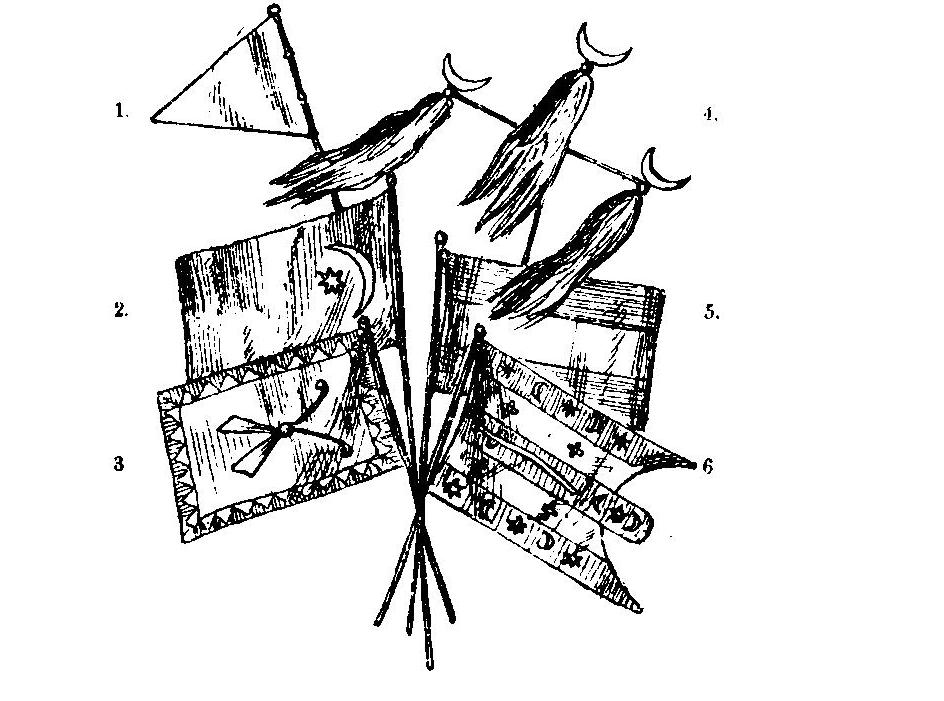

Ibn 'Abbas says ' The Prophet had two standards, a large black one and a small white one."
Al-Bara' ibn 'Azib says: "The standard, I remember, was a square one, and black spotted with divers colors."
In the struggle between the Shi'ahs and the Sunnis, the Fatimides adopted green as the colour of their standard, whilst the Bani Umaiyah assumed white for theirs.
In Central Asia, the, ordinary Muslim standards are either black or green, and are triangular. The sign of the crescent, as it appears on Turkish standards, was adopted after the taking of Byzantium; for, long before the conquest of Constantinople, the crescent had been used in the city for an emblem of sovereignty, as may be seen from the medals struck in honour of Augustus and Trajan. [CRESECENT.]
There is a standard still preserved at Constantinople amongst the ancient relics, and called as-Sinjaqu 'sh-sharif, which is held to
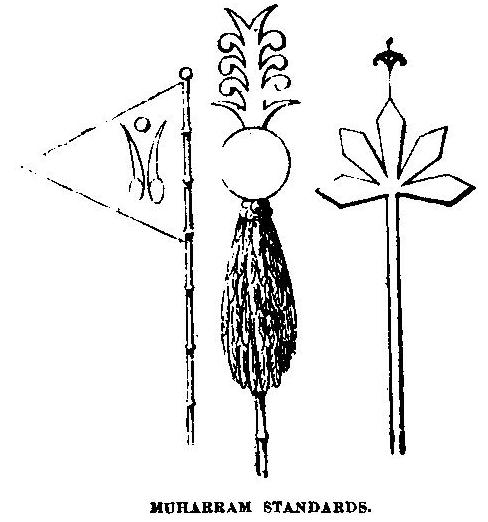
be a most sacred emblem, and is only produced on very special occasions. It is said to be the ancient standard of the Prophet.
A modern writer, describing this flag, says: "It is made of four 1ayers of silk, the top most of which is green, those below being composed of cloth, embroidered with gold. Its entire length is twelve feet, and from it is suspended the figure of a human hand, which, clasps a copy of the Qur'an, transcribed by the Khalifah 'Usman. In times of peace, the banner of the Prophet is kept in a chamber appropriated to the purpose, along with the clothes, teeth, the venerable locks, the stirrups, and the bow of the Prophet."
In the Muharram, when the martyrdom of al-Hasan and al-Husain is celebrated, numerous standards are carried about in the procession.
The origin of the horse-tail standard borne by modern Turks, appears to have been from the people bearing the horse-tail as a distinction of rank, the two ranks of sashes being distinguished respectively by two and three tails, and a further distinction of rank being marked by the elevation of one of the tails above the others.

According to the Traditions, the Mahdi, in the Last Days, will appear from the direction of Khorosan with black ensigns, and there seems to be every reason to regard the black standard as the primitive ensign of Islam, although the Wahhabis have generally carried green standards.
STATUES. [SCULPTURE.]
STONING TO DEATH.
Arabic rajm  In Muslim law, the punishment of lapidation is only inflicted for adultery. (Under the Jewish Law idolaters and bearers of false witness were also stoned.) it is founded, not upon the Qur'an. where the only punishment awarded is one hundred stripes (Surah xxiv. 2), but upon the Traditions (Mishkat, book xv. ch. 1), where Muhammad is related to have said. "Verily God hath ordained for a man or woman not married one hundred lashes and expulsion from their town one year, and for a men or woman having been married one hundred lashes and stoning. Abdu 'l-Haqq says the hundred lashes, in addition to the stoning is abrogated by the express example of the Prophet, who ordered stoning only; for 'Abdu 'llah ibn 'Umar relates the following tradition:-
"A Jew came to the Prophet and said. 'A man and woman of ours have committed adultery.' And the Prophet said. 'What do you meet with in the Book of Moses in the
matter of stoning?' The Jew said, 'We do not find stoning in the Bible, but we disgrace adulterers and whip them' Then 'Abdu llah ibn Salam, who was a learned man of the Jews, and had embraced Islam,, said, 'You lie, O Jewish tribe! verily the order for stoning is in the Book of Moses.' Then the book, was brought, and opened; and a Jew put his hand upon the revelation for stoning, and read the one above and below it and 'Abdu 'llah said, 'Lift up your hand he did so, and behold the revelation for stoning was produced in the book, and the Jews said, "Abdu 'llah spoke true, O Muhammad! the stoning revelation is in the Book of Muses' Then the Prophet ordered both the man and woman .to be stoned." (Mishkat, book xv. ch. i.)
The author of the Hidayah (vol. ii. p. 9) gives the following instructions as to the correct way of carrying out the sentence: —— "It is necessary, when a whoremonger is to be stoned to death, that he should be carried to some barren place void of houses or cultivation, and it is requisite that the stoning be executed—first by the witnesses and after them by the Imam or Qazi, and after those by the rest, of the bystanders, because it is so recorded from 'Ali, and also because in the circumstance of the execution being begun by the witnesses there is a. precaution, since a person may be very bold in delivering his evidence against a criminal, but afterwards, when directed himself to commence the infliction of that punishment which is a consequence of it, may from compunction retract his testimony; thus, causing the witnesses to begin the punishment may be a means of entirely preventing it. Ash-Shaf'i has said that the witnesses beginning the punishment is not a requisite, in a case of lapidation, any more than in a case of scourging. To this our doctors reply that reasoning upon a case of lapidation from a case of scourging is supposing an analogy between things which are essentially different, because all persons are not acquainted with the proper method of inflicting flagellation, and hence, if a witness thus ignorant were to attempt, it might prove fatal to the sufferer, and ho would die where death is not his due, contrary to a case of lapidation, as that is of a destructive natures and what every person is equally capable of executing. wherefore if the witnesses shrink back from the commencement of lapidation the punishment drops, because their reluctance argues their retraction.
"In the, same manner punishment is remitted when the witnesses happen to die, or to disappear, as in this case the condition, namely, the commencement of it by the witnesses, is defeated. This is when the whoredom is established upon the testimony of witnesses; but when it is established upon the confession of the offender, it is then requisite that the lapidation be executed, first by the Imam or the Qazi, and after them by the rest of the multitude, because it is recorded from 'Ali. Moreover, the Prophet threw a small stone like a bean at Ghamdiyah who had confessed whoredom. When a woman is to be stoned, a hole or excavation should be dug to receive her, as deep as her waist; because the Prophet ordered such a hole to be dug for Ghamdiyah before mentioned, and 'Ali also ordered a hole to be dug for Shuraha Hamdiani. It is, however, immaterial whether a hole be dug or not, because the Prophet did not issue any particular ordinance respecting this, and the nakedness of a woman is sufficiently covered by her garments; but yet it is laudable to dig a. hole for her, as decency is thus most effectually preserved. There is no manner of necessity to dig a hole for a man, because the prophet did not so in the case of Ma'iz. And observe, it is not lawful to bind a person in order to execute punishment upon him in this case, unless it appears that it cannot otherwise be inflicted.
"The corpse of a person executed by lapidation for whoredom is entitled to the usual ablutions, and to all other funeral ceremonies, because of the declaration of the Prophet with respect to Ma'iz. 'Do by the body as ye do by those of other believers'; and also, because the offender thus put to death is slain in vindication of the laws of God, wherefore ablution is not refused,. as in the case of one put to death by a sentence of retaliation; moreover the Prophet allowed the prayers for the dead to Ghamdiyah, after lapidation." (Hidayah, book ii. p. 9.)
This punishment of lapidation for adultery has become almost obsolete in modern times even in Bukharah, where the institutes of Muhammad are supposed to be most strictly observed, it is not inflicted.
SUBHAH.
 'The rosary of ninety-nine beads. . [ROSARY.]
SUBHIAN.
 [TASBIH.]
SUBHANA 'LLAHI.
 "Holiness be to God!" An ejaculation which
is called the Tasbih. It occurs in the liturgical. prayer, and is used as an ejaculation of. surprise or fear. [TASBIH.]
"Holiness be to God!" An ejaculation which
is called the Tasbih. It occurs in the liturgical. prayer, and is used as an ejaculation of. surprise or fear. [TASBIH.]
SUFAH.
 Banu. Sufrah. An
ancient tribe of Arabia. The descendants of Tabikha and Elyas (Muir, vol. 1. p. cxcix.)
Banu. Sufrah. An
ancient tribe of Arabia. The descendants of Tabikha and Elyas (Muir, vol. 1. p. cxcix.)
SUFI.
 more correctly
  Suf iy. (The Persian form of the plural being
  Sufiyan.) A man of the people called
  Sufiyah, who profess the mystic principles of
  Tasawwuf. There is considerable discussion as to time origin of this word. It is said to be derived (1) from the Arabic Suf "wool," on account of the woolen dress
Worn by the Eastern ascetics; (2) or from the Arabic Safu, "purity," with reference to the effort to attain to metaphysical purity (which is scarcely probabale); (3) or from the Greek
Tasawwuf. There is considerable discussion as to time origin of this word. It is said to be derived (1) from the Arabic Suf "wool," on account of the woolen dress
Worn by the Eastern ascetics; (2) or from the Arabic Safu, "purity," with reference to the effort to attain to metaphysical purity (which is scarcely probabale); (3) or from the Greek  , wisdom"; (4) or, according to the Ghiyasu 'l-Lugha', it is dervied from the Sufah, the name of a tribe of Arabia who in
the " time of ignorance," separated themselves from the world, and engaged themselves exclusively in. the service of the Makkah Temple.
It might at first sight appear almost an impossibility for mysticism to engrait itself upon the legal system of the Qur'an, and the Ahadis, with the detailed ritual and cold formality which are so strikingly exemplified in Islam; but it would appear that from the very days of Muhammad, there have been always those who, whihst they called themselves Muslims, set aside the literal meaning of the words of Muhammad for a supposed mystic or spiritual interpretation, and it is generally admitted by Sufis that one, of the great founders of their system, as found in Islam, was the adopted son aud son-in-law of the Prophet, 'All ibn Abi Talib. The Sufis themselves admit that their religions system has always existed in the world, prior to the mission of Muhammad, and the unprejudiced student of their system will observe that Tasawwuf, or Suflism. is hut a Muslim adaptation of the Vedanta school of Hindu philosophers, and which also we find in the writings of the old academics of Greece, and Sir William Jones thought Plato learned from the sages of the East.
The Sufis. are divided into innumerable sects, which find expression in the numerous religious orders of Darweshes or Faqirs [FAQIR]; but although they differ in name and in some of their customs, as dress, meditations and recitations, they are all agreed in their principal tenets, particularly those which inculcate the absolute necessity of blind submission to a murshid, or inspired guide. It is generally admitted that, quite irrespective of minor sects, the Sufis are divided into those who claim to be only the Ilhamiyah, or inspired of God, and those who assert that they are Ittihadiyah, or unionist with God.
The following is a succinct account of the doctrines of the Sufis:-
1. God only exists. He in all things, and all things in Him.
2. All visible and invisible beings are an emanation from Him, and are not really distinct from Him.
3. Religions are matters of indifference they however serve as leading to realities. Some for this purpose are more advantageous than others, among which is al-Islam, of which 5ufiism is the true philosophy.
4. There does not really exist any difference between good and evil, for all is reduced to Unity, and God is the real Author of the acts of mankind.
5. It is God who fixes the will of man: man therefore is not free in his actions.
6. The soul existed before the body, and is confined within the latter as in a cage. Death, therefore, should be the object of the wishes of the Sufi, for it is then that he returns of the bosom of Divinity.
7. It is by this metempsychosis that souls Which have not fulfilled their destination here below are purified and become worthy of reunion with God.
8. Without the grace of God, which the Sufis call Fagazanu 'llah, or Fazu 'llah, no one can attain to this spiritual union, but this, they assert, can be obtained by fervently asking for it.
9. The principal occupation of the Sufi whilst in the body, is meditation on the wahduniyah, or Unity of God,, the remembrance of God's names [ZIKR], and the progressive advancement in the Tariqah, or journey of life, so as to attain unification with God.
Human life is likened to a journey (safar), and the seeker after God to a traveller (salik).
The great business of the traveller is to exert himself and strive to attain that perfect knowledge (ma'rifah) of God which is diffused through all things, for the Soul of man is an exile from its Creator, and human existence is its period of banishment. The sole object of Sufiism is to load the wandering soul onward, stage by stage, until it reaches the desired goal—perfect union with the Divine Being.
The natural state of every human being is humanity (nasut), in which state the disciple must observe the Law (shari'ah); but as this is the lowest form of spiritual existence, the performance of the journey is enjoined upon every searcher after true knowledge.
The various stages (manazit) are differently described by Sufï writers, but amongst those of India (and, according to Malcolm, of Persia also,) the following is the usual journey.
The first stage, as we have already remarked, is humanity (nasut), in which the disciple must live according to the Law (shari'ah), and observe all the rites, customs, and precepts of his religion. The second is the nature of angels (malakut), for which there is the pathway of. purity (tariqah). The third is the possession of power (jubrut), for which there is knowledge (ma'rifah) and the fourth is extinction (fana') (i.e. absorption into the Deity), for which there is Truth (haqiqah).
The following more extended journey is marked out for the traveller by a writer, 'Aziz ibn Muhammad Nafasi, in a book called al-Maqsadu 'l-Aqsa, or the "Remotest Aim," which has been rendered into English by the lamented Professor Palmer (Oriental Mysticism, Cambridge, 1867):-
When a man possessing the necessary requirements of fully-developed reasoning powers turns to them for a resolution of his doubts and uncertainties concerning the real nature of the Godhead, be is called a talib, "a searcher after God."
If he manifest a further inclination to prosecute his inquiry according to their system, he is called a murid, or, "one who inclines."
Placing himself then under the spiritual
instruction of some eminent leader of the sect, be is fairly started upon his journey and becomes a salik, or "traveller," whose whole business in life is devotion, to the end that he may ultimately arrive at the knowledge of God.
1. Here he is exhorted to serve God, as the first stop towards a knowledge of Him. This is the first stage of his journey, and is called 'ubudiyah  , or "service."
2. When in answer to his prayers the Divine influence or attraction has developed his inclination into the love of God, he is said to have reached the stage called 'Ishq  or "love."
3. This Divine Love, expelling all worldly desires from his heart, leads him to the next stage, which is zuhd  , or "seclusion."
4. Occupying himself henceforward with contemplations and investigations of metaphysical theories concerning the nature, attributes, and works of God, he reaches wa'rifah  , or "knowledge."
5. This assiduous contemplation of start-ling metaphysical theories is exceedingly attractive to an oriental mind, and not unfrequently produces a state of, mental excitement. Such ecstatic state is considered a sure prognostication of direct illumination of the heart by God, and constitutes the next stage, called wajd  , or "ecstasy."
6. During this stage ho, is supposed to receive a revelation of the true- nature of the Godhead, and to have reached the stage called haqiqah  or "truth."
7. He then proceeds to the stage of wasl  or "union with God."
8. Further than this he cannot go, but pursues his habit of self-denial and contemplation until his death, which is looked upon as fana'  , "total absorption into the Deity, extinction."
To develop this quasi "spiritual life" the Sufi leaders have invented various forms of devotion called zikr  , or "recitations." These eccentric exercises have generally attracted the notice of travellers in the East, and have been described by Lane, Vambéry, Burton, and other Orientalists. For an account of these ceremonies of Zikr the reader is referred to the article under that head, [ZIKR.]
The late Professor E.B. Palmer of Cambridge has in his Oriental Mysticism, compiled from native sources, given a very correct idea of what may be considered the spiritual side of Muhammadanism, as expressed in the teaching of Muslim Sufis.
"The perfect man is he who has fully comprehended the Law, the Doctrine, and the Truth; or, in other words, he who is endued with four things in perfection, viz 1. Good works; 2. Good deeds; 3. Good principles; 4. the sciences. It is the business of the Traveller to provide himself with these things in perfection, and by so doing he will provide himself with perfection.
"The Perfect Man has had various other names assigned to him, all equally applicable, viz. Elder, Leader, Guide, Inspired Teacher, Wise, Virtuous, Perfect, Perfecter, Beacon and Mirror of the world, Powerful Antidote Mighty Elixir, 'Isa (Jesus) the Raiser of the Dead, Khizar the Discoverer of the Water of Life, and Solomon who knew the language of Birds."
The Universe has been likened to a single person, of whom the Perfect Man is the Soul; and again, to a tree, of which man-kind is the fruit, and the Perfect Man the pith and essence. Nothing is hidden from the Perfect Man; for after arriving at the knowledge of God, he has attained to that of the nature and properties or material objects, and can henceforth find no better employment than acting mercifully towards mankind, Now there is no mercy better than to devote oneself to the perfection and improvement of others, both by precept and example. Thus the Prophet is called in the Coran 'a mercy to the Universe.' (Cor. cap. 21, v. 107.) But with all his perfection the Perfect Man cannot compass his desires, but passes his life in consistent and unavoidable self-denial: ho is perfect in knowledge and principle, but imperfect in faculty and power.
"There have indeed been Perfect Men possessed of power; such power as that which resides in kings and rulers; yet a careful consideration of the poor extent of man's capacities will show that his weakness is preferable to his power, his want of faculty preferable to his possession of it. Prophets and saints, kings and sultans, have desired many things, and failed to obtain them; they have wished to avoid many things, and have had them forced upon them, Mankind is made up of the Perfect and the Imperfect. of the Wise and the Foolish, of Kings and Subjects, hut all are alike weak and helpless, all pass their lives in a manner contrary to their desires; this the Perfect Man recognises and acts upon, and, knowing that nothing is better for man than renunciation, forsakes all and becomes free and at leisure. As before he renounced wealth and dignity, so now be foregoes eldership and teachership, esteeming freedom and rest above everything the fact: is, that though the motive alleged for education and care of others is a feeling of compassion and a regard for discipline, yet the real instigation is the love of dignity: as the Prophet says, 'The last thing that is removed from the chiefs of the righteous is love of dignity. I have said that the Perfect Man should he endued with four things in perfection; now the Perfectly Free Man should have four additional characteristics, viz. renunciation, retirement, contentment, and leisure. He who has the first four is virtuous, and free. Furthermore, there are two grades of the Perfectly Free – those who have renounced
wealth and dignity only, and those who have further renounced eldership and teachership, thus becoming free and at leisure. Those again are subdivided into two classes: those who, after renunciation, retirement contentment, make choice of obscurity, and those who, after renunciation, make choice of submission, contemplation, and resignation; but the object of both is the same. Some writers assert that freedom and leisure consists in the former course, while others maintain that it is only to be found in the latter.
"Those who make choice of obscurity are actuated by the knowledge that annoyance and distraction of thought are the invariable concomitants of society ; they therefore avoid receiving visits and. presents, and fear them as they would venomous, beasts. The other class, who adopt submission, resignation and contemplation, do so because they perceive that mankind for the most part are ignorant of what is good for them, being dissatisfied with what is beneficial, and delighted with circumstances that are harmful to them; as the Coran says, 'Perchance ye may dislike what is good for, you, and like what is hurtful to you.' (Cor. cap. 2, v. 218.) For this reason they retire from society equally with the other class, caring little what the world may think of them."
Fellowship has many qualities and effects both of good and evil. The fellowship of the wise is the only thing that can conduct the Traveller safely to the Goal; therefore all the submission, earnestness, and discipline that have been hitherto inculcated are merely in order to render him worthy of such fellowship. Provided he have the capacity, a single day, nay, a single hour, in the society of the wise, tends more to his improvement than years of self-discipline without it. 'Verily one day with thy Lord is better than a thousand years.' (Cor. cap. 22, v. 49.)
"It is, however, possible to frequent the society of the wise without receiving any benefit therefrom, but this must proceed either from want of capacity or want of will. In order then to avoid such a result, the Sufis have laid down the following rules for 'the conduct of the disciple when in the presence of his teachers."
"Hear, attend, hut speak little."
"Never answer a question not addressed to you; but if asked, answer promptly and concisely, never feeling ashamed to say, 'I know not.'"
"Do not dispute for disputation's sake."
"Never boast; before your elders."
"Never seek the highest place, nor even accept it if it he offered to you."
"Do not be over-ceremonious, for this will compel your elders to act in the same manner towards you, and give them needless annoyance."
"Observe in all cases the etiquette appropriate to the time, place, and persons present."
"In indifferent matters, that is, matters involving no breach of duty by their omission or commission, conform to the practice
And wishes of those with whom you are associating."
"Do not make a practice of anything which is not either a duty or calculated to increase the comfort of your associates; otherwise it will become and idol to you; and it is incumbent on every one to break his idols and renounce his habits."
"This leads us to the subject of Renunciation, which is of two kinds, external and internal. The former is the renunciation of worldly wealth; the latter, the renunciation of worldly desires. Everything, that hinders or veils the Traveller's path must be renounced, whether it relate to this world or the next. Wealth and dignity are great hindrances; but too much praying and fasting are often hindrances too. The one is a shroud of darkness, the other a veil of light The Traveller must renounce idolatry, if he desire to reach the Goal, and everything that bars his progress is an idol. All men have some idol, which they worship; with one it is wealth and dignity,' with another overmuch prayer and fasting. If a man sit always upon his prayer-carpet, his prayer-carpet becomes his idol. And so on with a great number of instances."
"Renunciation must not be performed without the advice and permission of an elder. It should be the renunciation of trifles, not of necessaries, such as food, clothing, and dwelling-place, which are indispensable to man; for without them he would be obliged to rely on the aid of others, and this would beget avarice, which is 'the mother of vice.' The renunciation of necessaries produces as corrupting an influence upon the mind as the possession of too much wealth. The greatest of blessings is to have a sufficiency, but to over-step this limit is to gain nought but additional trouble."
"Renunciation is the practice of those who know God, and the characteristic mark of the wise. Every individual fancies that he alone possesses this knowledge, but knowledge is an attribute of the mind, and there is no approach, from unaided sense to the attributes of the mind, by which we can discover who is, or who is not, possessed of this knowledge. Qualities however are the sources of action: therefore a man's practice is an infallible indication of the qualities he possesses; if, for instance, a man asserts that he is a baker, a carpenter, or a blacksmith, we can judge at once if he possesses skill in those crafts by the perfection of his handiwork. In a word, theory is internal, and practice external, the presence of the practice, therefore, is a proof that the theory too is there."
"Renunciation is necessary to the real confession of faith; for the formula 'There is no God but God,' involves two things, negation and proof. Negation is the renunciation of other Gods, and proof is the knowledge of God. Wealth and dignity have led many from the right path, they are the gods the
people worship; if then you see that one has renounced these, you may be sure that ho has expelled the love of thift world from his heart, and completed the negation; and whosoever has attained to the knowledge of God has completed the proofs. This is really confusing that 'there is no God hut God'; and he who has not attained to the knowledge of God, has never really repeated the confession of faith. Early prejudices are a great stumbling block to many people; for the first pri~tip1es of Monotheism are contained in the words of the Hadis: 'Every one is born with a disposition [for the true faith], but his parents make him a Jew, a Christian, or a Magian.' The Unitarians also say, that the real confession of faith consists in negation and proof; but they explain negation by renunciation of self, and proof by acknowledgment of God.
"Thus, according to the Sufis, confession of faith, prayer and fasting. contain two distinct features, namely, form and truth; the former being entirely inefficacious without the latter. Renunciation and the knowledge of God are like a tree; the knowledge of God is the root, renunciation the branches, and all good principles and qualities are the fruit. To sum up, the lesson to be learnt is that in repeating the formula the Traveller must acknowledge in his heart that God only always was, God only always will be. This world and the next, nay, the very existence of the Traveller, may vanish, but God alone remains. This is the true confession of faith; and al-though the Traveller before was blind, the moment he is assured of this his eyes are opened, and he seeth.
"The Sufis hold that there are three aids necessary to conduct the Traveller on his path.
"1. Attraction (injiab  ; 2. Devotion 'ibadah
  ); 3. Elevation ('uruj
" Attraction is the act of God, who draws man towards Himself. Man sets his face towards this world, and is entangled in the love of wealth and dignity, until, the grace of God steps in and turns his heart towards God. The tendency proceeding from God is called Attraction; that which proceeds from man is called Inclination, Desire and Love. As the inclination increases, its name changes, and it causes the Traveller to renounce everything else becoming a Kiblah,to set his face towards God; when it has become his Kiblah, and made him forget everything but God, it is developed into Love. [QIBLAH.]
"Most men when they have attained this stage are content to pass their lives therein, and leave the world without making further progress. Such a person the Sufis call Attracted ( majzub).
"Others, however, proceed from this to self-examination, and pass the rest of their lives in devotion. They are then called Devoutly Attracted ( majzub-i-
Salik). If devotion be first practised, and the attraction of God then step in, such a person is called an Attracted Devotee (
majzub-i-
Salik). If devotion be first practised, and the attraction of God then step in, such a person is called an Attracted Devotee ( Salik-i-majzub). If he practise and complete devotion, he is 'not influenced by the attraction of God', he is called a Devotee (
 Salik).
"Sheikh Shehab-uddin, in his work entitled 'Awarif al Ma'arif, says that an elder or teacher should be selected from the second class alone: for although many may be estimable and righteous, it is but few who are fit for such offices, or for the education of disciples.
"Devotion is the prosecution of the journey, and that in two ways, to God and in God. The first, the Sufis say, has a limit, the second is boundless; the journey to God is completed when the Traveller has attained to the knowledge of God; and then commences the journey in God, which has for its object the knowledge of the Nature and Attributes of God, a task which they confess is not to be accomplished in so short a space as the lifetime of man.
is less, when with Thyself compared,
Than one drop in a sea.
"The Unitarians maintain that the journey to God is completed when the Traveller has acknowledged that there is no existence save that of God; the journey, in God they explain to ho a subsequent inquiry into the mysteries of nature.
"The term Elevation or ascent ( 'uruj) is almost synonymous with Progress.
"Every animal possesses a vegetative spirit, a living spirit, and, an instinctive spirit; but man has an additional inheritance, namely the Spirit of. Humanity, Now this was breathed by God into man directly from Himself, and is therefore of the same Character as the Primal Element: And when I have' fashioned him and breathed My spirit into him.' (Cor. cap, 15. v. 29.) The Sufis do not interpret this of the Life, but of the Spirit of Humanity, and say that it is frequently not attained until a late period of life, thirty or even eighty years. Before man can receive this Spirit of Humanity, he must be furnished with capacity, which is only to be acquired by purifying oneself from all evil and immoral qualities and dispositions, and adorning oneself with the, opposite ones. Sheikh Muhiy-uddlu ibn ul 'Arabi, in his 'Investigations'  , says that the words 'and when I have fashioned him,' 'refer to this preparation, and the rest of the sentence, 'and breathed My spirit into him', refers to the accession of the Spirit of Humanity.
"Two conditions are therefore imposed upon the Traveller, first to attain Humanity, second, to acquire capacity."
"There are three developments of character that must be suppressed before man
can attain to Humanity; the animal, the brutal and the fiendish. He who only eats sleeps, and gives way to lust, is mere animal; if besides these he gives way to anger and cruelty, he is brutal; and if in addition to, all these he is crafty, lying, and deceitful, he is fiendish.
"If the Traveller is moderate in his food, rest, and desires, and strives to attain a knowledge of himself and of God, then is the time for acquiring capacity by freeing himself from all that is evil and base, and adorning himself with the opposite qualities; after that by prayer he may obtain the Spirit of Humanity. Some one has truly said that there is none of the perfection, essence, or immortality of man, save only among such as are created with a godly disposition. When the Traveller has once been revivified by the Spirit of Humanity he becomes immortal, and inherits everlasting life. This is why it has been said that 'man has a beginning but no end.'
"If when he has attained this Spirit of Humanity; he is earnest, and does not waste his life in trifling, he soon arrives at the Divine Light itself. For 'God guideth whom He pleaseth unto His Light.' The attainment of this light is the completion of Man's upward progress, but no one can attain to it but those who are pure in spirit and in their lives. Mohammed asserted that he himself had attained it, 'To the light have I reached, and in the light I live;' now this light is the Nature of God; wherefore he said, 'who sooth me seeth God.' [NUR-I-MUHAMMAD.]
"The germ that contains the Primal Element of Man is the lowest of the low, and the Divine Light is the highest of the high; it is between these extremes that the stages of man's upward or downward progress lie. 'We have created man in the fairest of proportions, and then have thrown him hack to be the lowest of the low, save only such as believe and act with righteousness; and verily these shall have their reward. (Cor. cap. 95, v. 4). This reward is said by the Sufis to be defined by the word ajrat, 'reward,' itself. This word contains three radical letters  and
and  stands for
  'return,' for
  paradise, and
  for
for  that is 'those who have handed down the faith.'
Their acting righteously is their return to the Nature of God, for when they have finished their upward progress and reached this they are in Paradise, and in the presence of their God. He therefore is a man, in the true sense of the word, who being sent down upon earth strives upward towards Heaven. These aspirations are indispensable to man; he might by the Almighty Power of God exist without all beside, even had the Heavens and the elements themselves never been; but these things are the aim and want of all.
that is 'those who have handed down the faith.'
Their acting righteously is their return to the Nature of God, for when they have finished their upward progress and reached this they are in Paradise, and in the presence of their God. He therefore is a man, in the true sense of the word, who being sent down upon earth strives upward towards Heaven. These aspirations are indispensable to man; he might by the Almighty Power of God exist without all beside, even had the Heavens and the elements themselves never been; but these things are the aim and want of all.
"It has been said that the Primal Element or constructive spirit as well as the Spirit of Humanity proceed direct from God. They are therefore identical, and are both included by Sufis in the one term Concomitant Spirit. Now this Spirit, although distinct and individual, comprehends and governs the entire Universe. The Simple Natures are its administrators and exponents; of these the Seven Sires beget, and the Four Mothers conceive from the incarnation of this spirit in them, and their offspring is the triple kingdom, Mineral, Vegetable, and Animal. And so it is with the Lesser World of Man.
"Now this Spirit hath two functions, external and internal; the external is revealed in the material generation just alluded to, the internal abides in the heart of man. Whosoever purifies his heart from worldly impressions and desires, reveals this internal function of the Spirit within him, and illumines and revivifies his soul.
"Thus the Spirit at once comprehends the Universe and dwells in the heart of man.
"When Man has become assured of the truth of Revelation, he has reached the stage of Belief, and has the name of Mumin, 'Believer.' When he further acts in obedience, to the will of God, and apportions the night and day for earnest prayer, he has reached the stage of worship, and is called an 'A'bid, or 'Worshipper.' When he has expelled the love of this world from his heart, and occupies himself with a contemplation of the mighty Whole, he reaches the next stage, and becomes a Zahid, or 'Recluse.' When in addition to all this he knows God, and subsequently learns the mysteries of nature, he reaches the stage of Acquaintance, and is called 'A'rif 'One who knows.' The next stage is that in which he attains to the love of God, and is called a Weli, or 'Saint'. When he is moreover gifted with inspiration arid the power of working miracles, he becomes a Nebi, 'Prophet'; and when entrusted next with the delivery of God's own message, he is called an 'Apostle,' Rusul. When he is appointed to abrogate a previous dispensation and preach a new one, he is called Ulu 'l'Azm, 'One who has a mission.' When this mission is final, he has arrived at the stage called Khatm, or the 'Seal'. This is the Upward Progress of Man. The first stage is the 'Believer.' the last the 'Seal.'"
"After separation from the body, the soul of Man returns to that Heaven which corresponds to the stage which he has attained, thus the Believer at last dwells in the first or lowest Heaven, and the Seal in the Heaven of Heavens, for it will be noticed that the stages of upward progress correspond to the number of degrees in the Heavenly Spheres, namely, seven inferior and two superior."
"The metaphysicians say that these stages and degrees do not in reality exist, but that the Heavenly Intelligence which corresponds to the degree of intelligence attained by Man, attracts and absorbs his soul into itself after separation from the body. Thus every one who has attained intelligence corresponding to that of the highest sphere, his soul returns
thereto and he who has attained intelligence corresponding to the lowest sphere, his soul in like manner returns to that; those who have not attained intelligence corresponding to any of these will be placed in Hell, which is situate below the lowest sphere.
"As each of the Heavenly Spheres is furnished with knowledge and purity in proportion to its position, the rank of Man's soul in the future state will, according to this last account, be in proportion to his degree of knowledge and purity of life while upon the earth.
"The Unitarians say that man's Upward Progress has no end, for if he strive for a thousand years, each day will teach him something that he knew not before, inasmuch as the knowledge of God has no limit. So Mohammed says, 'He who progresses daily is yet of feeble mind.'
"The religious account says that the soul of every man returns to an individual place after separation from the body. This the metaphysicians deny; for how, say they, can the soul of a man return to a certain place when it has not originally come from a certain place? The soul of man is the Primal Spirit, and if a thousand persons live, it is the same spirit that animates them all; and in like manner if a thousand die, the same spirit returns to itself, and is not lessened or diminished. If a myriad persons build houses and make windows therein, the came sun illumines them all, and though every one of them should be destroyed, the sun would not be lessened or diminished. The sun is the lord of the sensible world, and the exponent of the attributes of the Primal Spirit. The Primal Spirit is the lord of the invisible world and the exponent of the Nature of God.
"When the heart of man has been revivified and illumined by the Primal Spirit, he has arrived at Intelligence; for Intelligence is a light in the heart, distinguishing between truth and vanity. Until he has been so revivified and illumined, it is impossible for him to attain to intelligence at all. But having attained to intelligence, then, and not till then, is the time, for the attainment of knowledge, for becoming Wise. Intelligence is a Primal Element, and knowledge the attribute there of. When from knowledge he has successively proceeded to the attainment of the Divine Light, and acquaintance with the mysteries of nature, his last step will be Perfection, with which his Upward Progress concludes,
"But dive he ever so deeply into the treasury of mysteries and knowledge, unless he examine himself and confess that after all he knows naught, all that he has acquired will slip through his hands, and leave him far poorer than before. His treasure of today should as much emceed the treasure of yesterday as an ocean exceeds a drop; but this can never be, unless he, leaving all else for contemplation and self-examination, have freedom and leisure to learn how poor he really is, and how much he needs the saving help of God. "One class of Unitarians explain the Upward Progress of Man thus. They say that every atom of existent beings is filled with light;
but that man walks abroad in darkness, blinded by the lusts of life, and laments the want of light that would, were he but aware of it, involve him in the glorious sheen of brightest day:
What they mean is this, that all existent beings are compounded of two things, darkness and light, which are indistinguishably blended together. The light belongs to the Invisible, and the darkness to the sensible world; but the two are intimately connected, and the former exercises a paramount influence upon the latter. The object of man, according to them, is to separate the light from the darkness, that its nature and attributes may he understood, and in this consists his Upward Progress.
"Although the light and the darkness can never be entirely separated, for the one is as it were the veil of the other, the light can be made to prevail, so that its attributes may become manifest."
"Now it is possible to separate thus far the light from the darkness in certain cases; in the bodies of men and animals, for instance, there are certain organs always at work, whose sole object is this separation. Thus, when food is introduced into the stomach, the liver receives the cream and essence of it and transmits it to the heart; the heart, in like manner, extracts the essence of this, which is the life, and transmits it to the brain; lastly, the brain extracts the essence of this, and' transforms it into the elixir of life, the real light of all."
"The elixir evolved by the brain is the instinctive spirit, and is, as it were, a lamp in a lantern; but it gives forth after all but a flickering and cloudy light, and man's object should therefore be to strengthen and purify it by Renunciation and Contemplation, until it give forth the true light which is the Spirit of Humanity. When man has attained to this he necessarily becomes free from all that is evil, and is adorned instead with every good and noble quality."
"The body of man is like a lantern, a Vegetative Spirit is the lamps the Animal Spirit is the wick, the instinctive Spirit the oil, and the Spirit of Humanity the fire that kindles all. 'Verily its oil would almost shine even though no fire kindled it.' (Cor cap. 24, v. 35.) In other words, the Instinctive Spirit should feed and supply the Spirit of Humanity, as the oil feeds and supplies the flame in the lamp. The Traveller must aim at completing this lamp, so that his heart may be illumined, and he may see
things as they really are. When the Spirit of Humanity a 'light upon light' (Cor. cap. 24, v. 35) has thus kindled the Instinctive Spirit, God guideth whom He pleaseth to His own light (idem), that is, to the divine light of His own nature, reaching which the Traveller's Upward Progress is complete; for from Him they spring, and unto Him return.' "
A clear and intelligible exposition of the principles of Sufiism, or Oriental Spiritualism, is given by Muhammad al-Misri, a Sufi of the Ilhamiyah school of thought, in the following categorical form (translated by Mr. J. P. Brown, in the Journal of the American Oriental Society). It represents more particularly the way in which this form of mysticism is adapted to the stern and dogmatic teaching of Islam.
Question. — What is the beginning of at-Tasawwuf?
Answer. — Iman, or faith, of which there are six pillars, namely, (1) Belief in God, (2) in His Angels, (3) in His Books, (4) and in His Prophets, (5) in the Last Day, and (6) in His decree of good and evil.
Q. — What is the result of at-Tasawwuf?
A. — It is not only the reciting with the tongue these pillars of faith, but also establishing them in the heart. This was the reply made by the Murshid Junaidu 'l-Baghdadi, in answer to the same question.
Q. — What is the distinction, between a Sufi and an ordinary person?
A..— The knowledge. of an ordinary person is but Imanu-i-Tahqiqi, or "a counterfeit faith," whereas that of the Sufi is Iman-i-Tahqiqi, or "true faith."
Q. — What do you mean by counterfeit faith?
A. —- It is that which an ordinary person has derived from his forefathers, or from the teachers and preachers of his own day, without knowing why it is essential that a man should believe in these six articles for his, soul's salvation. For example, a person may be walking in the public streets, and find a precious jewel which, perhaps, kings had sought for in vain, and rulers who had conquered the whole world had sought for and yet had not found. But in this precious jewel he has found that which is more effulgent than the sun, when it is so bright that it obscures the lesser light of the moon; or even he has found an alchemy which can convert copper into gold. And yet perhaps, the finder knows not the value of the, precious jewel, but thinks it a counterfeit jewel, and one which he would give away even for a drink of water if he were thirsty.
Q.— What is the establishment of faith?
A. – The establishment of faith consists in a search being made for the true origin of each of these six pillars of faith, until the enquirer arrives at al-Haqiqah, "the Truth." Many persons pursue the journey for ten, or twenty, or thirty, or even forty years, and. wandering away from the true path, enter upon the path of error, and hence there are known to be seventy-three ways, only one of which is the way of Salvation. [SECTS.] At last, by a perfect subjection to the teaching of the Murshid, or guide, they find out the value of the lost jewel which they have found, and their faith becomes manifest, and you might say that, with the light of a lamp, they have reached the sun. They then find out that the Tariqah, or journey of the Sufi, is consistent with the Shari'ah, or law of Islam.
Q. — In matters of faith and worship, to what sect are the Sufis attached?
A.— (To this reply the author says, speaking. of course, of his own people, that they are chiefly of the Sunni sect. But he does not notice that mystic doctrines are more prevalent amongst the Shi'ahs.)
Q.— When Bayazid al-Bistami was asked of what sect he was, he replied, "I am of the sect of Allah." What did he mean?
A.—The sects of, Allah are the four orthodox sects of Islam. [Here our author departs from true Sufi teaching.]
Q.— Most of the Sufis, in their poems, use certain words which we hear and understand as showing that they were of the Metempsychosians. They say, "I am sometimes Lot, sometimes a vegetable, sometimes an animal, at other times a man." What does this mean?
A.— Brother! the prophet has said: "My people, in the future life, will rise up in companies "—that is, some as monkeys, others as hogs, or in other forms—as is written in a verse of the Qur'an, Surah lxxviii. 18: "Ye shall come in troops," which has been commented on by al-Baizawi, who cites a tradition to the effect that, at the resurrection, men will rise up in the form of those animals whose chief characteristics resemble their own ruling passions in life: the, greedy, avaricious man as a hog; the angry, passionate man as a camel; the tale-bearer or mischief-maker as a monkey. For though these men, while in this life, bore the human form externally, they were internally nothing different from the animals whose characters are in common with their own. The resemblance is not manifest during the life, but becomes so in the other existence, after the resurrection. Let us avoid such traits; repentance before death will free us from these evils. The Prophet said with regard to this: "Sleep is the brother of death. The dying man sees himself in his true character, and so knows whether or not he is, by repentance, freed from his ruling passion of life. In like manner, he will see himself during his slumbers, still following in the path of his passions." For instance, the money-calculator, in sleep, sees himself engaged in his all-absorbing occupation; and this fact is a warning from God not to allow himself to be absorbed in any animal passion or degrading occupation. It is only by prayerful repentance that anyone can hope
to see himself, in his sleep, delivered from his ruling carnal passion, and restored to his proper human, intellectual form. If in your slumbers you see a monkey, consider it as a warning to abandon or abstain from the passion of mischief; if a hog, cease to seize upon the goods of others; and so Go and give yourself up to an upright Murshid, or spiritual guide, who will, through his prayers show you in your slumbers the evil parts of your character, until one by one they have passed away, and have been replaced by good ones—all through the power: of the name of God, whom he will instruct you to invoke [ZIKR]: at length you will only see in your slumbers the forms of holy and pious men, in testimony of that degree of piety to which you will have attained. This is what is meant by that expression of certain poets, referring to one's condition previous to the act of repentance, when the writer says, "I am sometimes an animal, sometimes a vegetable, sometimes a man"; and the same may be said by the Sufis, in application to themselves as of any other part of creation, for wan is called the khiru 'l-maujudat, or "the climax of beings": for in him are comprised all the characteristics of creation. Many mystical books have been written on this subject, all showing that man is the larger part, and the world the smaller part, of God's creation. The human frame is said to comprise all the other parts of creation; and the heart of man is supposed to be even more comprehensive than the rainbow, because when the eyes are closed, the mental capacity can take in the whole of a vast city; though not seen by the eyes, it is seen by the capacious nature of the mind. Among such books is the Hauzu 'l-Hayat, or the "Well of Life," which says that, if a man closes his eyes, ears and nostrils, he cannot take cold; that the right nostril is called the Sun, and the left the moon; that from the former be breathes heat, and from the latter cold air.
Q.— Explain the distinctive opinions of the Sufis in at-Tanasukh, or the Transmigration of Souls.
A. — O Brother! our teaching regarding al-Barzakh (Qur'an xxiii. 102.) has nothing whatever to do with at- Tanasukh. Of all the erring sects in the world, those who. believe in Metempsychosis, or Transmigration of Souls, is the very worst.
Q.— The Sufis regard certain things as lawful which are forbidden. For instance, they enjoin the use of wine, wine-shops, the wine-cup, sweethearts; they speak: of the curls of their mistresses, and the moles on their faces, cheeks, &c., and compare the furrows on their brows to verses of the Qur'an. What does this mean?
A. — The Sufis often exchange the external features of all things for the internal, the corporeal for the spiritual, and thus give an imaginary signification to outward forms. They behold objects of a precious nature in their natural character and for this reason the greater part of their words have a spiritual and figurative meaning. For instance, when, like Hafiz, they mention wine, they mean a knowledge of God, which, figuratively, considered, is the love of God. Wine, viewed figuratively, is also love: love and affection are here the same thing. The wine-shop, with them, means the murshidu 'l-kamil, or spiritual director, for his heart is said to be the depository of the love of God; the wine-cup is the Talqin, or the pronunciation of the name of God in a declaration of faith, as: "There is no God but Allah!" or it signifies the words which flow from the Murshid's mouth respecting divine knowledge, and which, when heard by the Salik, or "one who pursues the true path," intoxicates his soul. and divests his heart of passions, giving him pure spiritual delights; The sweetheart means the excellent preceptor, because, when anyone sees his be loved, he admires her perfect proportions, with a heart full of love; the Salik beholds the secret knowledge of God which fills the heart of his spiritual preceptor, or Murshid, and through it receives a similar inspiration, and acquires a full perception of all that be possesses, just as the pupil learns from his master. As the lover delights in the presence of his sweetheart, so the Salik rejoices in the company of his beloved Murshid, or preceptor. The sweetheart is the object of a worldly affection, but the preceptor of a spiritual attachment. Tue curls or ringlets of the beloved are the grateful praised of the preceptor, tending to bind the affections of the disciple; the moles on her face signify that when the pupil, at times, beholds the total absence of all worldly wants on the part of the preceptor, he also abandons all the desires of both worlds — he perhaps even goes so far as to desire nothing else in life than his preceptor; the furrows on the brow of the beloved one, which they compare to verses of the Qur'an, mean the light of the heart of the Murshid; they are compared to stories of the Qur'an, because the attributes of God, in accordance with the injunction of the Prophet: "Be ye endued with divine qualities," are possessed by the Murshid.
Q.— The Murshids and their disciples often say: "We see God." Is it possible for anyone to see God?
A. — It is not possible. What they mean by this assertion is that they know God, that they see His power; for it is forbidden to mortal eyes to behold Him, as is declared in the Qur'an, Surah vi. 103: "No sight reaches Him; He reaches the sight—the subtle, the knowing." The Prophet commanded us to adore God, as thou wouldst didst thou see Him; for, if thou dost not see Him, He sees thee." This permission to adore Him is a divine favour, and they say that they are God's servants by divine favour. 'Ali said: "Should the veil fall from my eyes, how would God visit me in truth?" This saying proves that no one really sees God, and that even the sainted 'Ali never saw Him.
Q. - Can it possibly be erroneous to say
that, by seeing the traces of anyone he may be beheld?
A. — One may certainly be thus seen; When any person sees the brightness of the sun, he may safely say that he has seen the sun, though, indeed, he has not really seen it. There is another example, namely: Should you hold a mirror in your hand, you see a figure in it, and you may, therefore, say that you see your own face, which is really an impossibility, for no one has ever seen his own face, and you have asserted what is not strictly correct.
Q. — Since everyone sees the traces of God, as everyone is able to do, how is at that the Sufis declare that they only see Him?
A. — Those who make this statement do not know what they see. for they have never really seen Him. A person who has eaten of a sweet and savoury dish given to him, but of which he knows not the name, seeks for it again with a longing desire after it, and thus wanders about in search of what has given him so much delight, even though he be ignorant of what it really was. So are those who seek after God, without knowing Him, or what He is.
Q.— Some Sufis declare: "We are neither afraid of Hell, nor de we desire Heaven " — a saying which must be blasphemous. How is this?
A. — They do not really mean that they do not fear Hell, and that they do not wish for Heaven. If they really meant this, it would be blasphemous. Their meaning is not as they express themselves probably they wish to say: . "O Lord, Thou who createdest us, and madest us what we are, Thou hast not made us because we assist Thy workings. We are in duty bound to serve Thee all the more devotedly, wholly in obedience to Thy holy will. We have no bargaining with Thee, and we do not adore Thee with the view of gaining thereby either Heaven or Hell!" As it is written in the Qur'an, Surah ix. 112: "Verily, God hath bought of the believers their persons and their wealth, for the Paradise they are to have," which means that His bounty has no bounds His mercy no end; and thus it is that He benefits His faithful servants. They would say: "Thou hast no bargaining with anyone: our devotion is from the sincerity of our hearts, and is for love of Thee only. Were there no Heaven, nor any Hell, it would still be our duly to adore Thee. To Thee belongs the perfect right to put us either in Heaven or in Hell, and may Thy commands be executed agreeably to Thy blessed will! If Thou putteat us in Heaven, it is through Thine excellence, not on account of our devotion; if Thou puttest us in Hell, it is from out of Thy great justice, and not from any arbitrary decision on Thy part; so be it for ever and for ever!" This is the true meaning of the Sufis when they say they do not desire Heaven or fear Hell.
Q. – Thou saidst that there is no conflict between the Shari'ah, "law," and the Haqiqah, "truth," and nothing on the latter is consistent with the former, and yet these two are distinguished from one another by "a something" which the Ahlu 'l-Haqiqah, "believers in the truth," conceal. Were there nothing contradicting, why should it be thus hidden?
A. — If it be concealed, it is not because there is a contrariety to the law, but only because the thing hidden is contrary to the human mind; its definition is subtle, and not understood by everyone, for which reason the Prophet said "Speak to men according to their mental capacities, for if you speak all things to all men, some cannot understand you, and so fall into error." The Sufis, therefore, hide some things conformably with this precept.
Q.—-Should anyone not know the science which is known to the Sufis and still do what the law plainly commands, and be satisfied therewith, would his faith and Islam be less than that of the Sufis?
A.— No. He would not be. inferior to the Sufis; his faith and Islam would be equal oven to that of the prophets, because Iman and Islam are a jewel which admits of no division or separation into parts, and can neither be increased nor diminished, just as the portion of the sun enjoyed by a king and by a faqir is the same, or as the limbs of the poor and the rich are equal in number: just as the members of the body of the king and the subject are precisely alike, so is the faith of the Muslim the same in all and common to all, neither greater nor less any case.
Q. — Some men are prophets, saints, pure ones, and others Fasias, who know God, but perform none of His commands); what difference is there among them?
A.— The difference lies in their ma'rifah or knowledge of spiritual things"; but in the matter of faith they are all equal; just as, in the case of the ruler and the subject, their limbs are all equal While they differ in their dress, power, and office.
The very essence of Sufiism is poetry, and the Eastern Mystics are never tired of expatiating on the 'Ishq, or "Love to God," which is the one distinguishing feature of Sufi mysticism. The Masnawi, which teaches in the sweetest strains that all nature abounds with love divine, that causes even the lowest plant to seek the sublime object of its desire; the works of the celebrated Jami, so full of ecstatic rapture; the moral lessons of the eloquent Sa'di; and the lyric odes of Hafiz, may be termed the Scriptures of the Sufi sect; and yet each of these authors contains passages which are unfit for publication in an English dress, and advocate morals at variance with what Christianity teaches us to be the true reflection of God's Holy Will. Whilst propriety demands the suppression of verses of the character alluded to, we give a few odes as specimens of the higher order of Sufi poetry.
Jalalu 'd-din ar-Rumi, the author of the Masnawi (A.H. 670), thus writes:-
And again :—
"Every night God frees the host of spirits;
Frees them every night from fleshly prison.
Then the soul is neither slave nor master;
Nothing knows the bondsman of his bondage;
Nothing knows the lord of sit his lordship.
Gone from such a night, is eating sorrow;
Gone, the thoughts that question good or evil.
Then without distraction, or division,
In this One the spirit sinks and slumbers."
The following in from the mystic poet Mahmud:-
The following verses are by Faridu 'd-din Shakrgunj (A.H. 662):-
Mr. Lane, in his Modern Egyptians, gives a translation of a Sufi poem recited by an Egyptian Darwesh :—
By dreary nights I'm wasted:
Absence makes my hope expire:
My tears, like pearls, are dropping;
And my heart is wrapt in fire.
Whose is like my condition?
Scarcely know I remedy.
Alas! Did not estrangement
Draw my tears, I would not sigh.
O turtle-dove! I acquaint me
Wherefore thus dost thou lament?
Art thou so stung by absence?
Of thy wings depriv'd and pent?
He saith, 'Our griefs, are equal:
Worn away with love, I lie.'
Alas! Did not estrangement
Draw my tears, I would not sigh.
O First, and sole Eternal!
Show thy favour yet to me
Thy slave, Amnad El-Bekree,
Hath no Lord excepting Thee.
By Ta-ha, the Great Prophet!
Do then not his wish deny.
Alas! Did not estrangement
Draw my tears, I would not sigh."
Dr. Tholuck quotes this verse from a Darwesh Breviary:-
One of the most characteristic Sufi poems is the Persian poem by the poet Jami entitled Salaman and Absal, The whole narrative is supposed to represent the joys of Love Divine as compared with the delusive fascinations of a Life of Sense. The story is
that of a certain King of Iona, who had a son named' Salaman, who in his infancy was nursed by a young maiden named Absal, who as he grew up, fell desperately in love with the youth, and in time ensnared Salaman and Absal rejoiced together a life of sense for a full year, and thought their pleasures would never end. A certain sage is then, sent by the king to reason with the erring couple. Salaman confesses that the sage is right, but pleads the weakness of his own will. Salaman leaves his native land in company with Absal, and they find them on an island of wonderful beauty. Salaman unsatiefied with himself and his love, returns once more to his native country, where he and Absal resolve to destroy themselves. They go to a desert and kindle a pile, and both walk into the fire. Absal is consumed, but Salaman is preserved in the fire, and lives to lament the late of his beloved one. In course of time he is introduced by the sage to a celestial beauty called Zuhrah, with whom he becomes completely enamoured, and Absal is forgotten.
In the epilogue to the poem, the author explains the mystic meaning of the whole story in the following language: —
His the Prime Spirit that, spontaneously
Projected by the tenth intelligence,
Was from no womb of matter reproduced
A special essence called the Soul — a Child
Fresh sprung from heaven in raiment undefiled
Of sensual taint, and. therefore call'd Salaman.
And who Absal ? The lust-adoring body.
Slave to the blood, and sense — through whom the Soul,
Although the body's very life it be,
Does yet imbibe the knowledge and desire
Of things of sends; and these united thus
By such a tie God only can unloose,
Body and soul are Lovers each of other.
What is the Sea on which they sail'd?— the Sea
Of animal desire — the sensual abyss,
Under whose waters lies a world of being
Swept far from God in that submersion.
And wherefore was Absal in that Isle
Deceived in her delight, and that Salaman
Fell short of his desire? — that was to show
How passion tires, and how with time begins
The folding of the carpet of desire.
And what the turning of Salaman's heart
Back to the King, and looking to the throne
Of pomp and glory ? What but the return
Of the lost soul to its true parentage,
And back from carnal error looking up
Repentant to its intellectual throne.
What is the Fire? — Ascetic discipline,
That burns away the animal alloy,
Till all the dross of matter be consumed,
And the essential Soul, its raiment clean.
Of moral taint, be left. But forasmuch.
As, any life long habit so consumed,
May well recur a pang for what is lost
This is the meaning of this mystery,
Which to know wholly ponder in thy heart,
Till all its ancient secret be enlarged.
Enough — the written summary I close.
And set my seal.
THE TRUTH GOD ONLY KNOWS."
It will be seen that the great object of the Sufi Mystic is to lose his own identity. Having effected this, perfection is attained. This ideal conception of the Sufi is thus expressed by Jalalu 'd-dinu 'r-Rumi in his book, the Masnawi (p. 78). It represents Human Love seeking admission into the Sanctuary of Divinity:-
"One knocked at the door of the Beloved, and a voice from within inquired, 'Who is there?' Then he answered, 'It is I.' And the voice said, "This house will not hold me and thee! So the door remained shut. Then the Lover sped away into the wilderness, and fasted and prayed in solitude. And after a year he returned, and knocked again at the door, and the voice again demanded, 'Who is there?'" And the Lover said, 'It is Thou.' Then the door was opened."
The Sufi doctrines are undoubtedly pantheistic, and are almost identical with those of the Brahmans and Buddhists, the Neo-Platonists, the Beghards and Beguins. There is the same union of man with God, the same emanation of all things from God, and the same final absorption of all things into the Divine Essence. And those doctrines are held in harmony with a Muhammadan view of predestination, which makes all a necessary evolution of the Divine Essence. The creation of the creature, the fall of those who have departed from God, and their final return, are all events pre-ordained by an absolute necessity.
Bayazidu 'l-Bistami, a mystic of the ninth century, said he was a sea without a bottom without beginning and without end Being asked, "What is the throne of God?" he answered, "I am the throne of God" "What is the table on which the divine decrees are written?" "I am that table" "What is the pen of God — the word by which God created all things?" "I am the pen." "What is Abraham, Moses, and Jesus?" "I am Abraham, Moses, and Jesus." "What are the angels Gabriel, Michael, Isfafil?" "I am Gabriel, Michael, Israfil, for whatever comes to true being is absorbed into God, and this is God." Again in another place, al-Bistami cries, "Praise to me, I am truth. I am the true God. Praise to me, I must be celebrated by divine praise."
The chief school of Arabian philosophy, that of al-Ghazzali (A.H. 505), passed over to Sufiism by the same reasoning which led Plotinus to his mystical theology. After long inquiries for some ground on which to base the certainty of our knowledge, al-Ghazzali was led to reject entirely all belief in the senses. He then found it equally difficult to be certified of the accuracy of the conclusions of reason, for there may be, he thought, some faculty higher than reason, which, if we possessed would show the uncertainty of reason, as reason now shows the uncertainty of the senses. He was left in skepticism, and saw no escape but in the Sufi union with Deity. There alone can man know what is true by becoming the truth itself. "I was forced," he said," to return to the admission of intellectual notions as the bases of all certitude. This, however, was not by systematic reasoning and accumulation of proofs, but by a flash of light which God sent into my soul! For whoever imagines that truth can only be rendered evident by proofs, places narrow limits to the wide compassion of the creator."
Sufiism (says Mr. Cowell) has arisen from the bosom of Muhammadanism as a vague protest of the human soul, in its intense longing after a purer creed. On certain tenets of the Qur'an the Sufis have erected their own system, professing, indeed, to reverence its authority as a divine revelation, but in reality substituting for it the oral voice of the teacher, or the secret dreams of the Mystic. Dissatisfied with the barren letter of the Qur'an, Sufiism appeals to human consciousness, and from our nature's felt wants, seeks to set before us nobler hopes than a gross Muhammadan Paradise can fulfill.
Whilst there are doubtless many amongst the Sufis who are earnest seekers after truth, it is well known that some of thorn make their mystical creed a cloak for gross sensual gratification. A sect of Sufis called the Muhabiyah, or "Revered," maintain the doctrine of community of property and women, and the sect known as the Malamatiyah, or "reproached," maintain the doctrine of necessity and compound all virtue with vice. Many such do not hold themselves in the least responsible for sins committed by the body, which they regard only as the miserable robe of humanity which encircles the pure spirit.
Some of the Sufi poetry is most objectionable. MacGukin de Slane, in his Introduction to Ibn Khallikan's Biographical Dictionary, says:- "It often happens that a poet describes his mistress under the attributes of the other sex, lest he should offend that excessive prudery of Oriental feelings which, since
the fourth century of Islamism, scarcely allows, an allusion to women, and more particularly in poetry; and this rigidness is still carried so far, that Cairo public singers dare not amuse their auditors with a song in which the beloved is indicated as a female. It cannot, however, be denied that the feelings which inspired poetry of this kind were not always pure, and that polygamy and jealousy have invested the morals of some Eastern nations with the foulest corruption."
The story of the Rev. Dr. 'Imadu 'd-din (the eminent native clergyman, a convert from Islam, now residing at Amritsar) is a remarkable testimony to the unsatisfying nature of Sufiistic exercises to meet the spiritual need of anxious soul. The following extract from the printed autobiography of his life will show this :—
"I sought for union with God from travellers and faqirs, and even from the insane people of the city, according to the tenets of the Sufi mystics. The thought of utterly renouncing the world then came into my mind with so much power, that I left everybody, and went out into the desert, and became a faqir, putting on clothes covered with red ochre, and wandered here and there, from city to city and from village to village, step by step, alone, for about 2,000, or (2,500 miles) without plan or baggage. Faith in the Muhammadan religion will never, indeed, allow true sincerity to be produced in the nature of man; yet I was then, although with many worldly motives, in search only of God. In this state I entered the city of Karuh, where a stream called Choida flows beneath a mountain, and there I stayed to perform the Hisbu 'l-bahar. I had a book with me on the doctrines of mysticism and the practice of devotion, which I had received from my religious guide, and held more dear, even than the Qur'an. In my journeys I slept with it at my side at night, and took comfort in clasping it to my heart whenever my mind was perplexed. My religious guide, had forbidden me to show this book, or to speak of its secrets to anyone, for it contained the sum of everlasting happiness; and so this priceless book is even now lying useless on a shelf in my house. I took up the book, and sat down on the bank of the stream, to perform the ceremonies as they were enjoined, according to the following rules: — The celebrant must first perform his ablutions on the bank of the flowing stream, and, wearing an unsewn dress, must sit in a particular manner on one knee for twelve days, and repeat the prayer called Jugorpar thirty times every day with a loud voice. 'He must not eat any food with salt, or anything at all, except some barley bread of flour lawfully earned, which he has made with his own hands; and baked with wood that he has brought himself from the jungles. During the day he must fast entirely, after performing his ablutions in the river before daylight; and he must remain barefooted, wearing no shoes; nor must he touch any man, nor except at an appointed time, even speak to anyone. The object of all this is, that he may meet with God, and from the longing desire to obtain this, I underwent all this pain. In addition to the above, I wrote the name of God on paper 125,000 times, performing a certain portion every day; and I cut out each word separately with scissors, and wrapped them up each in a ball of flour, and fed the fishes of the river with them, in the way the book prescribed. My days were spent in this manner; and during half the night I slept, and the remaining half I sat up, and wrote the name of God mentally on my heart, and saw Him with the eye of thought. When all this toil was over, and I went thence, I had no strength left in my body; my face was wan and pale, and I could not even hold myself up against the wind."
Major Durie Osborn, in his Islam under the Khalifs of Baghdad (p. 112), says : "The spread of this Pantheistic spirit has been and is the source of incalculable evil throughout the Muhammadan world. The true function of religion is to vivify and illuminate all the ordinary relations of life with light from a higher world. The weakness to which religious minds are peculiarly prone is to suppose that this, world of working life is an atmosphere too gross and impure for them to live in. They crave for better bread than can be made from wheat. They attempt to fashion a world for themselves, where nothing shall soil the purity of the soul or disturb the serenity of their thoughts. The divorce thus effected between the religious life and the worldly life, is disastrous to both. The ordinary relations of men become emptied of all divine significance. They are considered as the symbols of bondage to the world or to an evil deity. The religious spirit dwindles down to a selfish desire to acquire a felicity from which the children of this world are hopelessly excluded. Pre-eminently has this been the result of Muhammadan mysticism. It has dug a deep gulf between those who can know God and those who must wander in darkness, feeding upon the husks of rites and ceremonies. It has affirmed with emphasis, that only by a complete renunciation of the world is it possible to attain the true end of mans existence. Thus all the best and purest natures — the mob who might have put a soul in the decaying Church of Islam — have been drawn off from their proper task to wander about in deserts and solitary places, or expend their lives in idle and profitless passivity disguised under the title of spiritual contemplation.' [ZIKR.] But, this has only been part of the evil. The logical result of Pantheism is the destruction of a moral law. If God be all in all, and man's apparent individuality a delusion of the perceptive faculty, there exists no will which can act, no conscience which can reprove or applaud. The individual is but a momentary seeming; he comes and goes like 'the snow-flake on the river; a moment seen, then gone for ever.' To reproach such an ephemeral creature for being the slaves of its passions, is to chide the
thistledown for yielding to the violence of the wind. Muhammadans have not been show to discover these consequences. Thousands of reckless and profligate spirits have entered the orders of the derweshes to enjoy the licence thereby obtained. Their affectation of piety is simply a cloak for the practice of sensuality; their emancipation from the ritual of Islam involves a liberation also from its moral restraints. And thus a movement, animated at its outset by a high and lofty purpose, has degenerated into a fruitful source of ill. The stream which ought to have expanded into a fertilizing river, has become a vast swamp, exhaling vapours charged with disease and death." [FAQIP.]
(For further information on the subject of Eastern Mysticism the English reader is referred to the following works: Hunt's Pantheism; Tholuck's Sufismus; Malcolm's History of Persia; Brown's Darweshes; Oxford Essays for 1855, by E. B. Cowell; Palmer's Oriental Mysticism; De Slane's Introduction to Ibn Khallican; Bicknell's Translation of Hafiz of Shiraz; Ousley's Persian Poets; Vaughan's Hours with the Mystics. Persian and Arabic books on the subject are too numerous to mention. 'Abdu 'r-Razzaq's Dictionary of the Technical Terms of the Suf is was published in Arabic by Dr. Sprenger in Calcutta in 1845.) [FAQIR, ZIKR.]
SUFTAJAH.  The delivery of property by way of loan, and not by way of trust. It is forbidden by the Sunni law. (Hamilton's Hidayah, vol. iii. P. 244.)
SUHAIL IBN 'AMR.  One of the most noble of the Quraish , and one of their leaders on the day of the action of Badr. He was taken prisoner on that occasion. He embraced Islam after the taking of Makkah. He is said to have died A.H. 18.
SUICIDE. Arabic Qatlu nafsi-hi  Suicide in not once referred to in the Qur'an, but it is forbidden in the Traditions, where Muhammad is related to have said: "Whosoever shall kill himself shall suffer in the fire of hell" (al-Bukhari, Arabic ed., p. 984); and "shall be excluded from heaven for ever." (ibid. p. 182). It is also related that the Prophet refused the funeral rites of a suicide (Abu Da 'ud, Arabic ed., vol. ii p. 98), but it is usual in Muhammadan countries to perform the funeral service, although forbidden by the custom of the Prophet himself.
SUKR.  . [DRUNKENNESS.]
SULAIM.  . Banu Sulaim.
One of the powerful tribes of ancient Arabia, descended from the Banu 'Adwan.
. Banu Sulaim.
One of the powerful tribes of ancient Arabia, descended from the Banu 'Adwan.
SULAIMAN.  . [SOLOMON.]
SULH.  "Concord; reconciliation; peace."
It occurs in the Qur'an, as follows:-
"Concord; reconciliation; peace."
It occurs in the Qur'an, as follows:-
Surah iv. 127: "And if a woman fears from her husband perverseness or aversion, it is no crime in them both that they should be reconciled to each other, for reconciliation is best."
SULS.
 . "Three-quarters"
of a Siparah of the Qur'an, or of the Qur'an itself. [QUR'AN.]
. "Three-quarters"
of a Siparah of the Qur'an, or of the Qur'an itself. [QUR'AN.]
SULTAN.
 A. word in modern times used for a ruler or king, as the Sultan of Turkey. Its literal meaning is "strength" or "might," and in this sense it occurs in the Qur'an:—
Sürah xvii 35: "We have given his next of kin authority."
Surah lxix. 29: "My authority has perished from me."
Surah li. 38: "We sent him (Moses) to Pharaoh with a manifest power (miracle, or authority)."
SUNNAH.
 Lit. "A path or way, a manner of life" A term used in the religion of the Muslim to express the custom or manner of life. Hence the tradition which records either the sayings or doings of Muhammad. Consequently all traditional law is divided into (1) Sunnatu 'l-Fi'l, or what Muhammad did, (2) Sunnatu 'l-Qaul, or what Muhammad enjoined, (3) Sunnatu 't-Taqrir, or that which was done or said in the presence of Muhammad, and which was not for bidden by him.
Those things which the Prophet emphatically enjoined on his followers are called Sunnatu l-Huda, "Sunna of Guidance," or as-Sunnatu l-Mu'akkadah as, for example, the sounding of the azan before prayers. Those things which have not been emphatically enjoined, are called as-Sunnatu 'l-Za'idah, or" Superogatory Sunnah"
The Honorable Syed Ahmed Khan, C S L, says in his Essay on the Traditions, that "upon examining the sayings (or the Ahadis), and the deeds (or the Sunnah) of the Prophet, we find (1) some of them relating to religion, (2) others connected with the peculiar circumstances of his life, (3) some bearing upon society in general, and (4) others concerning the art of Government." When Muhammad spoke on the subject of religion, he is held to have been inspired, and also when he performed a religious act he is believed to have been guided by inspiration, but with regard to other matters, the degree to which he was inspired is held to he a subject for investigation as well as for discrimination. In support of this view, the following tradition is related by Rafi' ibn Khadij: The Prophet came to al-Madinah when the people were grafting the male bud of a date tree into the female in order to produce greater abundance of fruit, and he said, 'Why do you do this?' They replied, 'It is an ancient custom.' The Prophet said, 'Perhaps it would be better if you did not do it.' And then they left off the custom, and the trees yielded but little fruit. The people complained to the Prophet, and he said, ' I am no more than a man. When I order any-
thing respecting religion, receive It; but when I order you about the affairs of the world, then I speak only as a man.'" (Mishkat, book i. ch. vi. pt. 1.)
Abdu'llah ibn Mas'ud says: "The Prophet drew a straight line for us, and said, 'This is the path of God.'. Then he drew several other lines on the right and loft of it, and said, "There are the paths of those who follow the devil. Verily my path (sunnah) is straight and you must follow it."
It is upon the sayings and customs of Muhammad that that traditional law is founded which is handed down in the Hadis, and which is treated or under the article TRADITION.
SUNNI.
 Lit. - "One of the path." A Traditionist.
A term generally applied to the large sect of Muslims who acknowledge
the first four Khalifahs to have been the rightful successors of Muhammad,
and who receive the Kutubu 's-Sittah, or "six authentic" books of tradition,
and who belong to one of the four schools of jurisprudence founded by Imam Abu Hanifah,
Imam ash-Shafi'i, Imam Malik, or Imam Ahmad ibn Hambal.
Lit. - "One of the path." A Traditionist.
A term generally applied to the large sect of Muslims who acknowledge
the first four Khalifahs to have been the rightful successors of Muhammad,
and who receive the Kutubu 's-Sittah, or "six authentic" books of tradition,
and who belong to one of the four schools of jurisprudence founded by Imam Abu Hanifah,
Imam ash-Shafi'i, Imam Malik, or Imam Ahmad ibn Hambal.
The word Sunni is really a Persian form, with its plural Sunniyan, and stands for that which is expressed by the Arabic Ahlu 's-Sunnah, "the People of the Path." The word sunnah meaning a "path," but being applied to the example of Muhammad.
A Sunni is held to be a traditionist, not that any section of Islam rejects the traditions, but merely that the Sunnis have arrogated to themselves this title, and the rest of the Muslim world has acquiesced in the assumption; hence it comes to pass that although the Shi'ahs, even to a greater degree than the Sunnis rest their claims upon traditional evidence, they have allowed their opponents to claim the title of traditionists, and consequently Mr. Sale and many European writers have stated that the Shi'ahs reject the traditions.
The Sunnis embrace by far the greater portion of the Muhammadan world. According to Mr. Wilfrid Blunt's census, they are 145 millions, whilst the Sh'iahs are but some 15 millions.. The principal difference between the Sunni and the Shi'ahs are treated of in the article SHI'AH.
SUPEREROGATION, ACTS OF. [MAFL.]
SURAH.
 Lit. "A row or series." A term used exclusively
for the chapters of the Qur'an, of which there are one hundred and fourteen
in number These chapters are called after some word which occurs in the text,
e.g. Suratu 'l-Hadid, the "Chapter of Iron." The ancient Jews
divided the whole law of Moses into fifty-four siderim, or "sections,"
which were named after the same manner as the Surahs of the Qur'an.
[QUR'AN.]
Lit. "A row or series." A term used exclusively
for the chapters of the Qur'an, of which there are one hundred and fourteen
in number These chapters are called after some word which occurs in the text,
e.g. Suratu 'l-Hadid, the "Chapter of Iron." The ancient Jews
divided the whole law of Moses into fifty-four siderim, or "sections,"
which were named after the same manner as the Surahs of the Qur'an.
[QUR'AN.]
SUTRAH.
 Lit. "That wherewith anything is concealed or covered."
Something put up before one engaged in or prayer facing Makkah, to prevent others from
intruding upon his devotions. It may be a stick, or anything a cubit in height and
an inch in thickness. (Mishkat, book iv ch x) [PRAYER.]
Lit. "That wherewith anything is concealed or covered."
Something put up before one engaged in or prayer facing Makkah, to prevent others from
intruding upon his devotions. It may be a stick, or anything a cubit in height and
an inch in thickness. (Mishkat, book iv ch x) [PRAYER.]
SUWA'.
 An idol mentioned in Surah lxxi 22. Professor Palmer says it was
an idol in the form of a woman, and believed to be a relic of antediluvian times
(Introduction to the Qur'an, p xii.)
An idol mentioned in Surah lxxi 22. Professor Palmer says it was
an idol in the form of a woman, and believed to be a relic of antediluvian times
(Introduction to the Qur'an, p xii.)
SWEARING. [OATH.]
SWINE. Arabic khinzir  ,
Pl. khanazir. Heb.
,
Pl. khanazir. Heb.  khazir.
Swine's flesh is strictly forbidden to Muslims in four different places in the Qur'an,
namely, Surahs ii. 168 v. 4, vi. 146, xvi 116, in which places its use is prohibited
with that which dieth of itself and blood.
khazir.
Swine's flesh is strictly forbidden to Muslims in four different places in the Qur'an,
namely, Surahs ii. 168 v. 4, vi. 146, xvi 116, in which places its use is prohibited
with that which dieth of itself and blood.
In the Traditions, it is related that Muhammad said that "when Jesus the Son of Mary shall descend from the heavens upon your people as a just king, and he will break the cross and will kill all the swine (Mishkat, book xxiii. ch vi)
SYNAGOGUES. [CHURCHES.]
SYRIA. [SHAM.]
Hughes' Dictionary of Islam
Answering Islam Home Page