
QABALAH, QIBALAH.
A deed of conveyance of transfer of right or property. Any contract or bargain or sale signed by a judge. (Hidayah, vol. ii. p. 569.)
QABA QAUSAIN. 
Lit. "two bows' length." An expression which occurs in the Qur'an, Surah liii, 8-10: "Then he drew near and hovered o'er; until he was two bows' length off or nigher still. Then he revealed to his servant what he revealed him." Commentators understand this to refer to the angel Gabriel. Mystic writers use the term to express a state of nearness to God. (See 'Abdu 'r-Razzaq's Dict. Of Suf'i Terms.)
QABIL. 
[CAIN.]
AL-QABIZ. 
"The Restrainer." One of the ninety-nine attributes of God. But the word does not occur in the Qur'an.
QABR. 
A grave. [GRAVE, TOMB.]
QABUL. 
"Consent." A term in the Muhammadan law of marriage, contracts, &c.
QABZ WA BAST. 
Two terms which are employed to express two opposite states of the heart; aqbz being a contraction, and bast, an expansion, of the spiritual state. (See 'Abdu 'r-Razzaq's Dict. Of Suf'i Terms.)
QA'DAH. 
The sitting posture in the daily prayer, when the tashahhud is recited. [TASHAHHUD.]
QADAR. 
Lit. "Measuring." (1) The word generally used in the Hadis for fate, or predestination. (2) Al Qadar, the title of the xcviiith Surah of the Qur'an. [TAQDIR, PREDESTINATION.]
QADARIYAH. 
A sect of Muhammadans who deny absolute predestination, and believe in the power (qadr) of man's free will, They were the ancient Mutazilahs before al-Wasil separated from the school of Hasan al-Basri.
QADIM. 
"Ancient; old." Al-Qaaim, "'The one without beginning." Qadimu 'l-Aiyan, "Ancient of day." God.
AL-QADIR. 
"The Powerful." One of the ninety-nine attributes of God The word occurs in the Qur'an, Surah ii. 19, "God is mighty over all." and in many other passages.
QADIRIYAH. 
An ascetic order of Faqirs instituted A.H. 561, by Saiyid Abdu 'l-Qadir al-Jilani, surnamed Pir Dastagir, whose shrine is at Baghdad. It is most popular religions order amongst the Sunnis of Asia, [FAQIR, ZIKR.]
QAF. 
(1) The twenty-first letter of the Arabic alphabet. (2) The title of the Lth Surah of the Qur'an. (3) The circle of mountains which Easterns fancy encompass the world. The Muhammadan belief being that they are inhabited by demons and jinn, and that the mountain range is emerald which gives an azure hue to the sky. Hence in Persian az qaf ta qaf means the whole world. The name is also used for Mount Caucasus.
AL-QAHHAR. 
"The Dominant." One of the ninety-nine names of God. It occurs in the Qur'an, Surah xiii. 17: "He is the One, the Dominant."
QA'IF. 
Lit. " Skillful in knowing footsteps." One who can judge of character from the outward appearance.
One instance of the kind is related in the Traditions, namely, 'Ayishah relates, "One day the Prophet came home in high spirits and said, O 'Ayishah, verily Mujazziz al-Mudliiji came and saw Usaniah and Zaid covered over with a cloth, except their feet and he said, 'Verily, I know from these feet the relationship of father and son." (Mishkat, book xiii.ch xv. pt 1.) This knowledge is called Ilmu 'l-Qiqafah.)
QAINUQA'. 
A Jewish tribe near al-Madinah in the time of Muhhamad. He besieged them in their stronghold in the second year of the Hijrah, and having conquered them, sent most of them into exile. (See Muir's Life of Mahomet, vol. iii., p. 134.)
QAISAR. 
[CÆSAR.]
QAIS IBN SA'D. 
One of the leading companions. He was of the tribe Khazraj and, the son of Sa'd, a Companion of note. He was a man of large stature and corpulent, emiment for learning, wisdom, and courage. He commanded the Prophet's body-guard, and under the Khalifah 'Ali - he was made Governor of Egypt. Died at al-Madinah,, A.H. 60.
AL-QAIYUM. 
Lit. "The Self-Subsisting" One of the ninety nine attributes of God. It occurs in the Qur'an, Surah iii. 1: "There is no deity but God, the living, the self-subsisting."
QALAM. 
Lit. "A. (reed) pen." (1) The pen with which God is said to have pre-recorded the actions of men. The Prophet said the first thing which God created was the Pen (qalam) and that it wrote down the quantity of every individual thing to be created, all that was and all that will be to all eternity. (See Mishkat.) (2) Al-Qalam. the title of the lxviiith Surah of the Qur'an.
QALANDAR. 
A Persian title to an order of faqirs or darwishes. An Ascetic.
AL-QAMAR. 
"The moon." The title of the livth Surah of the Qur'an, in the first verse of which the word occures, "And the moon hath been split in sunder." [MOON, SHAQQU 'L-QAMAR.]
QANA'AH. 
Contentment, resignation.
QANIT. 
Lit. "One who stands in prayer or in the service of God, Godly, devout, prayerful. The term is used twice in the Qur'an:-
Surah xvi. 121: "Verily, Abraham was a leader in religion and obedient to God."
Surah xxxix. 12: "He who observeth the hours of the night in devotion."
QANUN. 
 Canon; a rule, a regulation, a law, a statute.
QARABAH. 
Lit. "Proximity." A legal term in Muhammadan law for relationship.
QARI. 
pl. qurra'. "A reader." A term used for one who reads the Qur'an correctly, and is acquainted with the 'Ilmu 't-Tajwid, or the science of reading the Qur'an. In the history of Islam there are seven celebrated Qurra', or " readers," who are known as al-Qurra'u 's-Sab'ah, or "the seven readers." They are:-
1. Imam Ibn Kasir. Died at Makkah, A.H. 120.
2. Imam 'Asim of al-Kufah, who learnt the 'way of reading the Qur'an from 'Abdu 'r-Rahman as-Salãmi, who was taught by the Khalifahs 'Usman and 'Ali. He died at al-Kufah, A.H. 127.
3. Imam Abu 'Umr was born at Makkah, A.H. 70, and died at al-Kufah, A.H. 154. It is on his authority that the following important statement has been handed down: "When the first copy of the Qur'an was written out
and presented to the Khalifah 'Usman, he said, 'There are faults of language in it let the Arabs of the desert rectify them with their tongues." The meaning of this is that they should pronounce the words correctly but not alter the written copy.
4. Imam Hamzah of al-Kufah was born A.H. 80, and died A.H. 156.
5. Imam al-Kisa'i who had a great reputation as a Qari', but none as a poet. It was a common saying, among the learned in grammar, that there was no one who knew so little poetry as al-Kisa'i. He is said to have died at Tus about the year 182.
6. Imam Nafi', a native of al-Madinah, who died A.H. 169.
7. Imam ibn 'Amir, who was a native of Syria. His date is uncertain.
AL-QARI'AH.
 . "The Striking." The title of the CIst Surah of the Qur'an, which begins with the words, " The Striking! What is the Striking? And what shall make thee understand how terrible the striking will be."
JalaIu 'd-din says it is one of the epithets given to the, last day, because it will strike the hearts of all creatures with terror.
QARIN.
 . Lit. "The one united." The demon which is said to be indissolubly united with every man. (See Mishkat, book xiii. ch. xv.; also
Surah xli. 24; Surah xliii. 35; Surah l. 22.)
. Lit. "The one united." The demon which is said to be indissolubly united with every man. (See Mishkat, book xiii. ch. xv.; also
Surah xli. 24; Surah xliii. 35; Surah l. 22.)
QARINAR.
 . The context.
A term used in theological and exegetical works.
QARUN.
 . [KORAH.]
QARZ.
 . Lit. "Cutting."
(1) A. word used in the Qur'an for good deeds done for God, for which a future recompense will be awarded. e.g. Surah v. 15: "Lend God a liberal loan and I will surely put away from you your evil deeds, and will cause you to enter garden through which rivers flow."
(2) Money advanced as a loan without interest, to be repaid at the pleasure of the borrower.
(3) The word is used in Persian, Urdu, and Pushtoo for money lent at interest, but the legal term for such a debt is riba'.
QASAM.
 . [OATH.]
QARZ.
QASAMAH  . Lit. "Taking an oath." An oath under the following circumstances:_
When a person is found slain in a place and it is not known who was the murderers, and his heirs demand satisfaction for his blood from the inhabitants of the district, then fifty of the inhabitants selected by the next kin, must be put to their oaths and depose to this effect.: "I swear by God that I did not kill him, nor do I know the murderer."
This custom is founded upon the Mosaic law. See Deut.. xxi. l-9.
AL-QASAS.  . "The narrative " The title of the xxviiith Surah of the
Qur'an. So called because in the 25th verse of this chapter Moses is said to have related the narrative of his adventures to Shu'aib.
. "The narrative " The title of the xxviiith Surah of the
Qur'an. So called because in the 25th verse of this chapter Moses is said to have related the narrative of his adventures to Shu'aib.
QASM.  . Lit. "To divide." A division of conjugal rights, which is enjoined by Muslim law. (See Mishkat, book xii. ch. x.)
AL-QASWA'.
 . Lit. "One whose ears are cropt." Muhammad's celebrated she-camel who conveyed him in the flight from Makkah.
QATL.
 [MURDER.]
QATTAT.
 . A slanderer. A tale bearer, who, according to the Traditions, will not enter. the kingdom of heaven; for the Prophet has said, "A tale-bearer shall not enter Paradise." (Mishkat, book xxii. ch. x. pt. I.)
QAT'U 'T-TARIQ. [HIGHWAY ROBBERY.]
QAUL.
 . , A saying; a promise; a covenant. The word occurs in the Qur'an frequently in these senses.
QAUIU 'L-HAQQ.
 .
.
"The Word of Truth" A title given to Jesus Christ in the Qur'an, Surah xix, 85: This was Jesus the son of Mary, the word of truth concerning wham they doubt" By the commentators Husain, al-Kamalan, and Abdu 'l-Qadir, the words are understood to refer to the statement made, but al-Baizawi says it is a title applied to Jesus the son of Mary [JESUS CHRIST.]
QAWAD.
 . "Retaliation."
Lex Talonis. [MURDER. QISAS. RETALIATION.].
. "Retaliation."
Lex Talonis. [MURDER. QISAS. RETALIATION.].
AL-QAWI.
 . "The Strong"
One of the ninety nine attributes of God. It occurs in the Qur'an, Surah xl 69 "'Thy Lord is the Strong, the Mighty."
. "The Strong"
One of the ninety nine attributes of God. It occurs in the Qur'an, Surah xl 69 "'Thy Lord is the Strong, the Mighty."
QAZA'.
 . pl. aqziyah.. Lit. "Consummating." (1) The office of a Qazi, or judge (2) The sentence of a Qazi (3) Repeating prayers to make up for having omitted them at the appointed time (4) Making up for an omission in religious duties such as fasting, &c (5) The decree existing in the Divine mind from all eternity, and the execution and declaration of a decree at the appointed time (6) Sudden death.
QAZF.
 . Lit. "Throwing at." Accusing a virtuous, man or woman of adultery, the punishment for which is eighty lashes, or, in the case of a slave, forty lashes. This punishment was established by a supposed revelation from heaven, when the Prophet's favourite wife, 'Ayishah. was accused of improper intimacy with Safwan Ibnn 'l-Murattil. Vide Qur'an, Suratu 'n-Nur (xxiv.), 4: "But to those who accuse married persons of adultery and produce not four witnesses, them shall ye scourge with four-score stripes." (Hidayah, vol. ii. p. 58.)
QIBLAH. 
"Anything opposite". The direction in which all Muhammadans must pray, whether in their public or in their private devotions, namely, towards Makkah. It is established by the express injunction of the Qur'ãn, contained in the Suratn l-Baqarab (ii.), 136—l45: -
"Fools among men will say, What has turned them from their Qiblah on which they were agreed? Say, God's is the east and the west, He guides whom He will unto the right path. Thus have we made you a middle nation to he witnesses against men, and that the apostle may be a witness against men. We have not appointed the qiblah on which thou wert agreed, save that we might know who follows the Apostle from him who turns upon his heels, although it is a great thing save to those whom God doth guide. But God will not waste your faith, for verily God with men is kind and merciful. We see thee often turn about thy face in the heavens, we will surely turn thee to a qiblah thou shalt like. Turn, then, thy face towards the Sacred Mosque, wherever, ye be turn your faces towards it, for verily those who have the Book know that it is the truth from their Lord. God is not careless of that which ye do. And if thou shouldst bring to those who have been given the Book every sign, they would not follow your qiblah, nor do some of them follow the qiblah of the others; and If thou followest their lusts after the knowledge that has come to thee, then art thou of the evil-doers. Those whom we have given the Book know him as they know their sons, although a sect of them do surely hide the truth the while they know. The truth (is) from thy Lord, be not therefore one of those who doubt thereof. Every sect has some one side to which they turn (in prayer), but do ye hasten onwards to good works, wherever ye are, God will bring you all together. Verily, God is mighty over all. From whencesoever thou comest forth, there turn thy face to wards the Sacred Mosque; for it is surely truth from thy Lord, God is not careless about what ye do. And from whencesoever thou comest forth, there turn thy face to wards the Sacred Mosque, and wheresoever ye are, turn your faces towards it, that may have no argument against you, save only those of them who are unjust, and fear them not, but fear me, and I will fulfil my favour to you; perchance ye may be guided yet."
In explanation of these verses (which are allowed to be of different periods), and the change of Qiblah, al-Baizawi, the commentator, remarks that when Muhammad was in Makkah he always worshipped towards the Ka'bah; but after the flight to al-Madinah, he was ordered by God to change the Qiblah towards as-Sakhrah, the rock at Jerusalem on which the Temple was formerly erected, in order to conciliate the Jews, but that, about sixteen months after his arrival in al-Madinah, Muhammad longed once more to pray towards Makkah, and he besought the Lord to this effect, and then the instructions were revealed, "Verily we have seen thee turning thy face," &c., as given above. (See al-Baizawi, in loco.)
This temporary change of the Qiblah to Jerusalem is now regarded as "a trial of faith," and it is asserted that Makkah was, always the true Qiblah. But it is impossible for any non-Muslim, not to see in this transaction a piece of worldly wisdom on the part of the Prophet.
Jalhlu 'd-din as-Suyuti admits that the 10th verse of the IInd Surah—which reads:
"The east and the west is God's, therefore whichever way ye turn is the face of God"— has been abrogated by a more recent verse, and that, at one time in the history of Muhammad's mission there was no Qiblah at all.
Major Osborne, remarks in his Islam under the Arabs, p. 58:—
"There have been few incidents more disastrous in their consequences to the human race than this decree of Muhammad, changing the Kibla from Jerusalem to Mekka. Had he remained true to his earlier and better faith, the Arabs would have entered the religious community of the nations as peace-makers, not as enemies and destroyers. To all alike —Jews, Christians, and Muhammadans—there would have been a single centre of holiness and devotion; but the Arab would have brought with him just that element of conviction which was needed to enlarge and vivify the preceding religions. To the Jew he would have been a living witness that the God who spoke in times past to his fathers by the prophets still sent messengers to men, though not taken from the chosen seeds—the very testimony which they needed to rise out of the conception of a national deity to that of a God of all men.
To the Christians, his deep and ardent conviction of God as a present living and working power, would have been a voice recalling them from their petty sectarian squabbles and virtual idolatry, to the presence of the living Christ. By the change of the Kibla, Islam was placed in direct antagonism to Judaism and Christianity. It became a rival faith, possessing an independent centre of existence. It ceased to draw its authenticity from the same wells of inspiration. Jew and Christian could learn nothing from a creed which they knew only as an exterminator; and the Muhammadan was condemned to a moral and intellectual isolation. And so long as he remains true to his creed, he cannot participate in the onward march of men. The keystone of that creed is a black pebble in a heathen temple. All the ordinances of his faith, all the history of it, are so grouped round and connected with this stone, that were the odour of sanctity dispelled which surrounds it, the whole religion would inevitably, perish. The farther and the faster men progress elsewhere, the more hopeless becomes the position of the Muslim. He can only hate the knowledge which would gently lead him to the light. Chained to a black stone in a barren wilderness, the heart and reason
of the Muhammadan world would seem have taken the similitude of the objects they reverence; and the refreshing dew, genial sunshines which fertilise all else, seke in vain for anything to quicken there." (Islam under the Arabs, p. 58.)
QIBTI. 
Copt. The Christian descendants of the Ancient Egyptians, derived from Coptos, a great city in Upper Egypt now called Gooft. The favourite slave of Muhammad, Mariyah, was a Copt, and is known in Muslim history as Mariyatu '1-Qibtiyah. [MUHAMMAD, WIVES OF.]
For an account of the manners and customs of the Coptic Christians, see Lane's Modern Egyptians.
QIMAR. 
Dice or any game of chance. It is forbidden by the Muhammadan religion. (Mishkat, book xvii. ch. ii. pt. 2.)
QINN. 
A slave, especially one born in the family and whose father and mother are slaves.
QINTAR. 
A talent. A sum of money mentioned in the Qur'an, Surah ii. 67: "And of the people of the Book there are some of them who if thou entrust them with a qintar give it back to you."
Muhammad Tahir, the author of the Majma'u 'l-Bihar, p. 173, says a qintar is a very large sum of money. As much gold as will go into the hide of a cow! or, according to others, 4,000 dinars. Others say it is an unlimited sum, which implies a considerable amount of money.
QIRA'AH. 
Lit. "Reading." A term given to the different methods of reading the Qur'an. A science which is termed Ilmu 't-Tajwid. [QUR'AN.]
QIRAN. 
Lit. "Conjunction." (1) The conjunction of 'two planets. The performance of the Hajj and the 'Umrah at the same time.
The subject of retaliation must be considered, first, as to the occasions affecting life, and, secondly, as to retaliation in matters short of life.
(1) In occasions affecting life, retaliation is incurred by willfully killing a person whose blood is under continual protection, such as a Muslim or a Zimmi, in opposition to aliens who have only an occasional or temporary protection. A freeman is to be slain for a freeman, and a slave for a slave; but according to Abu Hanifah, a freeman is to be slain for the murder of a slave if the slave be the property of another. A Muslim is also to be slain for the murder of a zimmi, according to Abu Hanifa, but ash-Shafi'i disputes this, because the Prophet said a Muslim is not to be put to death for an infidel. A man is slain for a woman, and adult for an infant, and a sound person for one who is blind, infirm, dismembered, lame, or insane. A father is not to be slain for his child, because the Prophet has said, "Retaliation must not be executed upon the parent for his offspring"; but a child is slain for the murder of his parent. A master is not slain for his slave, and if one of two partners in a slave kill such a slave, retaliation is not incurred. If a person inherit the right of retaliating upon his parent, the retaliation fails. Retaliation is to be executed by the next of kin with some mortal weapon or sharp instrument capable of inflicting a mortal wound.
If a person immerse another, whether an infant or an adult, into water from which it is impossible to escape, retaliation, according to Abu Hanifah, is not incurred, but his two disciples maintain otherwise.
(2) Of retaliation short of life. If a person wilfully strikes off the hand of another, his hand it to be struck off in return, because it is said in the Qur'an (Surah v. 49), "There is retaliation in case of wounds." If a person strike off the foot of another, or cut off the nose, retaliation is inflicted in turn. If a person strike another on the eye, so as to force the member, with its vessels, out of the socket, there is no retaliation; it is impossible to preserve a perfect equality in extracting the eye. If, on the contrary, the eye remain in its place, but the faculty of seeing be destroyed, retaliation is to be inflicted, as in this case equality may be effected by extinguishing the sight of the offender's corresponding eye with a hot iron. If a person strike out the teeth of another, he incurs retaliation: for it is said in the Qur'an, "A tooth for a tooth." (Surah v. 49.)
Retaliation is not to be inflicted in the case of breaking any bones except teeth, because it is impossible to observe an equality in other fractures. There is no retaliation, in offenses short of life, between a man and a woman, a free person and a slave, or one slave and another slave; but ash-Shafi'i maintains that that retaliation holds in these cases. Retaliation for parts of the body holds between a Muslim and an unbeliever, both being upon an equality between each other with respect to fines for the offences in question.
If the corresponding member of the maimer be defective, nothing more than retaliation on that defective member, or a fine; and if such member be in the meantime lost, nothing whatever is due.
There is no retaliation for the tongue or the virile member.
(3) Retaliation may be commuted for a sum of money. When the heirs of a murdered person enter into a composition with the murderer for a certain sum, retaliation is remitted, and the sum agreed to is due, to whatever amount. This is founded upon an express injunction of the Qur'an: "Where the heir of the murdered person is offered anything, by way of compensation, out of
the property of the murderer, let him take it." And also in the Traditions, it is related that Muhammad said (Mishkat, book xiv.): "The heir of the murdered person is at liberty either to take retaliation, or a fine with the murderer's consent." Moreover, it is maintained by Muhammadan jurists that retaliation is purely a matter which rests with the next of kin, who are at liberty to remit entirely by pardon, and that therefore a compensation can be accepted which is advantageous to the heirs and also to the murderer.
When a person who has incurred retaliation dies, the right of retaliation necessarily ceases, and consequently no fine is due from the murderer's estate. [MURDER.]
QISSIS. 
Persian kashish. A Christian presbyter or priest. The occurs once in the Qur'an, Surah v. 85:-
Thou shalt certainly find those to be nearest in affection to them who say, We are Christians." This because some of their priests (qissisun) and monks (ruhban), and because they are free from pride"
QITFIR. 
Potiphar alluded to in the Qur'an, Surah xii. 21, as "the man form Egypt", who had bought him (Joseph). Al-Baizawi, the commentator, says his name was Qitfir
QIYAM. 
Lit. "Standing." (1) The standing in the Muhammadan prayers when the Subhan, the Ta'awwuz, the Tasmiyah, the Fatihah, and certain portions of the Qur'an, are recited. [PRAYER.] (2 ) Yaumu 'l-Qiyam, the Day of Judgment.
AL-QIYAMAH . 
"The Standing up. (1) The Day of Resurrection [RESURRECTION.] (2) The title of the LXXVth Surah of the Qur'an. (3) The Sufis use the term in a spiritual sense for the state of man who, having counted himself dead the world, " stands up" in a new life in God. (See 'Abdu 'r-Razzao's Dict. of Sufi Terms.
QIYAS . 
Lit. "To compare." The fourth foundation of Islam, that is to say. the anological reasoning of the learned with regard to the teaching of the Qur'an, Hadis. and Ijma'.
There are four conditions of Qiyas : (1) That the precept or practice upon which it is founded must, be of common ('amro) and not of special (khass) application , (2) The cause ('illah) of the injunction must, be known and understood; (3) The decision must be based upon either the Qur'an, the Hadis, or the Ijma'; (4) The decision arrived at must be contrary to anything declared elsewhere in the Qur'an and Hadis.
Qiyas is of two kinds, Qiyas-l Jali, or evident, and Qiyas-i-Khaf'I, or hidden.
An example of Qiyas-l-Jali is as follows: Wine is forbidden in the Qur'an under word khamr which literally means anything intoxicating; it is, therefore, evident that opium and all intoxicating drugs are also forbidden.
Qiyas-l-Khaf'I is seen in the following example :—ln the Hadis it is enjoined that one goat in forty must be given to God. To some poor persons the money may be more acceptable; therefore, the value of the goat may be given instead of the goat.
QUBA. 
A place three miles from al-Madinah, where the Prophets she-camel., al-Qaswa' knelt down as she brought her master on his flight from Makkah, and where Muhammad laid the foundations of a mosque. This was the first place of public prayer in Islam. Muhammad laid the first brick with his javelin, and marked out the direction of prayer. It is this mosque which is mentioned in the Qur'an, Surah ix. 109:—
There is a mosque founded from its first day in piety. More worthy is it that thou enter therein: therein are men who aspire to purity, and God loveth the purified."
It is esteemed the fourth mosque in rank, being next to that al-Makkah, al-Madinah, and Jerusalem, and tradition relates that the Prophet said one prayer in it was equal to a lesser pilgrimage to Makkah. [UMRAH.] Captain Burton says:-
"It was originally a square building of very small size; Osman enlarged it in the direction of the minaret, making it sixty-six cubits each way. It is no longer 'mean and decayed' as in Burckhardt's time. The Sultan Abdel Hamid, father of Mahmud, created a neat structure of cut stone, whose crenelles make, it look more like a place of defence than of prayer. It has, however, no pretensions to grandeur. The minaret is of Turkish shape. To the south, a small and narrow Riwak (riwaq), or raised hypo-style, with unpretending columns, looks out northwards upon a little open area simply sanded over, and this is the whole building."
AL-QUDDUS. 
"The Holy." One of the ninety-nine names of God. It occurs in the Qur'an, Surah lix. 23 "He is God besides whom there is no deity, the King, the Holy."
QUDRAH. 
Power. Omnipotence. One of the attributes of God al-Qudratu l-halwa'. The sweet cake of God, i e. The manna of Israel. The word Qudrah does not occur in the Qur'an.
QUNUTU L-WITR. 
A special supplication said after the Witr prayers, or, according to some, after the morning prayers. It was at such times that the Prophet would pray for the liberation of his friends and for the destruction of his enemies.
For the different forms of supplication, see Mishkat, book iv. chapters xxxvi and xxxvii. The following is the one usually recited. "O God! direct me amongst those to whom Thou hast shown the right road, and keep me in safety from the calamities of this world and the nest, and love me amongst those Thou hast befriended. Increase Thy favours on me, and preserve me from ill; for verily Thou canst order at Thy will, and canst not
be ordered. Verily none are ruined that Thou befriendest; nor are any made great whom Thou art at enmity.
QURAISH. 
The Arab tribe from which Muhammad was descended, and of which his grandfather, 'Abdu l-Muttalib was chief or prince. This tribe occupies a very prominent place in the Qur'an and in Muhammadan history. In the Traditions, a special section is not apart for a record of the savings of the Prophet regarding the good qualities of this title.
Muhammad is related to have said: "Whosoever wishes for the destruction of the Quraish, him may God destroy."
Ibn 'Umar relates that the Prophet said, "The office of Khalifah should be in the Quraish as long as there are two persons in the tribe, one to be ruler and the other to be ruled." (Mishkat, book xxiv. c. xii.)
The Sharif, or Sheriff of Makkah, is always of the Quraish tribe, but ever since the extinction of the Abbaside KhaIifahs, the Sultans of Turkey have held the office of Khalifah, who are not of this tribe. [KHALIFAH.]
For an account of the Quraish, refer to Sir William Muir's Lifje of Mahomet, vol. i. Intro. excv. See also article [ARABIA.]
Muhamrnad Tahir, in his Majma'u 'l-Bihar vol. ii.. p. 138, says Quraish is the name of a great marine monster which preys on fish, and was given to this tribe on account of its strength and inportance amongst the tribes of Arabia. Quraish is the title of the cvith Surah of the Qur'an.
QURAIZAH. 
A tribe of Jews located near al-Madinah is the time of Muhammad. They at first professed to support his mission, but afterwards became disaffected. The Prophet asserted that he had been commanded by God to destroy them, and a complete massacre of the men took place, and the women and children were taken captive. The event Is referred to at length in the xxxiiird Surah of the Qur'an.
Sir William Muir thus records the event:- "The men and women were penned in for the night in separate yards; they were supplied with dates, and spent the night in prayer, repeating passages from their Scriptures, and exhorting one another in constancy. During the night graves or trenches sufficient to contain the dead bodies of the men were dug in the chief market-place of the city. When these were ready in the morning, Mahomet, himself a spectator of the tragedy, gave command that the captives should be brought forth in companies of five or six at a time. Each company was made to sit down by the brink of the trench destined for its grave, and there beheaded. Party after party they were thus led out, and butchered in cold blood, till the whole were slain. One woman alone was put to death. It was she who threw the millstone from the battlements. For Zoheir, an aged Jew, who had saved some of his allies of the Bani Ans in the battle of Boath. Thabit interceded and procured a pardon, including the freedom of his family and the restoration of his property. 'But what hath become of all our chiefs – of Kab, or Huway, of Ozzal, the son of Samuel?' asked the old man. As one after another he named the leading chiefs of his tribe, he received to each inquiry the same reply – they had all been slain already. 'Then of what use is life to me any longer? Leave me not to that bloodthirsty man who has killed all that are dear to me in cold blood. But slay me also, I entreat thee. Here, take my sword, it is sharp; strike high and hard.' Thabit refused, and gave him over to another, who, under Ali's orders, beheaded the aged man, but attended to his last request in obtaining freedom for his family. When Mahomet was told of his saying 'slay me also, that I may go to my home and join those that have preceded me,' he answered, 'Yea, he shall join them in the fire of hell?
"Having sated his revenge, and drenched the marketplace with the blood of eight hundred victims, and having given command for the earth to be smoothed over their remains, Mahomet returned from the horrid spectacle to solace himself with the charms of Ribana, whose husband and all male relative had just perished in the massacre. He invited her to he his wife, but she declined, and chose to remain (as, indeed. having refused marriage, she had no alternative) his save or concubine. She also declined the summons to conversion and continued in the Jewish faith, at which the Prophet was much concerned. It is said, however, that she afterwards embraced Islam. She lived with Mahomet till his death.
"The booty was divided into four classes – land, chattels, cattle, and slaves; and Mahomet took a fifth of each. There were (besides little children who counted with their mothers) a thousand captives from his share of these, Mahomet made certain presents to his friends of slave girls and female servants. The rest of the women and children he sent to be sold among the Bedouin tribes of Najd, in exchange for horses and arms; for he kept steadily in view the advantage of raising around him a body of efficient horse." (Life of Mahomet. vol. iii, p. 276.)
QUR'AN. 
The sacred book of the Muhammadans, and believed by them to be the inspired word of God. It is written in the Arabic language.
The word Qur'an is derived from the Arabic Qara', Which occurs at the commencement of Surah xcv.. which is said to have been the first chapter revealed to Muhammad, and has the same meaning as the Heb.  kara "to read," or "to recite." which is frequently used in Jeremiah xxxvi., as well as in other places in the Old Testament. It is, therefore, equivalent to the Heb.
  mikra, rendered in Nehemiah viii. 8, "the reading." it is the title given' to the Muhammadan Scriptures which are
usually appealed to and quoted from as al-Qur'an al-Majid, the "Glorious Qur'an"; aI-Qur'an ash Sharif, the "Noble Qur'an"; and is also called the Furqan, "Distinguisher"; Kalamu 'llah, the "Word of God"; and al-Kitab, "the Book."
According to JalaIu 'd-din as-Suyuti, in his Itqan, p. 117, the Qur'an is distinguished in the text of the book by the following fifty-five special titles :—
1. Al-Kitab • The Book.
2. Al-Mubin • The Enlightener.
3. Al-Qur'an • The Reading.
4. Al-Karim • The Good.
5. Al-Kalam • The Word.
6. Al-Burhan • The Proof.
7. An-Nur • The Light.
8. Al-Huda • The Guidance.
9. Ar-Rahmah • The Mercy.
10. Al-Furqan • The Distinguither.
11. Ash-Shifa • The Health.
12. Al-Mu'izah • The Sermon.
18. Al-Zikr • The Reminder.
14. Al-Mubarak • The Blessed.
15. Al-'Ali • The Lofty.
16. Al-Hikmah • The Wisdom
17. Al-Hakim • The Philosopher.
18. Al-Muhaimin • The Preserver.
19. Al-Musaddiq • The Establisher of Truth.
20. Al-Habl • The Rope.
21 As-Siratu 'l-Mustaqim • The Straight Path.
22. Al-Qaiyim • The Strong.
23. Al- Qaulu 'l-Fasl • The Distinguishing Speech.
24. An Naba'u 'l-Azim • The Exalted News.
25. Al-Hasanu 'l-Hadis • The Good Saying.
26. Al-Masani • The Repetition.
27. Al-Mutashabih • The Uniform.
28. At-Tamil • The Revelation.
29. Ar-Ruh • The Spirit.
30. Al-Wahy • The Inspiration.
31. Al-'Arabi • The Arabic.
32. Ak-Basa'ir • The Enlightenment.
33. Al-Bayan • The Explanation.
34. Al-Ilm • The Knowledge.
35 Al-Haqq • The Truth.
36. Al-Hadi • The Guide.
37. Al-'Ajab • The Wonderful.
38. At-Tazkirah • The Exhortation.
39. Al-'Urwatu 'l-Wusqa • The Firm Handle.
40. As-Sidq • The Righteous.
41 Al-'Adl • The Jusitce.
42. Al-Amr • The Order.
43. Al-Munadi • The Preacher.
44. Al-Bushra • The Glad Tidings.
45. Al-Majid • The Exalted.
46. Az-Zabur • The Psalm.
47. Al-Bashir • The Herald of Glad Tidings.
48. An-Nazir • The Warner.
49. Al-Aziz • . The Mighty.
50. Al-Balagh • . The Message.
51. Al-Qasas • The Narratives.
52. As-Suhuf • The Pamphlets.
53. Al-Mukarramah • The Excellent.
54. Al-Marfu'ah • The Exalted.
55. Al-Mutaharah • The Purified.
According to Abu Hanifah, the great Sunni Imam, the Qur'an is eternal, in its original essence. He says, "The Qur'an is the Word of God, and is His inspired Word and Revelation. It is a necessary attribute (sifah) of God. It is not God, but still it is inseparable from God. It is written in a volume, it is read in a language, it is remembered in the heart, and its letters and its vowel points, and its writing are all created, for these are the works of man, but God's word is uncreated (ghairu 'l-rnakhluq). Its words, its writing, its letters, and its verses, are for the necessities of man, for its meaning is arrived at by their use, but the Word of God is fixed in the essence (zat) of God, and he who says that the word of God is created is an infidel." (See Kitibu 'l- Wasiyah, p. 77.)
Muhammadans believe the Qur'an to have been written by "the hands of noble, righteous scribes," mentioned in the Suratu 'Abasa (lxxx.) 15, and to have been sent down to the lowest beaten complete, from whence it was revealed from time to time to the Prophet by the angel Gabriel. [GABRIEL.]
There is, however, only one distinct assertion in the Qur'an of Gabriel having been the medium of inspiration, namely, Suratu 'l-Baqarah (ii.), 91; and this occurs in a Medinah Surah revealed about seven years after the Prophet's rule had been established. In the Suratu 'sh-Shu'arä' (xxvi.), 198, the Qur'an is said to have been given by the Ruhu 'l-Amin, or "Faithful Spirit"; and in the Suratu 'n-Najm (liii.), 5, Muhammad claims to have been taught by the Shadidu 'l-Quwa, or "One terrible in power"; and in the Traditions the agent of inspiration is generally spoken of as "an angel" (malik). It is, therefore, not quite certain through what agency Muhammad believed himself to be inspired of God, the Holy Spirit or the angel Gabriel.
According to the traditions, the revelation was first communicated in dreams. 'Ayishah, one of the Prophet's wives, relates (Mishkat, xxiv. 5):—
"The first revelations which the Prophet received were in true dreams; and he never dreamt but it came to pass as regularly aa the dawn of day, After this the Prophet was fond of retirement, and used to seclude himself in a cave in. Mount Hira,' and worship there day and night. He would, when, ever be wished, return to his family at Makkah, and then go back again, taking with him the necessaries of life. Thus he continued to return to Khadijah from time to time, until one day the revelation came down to him, and the angel (Arabic malak, Heb. malakh, "an angel a prophet"; a name of
office, not of nature [See Wilson's Hebrew Lexicon, p. 13] came to him and said, ' Read' (iqra'); but the Prophet said, 'I am not a reader.' And the Prophet related that he (i.e. the angel) took hold of me and squeezed me as much as I could boar, and he then let me go and said again, 'Read! ' And I said, 'I am not a reader.' Then he took hold of me a second time, and squeezed me as much as I could bear, and then let me go, and said, 'Read!' And I said, 'I am not a reader.' Then he took hold of me a third time and squeezed me as much as I could bear, and said:-
"Then the Prophet repeated the words himself, and with his heart trembling he returned (i.e. from Hira to Makkah) to Khadijah, and said, 'Wrap me up, wrap me up.' And they wrapped him up in a garment till all fear was dispelled. and he told Khadijah what had passed, and he said: 'Verily, I was afraid I should have died.' Then Khadijah said, 'No, it will not be so. I swear by God, He will never make you melancholy or sad. For verily you are kind to your relatives, you speak the truth, you are faithful In trust, you bear the afflictions of the people, you spend in good works what you gain in trade, you are hospitable, and you assist your fellow men.' After this Khadijah took the Prophet to Waraqah, who was the son of her uncle, and he said to him, 'O son of my uncle I hear what your brother's son says.' Then Waraqah said to the Prophet, 'O son of my brother! what do you see!'' Then the Prophet told Waraqah what be saw, and Waraqah said, 'That is the Namus [NAMUS] which God sent to Moses.' 'Ayishih also relates that Haris ibn Hisham asked the Prophet, 'How did the revelation come to you?' and the Prophet said,' Sametimes like the noise of a bell, and sometimes the angel would come and converse with me in the shape of a man.'"
According to 'Ayishah's statement, the Suratu 'I-'Alaq (xcvi.) was the first portion of the Qur'an revealed; but it is more probable that the poetical Surahs, in which there is no express declaration of the prophetic office, or of a divine commission, were composed at an earlier period. Internal evidence would assign the earliest date to the Surahs az.ZaIzalah (xcix.), al-'Asr (ciii.); al-'Adiyat (c.), and al-Fatihah (i.), which are rather the utterances of a searcher after truth than of an Apostle of God.
Although the Qur'an now appears as one book, the Muslim admits that it was not at made known to the Prophet in one and the same manner.
Mr. Sell, in his Faith of Islam, quoting from the Mudariju 'n-Nubawah, p. 509 the following as some of the modes of inspiration.
"1. It is recorded on the authority of 'A'yesha, one of Muhammad's wives, that a brightness like the brightness of the morning upon the Prophet. According to some commentators, this brightness remained six months. In some mysterious way Gabriel through this brightness or vision, known the Will of God."
"2. Gabriel appeared in the form of Dahiah (Dabyah), one of the Companions of the Prophet, renowned for his beauty, and gracefulness. A learned dispute has arisen with regard to the abode of the soul of Gabriel when be assumed the bodily form of Dahiah. At times, the angelic nature of Gabriel over-came Muhammad, who was then translated to the world of angels. This always happened when the revelation was one of bad news, such as denunciations or predictions of woe. At other times, when the message brought by Gabriel was one of consolation and comfort, the human nature of the Prophet overcame the angelic nature of the angel, who, in such case, having assumed a human form, proceeded to deli or the message."
"3. The Prophet heard at times the noise of the tinkling of a bell. To him alone was known the meaning of the sound. He alone could distinguish in, and through it, the words which Gabriel wished him to understand. The effect of this mode of Wahf (Wahy) was more marvellous than that of any of the other ways. When his ear caught the sound his whole frame became agitated. On, the coldest day, the perspiration, like beads of silver, would roll down his face. The glorious brightness of his countenance gave place to a ghastly hue, whilst the way in which he bent down his head showed the intensity of the emotion through which he was passing. If riding, the camel on which he sat would fall to the ground. The Prophet one day, when reclining with his head on the lap of Zeid, heard the well known sound: Zeid, too, knew that something unusual was happening, for so heavy became the head of Muhammad that it was with the greatest difficulty he could support the weight."
"4. At the time of the Mi'raj, or night ascent into heaven, God spoke to the Prophet without the intervention of an angel; It is a disputed point whether the face of the Lord was veiled or not."
"5. God sometimes appeared in a dream, and placing his hands on the Prophet's shoulders made known his will."
"6. Twice, angels having each six hundred wings, appeared and brought the message from God."
"7. Gabriel, though not appearing in bodily form, so inspired the heart of the Prophet."
that the words be uttered under its influence were the words of God.' This is technically called Ilka (Ilqa), and is by some supposed to be the degree of inspiration to which the Traditions belong. (See, as-Suyutis Itqan., p. 103.)
"Above all, the Prophet was not allowed to remain in any error; if, by any chance, he had made a wrong deduction from any previous revelation, another was always sent to rectify it. This idea has been worked up to a science of abrogation, according to which some verses of the Qur'an abrogate others. Muhammad found it necessary to shift his stand-point more than once, and thus it became necessary to annul earlier portions of his revelation." [MANSUKH.]
"Thus in various ways was the revelation
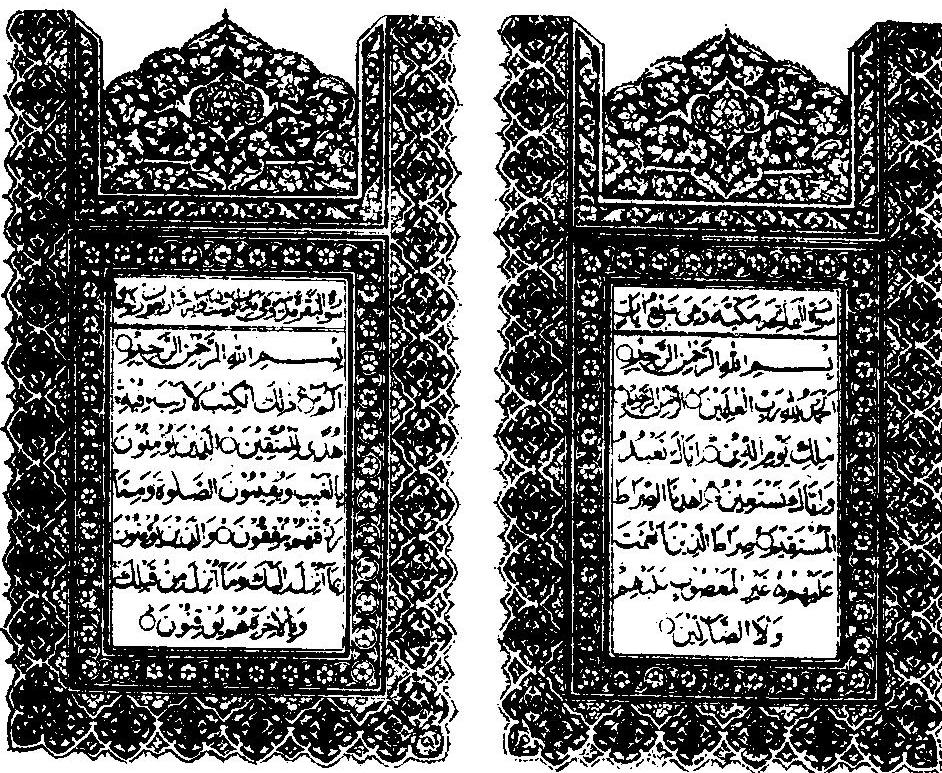
A SPECIMEN OF THE FIRST TWO PAGES OF A QUR'AN
made known to Muhammad. At first there seems to have been a season of doubt, the dread lost after all it might be a mockery. But as years rolled on, confidence in himself and in his mission came. At times, too, there is a joyousness in his utterances as he swears by heaven and earth, by God and man; but more often the visions were weird and terrible. Tradition says :— "He roared like a camel, the sound as of hells well-nigh rent his heart in pieces.' Some strange power moved him, his fear was uncontrollable. For twenty years or more the revelations came, a direction on things of heaven and of earth, to the Prophet as the spiritual guide of all men, to the Warrior-Chief, as the founder of political unity among the Arab tribes."
The whole book was not arranged until after Muhammad's death, but it is believed that the Prophet himself divided the Surahs [SURAH] and gave most of them their present titles, which are chosen from some word which occurs in the chapter. The following is the account of the collection and arrangement of the Qur'an, as it stands at present, as given in traditions recorded by al-Bukari (see Sahihu 'l-Bukhari, Arabic ed , p. 745.)
"Zaid ibn Sabit relates —' Abu Bakr sent a person to me, and called me to him, at the time of the battle with the people of Yammah; and I went to him, and 'Umar was with him; and Abu Bakr said to me, "Umar came to me and said,' Verily a great many of the readers of the Qur'an were slam on the day of the battle with the people of Yama-
mah; and really I am afraid that if the slaughter should be great, much will be lost from the Qur'an, because every person remembers something of it; and, verily, I see it advisable for you to order the Qur'an to be collected into one book.' I said to 'Umar 'How can I do a thing which the Prophet has not done?' He said, 'I swear by God, this collecting of the Qur'an is a good thing. And 'Umar used to be constantly returning to me and saying: 'You must collect th Qur'an, till at length God opened my breast so to do, and I saw what 'Umar had been advising.' And Zaid ibn Sabit says that 'Abu Bakr said to me, "You are a young and sensible man, and I do not suspect you of forgetfulness, negligence or perfidy, and verily, you used to write for the Prophet his instructions from above; then look for the Qur'an in every place and collect it.' I said "I swear by God, that if people had ordered me to carry a mountain about from one place to another, it would not he heavier upon me than the order which Abu Bakr has given for collecting the Qur'an." I said to Abu Bakr' "How do you do a thing which the Prophet of God did not?" He said, "By God, this collecting of the Qur'an is a good act." And he used perpetually to return to me, until God put it into my heart to do the thing which the heart of Abu Bakr had been set upon. Then I sought for the Qur'an, and collected it from the leaves of the date, and white stones, and the breasts of people that remembered it, till I found the last part of the chapter entitled Tauba (Repentance), with Abu Khuzaimah al-Ansari, and with no other person. These leaves were in the possession of Abu Bakr, until God caused him to die; after which 'Umar had them in his life-time; after that they remained with his daughter, Hafsah after that, 'Usman compiled them into one book.'
"Anas ibn Malik relates : 'Huzaifah came to 'Usman, and he had fought with the people of Syria in the conquest of Armenia; and had fought in Azurbaijan, with the people of al 'Iraq, and he was shocked at the different ways of people reading the Qar'an. And Huzaifah said to 'Usman, "O 'Usman, assist this people, before they differ in the Book of God just as the Jews and Christians differ, in their books." Then 'Usman sent a person to Hafsah, ordering her to send those portion which she had, and saying.'" I shall have number of copies of them taken, and will they return them to you." And Hafsah sent the portions to 'Usrnan, and 'Usman ordered Zaid ibn Sabit Ansari,and Abdu 'llah ibn az-Zubair and Sa'id ibn Ab'as, and 'Abdu 'r-Rahman Ibn al-Haris ibn Hisham ; and these were all of the Quraish tribe, except Zaid ibn Sabit and 'Usman. And he said to the three Quraishites, "When you and Zaid ibn-Thabit differ about any part of the dialect of the Qur'an then, do ye write it in the Quraish dialect because it came not down in the language of any tribe but theirs." Then they did' 'Usman had ordered.; and when a number of copies had been taken, 'Usman returned the leaves to Hafsah. And 'Usman sent a copy to every quarter of the countries of Islam, and ordered all other leaves to be burnt, and Ibn Shahab said, "Kharijah, son of Zaid Ibn Sabit, informed me, saying, I could not find one verse when I was writing the Qur'an, which, verily, I heard from the Prophet; then I looked for it, and found it with Khuzaimah, and entered it into the Suratu 'l – Ahzab.'"
This recension of the Qur'an produced by the Khalifah 'Usman has been handed down to us unaltered; and there is probably no other book in the world which has remained twelve centuries with so pure a text.
Sir 'William Muir remarks in his Life of Mahomet:-
"The original copy of the first edition was obtained from Haphsa's (Hafsah) depository, and a careful recension of the whole set on foot. In case of difference between Zaid and his coadjutors, the voice of the latter, as demonstrative of the Coreishite idiom, was to preponderate; and the new collation, was thus assimilated to the Meccan dialect, in which the Prophet had given utterance to his inspiration. Transcripts were multiplied and forwarded to the chief cities in the empire, and the previously existing copies were all, by the Caliph's command, committed to the flames. The old original was returned to Haphsa's custody.
"The recension of Othman ('Usman) has been handed down to us unaltered. .So carefully, indeed, has it been preserved, that there are no variations of importance,—we might almost say no variations at all, amongst the innumerable copies of the Coran scattered throughout the vast bounds of the empire of Islam.
"Contending and embittered factions, taking theft rise in the murder of 0thman himself within a quarter of a century from the death of Mahomet, have ever since rent the Mahometan world. Yet but one Coran has been current amongst them; and the consentaneous use by them all in every age up to the present day of the same Scripture, is an irrefragable proof that we have now before us the very text prepared by command of the unfortunate Caliph. There is probably in the world no other work which has remained twelve centuries with so pure a text. The various readings are wonderfully low in number, and are chiefly confined to differences in the vowel points and diacritical signs. But these marks were invented at a later date.
"They did not exist at all in the early copies, and can hardly be said to affect the text of Othman. Since, then, we possess the undoubted text of Othman's recension, it remains to be inquired whether that text was an honest reproduction of Abu Bakr's edition, with the simple reconcilement of unimportant variations. There is the fullest ground for believing that it was so. No early or trustworthy traditions throw suspicion of tampering with the Coran in order to support his own claims upon Othman. The
Sheeahs (Shi'ahs)* of later times, indeed pretend that Othman left out certain Suras or passages which favoured 'Ali, But this is incredible. He could not possibly have done so without it being observed at the time; and it cannot be imagined that Ali and his followers (not to mention the whole body of the Mussulmans who fondly regarded the Coran as the word of God, would have permitted such a proceeding.
"In support of this position, the follow arguments may be adduced, First: When Othman's edition was prepared, no open breech had yet taken place between Omeyads and the Alyites. The unity of Islam was still complete and unthreatened. Ali's pretensions were as yet undeveloped. No sufficient object can, therefore, be assigned for the perpetration by Othman of an offence which Moslems regard as one of the blackest dye. Second: On the other hand, Ali, from the very commencement of Othman's reign had an influential party of adherents, strong enough in the end to depose the Caliph, to storm his palace in the heart of Medina, and to put an end to his life. Can we conceive that these men would have remained quiet when the very evidence of their leader's superior claims was being openly expunged from the book of God. Third: At the time of the recension, there were still multitudes alive who had the Coran, as originally delivered, by heart and of the supposed sages favouring Ali — had any ever existed there would have been numerous transcripts, in the hands of his family and followers. Both of these sources mast have prove an effectual check upon any attempt at suppression. Fourth: The party of Ali shortly after assumed an independent attitude, and himself succeeded to the Caliphate. It is possible that either Ali, or his party, when thus arrived at power, would have tolerated a mutilated Coran—mutilated expressly to destroy his claims Yet we find that they used the same Coran as their opponents, and raised no shadow of an objection against it.
"The insurgents are indeed said to have made it one of their complaints against Othman that he had caused a new edition to be made of the Coran, and had commited all the old copies to the flames: but these proceedings were objected to simply as unauthorised and sacrilegious. . No hint was dropped of, any alteration or omission. Such a supposition, palpably absurd at the time, is altogether an after-thought of the modern Sheeas.
"We may, then, safely conclude that Othman's recension was, what it professed to be, a reproduction of Abu Bakr's edition, with a more perfect conformity to the dialect Mecca, and possibly a more uniform arrangement of its parts,—but still a faithful reproduction.
"The most important question yet remains, viz. Whether Abu Bakr's edition was itself an authentic and complete collection of Mahomet's Revelations. The following considerations warrant the belief that it was authentic and, in the main, as complete as at the time was possible.
' First. — We have no reason to doubt that Abu Bakr was a sincere follower of Mahomet, and an earnest believer it the divine origin of the Coran. His faithful attachment to the Prophet's person, conspicuous for the last twenty years of his life, and his simple, consistent, and unambitious deportment as Caliph, admit no other supposition. Firmly believing the revelations of his friend to be the revelations of God himself, his first object would be to secure a pure and complete transcript of them. A similar argument applies with almost equal force to Omar, and the other agents in the revision. The great mass of Mussulmans were undoubtedly sincere In their belief. From the scribes themselves, employed in the compilation, down to the humblest believer who brought his little store of writing on stones or palm-leaves, all would be influenced by the same earnest desire to reproduce the very words which their Prophet had declared as his message from the Lord. And a similar guarantee existed in the feelings of the people at large, in whose soul no principle was more deeply rooted than an awful reverence for the supposed word of God. The Coran itself contains frequent denunciations against those who should presume to 'fabricate, anything in the name of the Lord,' or conceal any part of that which He had revealed,. Such an action, represented as the very worst description of crime, we cannot believe that the first Moslems, in the early ardour of their faith and love, would have dared to contemplate.
"Second. — The compilation was made within two years of Mahomet's death. We have seen that several of his followers had the entire revelation (excepting, perhaps, some obsolete fragments), by heart; that every Moslem treasured up more or leas some portions in his memory; and that there were official Reciters of it, for public worship and tuition, in all countries to which Islam extended. These formed an unbroken link between the Revelation fresh from Mahomet's lips, and the edition of it by Zeid. Thus the people were not only sincere and fervent in wishing for a faithful copy of the Coran; they were also in possession of ample means for realising their desire, and for testing the accuracy and 'completeness of the volume placed in their hands by Abu Bakr.
"Third. — A still greater security would be obtained from the fragmentary transcripts which existed in Mahomet's life-time, and which must have greatly multiplied before the Coran was compiled. These were in the possession, probably, of all who could read. And as we know that the compilation of Abu Bakr came into immediate and unquestioned
* Hayatu 'l-Qulab, leaf 420: "The Ansars were ordained to oppose the claims of the family of Muhammad, and this was the reason why the other wretches took the office of Khalifah by force. After thus treating one Khalifah of God, they then mutilated and changed the other Khalifah, which is the book of God,"
use, it is reasonable to conclude that it embraced and corresponded with every extant fragment, and therefore by common consent, superseded them. We hear of no fragments, sentences, or words, intentionally omitted by the compilers, nor of any that differed from the received edition. Had any such been discoverable, they would undoubtedly have been preserved and noticed to those traditional repositories which treasured up the minutest and most trivial acts and sayings of the Prophet.
"Fourth.—The contents and the arrangement of the Coran speak forcibly for its authenticity. All the fragments that could possibly be obtained have with artless simplicity been joined together. The patchwork bears no marks of a designing genius or a moulding hand. It testifies to the faith and the reverence of the compilers, and proves that they dared no more than simply collect the sacred fragments and place them in juxtaposition. Hence the interminable repetitions; the palling reiteration of the same ideas, whet truths, and doctrines; hence, scriptural stories and Arab legends, told over and over again with little verbal variation; hence the pervading want of connection, and the startling chasms between adjacent passages. Again, the frailties of Mahomet, supposed to have been noticed by the Deity, are all with evident faithfulness entered in the Coran. Not less undisguised are the frequent verses which are contradicted or abrogated by later revelations. The editor plainly contented himself with compiling copying out in a continuous form, with scrupulous accuracy, the fragmentary materials within his reach. He neither ventured to select from repeated versions of the same incident, nor reconcile differences, nor by the alteration of a single letter to connect abrupt transitions of context, nor by tampering with the text to soften discreditable appearance. 'Thus we possess every internal guarantee of confidence.
"But it may be objected, -if the text of Abu Bakr's Coran was pure and universally received, how came it to be soon corrupted, and to require, in consequence of its variations, an extensive recension? Tradition does not afford sufficient light to determine the cause of these dincrepancies. They may have been owing to variouas readings in the so older fragmentary manuscripts which remained in the possession of the people; they may have originated in the diverse dialects of Arabia, and the different modes of pronunciation and orthography; or they may have sprung up naturally in the already vast domains of Islam, before strict uniformity was officially enforced. It is sufficient for us to know that in Othman's revision recourse had to the original exemplar of the first compilation, and that there is other wise every security, internal and external, that we possess a text the same as that which Mahomet himself gave forth and used." (Life of Mahomet, new ed., p. 557 et .seqq.)
The various readings (qira'ah) in the Qur'an are not such as are usually understood by the terms in English authors, but different dialects of the Arabic language. Ibn Abbas says the Prophet said, "Gabriel taught me to read the Qur'an in one dialect, and when I recited it he taught me to recite it in another dialects increased to seven/" (Mishkat, book ii. Ch. Ii.)
Muhammad seems to have adopted this expedient to satisfy the desire of the leading tribes to have a Qua'an in their own dialect; Abdu 'l-Haqq says, "The Qur'an was first revealed in the dialect of the Quraish, which was the Prophet's native tongue; but when the Prophet saw that the people of other tribes recited it with difficulty, then he obtained permission from God to extend its currency by allowing it to be recited in all the chief dialects of Arabia, which were:- Quraish, Taiy, Hawazin, Yaman, Saqif, Huzail, and Banu Tamim. Every one these tribes accordingly read the Qur'an in its own dialect, till the time of 'Usman, when these differences of reading were prohibited."
These seven dialects are called in Arabic Saba'tu, Ahruf, and in Persian Haft Qira'at.
The Qur'an, which is written in the Arabic language, is divided into Harf, Kalimah, Ayah, Surah, Ruku', Rub', Nisf, Suls, Juz', Manzal
1. Harf (pl. Huruf), Letters; of which there are said to be 328,671, or according to some authorities, 338,606.
2. Kalimah (pl. Kalimat), Words; of which there are 77,984, or, according to some writers, 79,934.
3. Ayah (pl. Ayat), Verses. Aye/I (Heb.  is a word which signifies "sign." It was used by Muhammad for short sections or verses of his supposed revelation. The division of verses differs in different editions of the Arabic Qur'an. The number of verses in Arabic Qur'ans are recorded after the title of the Surah, and the verses distinguished in the text by a small cypher or circle. The early readers of the Qur'an did not agree as to the original position of these circles, and it happens that there are five different systems of numbering the verses.
(a) Kufah verses. The Readers in the city of al-Kufah say that they followed the custom 'Ali. Their way of reckoning is generally adopted in India. They reckon 6,239 verses.
(b) Basrah verses. The Readers of al-Basrah follow Asim ibn Hajjaj, a Companion. They reckon 6,.204.
(c) Shami verses. The Readers in Syria (Sham) followed 'Abdu 'llah ibn 'Umar, a Companion. They reckon 6,225 verses.
(d) Makkah verses. According to this arrangement, there are 6,219 verses.
(e) Madinah verses. This way of reading contains 6,211 verses.
4. Surah (pl. Suwar), Chapters A word which signifies a row or series, but which
is now used exclusively for the chap the Qur'an, which are one hundred and fourteen in number. These chapters are called after some word which occurs in the text, and if the Traditions are to be trusted, they were so named by Muhammad himself, although the verses of their respective Surahs were undoubtedly arranged after his death, and sometimes with little regard to their sequence. Muslim doctors admit that the Khalifah 'Usman arranged the chapters in the order in which they now stand in the Qur'an.
The Surahs of the Muhammadan Qur'an are similar to the forty-three divisions of the
the Law amongst the Jews known as  Sidarim,
or "orders". These were likewise named after a word in the section,
e.g. The first is Bereshith, the second Noah, &c. (See Buxtorf's Tiberias p. 181.)
Sidarim,
or "orders". These were likewise named after a word in the section,
e.g. The first is Bereshith, the second Noah, &c. (See Buxtorf's Tiberias p. 181.)
Each Surah of the Qur'an, with the exception of the IXth begins with the Words....

"ln the name of the Merciful, the Compassionate."
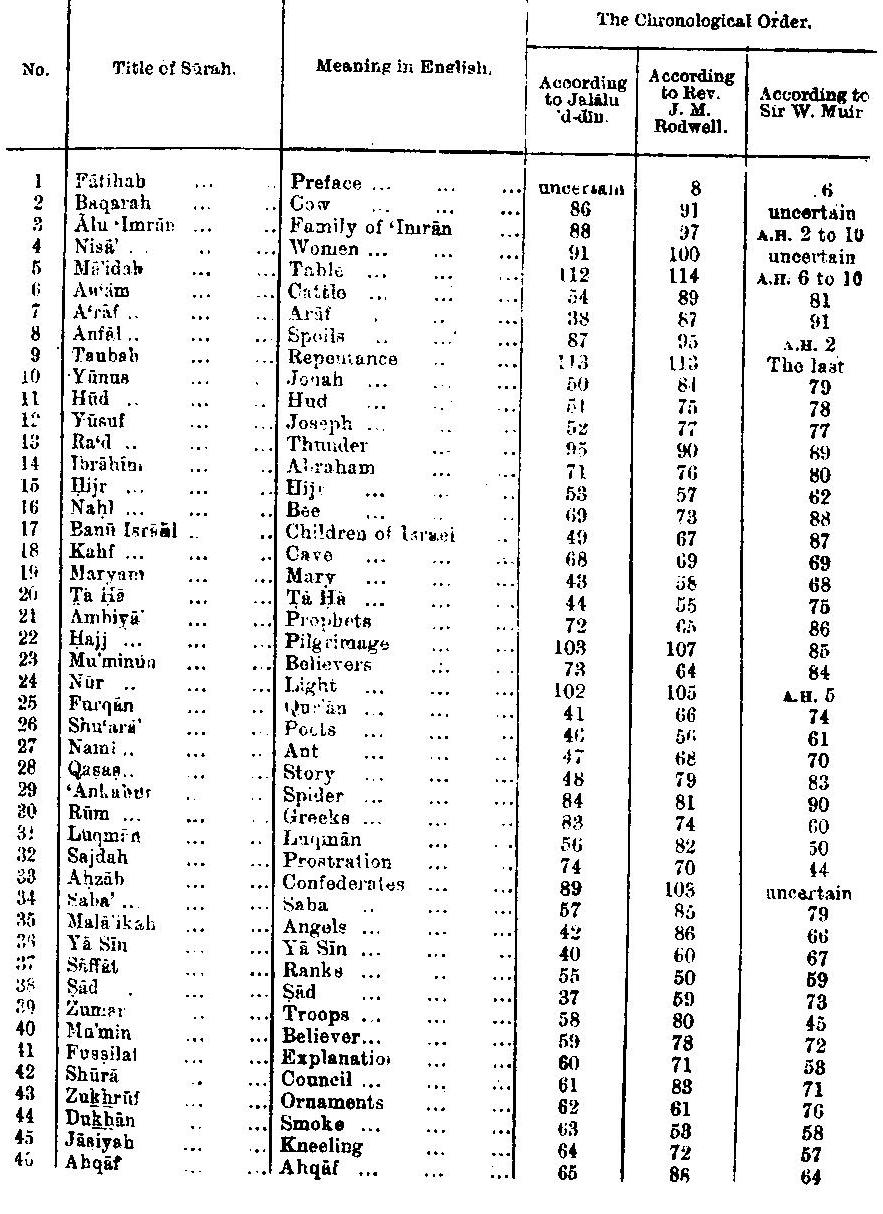
The Surahs, as they stand in Arabic editions of the Qur'an, are as follow:-
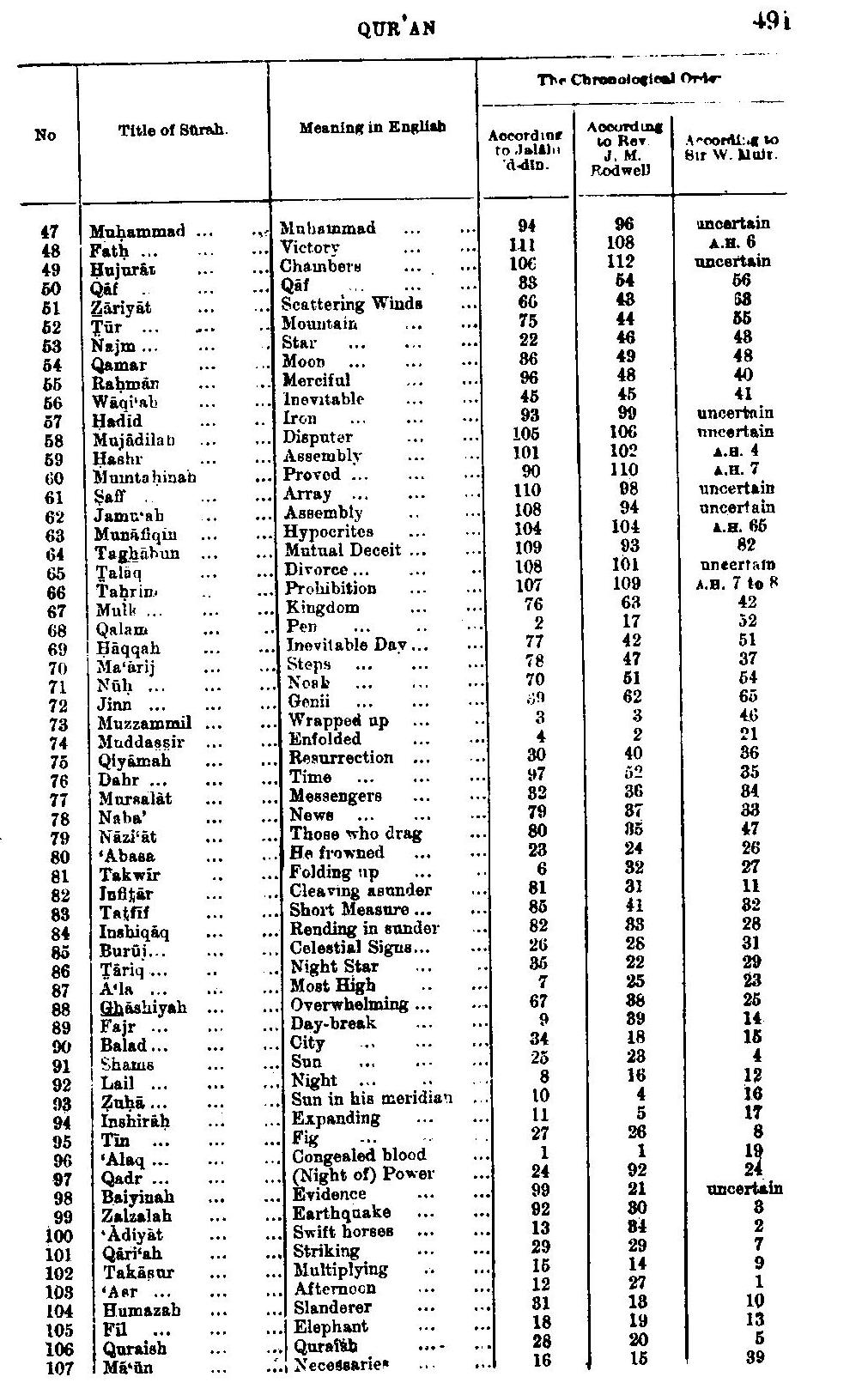
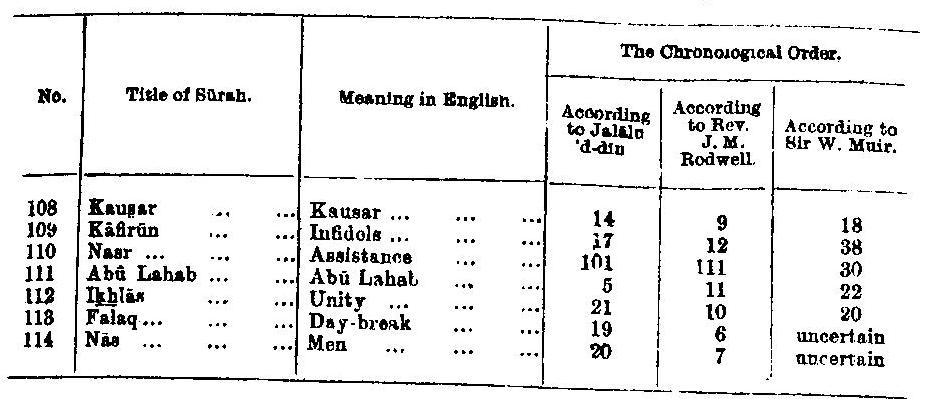
5. Ruku'. (pl. Ruku'at), an inclination of the head or bow. These are sections of about ten verses or less, at which the devout Muslim makes a bow of reverence; they are marked in the margin of the Qur'an with the letter  with the number of the ruku' over it. Muhammadans generally quote their Qur'an by the Juz' or Siparah and the Ruku'.
6. Rub'.. The quarter of a Juz', or Siparah.
7. Nisf. The half of a Siparah.
8. Suls. The three-quarters of a Siparah. These three divisions are denoted by the words being written on the margin.
9. Juz' (pl. Ajza') Persian Siparh. Thirty divisions of the Qur'an which have been made to enable the devout Muslim to recite the whole of the Qur'an in the thirty days of Ramadan. Muhammadans usually quote their Qur'an by the Siparah or Juz' and not by the Surah.
10. Manzil (pl. Manazil, Stages). These are seven in number, and are marked by the letters , which are said to spell Fami bi Shauq, "My mouth with desire." This arrangement is to enable the Muslim to recite the whole in the course of a week.
In the Arabic Qur'an, the Surahs are placed as they were arranged by Zaid ibn Sabit, who seems to have put them together regardless of any chronological sequence. The initial, or opening prayer, stands first, and then the longest chapters. But the Muhammadan commentators admit that the Qur'an is not chronologically arranged; and Jalalu'd-din, in his Itqan, has given a list of them as they are supposed to have been revealed. This list will be found under the Divisions of the Qur'an in the present article. And, what is still more confusing, all Muhammadan doctors allow that in some of the Surahs there are verses which belong to a different date from that of other portions of the chapter; for example, in the Suratu 'l-'Alaq, the first five verses belong to a much earlier date than the others; and in Suratu 'l-Baqarah, verse 234 is acknowledged by all commentators to have been revealed after verse which it abrogates.
If we arrange the Surahs or Chapters according to the order given in Suyuti's Itqan, or by Sir William Muir, or by Mr Rodwell, we cannot fail to mark the gradual development of Muhammad's mind from that of a mere moral teacher and reformer to that of a prophet and warrior-chief. The contrast between the earlier, middle, and later Surahs is very instructive and interesting.
In the earlier Surahs we observe a predominance of a poetical element, a deep appreciation of the beauty of natural objects, fragmentary and impassioned utterances; denunciation of woe and punishment being expressed in these earlier Surahs with extreme brevity.
"With a change, however, in the position of Muhammad when he openly assumes the office of 'public warner,' the Surahs begin to wear a more prosaic and didactic tone, though the poetical ornament of rhyme is preserved throughout. We lose the poet in the missionary aiming to convert, and in the warm asserter of dogmatic truths; the descriptions of natural objects, of the Judgment, of Heaven and Hell, make way for gradually increasing historical statements, first from Jewish, and subsequently from Christian histories; while in the twenty-nine (thirty?) Surahs revealed at Medina we no longer listen to vague words often, as, it would seem, without definite aim, but to the earnest disputant with the opponents of the new faith, the Apostle pleading the cause of what be believes to be the truth of God. He who at Mecca is the admonisher and persuader, at Medina is the legislator and the warrior dictating obedience, and who uses other weapons than the pen of the poet and the scribe; while we are startled by finding obedience to God and the Apostle. God's gifts and the Apostle's. God's pleasure and the Apostle's, spoken of in the same breath, and epithets and attributes elsewhere applied to Allah openly applied to himself, 'Whose obeyeth the: Apostle obeyeth Allah.'"
"The Suras, viewed as a whole, will appear to be the work of one who began his career as a thoughtful inquirer after truth
and as an earnest assertor of it In such rhetorical and poetical forms as he deemed most likely to win and attract his countrymen, but who gradually proceeded from the dogmatic teacher to the political founder of a system for which laws and regulations had to be provided as occasions arose. And of all the Suras, it must be remarked that they intended not only for readers but for hearers —- that they were all promulgated by public recital — and that much was left, as the imperfect sentences show, to the, manner and suggestive action of the reciter." (Rodwell's Preface to the Qur'an.)
The absence of the historical element from the Qur'an, as regards the details of Muhammad's daily life, may be judged of by the fact that onliy two of his contemporaries (Abu Lahab and Zaid) are mentioned in the entire volume, and that Muhammad's name occurs but five times, although he is all the way through addressed by the angel Gabriel as the recipient of the divine revelations, with the word "Say." Perhaps also such passages as Surah ii., verses 5, 246, and 274, and the constant mention of guidance, direction, wandering, may have been suggested by reminiscences of his mercantile journeys in his earlier years.
Sir William Muir has very skillfully arranged the Surahs into six periods. (See Coran S.P.C.K. ed), and although they are not precisely in the chronological order given by Jalalu 'd-Din in his ltqan, the arrangement seems to be fully borne out by internal evidence. With the. assistance of Prof. Palmer's "Table of Contents" slightly altered (The Qur'an, Oxford ad. 1880), we shall arrange the contents of the Qur'an according to thee periods.
Eighteen Surahs, consisting of short rhapsodies may have been composed by Muhammad before he conceived the idea of a divine mission, none of which are in the form, of message from the Deity.
A short chapter of one verse an follows :-.
"By the afternoon! Verily, man is in loss! Save those who believe and do right and bid each other be true, and bid each other be patient."
Oath by the charging of war-horses.
Man is ungrateful.
Certainty of the Judgment.
The earthquake preceding the Judgment Day.
Purity of the soul brings happiness.
Example of Samud.
(The latter verses are dearly of a later date than the first ten.)
The Quraish are bidden to give thanks to God for the trade of their two yearly caravans.
A prayer for guidance.
(This short chapter, which is the opening chapter of' the Qur'an, is recited in the liturgy.)
"Praise be to God, Lord of all the worlds!
The compassionate, the merciful!
King of the day of reckoning!
Thee only, do we worship, and to Thee only do we cry for help.
Guide Thou us in the straight path, The path of those to whom Thou hast been gracious;
With whom Thou art not angry, And who go not astray.."
The terrors of the last day and of hell fire (al-Hawiyah)
The degradation of man.
Future reward and punishment.
Two families of the Arabs rebuked for contending which was the more numerous.
Warning of the punishment of hell.
Backbiters shall be cast into hell.
Signs of the Judgment Day.
Guardian angels.
Promise of reward to those who give alms and fear God and "believe in the best."
The miraculous destruction of the Abyssinian army under Abrahatu 'l-Ashram by birds when invading Makkah with elephants, in the year that Muhammad was born.
Fate of previous nations who rejected their
teachers.
Admonition to those who rely too much on
their prosperity.
Exhortation to practise charity.
Muhammad encouraged and bidden to remember how God has cared for him hitherto; he is to be charitable, in return, and to publish God's goodness.
God has made Muhammad's mission easier to him.
Muhammad is commanded to offer the
sacrifices out of his abundance.
Threat that his enemies shall he childless.
Four Surahs. The opening of Muhammad's Ministry. Surah xcvi. contains the command to recite, and, according to the Traditions, it was the first revelation.
Muhammad's first call to read the Qur'an.
Denunciation of Abu Lahab for his opposition.
(The latter verses of this Surah are admitted to be of a later date than the former.)
Declaration of God's unity.
(This short Suruh is highly esteemed, and recited in the daily liturgy.)
"Say: He is God alone:
God the Eternal!
He begetteth not,
And is not begotten;
And there is none like unto Him."
Muhammad while covered up is bidden to
arise and preach.
Denunciation of a rich infidel who mocks
at the revelation.
Hell and its nineteen angels.
The infidels rebuked for demanding material scriptures as a proof of Muhammad's
mission.
Denunciation ,of Abu Lahab and his wife, who are threatened with hell fire.
Nineteen Surahs, chiefly descriptions of the Resurrection, Paradise, and Hell, with reference to the growing opposition of the Quraish, given from the commencement of Muhammad's public ministry to the Abyssinian emigration.
Muhammad shall not forget any of the
revelation save what God pleases.
The revelation is the same as that given to
Abraham and Moses.
Tbe Qur'an revealed on the night of
power.
Its excellence.
Angels descend thereon.
Description of the Last Day, Heaven and Hell.
The Prophet rebuked for frowning on a
poor blind believer.
The Creation and Resurrection
Signs of the Judgment Day.
The books of men's actions.
The Resurrection.
Denunciation of misbelievers.
Terrors of the Judgment Day.
The female child who has been buried alive will demand vengeance.
Allusion to the Prophet's vision of Gabiel
on Mount Hira'.
He is vindicated from the charge of
madness.
By the night-star, every soul has a guardian angel.
Creation and resurrection of man.
The plot of the infidels shall be frustrated.
Prophecy that men shall join Islam troops.
Denunciation of those who persecute believers.
Example of the fate of Pharaoh and Samud.
Fraudulent traders are warned.
Sijjin, the register of the act's of the wicked.
Hell and heaven.
Description of the Day of Judgment, hell and heaven.
Oath by the angels who execute God behests.
Terrors of the Last Day.
Roll and Heaven.
Man's conception and birth.
Unbelievers warned and believers promise a reward.
Exhortation to charity.
Bliss of the charitable in Paradise.
The Qur'an revealed by degrees.
Only those believe whom God wills.
The Resurrection.
Muhammad is bidden not to be hurried in repeating the Qur'an so as to commit
it to memory.
Dying agony of an infidel.
An unbeliever mockingly calls for a judgment on himself and his companions.
The terrors of the Judgment Day.
Man's ingratitude.
Adultery denounced.
Certainty of the Judgment Day.
The Prophet will not follow the religion of the misbelievers.
Denunciation of the unbelieving and uncharitable.
An enumeration of the works of the Lord ending with a description of Paradise and Hell.
A refrain runs throughout this chapter:-
"Which then of your Lord's bounties do ye I wain deny?"
Terrors of the inevitable Day of Judgment.
Description of Paradise and Hell.
Proofs in Nature.
None but the clean may touch the Qur'an.
The condition of a dying man.
Twenty-two Surahs, given from the sixth to the tenth year of Muhammad's ministry. With this period begin the narratives of the Jewish Scriptures, and Rabbinical and Arab legends. The temporary compromise with idolatry is connected with Surah liii.
God the Lord of heavens.
Oath by the star that Muhammad's vision of his ascent to heaven was not a delusion.
Rebuke of an apostle who paid another to take upon him his burden at the Judgment Day.
The Qur'an is truth from the Lord.
Rebuke to the idolaters who say they
serve false gods as a means of access to God
himself.
Muhammad, when wrapped up in his
mantle, is bidden to arise and pray.
The coming of the Day of Judgment.
The splitting asunder of the moon.
The omniscience of God.
The affluence of the Makkans will only increase their ruin.
The Qur'an a guidance to believers.
The inevitable judgment.
Muhammad is neither mad nor an imposter.
The Makkans are called on to believe the Qur'an.
Noah's preaching to the Antediluvians.
Oath by Mount Sinai and other things.
Proofs in nature of a future life.
God revealed in nature.
Night of the revelation of the Qur'an.
Threat of the Last Day, when a smoke shall cover the heavens, and the unbelievers shall be punished for rejecting the Prophet, and saying he is taught by others or distracted.
Oath by the angels ranged in rank, by those who drive the clouds, and by those who rehearse the Qur'an, that God is alone!
Victory of the Persians over the Greeks.
Muhammad is not to be vexed by the people's unbelief.
Misbelievers will one day regret their misbelief.
Oaths by different natural phenomena that the Judgment Day will come.
Thirty-one Surahs. From the tenth year of Muhammad's ministry to the flight from Makkah.
The Surahs of this period contain some narratives from the gospel. The rites of pilgrimage are enjoined. The cavillings of Quraish are refuted; and we have vivid picturings of the Resurrection and Judgment, Heaven and hell, with proof's of God'e unity, power and providence.
From, stage to stage the Surahs become, on the average, longer, and some of them
Now fill many pages. In the latter Surahs of this period, we meet not unfrequently with Madinah passages, which have been interpolated as bearing on some connected subject. As examples may be taken, verse 40 of Surah xiii., in which permission is given to bear arms against the Makkans; verse 33, Surah xvii., containing rules for the administration of justice; verse 111, Surah xvi., referring to such believers as had fled their country and fought for the faith;' being all passages which could have been promulgated only after the Flight to al-Madinah.
God the only God and Creator.
A crowd of jinns listen to Muhammad's teaching at NakIah.
Praise of God, who makes the Angels his messengers.
punishment of bell for the infidels.
Muhammad is Gods messenger, and the Qur'an Is a revelation from God to warn a heedless people.
Zachariah prays for an heir.
The Qur'an is a warning especially to those who say God has begotten a son.
Builds a rampart to keep in Gog and Magog.
The Qur'an a guidance to believers.
The Qur'an inspired by God to warn the Mother of cities of the judgment to come.
Attributes of God.
Oath by the Qur'an.
Fate of the people of Noah, 'Ad, Pharaoh, Samud, and Lot.
The Discrimination sent down as a warning that God is one, the Creator and Governor
of all; yet the Makkans call it old folks' tales.
The Qur'an a reminder from the Merciful, who owns all things and knows all things.
The fate of those of yore a sufficient sign.
The original of the Qur'an is with God.
The Qur'an revealed in Arabic that the Makkans may understand.
The Qur'an a book calling men to believe in the unity of God.
Salih was sent to Samud.
No wonder that the Qur'an was revealed to a mere man.
The Qur'an revealed to bring men from darkness Into light.
Light and darkness are both created by God.
If the Prophet had. been an angel, he would have come in the guise of a man.
God the Creator.
The history of Moses and Pharaoh.
His punishment.
The humble, chaste, and honest, shall prosper.
Terrors of the Last Day, yet men dispute about God and follow devils.
Men mock at the revelation.
creation of the night and day, and of the sun and moon, are signs.
Allusion to the night journey from the Sacred Mosque (at Makkah) to the Remote Mosque (at Jerusalem).
God's decree will come to pass.
The creation and ordering of objects are signs of His power.
The Qur'an a revelation from the Lord, the Creator and Governor of all.
Believers must he proved.
'Ad and Samud.
Muhammad is bidden to accept the Qur'an fearlessly.
The Prophet seeks refuge in God from the devil and his evil influences.
The Prophet seeks refuge in God from the
devil and his evil suggestions.
Twenty Surahs given at al-Madinah.
The Chapter of the Manifest Sign.
Rebuke to Jews and Christians for doubting the manifest sign of Muhammad's mission.
The Qur'an a guidance.
A parable of one who kindles fire.
God's unity and self-subsistence.
Spoils belong to God and the Apostle.
Rebuke of the idolators for mocking the Muslims at prayer.
Promise of reward to believers.
God has sent the illiterate prophet.
Believers are to fulfill their compacts.
The Apostles ask for a table from heaven as a sign.
The chastisements of the Jews who would not believe in the Qur'an.
God creates and watches over man.
Abolition of the idolatrous custom of divorcing women with the formula, "Thou art to me as my mother's back."
The laws of divorce.
The treacherous designs of the hypocrites.
(This chapter deals with the accusation of unchastity against 'Ayishah.)
Punishment of the whore and the whore-monger.
Vindication of 'Ayishah's character and denunciation of the accusers.
Muhammad is warned against the hypocrites.
God the controller of all nature.
Believers are bidden to keep their word and to fight for the faith.
Announcement of a victory.
Exhortations to the Muslims not to treat secretly with the Quraish.
The Prophet is relieved from a vow he made to please his wives.
(This chapter is without the initial formula, "In the name of the Merciful," &c.)
Rebuke to some of the Muslims who had presumed too much in the presence of the Apostle, and of the others who had called out rudely to him.
All sacrifices for the sake of the religion are counted to them.
Muhammadanism owes more to Judaism (see a book by M. Geiger, entitled, Was hat Muhammed aus dem Judenthume aufgenommen in which that learned Jew has traced all the leading features of Islam to Talmudic source also Literary Remains of Emanuel Deutsch, Essay on Islam; also article on JUDAISM in the present work) than it; does to either Christianity or Sabeaniem, for it is simply Talmudic Judaism adapted to Arabia, plus the Apostleship of Jesus and Muhammad; and wherever Muhammad departs from the monotheistic principles of Judaism, as in the idolatrous practices of the Pilgrimage to th Ka'bah, it is evident that it is done as a necessary concession to the national feelings and sympathies of the people of Arabia, and it is absolutely impossible for Muhammadan divines to reconcile the idolatrous rites of thi Ka'bah with that simple monotheism which it was evidently Muhammad's intention to establish in Arabia.
"The sources (say Mr. Rodwell) whence Mohammad derived the materials of his Koran, are, over and above the more poetcal parts which are his own creation, the legend of his time and country, Jewish tradition based upon the Talmud, and the Christian traditions of Arabia and of S. Syria. At a later period of his career, no one would venture to doubt. the divine origin of his whole book. But at its commencement the case was different. The people of Mecca spoke openly and tauntingly of it as the work of a poet, as a collection of antiquated or fabulous legends, or as palpable sorcery They accused him of having confederates, and even specified foreigners who had been his coadjutors. Such were Salman the Persian (Salman al-Farisi), to whom he may have owe the descriptions of heaven and hell, which are analogous to those of the Zendavesta and the Christian monk Sergius, or, as the Muhammadans term him, Boheira (Buhairah).
From the latter and perhaps from other Christians, especially slaves naturalized at Mecca, Muhammad obtained access to the teaching of the Apocryphal Gospels, and to many popular traditions of which those gospels are the concrete expression. His wife Chadijah (Khadijah), as well as her cousin Waraka (Waraqah), a reputed convert to Christianity, and Muhammad's intimate friend, are said to have been well acquainted with he doctrines and sacred books, both of Jews and Christians. And not only were several Arab tribes in the neighbourhood of Mecca converts to the Christian faith, but on two occasions Muhammad had travelled with his uncle Abu Talib, as far as Bostra where
be must have had opportunities of learning the general outlines of Oriental Christian doctrine, and perhaps of witnessing the ceremonial of their worship.
"It has been supposed that Muhammad derived many of his notions concerning Christianity from Gnosticism and that it is to the numerous Gnostic sects the Koran alludes when it reproaches the Christians with having 'split up their religion into parties.' But for Muhammad thus to have confounded Gnosticism with Christianity itself, its prevalence in Arabia must have been far more universal than we have reason to believe that it really was. In fact, we have no historical authority for supposing that the doctrines of these heretics were taught or professed in Arabia at all. It is certain, on the other hand, that the Basilidans, Valentinians, and other Gnostic sects had either died out, or been reabsorbed into the Orthodox Church, towards the middle of the fifth century, and had disappeared from Egypt before the sixth. It remains possible, however, that the Gnostic doctrine concerning the Crucifixion may have been adopted by Muhammad as likely to reconcile the Jews to Islam, as a religion embracing both Judaism and Christianity, if they might believe, that Jesus had not boon put to death, and thus find the stumbling block of the Atonement removed out of their path. The Jews would, in this case, have simply been called upon to believe in Jesus as a divinely born and inspired teacher, who, like the patriarch Enoch, or the prophet Elijah, had been miraculously taken from the earth. But, in all other respects, the sober and matter-of-fact statements of the Koran, relative to the family and history of Jesus, are opposed to the wild and fantastic doctrines of Gnostic emanations, and especially to the manner in which they supposed Jesus, at his baptism, to have been brought into union with a higher nature. It is more clear that Muhammad borrowed in several points from the doctrines of the Ebionites, Essenes, and Sabeites. Epiphanius describes the notions of the Ebionites of Nabathaea, Moabites, and Baeanitea, with regard to Adam Jesus, almost in the very words of Sura iii. 52. He tells us that they observed circumcision, were opposed to celibacy, forbade turning to the sunrise, but enjoined Jerusalem as their Kebla (Qiblah), (as did Muhammad during twelve years), that they prescribed (as did the Sabeites) washings, very similar to those enjoined In the Koran, and allowed oaths (by certain natural objects, as clouds, signs of the Zodiac, oil, the winds, etc.), which also we find adopted therein. These points of contact with Islam, knowing as we do Muhammad's eclecticism, can hardly be accidental.
"We have no evidence that Muhammad had access to the Christian scriptures, though it is just possible that fragments of the Old or New Testament may have reached him through Chadijah or Waraka, or other Meccan Christians, possessing MSS. of our sacred volume. There is but one direct quotation
(Sura xxi. 105) ln the whole Koran from the scriptures; and though there are a few passages, as where alms, are said to be given to be seen of men and as, none forgiveth sins but
God only, which might seem to be identical with texts of the New Testament, yet this similarity is probably merely accidental. It is, however, curious to compare such passages as Deut. xxvi. 14, 17, and 1 Peter v. 2, with Sura xxiv. 50, and Sura x. 73 — John vii. 15, with the 'illiterate' prophet — Matt. xxiv. 36, and John xii. 27, with the use of the word hour, as meaning any judgment or crisis, and the last Judgment — the voice of the Son of God which the dead are to hear, with the exterminating or awakening cry of Gabriel, etc. The passages of this kind, with which, the Koran abounds, result from Muhammad's general acquaintance with scriptural phraseology, partly through the popular legends, partly from personal intercourse with Jews and Christians. And we may be quite certain that, whatever materials Muhammad may have derived from our Scriptures, directly or indirectly, were carefully recast.
"It should also he borne in mind that we have no clear traces of the existence of Arabic versions of the Old or New Testament previous to the time of Muhammad. The passage of St. Jerome— ' Haec autem translatio nullum do veteribus sequitur interpretem; sed ex ipso Hebraico, Arabicoque sermone, et interdum Syro, nunc verba, nunc sensum, nunc simul utrumque resonabit' (Prol. Gal.), obviously does not refer to versions, but to idiom. The earliest Ar. version of the Old Testament of which we have any knowledge is that of R. Saadias Gaon. A.D. 900: and the oldest Ar. version of the New Testament is that published by Erpenius in 1616, and transcribed in the Thebais, in the year 1271, by a Coptic bishop, from a copy made by a person whose name is known, but whose date is uncertain. Michaslis thinks that the Arabic versions of the New Testament were made between the Saracen conquests in the seventh century and. the Crusades in the eleventh century — an opinion in which he follows, or coincides with, Walton (Prol. in Polygi. § xiv.), who remarks —— ' Plane consist versionem Arabicam apud eas (ecclesias orientales) factam esse postquam lingua Arabica per victorias et religionem Muhammedanicam per Orientem propagata fuerat, et in multis locis facta esset vernacula.' If, indeed, in those comparatively late versions, the general phraseology, especially in the histories common to the Scriptures and to the Koran, bore any similarity to each other, and if the orthography of the proper names had been the same in each, it might have been fair to suppose that such versions had been made, more or less, upon the basis of others, which, though now lost, existed in the ages prior to Muhammad, and influenced, if they did not directly form, his sources of information. But this does not appear to be the case. The phraseology of our existing versions is not that of the Koran, and the versions as a whole appear to, have been made from the
Septuagint, the Vulgate, Syriac, Coptic, and Greek; Tischendorf, indeed, says that the four Gospels originem mixtam haberere videntur but the internal evidence is clearly in favour of the Greek origin of the Arabic Gospels. This can be seen in part even from the order of the words, which was retained, like that of the Greek, so far as possible, even in such constructions and transpositions of words as, violate the rules of Arabic Syntax.
"From the Arab Jews, Muhammad would be enabled to derive an abundant though distorted knowledge of the Scripture histories," The secrecy in which ho received his instructions from them and from his Christian informants, enabled him boldly to declare to the ignorant pagan Meccans that God had revealed those Biblical histories to him. But there can be no doubt, from the constant identity between the Talmudic perversions of Scripture histories and the statements of the, Koran, that the Rabbis of Hijaz communicated their legends to Muhammad. And it should be remembered that the Talmud was completed a century previous to the era of':
Muhammad, and cannot fail to have extensively influenced the religious creed of all the Jews of the Arabian peninsula. In one passage, Muhammad speaks of an, individual Jew — perhaps some one of note among his professed followers, as a witness to his mission; and there can be no doubt that his relations with the Jews were, at one time, those of friendship and intimacy, when we find him speaking of their recognizing him as they do their own children, and blaming their most colloquial expressions. It is impossible, however, for us at this distance of time to penetrate the mystery in which this subject is involved. Yet certain it is, that, although their testimony against Muhammad was speedily silenced, the Koreish knew enough of his private history to disbelieve and to disprove his pretensions of being the recipient of a divine revelation, and to accuse him of writing from the dictation of teachers morning and evening. And it is equally certain that all the information received by Muhammad was embellished and recast in his own mind and with his own words. There is a unity of thought, a directness and simplicity of purpose, a peculiar and labourod style, a uniformity of diction, coupled with a certain deficiency of imaginative power, which indicate that the ayats (signs or verses) of the Koran are the product of a single mind. The longer narratives were, probably, elaborated in his leisure hours, while the shorter verses, each proclaiming to be a sign or miracle, were promulgated as occasion required them. And, whatever Muhammad may himself profess in the Koran as to his ignorance even of reading and writing, and however strongly, modern Muhammadans may insist upon the, same point — an assertion, by the way, contradicted by many good authors —— there can be no doubt that to assimilate and work up his materials, to fashion them into elaborate Suras, and to fit them for public recital, must have been a work requiring much time, study, and medi-
tation, and presumes a far greater degree of general culture than any orthodox Muslim will be disposed to admit." (The Preface to Rodwell's El-Koran, p. xvi. et seq.)
TiIawah
The reading or recital of the Qur'an should commence with legal ablution and prayer. The usual prayer is, "I seek protection from God against the cursed Satan!" which is followed by the invocation. "In the name of God the Merciful, the Compassionate !"
The mosque is considered the most suitable of all places in which to read the Qur'an, and the most auspicious days of the week are Friday, Monday, and Thursday. The ordinary time allowed for reading the Qur'an through is forty days, although by reciting a juz or siparah daily, it can be 'done in thirty days, which is said to have been the custom of the Prophet. Some read it through by manzils, or stages, Of which there are seven, which is done in a week. On no account should it be read through in less than three days, for which there is a three-fold, division known in Persian as the Khatam-i-Manzil-Fil, the initial letters of each portion
Ejaculations, or responses, are made at certain places. For example, at the end of the Suratu 't-Fatihah (i ) and of the Suratu 'I-Baqarah (ii) say, " Amen'" At the end of the Suratu Bani Isra'il (xvii), say, "God is great!" After the last verse of the Suratu 'I-Qiyanab (lxxv), say, "Is He not powerful enough to raise the dead? Say, Yes, for He is my Lord Most High!" At the end of the-Suratu 'l-Mulk (lxvii), say, "God brings it (clear water) to us and He is Lord of all the Worlds!"
In addition to responses to be made after each Surah, or Chapter, there are certain ejaculations to be made after certain verses, for example, after the sixteenth verse of the third Surah, " There is no God but He, the Mighty, the Wise!" say, "I am a witness to this!"
There are fourteen verse's known as the Ayatu 's-Sajdah, after which a prostration is made. They are Surahs vii. 205; xiii. 16; xvi. 51; vii. 109; xix. 59; xxii. 19; xxv. 61; xxvii. 26; xxxii. 15; xxxviii. 24; xli. 38; liii. 62; lxxxiv. 20; xcvi. 18.
There are numerous instructions given as pronunciation, and there have arisen seven schools of pronunciation, which are known as
those of the Qur'an's 's-Sabrah, or "seven readers" (for a list of these readers, see Qari) It is considered quite lawful to recite the Qur'an according to the pronunciation established by any one of these seven worthies.
There are many marks and symbols on the margin of an Arabic Qur'an. Mr. Sell in his Ilm i Tajwid,
gives them in detail. (Ilm i Tajwid, Keys & Co., Madras, 1852.) The symbol for full stop is
There are twenty-nine Surahs of the Qur'an which begin with certain letters of the alphabet. These letters the learned say, have some profound meaning, known only to the Prophet himself, although it seems probable that they are simply marks recorded by the amanuensis.
(1) Six Surahs begin with the letter Alif, Lam, Mim .
(2) At the commencement of Suratu 'l-A'raf (vii.), there is Alif, Lam, Mim, Sad
(3) The Suratu r-Ra'd (xiii.) begins with the letters Alif, Lam, Mim, Ra.
(4) Five Surahs begin with Alif, Lam, Ra.
(5) The Suratu Maryam (xix.) begins with the letters Kaf, Ha, Ya, 'Ain, Sad. KHY'AS, which Ibn 'Abbas says stand for five attributes of, the Almighty: Karim; "Gracious"; Hadi, "Guide"; Hakim (taking the middle letter), "Wise"; 'AIim, "Learned "; Sadiq, "Righteous."
(6) The Suratu TH (xx.), as its title implies, begins with the letters Ta Ha
"Pure": Hadi, "Guide"; being attributes of God.
(7) Six Surahs commence with the letters Ha Mim
(8) The Suratu 'sh-Shura (xlii.) begins with Ha Mim 'Ain Sin Qaf
(9) The Suratu YS (xxxvi.), as its title implies, begins with the letters Ya Sin
(10) The Suratu S (xxxviii), as its title signifies, begins with the letter Sad
(11) The Suratu Q (I.), as its name implies, begins with the letter Qaf
(l2) The Suratu 'l-Naml (xxvii.) begins with the letters Ta Sin
(18) Two Surahs, namely ash-Shu'ara' (xxvi.), and al-Qasas (xxviii.), begin with Ta Sin Mim
(14) The Suratu 'l-Qalam (lxviii.) begins with Nun,
'Ibnu 'l-Usil
The words (aIfaz) of the Qur'an are of four classes: Khass, 'Amm, Mushtarak, and Mu'awwal.
(1) Khass, Words used in a special sense.
This speciality of sense is of three, kinds: Khususu 'l-jinns., Speciality of genus, e.g. mankind; Khususu 'n-nau, Speciality of species, e.g. a man; khususu 'l-'ain, Speciality of an individual, e.g. Muhammad.
(2) 'Amm, Collective or common, which embrace many individuals or things, e.g. people.
(3) Mushtarak, Complex words which have
several significations: e.qg 'ain, a word which signifies an Eye, a Fountain, the Knee, or the Sun.
(4.) Mu'awwal, words which have several significations, all of which are possible, and so a special explanation is required. For example, Surah cviii. 2, reads thus in Sale's translation. "Wherefore pray unto the Lord and slay (the victims)". The word translated "slay" is in Arabic inhar, from the roor, nahr, which has several meanings. The followers of the great Legist, Abu Hanifah, render it "sacrifice," and add 'the words (the "victims"). The followers of Ibn Ash Shafi'i say it means "placing the hands on the breast in prayer."
II. The Sentences ('Ibarah) of the Qur'an are either Zahir or Khaf'I i.e., either Obvious or Hidden.
Obvious sentences are of four classes:- Zahir, Nass, Mufassar, Muhkam.
(1.) Khahir.—Those sentences, the meaning of which is Obvious or clear, without any assistance from the context (qrarinah).
(2.) Nass. a word commonly used for a text of the Qur'an, but in its technical meaning here expressing what is meant by a sentence, the meaning of which is made clear by some word which occurs in it. The following sentence illustrates both Zahir and Nass:
"Take in marriage of such other women as please you, two, three, four." This sentence is Zahir, because marriage is here declared lawful; it is Nass, because the words "one, two, three, four," which occur in the sentence, show the unlawfulness of having more
than four wives.
(3.) Mafassar, or explained. A sentence which needs some word in it to explain it and make it clear. Thus: "And the angels prostrated themselves, all of them with one accord, save Iblis (Satan)." Here the words save Iblis" show that he did not prostrate himself. This kind, of sentence may be abrogated.
(4.) Muhkam, or perspicuous. A sentence as to the meaning of which there can be no doubt, and which cannot be controverted, thus: "God knoweth all things." This kind of sentence cannot be abrogated. To act on such sentences without departing from the literal sense is the highest degree of' obedience to God's command.
The difference between these sentences is seen when there is a real or apparent contradiction between them. If such should occur, the first must give place to the second, and so on. Thus Muhkarn cannot be abrogated or changed by any of the preceding, or Mufassar by Nass, &c.
Hidden sentences are either Khafi, Mushkil, Mujmal, or Mutashabih.
(1:) Khaji. — Sentences in which other persons or things are hidden beneath, the plain
meaning of a word or expression contained therein: e.g. Suratu 'l-Ma'idah (v.), 42, "As
for a thief whether male or female cut ye off their hand's in recompense for their doings.'
In this sentence the word sariq, " thief," is understood to have hidden beneath its literal
meaning, both pickpockets and highway robbers.
(2.) Mushkil. — Sentences which are ambiguous; e.g. Suratu 'd.Dahr (lxxvi.), 15,
"And (their attendants) shall go round about them with vessels of silver and goblets. The bottles shall be bottles of silver." The difficulty here is that bottles are not made of silver, but of glass. The commentators say, however, that glass is dull in colour, though it has some lustre, whilst silver is white, and not so bright as glass. Now it may be, that the bottles of Paradise will be like glass bottles as regards their lustre, and like silver as regards their colour. But anyhow, it is very difficult to ascertain the meaning.
(8.) Mujmal.—Sentences which may have a variety of interpretations, owing to the words in them being capable of several meanings; in that case the meaning which is given to the sentence in the Traditions relating to it should be acted on and accepted; or which may contain some very rare word, and thus its meaning may be doubtful, as: "Man truly is by creation hasty" (Surah lxx. 19). In this verse the word halu', "hasty," occurs. It is very rarely used, and had it not been for the following words, "when evil toucheth him, be is full of complaint; but when good befalleth him, he becometh niggardly," its meaning would not have been at all easy to understand.
The following is an illustration of the first kind of Mujmal sentences: "Stand for prayer (salat) and give alms (zakat)." Both saIat and zakat are "Mushtarak" words. The people, therefore, did not understand this verse, so they applied to Muhammad for an explanation. He explained to them that salat might mean the ritual of public prayer, standing to say the words "God is great," or standing to repeat a few verses of the Qur'an; or it might mean private prayer. The primitive meaning of zakat is "growing." The Prophet, however, fixed the meaning here to that of " almsgiving" and said, "Give of your substance one-fortieth part."
(4) Mutashabih — Intricate sentences, or expressions, the exact meaning of which it is impossible for man to ascertain until the day of resurrection but which was known
to the Prophet: e.g. the letters Alif, Lam, Mim (A.L.M.); Alif, Lam, Ra (A.L.R.);
Alif, Lam, Mim Ra (A.L.M.R.), &C., at the commencement of different Surahs or chapters. Also Suratu 'l-Mulk (livii.) "In whose hand is the Kingdom," i.e. Go hand (Arabic, yad); and Suratu TH (xx.) He is most merciful and Sitteth on throne," i.e. God sitteth (Arabic, istawa); and Suratu 'l-Baqarah (ii.), 116. "The face of God" (Arabic, wajhu 'llah).
III. The use (isti'mal) of words in the Qur'an is divided into four classes. They are either Haqiqah, Majaz, Sarih, or Kinayah.
(1.) Haqiqah. - Words which are used in their literal meaning: e.g. ruku', "a prostration"; zina, adultery."
(2.) Mejaz. Words which are figurative, such as salat in the sense of names of the liturgical prayers.
(3.) Saril. — Words the meaning of which is clear and palpable, e.g.
"Thou are free. Thou art divorced."
(4.) Kindyah. — Words which are metaphorical In their meaning: e.g. "Thou art separated"; by which may be meant, "thou art divorced."
IV The deduction of arguments, or tidlal, as expressed. in the Qur'an, is divided into four sections: 'Ibarah, Isharah, Dalalah, and Iqtiza.
(1.) 'Ibarah, or the plain sentence. "Mothers, after they are divorced, shall give suck unto their children two full years, and the father shall be obliged to maintain them and clothe them according to that which is reasonable." (Surah ii. 233.) From this verse two deductions are made. First, from the fact that the word "them" is in the feminine plural, it must refer to the mothers and not to the children; secondly, as the duty of supporting the mother is incumbent on the father, it shows that the relationship of the child is closer with the father than with the mother. Penal laws may be based on a deduction of this kind.
(2.) Isharah, that is, a sign or hint which may be given from the order in which the words are placed; e.g. "Born of him," meaning, of course, the father.
(3.) Dalalah, or the argument which may be deducted from the use of some special word in the verse, as: "say not to your parents, 'Fie!' (Arabic, uff)." (Surah xvii. 23.) From the use of the, word uff, it is argued that children may not beat or abuse their parents. Penal laws may be based on dalalah, thus: "And they strive after violence on the earth; but God loveth not the abettors of violence." (Surah v. 69.) The word translated "strive" is in Arabic literally yas'auna, "they run." From this the argument is deduced that as highway-men wander about, they are included amongst those whom "God loveth not," and that,
thereto, the severest punishment may be given to them, for any deduction that comes under the head of dalalah is a sufficient basis for the formation of the severest penal laws.
(4.) Iqtiza. This is a deduction which demands certain conditions: "whosoever killeth a believer by mischance, shall be bound to free a believer from slavery." (Surah iv. 94.) As a man has no authority to free his neighbour's slave, the condition here required, though not expressed, is that the slave should be his own property.
Some passages of the Qur'an are contradictory, and are often made the subject of attack; but it is part of the theological belief of the Muslim doctors that certain passages of the Qur'an are mansukh
taught by Muhammad in the Suratu' 'l-Baqarah (ii.) 105: "Whatever verses we (i.e. God) cancel or cause thee to forget, we bring a better or its like." This convenient doctrine fell in with that law of expediency which appears to be the salient feature in Muhammad's prophetical career.
In the Tafsir-i-'Azizi, it, is written, that abrogated (mansukh) verses of the Qur'an are of three kinds: (1) Where the verse has been removed from the Qur'an and another given in its place; (2) Where the injunction is abrogated and the letters of the verse remain; (3) Where both the verse and its injunction are removed from the text. This is also the view of Jalalu 'd-Din, who says that the number of abrogated verses has been variously estimated from five to five hundred.
The Greek verb
"He taketh away the first that he may establish the second," Heb. x. 9.
In the Arabic translation of the New Testament, printed at Beyrut A.D. 1869,
Jalalu 'd-Din in his Itqan, gives the following list of twenty verses which are acknowledged by all commentators to be abrogated. The verses are given as numbered the Itqan.
Copies of the Qur'an are held in the greatest esteem and reverence amongst Muhammadans. They dare not to touch it without being first washed and purified, and they read it with the greatest care and respect, never holding it below their girdles. They swear by it, consult it on all occasions, carry it with them to war, write sentences of it on their banners, suspend it from their necks as a charm, and always place it on the highest shelf or in some place of honour in their houses. Muhammadans, as we have already remarked, believe the Qur'an to be uncreated and
eternal, subsisting in the very essence of God. There have, however, been great differences of opinion on this subject. It was a point controverted with much heat that it occasioned many calamities under the Abbaside Khalifahs. AJ-Ma'mun (A.H. 218) made a public edict declaring the Qur'an to be created, which was confirmed by his successors al-Mu'tasim and al-Wasiq, who whipped and imprisoned and put to death those of the contrary opinion. But at length al-Mutawakkil, who succeeded al-Wasiq, put an end to those persecutions by revoking the former edicts, releasing those that were imprisoned on that account, and leaving every man at liberty as to his belief on this point. (Abu 'l-Faraj, p. 262.) The Qur'an is, however, generally held to be a standing miracle, indeed, the one miracle which bears witness to the truth of Muhammad's mission, an assumption 'which is based upon the Prophet's own statements in the Qur'an (Surah
x. 39, xi. 16, lii. 34), where he calls upon the people who charge him with having invented it to procure a single chapter like it. But the Mu'tazalites have asserted that there is nothing miraculous in its style and composition. (vide Sharhu 'l-Muwaqif). The excellences of the Qur'an, as explained by the Prophet himself, claim a very important place in the traditions (see Faza'ilu 'l- Qur'an, in the Traditions of al-Bukhari and Muslim), from which the following are a few extracts :—
"The best person amongst you is he who has learnt the Qu'ran, and teaches it."
" Read the Quran as long as you feel a pleasure in it, and when tired leave off."
"If the Qur'an were wrapped in a skin and thrown into a fire, it would not burn."
"He who is an expert in the Qur'an shall rank with the 'Honoured Righteous Scribes, and he who reads the Qur'an with difficulty and gets tired over it shall receive double rewards."
"The state of a Musulman who reads the Qur'an is like the orange fruit whose smell
and taste are pleasant."
"The person who repeats three verses from the beginning of the chapter of the Cave (Surah xviii.) shall be guarded from the strife of ad-Dajjil."
"Everything has a heart, and the heart of the Qur'aan - is the chapter Ta-sin (Surah
xxxvi.) ; and he who reads it, God will write
for him rewards equal to those for reading the whole Qur'an ten times."
"There is a Surah in the Qur'an of thirty verses which intercedes for man until he is pardoned, and it is that commencing with the words, "Blessed is he in whose hands is the kingdom " (Surah lxvii.)
"God wrote a book two thousand years before creating the heavens and the earth, and sent two verses down from it, which are the two last verses of the chapter of the Cow (Surah ii); and if they are not repeated in a house, for three nights, the devil will be near that house."
"Verily the devil runs away from the house in which the chapter entitled the Cow is read."
"The chapter commencing with these words, 'Say God is one God' Surah cxii.), is equal to a third of the Qur'an."
"The person that repeats the chapter of the Cave (Surah xviii.) on Friday, the light of faith brightens him between two Fridays."
In the Qur'an there are many assertions of its excellence; the following are a few selected verses:—
Surah iv. 94: "Can they not consider the Qur'an? Were it from any other than God, they would assuredly have found in it many contradictions."
Surah ix. 16: "If they shall say, 'The Qur'an is his own device' Then bring ton Surahs like it of your devising."
Surah xlvi. 7: "Will they say, 'He hath devised it'? Say, If I have devised it, then not one single thing can ye ever obtain for me from God."
Surah liii. 4: "Verily the Qur'an is none other than a revelation. One terrible in power taught it him."
Maracci, von Hammer, and other Orientaliats, have selected the xcist chapter of the
Qur'an, entitled the Suratu 'ah'Shams, or the Chapter of the Sun, as a favourable specimen of the best style of the Qur'an. It begins in Arabic thus :—
Which Mr. Rodwell translates as follows :—
1 By the Sun and his noonday brightness!
9 Blessed now is he who hath kept it pure,
Baron von Haimrer rendered it in German thus:-
1 Bey der Sonne, und ihrem schimmer;
The renowned Orientalist, Sir William Jones, praised the following account of the drowning of Noah's suns as truly magnificent, and inferior in sublimity only to the simple declaration of the creation of light in Genesis. D'Herbelot also considers it one of the finest passages in the Qur'an (Surah xi. 44-46):
It may be rendered as follows :—
"And the ark moved on with them amid waves like mountains:
In the earliest ages of Islam the expositions of the Qur'an were handed down in the traditional
sayings of the companions and the successors, but we have it on the authority of the Khashfu 'z-Zunan that one Qutaibah ibn Ahmad. who died A.H. 316, compiled a systematic commentary on the whole of the Qur'an. The work is not now extant.
Muslim commentaries are very numerous Dr, M. Arnold (Islam and Christianity p. 81) says there are no less than 20,000 in the Library at Tripolis.
The best known commentaries amongst the Sunnis are those of:-
Al-Baghawi, A.H. 515.
Amongst the Shi'ahs the following are works of reputation:-
Shaish Naduq, A.H. 381.
The Qur'an was first printed in Arabic at Rome by Paguinus Brixixusis, Rome, 1530, but it was either burned or remained unpublished. Since then the following editions of the Arabic text have appeared in Europe:—
Al-Coranus, seu lex Islamica, &c., the Arabic text of the Qur'an, publisbed by A. Hinkelmann, Hamburg, 1649, 4 to:
Alcorani textus univercus, &c., the Arabic text, with a Latin translation and numerous extracts from the principal commentaries, and preceded by a Prodromus, containing a "refutation" of the Qur'an, by Maracci, Padua, 1698, folio.
Corani textus arabicus &c. the first critical edition of the text, by G. Flügel, Leipzig.
1884, 4to. Second edition, 1842; third edition, 1869.
Coranus arabice, &c., revised republication of Flügel'a text, by G.M. Redsloh, Leipzig, 1837, 8vo.
Beiadhawii commentarius in Coranum, the text of the Qur'an with al-Baizawi's Commentary, by H. O. Fleisher, two vols. 4 Leipzig. 1846.
The Muhammadans, so far from thinking the Qur'an profaned by a translation, as some
authors have written (Marracci de Alcoran p. 33), have taken care to have it translated into various languages, although these translations are always interlinear with the original text. Translations exist in Persian Urdu, Pushto, Turkish, Javan, Malayan, and other lanuages which have been made by Muhammadans themselves.
The first translation attempted by Europeans was a Latin version translated by an Englishman, Robert of Retina, and a German Hermann of Dalmatia. This translation which was done at the request of Peter Abbot of the Monastery of Clugny A.D. 1143 remained hidden nearly 400 years till it was published at Basle, 1543, by Theodore Bibliander, and was afterwards rendered into Italian, German, and Dutch. The next translation. in German was by Schweigger, at Nurnburg, in 1616. This was followed by the above-mentioned work of Maracci, consisting of the Qur'an, in Arabic, with a Latin version with notes and refutations, AD. 1698.
The oldest French translation was done by M. Du Ryer (Paris, 1647). A Russian version appeared at St. Petersburg in 1776. M. Savary translated the Qur'an into French in 1783. There have also been more recent French translations by Kasimirski (Paris, 1st ad. 1840, 2nd ed. 1841, 3rd ad. 1857).
The first English Qur'an was Alexander Rosa's translation of Du Ryer's French version (1649-1688). Sale's well-known work first appeared in 1734, and has since passed through numerous editions. A translation by the Rev. M. Rodwell, with the Surahs arranged in chronological order, was printed in 1861 (2nd ed. 1876). Professor PaImer, of Cambridge, translated the Qur'an in 1880 (Oxford Press). A Roman-Urdu edition of the Qur'an was published at Allahabad in 1844, and a second and revised edition at Ludianah in 1876 (both these being a transliteration of Abdu 'l-Qidir's well-known Urdu translation).
The best known translations in German are those by Boysen, published in 1773, with an introduction and notes, and again revised and corrected from the Arabic by G. Wahl in 1828, and another by Dr. L. Ullmann, which has, passed through two editions (1840, 1853).
Mr. Sale, In his 'Preliminary 'Discourse, remarks:-
'"The style of the Koran is generally beautiful and fluent, especially where it imitates the prophetic manner, and scripture phrases. It is concise, and often obscure, adorned with bold figures after the Eastern taste, enlivened with florid and sententious expressions, and in many places, especially where the majesty
and attributes of God are described, sublime and magnificent: of which the reader cannot but observe several instances, though be must not imagine the translation comes up to the original, not withstanding my endeavours to do it justice.
"Though it be written in prose yet the sentences generally conclude in a long continued rhyme, for the sake of which the sense is often interrupted, and unnecessary repetitions too frequently made, which appear still more ridiculous in a translation. where the ornament, such as it is, for whose sake they were made, cannot be perceived. However, the Arabians are so mightily delighted with this jingling that they employ it in their most elaborate compositions, which they also embellish with frequent passages of and allusions to the Koran, so that it is next to impossible to understand them without being well versed in this book.
It is probable the harmony of expression which the Arabians find in the Koran might contribute not a little to make them relish the doctrine therein taught, and give an efficacy to arguments, which, had they been nakedly proposed without this rhetorical dress, might not, have so easily prevailed. Very extraordinary effects are related of the power of words well chosen and artfully placed, which are no less powerful either to ravish or amaze than music itself ; wherefore as much as has been ascribed by the best orators to this part of rhetoric as to any other. He must have a very bad ear, who is not uncommonly moved with the very cadence of a well-turned sentence; and Mohammed seems not to have been ignorant of the enthusiastic operation of rhetoric on the minds of men; for which reason he has not only employed his utmost skill in these his pretended revelations, to preserve that dignity and sublimity of style, which might seem not unworthy of the majesty of that Being, whom he gave out to be the author of them, and to imitate the prophetic manner of the Old Testament; but he has not neglected even the other arts of oratory; wherein he succeeded so well, and so strangely captivated the minds of his audience, that several of, his opponents thought it the effect of witchcraft and enchantment as he sometimes complains (Surah xv. 21. &c.)"
Tho late Professor Palmer, in his introduction to the Qur'an remarks:-
"The Arabs made. use of a rhymed and rhythmical prose, the origin of which it is not difficult to imagine. The Arabic language consists for the most part of triliteral, i.e. the single words expressing individual ideas consist generally of three consonants each, and the derivative forms expressing modifications of the original, idea are not made by affixes and terminations alone, but also by the insertion of letters in the root. Thus zaraba means 'he struck,' and qatala, 'he killed,' while mazrub and maqtul signify 'one struck' and 'one killed.' A sentence, therefore, consists of a series of words which
Would each require to be expressed in clause of several words in other languages, and it is easy to see how a next following sentence, explanatory of or completing the first, would be much more clear and forcible if it consisted of words of a similar shape and implying similar modifications of other ideas. It follows then that the two sentences would be necessarily symmetrical, and the presence of rhythm would not only please the ear but contribute to the better understanding of the sense, while the rhyme would mark the pause in the sense and emphasize the proportion.
"The Qur'an is written in this rhetorical style, in which the clauses are rhythmical though not symmetrically so, and for the most part end in the same rhyme throughout the chapter.
The Arabic language lends itself very readily to this species of composition, and the Arabs of the desert in the present day employ it to a great extent in their more formal orations, while the literary men of the towns adopt it as the recognized correct style, deliberately imitating the Qur'an.
"That the best of Arab writers has never succeeded in producing anything equal in merit to the Qur'an itself is not surprising.
"In the first place, they have agreed before-hand that it is unapproachable, and they have adopted its style as the perfect standard; any deviation from it therefore must of necessity be a defect. Again, with them this style is not spontaneous as with Mohammed and his contemporaries, but is as artificial, as though Englishmen should still continue to follow Chaucer as their model, in spite of the changes which their, language has under-gone. With the prophet the style was natural, and the words were those used in every-day ordinary life, while with the later Arabic authors the style is imitative and. the ancient words are introduced as a literary embellishment. The natural consequence is that their attempts look laboured and unreal by the side of his impromptu and forcible eloquence.
"'That Mohammed, though, should have been able to challenge even his contemporaries to produce anything like the Qnr'an, 'And if ye are in doubt of what we have revealed unto our servant, then bring a chapter like it. . . But if ye do it not, and ye surely shall do it not, &c,' is at first sight surprising, but, as Nöldeke has pointed out, this challenge really refers much more to the subject than to the mere style, — to the originality of the conception of the unity of God and of a revelation supposed to be couched in God's own words. Any attempt at such a work must of necessity have had all the weakness and want of prestige which attaches to an imitation. This idea is by no means foreign to the genius of the old Arabs.
"Amongst a people who believed firmly in witchcraft and soothsaying, and who, though passionately fond of poetry, believed that every poet had his familiar spirit who inspired his utterances, it was no wonder that the
prophet should be taken for a 'soothsayer', for 'one possessed with an evil spirit,' or for 'an infatuated poet."
Mr. Stanley Lane Poole, in his Introduction to Lane's Selections from the Kur-an remarks:-
"It is confused in its progression and strangely mixed in its content; but the development of Mohammad's faith can be traced in it, and we see dimly into the workings of his mind, as it struggles with the deep things of God, wrestles with the doubts which echoed the cavils of the unbelievers, soars upwards on the wings of ecstatic faith, till at last is gains the repose of fruition. Studied thus, the Kur-an is no longer dull reading to one who cares to look upon the working of a passionate troubled human soul, and who can enter into its trials and share in the joy of its triumphs.
"In the soorahs revealed at Mekka, Mohammad has but one theme — God and one object --- to draw his people away from their idols and bring them to the feet of that God. He tells them of Him in glowing language, that comes from the heart's white heat. He points to the glories of nature, and tells them these are God's works. With all the brilliant imagery of the Arab, he tries to show them what God is, to convince them of His power and His wisdom and His justice. The soorahs of this period are short, for they are pitched in too high a key to be long sustained. The language has the ring of poetry, though no part of the Kur-an complies with the demands of Arab metre. The sentences are short and full of half-restrained energy, yet with a musical cadence. The thought is often only half expressed; one feels the speaker has essayed a thing beyond words, and has suddenly discovered the impotence of language, and broken off with the sentence unfinished. There is the fascination of true poetry about these earliest soorahs; as we read them we understand the enthusiasm of the Prophet's followers, though we cannot fully realise the beauty and the power, inasmuch as we cannot hear them hurled forth with Mohammad's fiery eloquence. From first to last the Kur-an is essentially a book to be heard, read, but this is especially the case with earliest chapters.
In the soorahs of the second period of Mekka, we begin to trace the decline of the Prophet's eloquence. There are still the same earliest appeals to the people, the same gorgeous pictures of the Last Day and the world to come; but the language begins to approach the quiet of prose, the sentences become longer, the same words and phrases. are frequently repeated, and the wearisome stories of the Jewish prophets and patriarchs, which fill so large a space in the later portion of the Kur'-an now make their appearance. The fierce passion of the earliest soorahs, that could not out save in short burning verses, gives place to a calmer more argumentative style. Muhammad appeals less to the works of God as proofs of his teach-
ing, and more in the history of former teachers, and the punishments of the people who would not hear him. And the characteristic oaths of the first period, when Muhammad swears by all the varied sights of nature as they mirrored themselves in his imagination, have gone, and in their place we find only the weaker oath 'by the Kur-an'. And this declension is earned still further in the last group of the soorahs revealed at Mekka The style becomes more involved
and the sentences longer, and though the old enthusiasm bursts forth ever and anon, it is rather an echo of former things than a new and present intoxication of faith. The fables and repetitions become more and more dreary, and but for the rich eloquence of the old Arabic tongue, which gives some charm even to inextricable sentences and dull stories, the Kur-an at this period would be unreadable. As it is, we feel we have fallen the whole depth from poetry to prose and the matter of the prose is not so superlative as to give us amends for the loss of the poetic thought of the earlier time and the musical fall of the sentences.
"In the soorabs of the Medina period these faults reach their climax. We read a singularly varied collection of criminal laws, social regulations, orders for battle, harangues to the Jews, first. conciliatory, then denunciatory, and exhortations to spread the faith, and such-like heterogeneous matters. Happily the Jewish stories disappear in the latest soorahs but their place is filled by scarcely more palatable materials. The chapters of this period are interesting chiefly as containing the laws which have guided every Muslim state, regulated every Muslim society and directed in their smallest acts every Mohammadan man and woman in all parts of the world from the Prophet's time till now The Medina part of the Kur-an is the most important part for Islam, considered as a scheme of ritual and a system of manners, the earliest Mekka revelations are those which contain what is highest in a great religion and what was purest in a great man."
Mr. Rodwell, in his Introduction to the Qur'an, says :'—
"The contrast between the earlier, middle, and later Suras is very striking and interesting, and will be at once apparent from he arrangement here adopted. In the Suras as far as the 54th, we cannot but notice the entire predominance of the poetical element, a deep appreciation (as in Sura xci.) of the beauty of natural objects, brief fragmentary and impassioned utterances, denunciations of woe and punishment, expressed -for the-most part in lines of extreme brevity. With a change, however, in the position of Muhammad when he openly assumes the office of 'public warner,' the Surae begin to assume a more prosaic and didactic tone, though the poetical ornament of rhyme is preserved throughout. We gradually lose the Poet in the missionary aiming to convert, the warm asserter of dogmatic truths; the descriptions
of natural objects, of the judgment, of heaven and hell, make way for gradually increasing historical statements nest from Jewish, and subsequently from Christian histories; while, in the 29 Suras revealed at Medina, we no longer listen to vague words, often as it would seem without positive aim, but to the earnest disputant with the enemies of his faith, the Apostle pleading the cause of what he believes to be the truth of God. He who at Mecca is the admonisher and persuader, at Medina is the legislator and warrior, who dictates obedience, and uses other weapons than the pen of the Poet and the Scribe. When business pressed, as at Medina, Poetry makes way for prose, and although touches of the Poetical element occasionally break forth, and he has to defend himself up to a very late period against the charge of being merely a Poet, yet this is rarely the case in the Medina Suras; and we are startled by finding obedience to God and the Apostle, God's gifts and the Apostle's, God's pleasure and the Apostle's, spoken of in the same breath, and epithets and attributes elsewhere applied to Allah openly applied to himself, as in Sura ix. 118,129.
"The Suras, viewed as a whole, strike me as being the work of one who began his career as a thoughtful enquirer after truth, and an earnest asserter of it in such rhetorical and poetical forms as he deemed most likely to win and attract his countrymen, and who gradually proceeded from the dogmatic teacher to the politic founder of a system for which laws and regulations had to be provided as occasions arose. And of all the Suras iIt must be remarked, that they were intended not for readers but for hearers —- that they were all promulgated, by public recital and that much was left, - as the imperfect sentences show, to the manner and suggestive action of the reciter. It would be impossible, and indeed it is unnecessary, to attempt a detailed life of Muhammad. within the narrow limits of a Preface. The main events, thereof with which the Sura of the Koran stand in connection, are the visions of Gabriel, seen, or said to have been seen, at the outset of his career in his 40th year, during one of his seasons of annual monthly retirement, for devotion and meditation to Mount Hirâ, near Mecca — the period of mental depression and reassurance previous to the assumption of the office of public teacher-—the Fatrah or pause during which he probably waited for a repetition of the angelic vision — his labours in comparative privacy for three years, issuing in about 40 converts of whom his wife Chadijah was the first, and Abu Bekr the most important; (for it is to him and to Abu JahI the Sura xcii. refer.) - struggles with Meccan unbelief and idolatry followed by a period during which probably he had the second vision. Sura liii. was listened to and respected as a person 'possessed' (Sura lxix. 42, lii. 29) — the first emigration to Abyssinia in A.D. 616, in consequence of the Meccan persecutions brought on by his now open attacks upon idolatry (Taghout)—
increasing reference to Jewish and Christian histories, shewing that much time had been
devoted to their study — the conversion of Omar in 617 — the journey to the Thaquitites at Taief in A.D. 620 — the intercourse with pilgrims from Medina who believed in Islam, and spread the knowledge thereof in their native town, in the same year — the vision the midnight journey to Jerusalem and the Heavens – the meetings by night at Acaba, a mountain near Mecca, in the 11th year of his mission, and the pledges of fealty there given to him --- the command given to the believers to emigrate to Yathrib, henceforth Medina en-nabi (the city of the Prophet), or EI-Medina (the city). in April of A.D. 622 - the escape of Muhammad and Abu Bekr from Mecca to the cave of Thaur — the FLIGHT to Medina in June 20, A.D. 622 — treaties made with Christian tribes – increasing, but still very imperfect acquaintance with Christian doctrines - the Battle of Bedr in Hej 2, and of Ohod - the coalition formed against Muhammad by the Jews and idolatrous Arabians, issuing in the siege of Medina, Hej. 5 (A.D. 627) — the convention, with reference to the liberty of making the pilgrimage, of Hudaibiya, Hej 6 — the embassy to Chosroes King of Persia in the same year, to the Governor of Egypt and to the King of Abyssinia, desiring then to embrace Islam — the conquest of several Jewish tribes, the most important of which was that of Chaibar in Hej. 7, a year marked by the embassy sent to Heraclius, then in Syria, on his return from the Persian campaign, and by a solemn and peaceful pilgrimage to Meccs - the triumphant entry into Mecca in Hej 8 (A.D. 630), and the demolition of the idols of the Qaaba —the submission the Christians of Nedjran, of Aila on the Red Sea, and of Taief, etc., in Hej. 9, called 'the year of embassies or deputations' from the numerous deputations which flocked to Mecca proffering submission — and lastly in Hej 10 the submission of Hadramont, Yemen, the greater part of the southern and eastern provinces of Arabia — and the final solemn pilgrimage to Mecca.
"While, however, there is no great difficulty in ascertaining the Suras which stand in connection with the more salient features of Muhammad's life, it is a much more arduous, and often impractical, task, to point out the precise events to which individual verses refer, and out of which they sprung, it is quite possible that Muhammad himself, in a later period of his career, designedly mixed up later with earlier revelations in the same Suras — not for the sake of
producing that mysterious style which seems so pleasing to the mind of those who value truth least when it is most clear and obvious — but for the purpose of softening down some of the earlier statements which represent the last hour and awful judgment as imminent; and thus leading his followers to continue still in the attitude of expectation, and to see in his latter successes the truth of his earlier predictions. If after-thoughts of this kind are to be tamed, and they will often strike
the attentive reader, it then follows that the perplexed state of the text in individual Suras is to be considered as due to Muhammad himself, and we are furnished with a series of constant hints for attaining to chronological accuracy. And it may be remarked in passing, that a belief that the end of all things was at hand, may have tended to promote the earlier successes of Islam at Mecca, as it unquestionably was an argument with the Apostles, to flee from 'the wrath to come.' It must be borne in mind that the allusions to contemporary minor events, and to the local efforts made by the new religion to gain the ascendant are very few, and often coached in terms so vague and general, that we are forced to interpret the Koran solely by the Koran itself. And for this, the frequent repetitions of the same histories and the same sentiments, afford much facility:
and the peculiar manner in which the details of each history are increased by fresh traits at each recurrence, enables us to trace their growth in the author's mind to ascertain the manner in which a part of the Koran was composed. The absence of the historical element from the Koran as regards the details of Muhammad's daily life, may be judged of by the fact, that only two of his contemporaries are mentioned in the entire volume, and that Muhammad's name, occurs but five times, although he is all the way through addressed by the Angel Gabriel as the recipient of the divine revelations with the word SAY. Perhaps such passages as Sura Ii. 15 and 246, and the constant mention of guidance, direction, wandering, may have been suggested by reminiscences of his mercantile journeys in his earlier years."
Dr. Steingass' the learned compiler of the English-Arabic and Arabic-English Dictionaries (W. H. Allen & Co., has obligingly recorded his opinion as follows:-
Invited to subjoin a few further remarks on the composition and style of the Qur'an,
in addition to the valuable and competent opinions contained in the above extracts, I
can scarcely introduce them better than by quoting the striking words of Göthe, which Mr. Rodwell places by way of motto on the reverse of the title page of his Translation. These words seem to me so much the more weighty and worthy of attention, as they are uttered by one who, whatever his merits or demerits in other respect, may be deemed to be, indisputably belongs to the greatest masters of language of all time, and stands foremost as a leader of modern thought and the intellectual culture of modern times. Speaking of the Qur'an in his West-Oestlicher Divan, he says "However often we turn to it, at first disgusting us each time afresh, it soon attracts, astounds, and in the end enforces our reverence . . . Its style, in accordance with
its contents and aim, is stern, grand, terrible — ever and anon truly sublime ... Thus this book will go on exercising through all ages a most potent influence,"
A work, then which calls forth so powerful
and seemingly incompatible emotions, even in the distant reader – distant as to time and still more so as to mental development – a work which not only conquers the repugnance with which he may begin its perusal, but changes this adverse feeling into astonishment and admiration such a work must be a wonderful production of the human mind indeed, and a problem of the highest interest to every thoughtful observer of the destinies of mankind. Much has been said in the preceding pages to acknowledge, to appreciate, and to explain the literary excellences of the Qur'an, and a more or less distinct admission that Buffon's much quoted saying: "Le style c'est l'homme," is here more justified that ever underlies all these various verdicts. We may well say the Qur'an is one of the greatest books ever written, because it faithfully reflects the character and life of one of the greatest men that ever breathed. "Sincerity," writes Carlyle, "sincerity in all senses, seems to me the merit of the Koran." This same sincerity, this ardour and earnestness in the search for truth, this never-flagging perseverance in trying to impress it, when partly found, again and again upon his unwilling hearers appears to me as the real and undeniable "seal of prophecy" in Muhammad.
Truth, and above all religious truth, can only be one. Christianity may duly rejoice in the thought that, at the very moment when the representative of the greatest Empire of the ancient world mockingly or disparagingly put for the question, "What is truth?" this one eternal truth was about to be written down with the blood of the Divine Redeemer in the salvation deed of our race. Christ's glorious and holy Gospel. But the approaches to truth are many, and he who devoted all his powers and energies, with untiring patience and self denial, to the task of leading a whole nation by one of these approaches, from a coarse and effete idolatry, to the worship of the living God has certainly a strong claim to out warmest sympathies as a faithful servant and noble champion of truth.
It is, however, not my intention to dwell here any longer upon this side of the question. Praise has been bestowed on this work on the Qur'an and its author without stint or grudge, and the unanimity of so many distinguished voices in this respect will no doubt impress the general redder In favour of the sacred book of the Muharnmadans, which until now he may have known only by name. At the same time, it will be noticed that no less unanimity prevails in pointing out the inferiority of the later portion of the Qur'an in comparison with the earlier Surahs; a falling off, as it were, from the original poetical grandeur and loftiness of its composition into prose and common-place. Göthe, we have seen, uses such a strong word as disgust, again and again experienced by him at the very outset of its repeated reading.
Not being an Arabic scholar himself, he knew the Qur'an only through the translations existing at the time, which follow through
Out the order of the received text. Thus he was able to pass, roughly speaking, from the later and earlier Surahs given Medinah Surahs, and from these again to the Surahs given at Makkah at the various stages which mark Muhammad's ministry, while he was yet staying in his irresponsive parent town. In other words, he would have proceeded from the utterances of the worldly ruler and law-giver to those of the inspired Divine, who had just succeeded in laying the foundation –stones of a new religion, under fierce struggles and sufferings, but in obedience to a call which, in his innermost heart, he felt had gone out to him, and which he had accepted with awe, humility, and resignation. While, therefore, in the beginning of his studies, Göthe may have met with a number of details in the vast structure raised by Muhammad which appeared distasteful to the refined scion of the nineteenth century his interest must have been awakened, his admiration kindled and kept increasing, the more he became acquainted, through the work itself, with the nature and personality of its creator, and with the purity and exalted character of the main-spring of his motives.
Those critics on the other band, who view the Qur'an with' regard to the chronological order of its constituents, follow the descending scale in their estimate. Speaking at first highly — nay frequently with enthusiasm — of the earlier parts, they complain more and more of the growing tediousness and wearisomeness of the Surahs of later origin.
Nöldeke, for instance, the learned and ingenious author of Geschichte des Qorans, speaking of the deficiencies in style; language and treatment of the subject matter, which, in his opinion, characterise the second and third period of the Makkan revelations, and in general the Madinah Surahs, pointedly terminates his indictment by the sentence, "if it were not for the exquisite flexibility and vigour (die ungemeine Feinheit und Kraft) of the Arabic language itself, which, however, is to be attributed more to the age in which the author lived than to his individuality, it would scarcely be bearable to read the later portions of the Qur'an a second time.
But if we consider the variety and heterogeneousness of the topics on which the Qur'an touches, uniformity of style and diction scarcely be expected, on the contrary, it would appear to be strangely out of place. Let us not forget that in the book as Muhammad's newest biographer, Ludolf Krehl (Das Leben des Muhammed, Leipzig, 1884), expresses it., "there is given a complete code of creed and morals, as well as of the law based thereupon. There are also the foundations laid for every institution of an extensive commonwealth, for instruction, for the administration of justice, for military organization, for the finances, for a most careful legislation for the poor; all built up on the belief In the One God, who holds man's destinies in His hand." Where so many important objects are concerned, the standard of excellence by which we have to gauge the compo-
sition of the Qur'an as a whole must needs vary with the matter treated upon in each particular case. Sublime and chaste where the supreme truth of God's unity is to be proclaimed, appealing in high-pitched strains to the imagination of a poetically-gifted people where the eternal consequences of man's submission to God's holy will, or of rebellion against it, are pictured, touching in its simple, almost crude, earnestness, when it seeks again and again encouragement or consolation for God's messenger, and a solemn warning for those to whom he has been sent in the histories of the prophets of old: the language of the Qur'an adapts itself to the exigencies of every-day life, when this every-day life, in its private and public bearings to be brought in harmony with the fundamental principles of the new dispensation.
Here, therefore, its merits as a literary production should, perhaps, not be measured by some preconceived maxims of subjective and aesthetic taste, but by the effects which it produced in Muhammad's contemporaries and fellow countrymen. If it spoke so powerfully and convincingly to the hearts of his hearers as to weld hitherto centrifugal and antagonistic elements into one compact and well organised body, animated by ideas far beyond those which had until now ruled the Arabian mind, then its eloquence was perfect imply because it created a civilized nation out of savage tribes, and shot a fresh woof into the old warp of history.
Nöldeke's above-quoted remark, it seems to me, raises, however, a very important question. It must, of course, be admitted that the Arabic language, which is now so greatly and deservedly admired, cannot be attributed to Muhammad individually, but originated in and was at his time the common property of the Arabic-speaking section of the human race, or, more accurately, of its Semitic branch, who were then living within the Peninsula and in some of the neighbouring countries. But we may well ask ourselves what would in all probability have become of this language without Muhammad and Qur'an? This is not at all an idle and desultory speculation. It is true the Arabic language had already produced numerous specimens of genuine and high-flown poetry but such poetry was chiefly, if not exclusively, preserved in the memory of the people, for the art of writing was certainly very little known, and still less practiced.
Moreover, poetry is not tantamount to literature; it may lead to it, and will always form a most essential part of it; but it will live on, and perhaps die, in solitary isolation, unless it becomes, as it were, as Brabmans say "twice born," by participating in a literary development of vaster dimensions and a more general character. Divided among themselves into numerous tribes, who were engaged in a perpetual warfare against each other, the Arabs, and with them their various dialects, would more and more have drifted asunder, poetry would have followed in the wake, and the population of Arabia would
have broken up into a multitude of clans, with their particular bards, whose love-and-war-songs enterprising travellers of our days might now collect, like the popular songs of the Kosaks of the steppe, or the Kalmuks and similar nationalities, vegetating for centuries in a more or less primitive state of existence.
It seems, then, that it is only a work of the nature of the Qur'an which could develop ancient Arabic into a literary language, not-withstanding the fact that it had already been admirably handled by local poets. As this book places the national life of the Arabs upon an entirely new basis, giving it at the same tune a much-needed centre and a wonderful power of expansion, it became a matter of the utmost importance, nay, of urgent necessity, that the contents of the volume should be preserved with scrupulous accuracy and indisputable conformity. This again was only possible by fixing upon one dialect, which by its recognized excellence
commended itself to general acceptances and also by establishing a written text.
But not only by raising a dialect, through its generalization, to the power of a language, and by rendering the adoption of writing indispensable, has the Qur'an initiated the development, of an Arabic literature; its composition itself has contributed two factors absolutely needful to this development it has added to the existing poetry the origins of rhetoric and prose.
Although the decidedly poetical character of the earlier Surahs is obvious, they differ in two important points from the hitherto acknowledged form of poetry, which is that of the Qasidah. This form consists of baits, or districts; measured by some variation of one of the fifteen (or sixteen) principal metres, and each containing two half-lines, the same rhyme running through both hemistichs of the first bait, and through every second one of the following. For instance:
1. Qifa nabki min zikra habibin wa-manzili
2 Fa-tuziha fa 'l-maqrati lam ya'fu rasmahu
which would scan
Qifa nab- ki min zikra habibun wa-manzili &c.
and belongs to the first variation of the metre Tawil.
Emancipating himself from the fetters of metre, and gradually also of the uniform rhyme, Muhammad created what is now called saj, that is to say, a rhythmical prose, in which the component parts of a period are balanced and cadenced by a varying rhyme, and of which e.g. the Suratu 'I-Qiyamah (lxxv.) offers some fair examples; as (5-10):-
Bal yuridu 'l-insanu li-yafjura amamah,
Fa-iza bariqa 'l-basar.
(But man chooseth to go astray as to his future;
And again (22-80):
Wa-wujuhin yauma'izin nazirah
'On that day shall faces beam with light,
This kind of rhetorical style, the peculiarity of which Professor Palmer, in the passage quoted, p. 523, aptly explains from the etymological structure of Arabic, has become the favourite model of oratorical and ornate language with the later Arabs. It is frequently employed in ordinary narratives such as the tales of the Arabian Nights whenever the occasion requires a more elevated form of speech; it is the usual garb of that class of compositions which is known by the name of Maqamat, and even extensive historical works, as the Life of Timur, by Arab Shah, are written in it throughout.
But Muhammad made a still greater and more decisive step towards creating a literature for his people. In those Surahs, in which he regulated the private and public life of the Muslim, he originated a prose which has remained the standard of classical purity ever since.
Still continue to follow Chaucer as their model in spite of the changes which their language has undergone." But is such a parallel justified in facts? In English as amongst modern nations in general, the written language has always kept in close contact with the spoken language; the changes which the former has undergone are simply the registration and legalisation of the changes which in course of time had taken place in the latter. Not so in Arabic.
From the moment when, at the epoch of its fullest and richest growth, it was, through the composition of the Qur'an, Invested with the dignity of a literary language, it was, by
its very nature, for many centuries to come, precluded from any essential change, whether this be considered as an advantage or not.
The reason for this, lies in the first instance in the triliteral character of the Semitic roots, referred to by Professor Palmer, which allows such a root to form one, two, or three syllables, according to the pronunciation of each letter, with or without a vowel. Let us take as an example once more the root z-r-b
From all this it will be easily understood
that any essential change in the written language must deeply affect the whole system of Arabic accidence, and that this language will, therefore, naturally be averse to such changes. But, moreover, this system stands in closest connection with and dependence on the syntactical structure of the language, which is equally "conservative," if I may use this expression, in its fundamental principles. The Arabic syntax knows only two kinds of sentences ( jumlah), one called nominal (isimiyah), because it begins with a noun the other verbal (fi'liyah), because it begins with a verb. Reduced to their shortest expression an example of the first would be:
Zaidun zaribun
The verb with its agent (fi'l and fa'il), or the subject with its predicate (mubtadu' and khabar), form the essential elements of the Arabic sentences. But, there are a great many accidental elements, called fazluh, "what is superabundant or in excess," which may enter into the composition of a clause, and expand it to considerable length. Such additional parts of speech expressing various objective relations (maf"ul) in which a noun may stand to an active verb, or condition (hal) of the agent at the moment when the action occurred, or circumstances of time and place (zarf) accompanying the action, or specificative distinctions (tamyiz) in explanation of what may be vague in a noun, or the dependence of one noun upon another (izafah) or upon a preposition (khaj'z), or the different kinds of apposition (tawabi') in which a noun may be joined another, either in the subject or the predicate and so on.
All these numerous component parts of a fully-developed sentence are influenced by certain ruling principles ('amamil, or "regents "), some merely logical, but most of them expressed in words and particles, which determine the i'rab, that is, the grammatical inflection of nouns and verbs, and bring into play those various vowel-changes, of which we have above given examples with regard to the interior of roots, and which, we must now add, apply equally to the terminations employed in declension and conjugation.
The subject and predicate, for instance, of the nominal sentence stand originally,
as it is natural, both in the nominative. There are, however, certain regents called nawasikh, "effacing ones," which, like the particle inna, "behold," change the nominative of the subject into the accusative while others, like the verb kana, "he was," leave the predicate subject unaltered, but place the predicate in the objective case
zaid-un zarib-un becomes thus either inna zaid-an zarib-un, or kana zaid-un zaib-un.
Again, we have seen that the aorist proper of the third person singular terminates in a (yazrib-a). But under the influence of one class of regents this vowel changes into (yuzrib-a), under that of others it is dropped altogether, and in both cases the meaning and grammatical status of the verb is thereby considerably modified. If we consider the large number of these governing parts of speech — a well-known book treats of the
"hundred regents" but other grammarians count a hundred and fifteen and more — it will be seen what delicate and careful handling the Arabic syntax requires, and how little scope there is left for the experiments, of willful innovators.
At the time of Muhammad this was, then was apart from some slight dialectical differences, the spoken language of his people. He took it, so to say from the mouth of his interlocutors, but, wielding it with the power of a master-mind, he made in the Qur'an such a complete and perfect use of all its resources as to create a work that, in the estimation of his hearers, appeared worthy to be thought the word of God Himself.
When a long period of conquests scattered the Arabs to the farthest East and to the farthest West, their spoken language might deviate from its primitive purity, slurring over unaccented syllables and dropping terminations. But the fine idiom of their forefathers, as deposited in the Qur'an, remained the language of their prayer and their pious meditation, and thus lived on with them, as a bond of unity, an object of national love and admiration, and source of literary development for all times.
AL-QUR'ANU 'L-'AZIM.
A title given to the Introductory chapter of the Qur'an by Muhammad (Mishkat, book viii. ch. 1. pt. 1.)
QURBAN.
QURBU 'S-SA'AH.
QUSTANTINIYAYH.
the word generally used by modern Muslims.
QUTB.
Hughes' Dictionary of Islam
The discomfiture of the misbelievers in Hell.
The power of God exhibited in Nature.
Warnings and threats of punishment.
Suratu 'n-Najm.
The Chapter of the Star.
Description of the same.
The amended passage relating to idolatry.
Wickedness of asserting the angels to be females.
God's Omniscience.
496
Definition of true religion.
God's attributes.
Suratu 's-Sajdah.
The Chapter of Adoration.
God the Creator and Governor.
The Resurrection.
Conduct of true believers when they hear the word.
Their reward.
The punishment of misbelievers.
Description of Hell.
The people are exhorted, to believe and are
admonished by the fate of the ruined cities they see around them.
They are warned of the Judgment Day.
Suratu 'z-Zumar.
The Chapter of the Troops.
The unity of God, the Creator and Controller of the universe.
His Independence and omnipotence.
Ingratitude of men for God's help.
Difference between the believers and unbelievers.
Muhammad is called to sincerity of religion and to Islam.
He is to fear the torment at the Judgment Day if be disobeys the call.
Hell-fire is prepared for the infidels.
Paradise promised to those who avoid idolatry.
The irrigation of the soil and the growth of corn are signs.
The Qur'an makes the skin of those who fear God creep.
Threat of the Judgment Day.
The Makkans are warned by the fate of
their predecessors not to reject the Qur'an.
Parable showing the uncertain position of
the idoIators.
Muhammad not immortal.
Warning to those who lie against God, and
promise of reward to those who assert the truth.
Muhammad is not to be frighten the Idols of the Makkans.
Their helplessness demonstrated.
The Qur'an is a guide, but the Prophet cannot compel men to follow it.
Human souls are taken to God during sleep, and those who are destined to live on are sent-back.
No intercession allowed with God.
The doctrine of the unity of God terrifies the idolaters.
Prayer to God to decide between them.
The infidels will regret on the Resurrection Day.
Ingratitude of man for God's help in trouble.
The Makkans are warned by the fate of their predecessors.
Exhortation to repentance before it is too late.
Salvation of the God-fearing.
God the creator and controller of every thing.
Description of the Last Judgment.
All souls driven in troops to heaven or to hell.
Suratu 'I-Muzzanmil.
The Chapter of the Enwrapped.
Is bidden to repeat the Qur'an and to practice devotion by night.
He is to bear with the unbelievers for a while.
Pharaoh rejects the apostle sent to him.
Stated times for prayer prescribed.
Almsgiving prescribed.
Suratu 'n-Nazi'at.
The Chapter of those who Tear Out.
The call of Moses.
His interview with Pharaoh.
Chastisement of the latter.
The Creation and Resurrection.
Suratu 'l-Qamar.
The Chapter of the Moon.
Muhammad accused of imposture.
The Makkans warned by the stories of Noah and the Deluge, of Samud, the people of Sodom, and Pharaoh.
The sure coming of the Judgment.
Suratu Saba'.
The Chapter of Saba.'
Those who have received knowledge recognise the revelation.
The unbelievers mock at Muhammad for preaching the Resurrection.
The birds and mountains sing praises with David.
Iron softened for him.
He makes coats of mail.
The wind subjected to Solomon.
A fountain of brass made to flow for him.
The jinns compelled to work for him.
His death only the covered by means of the worm that gnawed.
The staff that supported his corpse.
The prosperity of Saba.
Bursting of the dyke (al-'Arim') and ruin of the town.
Helplessness of the false gods.
They cannot intercede for their worshippers when assembled at the Last Day.
The proud and the weak shall dispute as to which misled the others.
497
The angels shall disown the worshippers of false gods.
The Makkans accuse Muhammad of imposture.
So did other nations deal with their Prophets and were punished for it.
Muhammad is cleared of the suspicion of insanity.
The wretched plight of the misbelievers on the Last Day.
Suratu Luqman.
The Chapter of Luqman.
Denunciation of one who purchased Persian legends and preferred them to the Qur'an.
God in Nature.
Other gods can create nothing.
Wisdom granted to Luqman.
His advice to his son.
The obstinacy of the infidels rebuked.
If the sea were ink and the trees pens, they would not suffice to write the words of the Lord.
God manifest in the night and day, in the sun and moon, and in rescuing men dangers by sea.
God only knows the future.
Suratu 'l-Haqqah,
The Chapter of the Inevitable.
Fate of those who denied it, of Ad, Samud, and Pharaoh.
The Deluge and the Last Judgment.
Vindication of Muhammad from the charge of having 'forged the Qur'an.
Saratu 'l-Qalam.
The Chapter of the Pen.
Denounced by an insolent opponent.
Example from the fate of the owner of the gardens.
Unbelievers threatened.
Muhammad exhorted to be patient and not to follow the example of Jonah.
Suratu Fussilat.
The Chapter "Are Detailed."
The creation of the heavens and the earth.
Warning from the fate of 'Ad and Samud.
The very skins of the unbelievers shall bear witness against them on the Day of Judgment.
Punishment of those who reject the Qur'an.
The angels descend and encourage those who believe.
Precept to return good for evil.
Refuge to be sought with God against temptation from the devil.
Against sun and moon worship.
The angels praise God though the Idolators are too proud to do so.
The quickening of the earth with rain is a sign.
The Qur'an a confirmation of previous scriptures.
If it had been revealed in a foreign tongue the people would have objected that they could not understand it, and that the Prophet, being an Arab, should have had a revelation in his own language.
Moses' scripture was also the subject of dispute.
God is omniscient.
The false gods will desert their worshippers at the Resurrection.
Man's ingratitude for God's help in trouble.
God is sufficient witness of the truth.
Suratu Nuh.
The Chapter of Noah.
Their five idols also worshipped by the Arabs.
Their fate.
Suratu 't-Tur.
The Chapter of the Mount.
Terrors of the Last Day.
Bliss of Paradise.
Muhammad is neither a madman, soothsayer, poet, nor impostor.
Reproof of the Makkans for their superstitions, and for proudly rejecting the Prophet.
Suratu Qaf.
The Chapter of Qaf.
Example of the fate of the nations, of old who rejected the apostles.
Creation of man.
God's proximity to him.
The two recording angels.
Death and Resurrection.
The Last Judgment and exhortation to believe.
Suratu 'l-Jasiyah.
The Chapter of the Kneeling.
Denunciation of the infidels.
Trading by sea a sign of God's providence.
The law first given to Israel, then to Muhammad in the Qur'an.
Answer to the Infidels who deny the Resurrection, and warning of their fate on that day.
Suratu 'd-Dukhan.
The Chapter of the Smoke.
Unity of God.
498
Fate of Pharaoh for rejecting Moses.
Fate of the people of Jubba'.
The Judgment Day.
The tree Zaqqum and the punishment of hell.
Paradise and the virgins thereof.
The Qur'an revealed in Arabic for an admonition.
Suratu 's-Saffat.
The Chapter of the Ranged.
They guard. the gates of heaven, and pelt the devil, who would listen there, with shooting-stars.
Do the Makkans imagine themselves stronger than the angels, that they mock of God's signs and deny the Resurrection?
The false gods and the Makkans shall recriminate each other at the Judgment Day.
They say now, "Shall, we leave our gods for a mad poet?"
They shall taste hell-fire for their unbelief, while the believers are in Paradise.
Description of the delights thereof.
The maidens there.
The blessed shall see their unbelieving former comrades in hell.
Immortality of the blessed.
Az-Zaqqum the accursed tree in hell.
Horrors of that place.
The posterity of Noah were blessed.
Abraham mocks at and breaks the idols.
He is condemned to be burnt alive, but is delivered.
Is commanded to offer up his son as a sacrifice: obeys but his son is spared.
His posterity is blessed.
Moses and Aaron, too, left a good report behind them; so, too, did Elias, who protested against the worship of Baal.
Lot was saved.
Jonah was delivered after having been thrown overboard and swallowed by a fish.
The gourd.
Jonah is sent to preach to the people of the city (of Nineveh).
The Makkans rebuked for saying that God has daughters, and for saving that He is akin to the jinns.
The angels declare that they are but the humble servants of God.
The success of the Prophet and the confusion of the infidels foretold.
Suratu 'r-Rum.
The Chapter of the Greeks.
Prophecy of the coming triumph of the latter.
The Makkans warned by the fate of former cities.
The idols shall forsake them at the Resurrection.
The believers shall enter Paradise.
God is to be praised hi the morning and evening and at noon and sunset.
His creation of man and of the universe and His providence are signs.
He is the incomparable Lord of all.
Warning against idolatry and schism.
Honesty inculcated and usury reproved.
God only creates and kills.
Corruption in the earth through sin.
The fate of former idolaters.
Exhortation to believe before the sudden coming of the Judgment Day.
God's sending rain to quicken the earth is a sign of His power.
Muhammad cannot make the deaf hear his message.
Warning of the Last Day.
Suratu 'sh-Shu'ara.
The Chapter of the Poets.
Though called a liar now, his cause shall triumph in the end.
Moses and Pharaoh.
He fears lest he may be killed for slaying the Egyptian.
Pharaoh charges him with ingratitude.
Their dispute about God.
Pharaoh claims to be God himself.
The miracles of the God and the white hand.
Moses' contest with the magicians.
The magicians, are conquered and believe.
Pharaoh threatens them with condign punishment.
The Israelites leave Egypt and are pursued.
The passing of the Red Sea and destruction of Pharaoh and his hosts.
The history of Abraham.
He preaches against idolatry.
Noah is called a liar and vindicated.
Hud preaches to the people of 'Ad and Salih to Samud.
The latter hamstring the she-camel and perish.
The crime and punishment of the people of Sodom.
The people of the Grove and the prophet Shu'aib.
The Qur'an revealed through the instrumentality of the Faithful Spirit (Gabriel) in plain Arabic.
The learned Jews recognise its truth from the prophecies in their own scriptures.
The devils could not have brought it.
Muhammad Is to be meek towards believers and to warn his clansmen.
Those upon whom the devils descend namely, the poets who wander distraught, in every vale.
499
Suratu 'l-Hijr.
The Chapter of al-Hijr.
No city was ever destroyed without warning.
The infidels mockingly ask Muhammad to bring down angels to punish them.
So did the sinners of old act towards their apostles.
There are signs enough in the zodiac guarded as they are from the devils who are pelted with shooting-stars if they attempt to listen.
All nature is under God's control.
Man created from clay, and jinn from smokeless fire.
The angels bidden to adore Adam.
The devil refuses, is cursed and expelled out respited until the Day of Judgment.
Is allowed to seduce mankind.
Hell, with its seven doors, promised misbelievers, and Paradise to believers.
Story of Abraham's angelic guests.
They announce to him the birth of a son.
They proceed to Lot's family.
The crime and punishment of the people of Sodom.
The ruined cities still remain to tell the tale.
Similar fate of the people of the Grove and of al-Hijr.
The hour draws nigh.
The Lord Omniscient, Creator has sent the Qur'an and the seven verses of repetition.
Muhammad is not to grieve at the worldly success of unbelievers.
Those who dismember the Qur'an threatened with punishment.
Muhammad is encouraged against the unbelievers.
Suratu 'z-Zaiyat.
The Chapter of the Scatterers.
Story of Abraham's entertaining the angels.
The destruction of Sodom.
Fate of Pharaoh, of 'Ad, of Samud, of the people of Noah.
Vindication of Muhammad against the charges of imposture or madness.
Suratu 'l-Ahqaf.
The Chapter of l-Ahqaf.
The unbelievers call Muhammad a sorcerer or a forger.
The book of Moses was revealed before and the Qur'an is a confirmation of it in Arabic.
Conception, birth, and life of man.
Kindness to parents and acceptance of Islam enjoined.
The unbelievers are warned by the example of 'Ad, who dwell in Ahqaf and by that of the cities whose ruins lie around Makkah.
Allusion to the jinns who listened to Muhammad's preaching at Makkah on his return from at-Ta'if.
Warning to unbelievers of the punishment of the Last Day.
Suratu 'l-Jinn.
The Chapter of the Jinn.
Their account of themselves.
Muhammad exhorted to persevere in preaching.
Suratu 'l-Mala'ikah.
The Chapter of the Angels.
God's unity.
Apostles before Muhammad were accused of imposture.
Punishment in store for the unbelievers.
Muhammad is not to be vexed on their account.
God sends rain to quicken the dead earth.
This is a sign of the Resurrection.
The power of God shown in all nature.
The helplessness of the idols.
They will disclaim their worshippers at the Resurrection.
No soul shall bear the burden of another.
Muhammad cannot compel people to believe.
He is only a warner.
Other nations have accused their prophets imposture and perished.
Reward of the God-fearing of believers, and of those who read and follow, the Qur'an,
500
The idolaters shall be confounded on Judgment Day.
The Qaraish, in spite of their promises and of the examples around them, are more arrogant and unbelieving than other people.
If God were to punish men as they deserve, he would not leave so much as a beast on the earth; but He respites them for a time.
Suratu Ya Sin
The Chapter of Ya Sin.
The infidels are predestined not to believe.
All men's work shall be recorded.
The apostles of Jesus rejected at Antioch.
Habibu 'n-Najjar exhorts the people to fellow their advice.
He is stoned to death by the populace.
Gabriel cries out and the sinful people are destroyed.
Men will laugh at the apostles who come to them, but they have an example in the nations who have perished before them.
The quickening of the dead earth Is a sign of the Resurrection.
God's power shown in the procreation of species.
The alternation of night and day, the phases of the moon; the aim and moon In their orbits, are signs of God's power.
So, too, the preservation of men in ships at sea.
Almsgiving enjoined.
The unbelievers jeer at the command.
The sadden coming of the Judgment Day.
Blessed state of the believers in Paradise, and misery of the unbelievers in hell.
Muhammad is no mere poet.
The Qur'an an admonition.
God's providence.
The false gods will not be able to help their worshippers.
Proofs of the Resurrection.
Suratu Maryam.
The Chapter of Mary.
He is promised a son, who is to be called John.
Is struck dumb for three days as a sign.
John is born and given the Book, Judgment, grace, and purity.
Story of Mary.
The annunciation.
Her delivery beneath a palm-tree.
The infant Jesus in the cradle testifies to her innocence and to his own mission.
Warning of the Day of Judgment.
Story of Abraham.
He reproves his father, who threatens to stone him.
Abraham prays for him.
Isaac and Jacob are born to him.
Moses communes with God and has Aaron for a help.
Ishmael and Idris mentioned as Prophets.
Their seed, when the signs of the Merciful are read, fall down adoring.
The Mekkans, their successors, are promised reward in Paradise, if they repent ant believe.
The angels only descend at the bidding of the Lord.
Certainty of the Resurrection.
Punishment of those who have rebelled against the Merciful.
Reproof of one who said he should have wealth and children on the Judgment Day.
The false gods shall deny their worshippers then.
The devils sent to tempt unbelievers.
The gathering of the Judgment Day.
All nature is convulsed at the imputation that the Merciful has begotten a son.
This revelation is only to warn mankind by the example of the generations who have passed away.
Suratu 'l-Kahf.
The Chapter of the Cave.
Muhammad is not to grieve if they refuse to believe.
Story of the Fellows of the Cave.
Their number known only to God Muhammad rebuked for promising a revelation on the subject.
He is enjoined to obey God in all things, and not to be induced to give up his poorer followers.
Hell-fire threatened for the unbelievers and Paradise promised to the good.
Parable of the proud man's garden which was destroyed while that of the humble man flourished.
This life is like the herb that springs up and perishes.
Good works are more lasting than wealth and children.
The Last Day.
The devil refuses to adore Adam.
The men are not to take him for a patron.
They shall be forsaken by their patrons at the Last Day.
Men would believe, but that the example of those of yore must be repeated.
Misbelievers are unjust, and shall not he allowed to understand, or be guided.
That God is merciful.
Story of Moses and his servant in search of al-Khizr.
They lose their fish at the confluence of the two seas.
They meet a strange prophet, who bide Moses not question anything he may do.
He scuttles a ship, kills a boy, and builds up a tottering wall.
Moses desires an explanation, which the stranger gives, and leaves him.
Story of Zu 'l-Qarnain.
Be travels to the ocean of the setting sun.
501
These are to be let loose again before the Judgment Day.
Reward and punishment on that day.
Were the sea ink, it would not suffice for the words of the Lord.
The Prophet is only a mortal.
Suratu 'n-Naml.
The Chapter of the Ant.
God appears to Moses in the fire.
Moses is sent to Pharaoh with signs, but is called a sorcerer.
David and Solomon endowed with knowledge.
Solomon taught the speech of birds.
His army of men, jinns, and birds, marches through the valley of the ant.
One ant bids the rest retire to their holes lest Solomon and his hosts crush them.
Solomon smiles and answers her.
He reviews the birds and misses the hoopoe, who, returning, brings news of the
magnificence of the Queen of Sheba.
Solomon sends him back with a letter to the Queen.
A demon brings him her throne.
She comes to Solomon, recognises her throne; marvels at the palace with the glass floor, which she mistakes for water.
Becomes a Muslim.
Samud reject Salih and perish.
Lot is saved, while the people of Sodom are destroyed.
The Lord, the God of nature; the only God and Creator.
Certainty of the Resurrection.
The ruins of ancient cities an example.
The Qur'an decides disputed points, for the Jews.
Muhammad bidden to trust in God, for he cannot make the deaf to hear his message.
The beset that shall appear at the Resurrection.
Terrors of the Last Day.
The Prophet bidden to worship the Lord of this land, to recite the Qur'an, and to become a Muslim.
Suratu 'sh-Shura
The Chapter of Counsel.
God is one, the Creator of all things, who provides for all.
He calls men to the same religion as that of the prophets of old, which men have broken up into sects.
Muhammad has only to proclaim his message.
Those who argue shout God shall be confuted.
Nono knows when the hour shall come but God.
The idolaters shall only have their portion in this life.
God will vindicate the truth of His revelation.
His creation and providence signs of His power.
Men's misfortunes by land and sea are due to their own sins.
The provision of the next world is best for the righteous.
It is not sinful to retaliate if wronged, though forgiveness is a duty.
The sinners shall have none to help them the Day of Judgment.
They are exhorted to repent before it comes.
Ingratitude of man.
God controls all.
No mortal has ever seen God face to face.
He speaks to men only through inspiration His apostles.
This Qur'an was revealed by a spirit to do into the right way.
Suratu 'l-Mimin.
The Chapter of the Believer.
Muhammad encouraged by the fate of other nations who rejected their apostles.
The angels' prayer for the believers.
Despair in hell of the idolaters.
The terrors of the Judgment Day.
God alone the Omniscient Judge.
The vestiges of former nations are still visible in the land to warn the people.
The story of Moses and Pharaoh.
The latter wished to kill Moses, but a believer makes a long appeal.
Pharaoh bids Haman construct a tower to mount up to the God of Moses.
God saves the believer, and Pharaoh is ruined by his own devices.
Mutual recrimination of the damned.
Exhortation to patience and praise.
Those who wrangle about God rebuked.
The certain coming of the Hour.
The unity of God asserted and His attributes enumerated.
Idolatry forbidden.
The conception, birth, life, and death of man.
Idolaters shall find out their error in hell.
Muhammad encouraged to wait for the issue.
Cattle to ride on and to eat are signs of God's providence.
The example of the nations who perished of old for rejecting the apostles.
Suratu 's-Sad.
The Chapter of Sad.
Example of former generations who perished for unbelief, and for saying that their
prophets were sorcerers and the Scriptures forgeries.
The Makkans are warned thereby.
Any hosts of the confederates shall be routed.
502
The Makkans must expect the same.
Muhammad exhorted to be patient of what they say.
He is reminded of the powers bestowed on David.
The parable of the ewe lambs proposed to David by the two antagonists.
David exhorted not to follow lust.
The heaven and earth were not created in vain, as the misbelievers think.
The Qur'an a reminder.
Solomon, lost in admiration of his horses, neglects his devotions but, repenting, slays
them.
A jinn in Solomon's likeness is sot on his throne to punish him.
He repents and prays God for a kingdom such as no one should ever possess again.
The wind and the devils made subject to him.
The patience of Job.
Abraham, Isaac, and Jacob.
Elisha and Zu 'l-Kifl
Happiness of the righteous in Paradise.
Misery and mutual recrimination of the wicked in hell.
Muhammad only sent to warn people and proclaim God's unity.
The creation of man and disobedience of Iblis, who is expelled.
He is respited till the Judgment Day, that he may seduce people to misbelief.
But he 'and those who follow him shall
fill hell.
Sur'atu 'l-Furqan.
The Chapter of the Discrimination.
They object that the Prophet acts and lives as a mere mortal or is crazy.
Hell-fire shall be the punishment of those who disbelieve in the Resurrection.
Description of the Judgment Day.
The Quraish object that the Qur'an was revealed piecemeal.
Moses and. Aaron and Noah were treated
like Muhammad, but those who called them
liars were punished.
'Ad and Samud perished for the same sin.
The ruins of the cities of the plain are existing examples.
Yet they will not accept the Prophet.
God controls the shadow, gives night for a repose, quickens the deed earth with
for a repose, quickens the deed earth rain.
He lets loose the two seas, but places a barrier between them.
He has created man.
He is the loving and merciful God.
The Quraish object to the Merciful as a new God.
The lowly and moderate are His servants.
They abstain from idolatry, murder, false witness, and frivolous discourse.
These shall be rewarded.
God cares nothing for the rejection of his message by the infidels.
Their punishment shall be lasting.
Suratu Ta Ha.
The Chapter of Ta Ha.
There is no god but He.
His are the excellent names.
Story of Moses.
He perceives the fire and is addressed from it by God in the holy valley Tuvan.
God shows him the miracle of the staff turned to a snake and of the white hand.
Sends him to Pharaoh.
Moses excuses himself because of the impediment in his speech.
Aaron is given him as a minister.
Moses' mother throws him into the sea.
His sister watches him.
He is restored to his mother.
Slays an Egyptian and flees to Midian.
Moses and Aaron go to Pharaoh and call on him to believe.
Pharaoh charges them with: being magicians.
Their contest with the Egyptian magicians, who believe, and are threatened with punishment by Pharaoh.
Moses leads the children of Israel across the sea, by a dry road.
Pharaoh and his people are overwhelmed.
The covenant on Mount Sinai.
The miracle of the manna and quails.
As-Samiri makes the calf in Moses absence.
Moses seizes his brother angrily by the beard and destroys the calf.
Misbelievers threatened with the terrors of the Resurrection Day.
Fate of the mountains on that day.
All men shall be summoned to judgment.
No intercession shall avail except from such as the Merciful permits.
The Qur'an is in Arabic that people may fear and remember.
Muhammad is not to hasten on its revelation.
Adam broke his covenant with God.
Angels bidden to adore Adam.
Iblis refuses.
Tempts Adam.
Adam, Eve and the Devil expelled from Paradise.
Misbelievers shall be gathered together blind on the Resurrection Day.
The Makkans pass by the ruined dwelling of the generations who have been aforetime destroyed for unbelief.
But for the Lord's word being passed, they would have perished too.
Muhammad is exhorted to hear their insults patiently and to praise God through the day.
Prayer enjoined.
503
Let them wait and see the issue.
Surata 'z-Zuhruf.
The Chapter of Gilding.
The example of the nations of old who mocked at the prophets.
God the Creator.
Men are hidden to praise Him who provides man with ships and cattle whereon to ride.
The Arabs are rebuked for attributing female offspring to God, when, they themselves repine when a female child is born to any one of them.
They are also blamed for asserting that, the angels are female.
The excuse that this was the religion of their fathers, will not avail.
It s the same as older nations made.
Their fate.
Abraham disclaimed idolatry.
The Makkans were permitted to enjoy prosperity only until the Apostle came, and now that be has come they reject him.
They are reproved for saying that had the Prophet been a man of consideration at Makkah and at-Ta'if, they would have owned him.
Misbelievers would have had still more wealth and enjoyment, but that men would have then all become infidels.
Those who turn from the admonition shall be chained to devils, who shall mislead them.
God will take vengeance on them, who Muhammad live to see it or not.
He is encouraged to persevere.
Moses was mocked by Pharaoh whom he was sent to warn.
But Pharaoh and his people were drowned.
Answer to the Arabs, who objected that Jesus, too, must come under the ban against false gods.
But Jesus did not assume to be a god.
Threat of the coming of the Hour.
The joys of Paradise and the terrors of Hell.
The damned shall beg Málik to make an end of them.
The recording angels note down the secret of the infidels.
God has no son.
He is the Lord of all.
Suratu Yusuf.
The Chapter of Joseph.
It contains the best of stories.
Story of Joseph.
He tells his father his dream.
Jacob advises him to keep it to himself.
Jealousy of Joseph's brethren.
They conspire to throw him in a pit.
Induce his father to let him go with them.
They cast him in the pit, and bring home his shirt covered with lying blood.
Travellers discover him and sell him into Egypt.
He is adopted by his master.
His mistress endeavours to seduce him.
His innocence proved.
His mistress shows him to the women of the city to excuse her conduct.
Their amazement at his beauty.
He is imprisoned.
Interprets the dreams of the baker and the cupbearer.
Pharaoh's dream.
Joseph is sent for to expound it.
He is appointed to a situation of trust in the land.
His brethren arrive and do not renognise him.
They ask for corn and he requires them to bring their youngest brother as the condition of his giving it to them.
The goods they had brought to barter are returned to their sacks.
Benjamin is sent back.
Joseph discovers himself to him.
Joseph places the king's drinking-cup in his brother's pack.
Accuses them all of the theft.
Takes Benjamin as a bondsman for the theft.
They return to Jacob, who, in great grief, sends them back again, to bring him news.
Joseph discovers himself to them and sends back his shirt.
Jacob recognises it by the smell.
Jacob goes back with them to Egypt.
This story appealed to as a proof of the truth of the Revelation.
Suratu Hud.
The Chapter of Hud.
Nothing is hidden from Him.
He is the Creator of all.
Men will not believe, and deem themselves secure, because their punishment is deferred.
They demand a sign, or say the Qur'an is invented by the Prophet; but they and their false gods together cannot bring ten such Surahs.
Misbelievers threatened with future punishment, while believers are promised Paradise.
Noah was likewise sent, but his people objected that he was a mere mortal like themselves, and only followed, by the meaner sort of men.
He also is accused of having invented his revelation.
He is saved in the ark and the unbelievers drowned.
He endeavours to save his son.
The ark settles on Mount al-Judi.
Hud was sent to 'Ad.
His people plotted against him and were destroyed while he was saved.
504
The she camel given for a sign.
The people hamstring her and perish.
Abraham entertains the angels who were sent to the people of Lot.
He pleads for them.
Lot offers his daughters to the people of Sodom, to spare the angels.
He escapes by night, and Sodom is destroyed.
Shu'aib is sent to Midian, and his people, rejecting his mission, perish too.
Moses sent to Pharaoh, who shall be punished at the Resurrection.
The Makkans, too, shall be punished.
They are threatened with the Judgment Day, when they shall be sent to hell, while the believers are in Paradise.
The Makkans are bidden to take warning by the fate of the cities whose stories are related above.
These stories are intended to strengthen the Prophet's heart.
He is bidden to wait and leave the issue to God.
Suratu Yunus.
The Chapter of Jonah.
Misbelievers deem him a sorcerer.
God the Creator and Ruler.
No one can intercede with Him except by His permission.
Creation Is a sign of His power.
Reward hereafter for the believers.
Man calls on God in distress, but forgets Him when deliverance comes.
Warning from the fall of former generations.
The Infidels are not satisfied with the Qur'an.
Muhammad dare not invent a false revelation.
False gods can neither harm nor profit them.
People require a sign.
God saves people in dangers by land and sea.
This life is like grass.
Promise of Paradise and threat of Hell.
Fate of the idolaters and false gods at the Last Day.
God the Lord of all.
Other religions are mere conjecture.
The Qur'an could only have been devised by God.
The Makkans are challenged to produce a single Surah like it.
Unbelievers warned of the Last Day by the fate of previous nations.
Reproval of those who prohibit lawful things.
God is ever watchful over the Prophet's actions.
Happiness of the believers.
The infidels cannot harm the Prophet.
Refutation of those who ascribe offspring to God.
Muhammad encouraged by the story of Noah and the other prophets of old.
Pate of Pharaoh and vindication of Moses and Aaron.
The people of the Book (Jews and Christians) appealed to In confirmation of the truth of the Qur'an.
The story of Jonah.
The people of Nlneveh saved by repenting and believing in time.
The people are exhorted to embrace Islam, the faith of the Hanif.
God alone is powerful.
Belief or unbelief affect only the individual himself.
Resignation and patience inculcated.
Suratu Ibrahim.
The Chapter of Abraham.
God Is Lord of all.
No apostle sent except with the language of his own people.
Moses sent to Pharaoh.
The people of Noah.
'Ad and Samud objected that their prophets were mortals like themselves.
The prophets relied on God, who vindicated them.
Frightful description of hell.
Misbelievers are like ashes blown away by the stormy wind.
Helplessness of the damned.
But believers are in Paradise.
A good word is like a good tree whose root is in the earth and whose branches are in the sky, and which gives, fruit in all seasons.
A bad word is as a tree that is felled.
God's word is sure.
Idolaters are threatened with hell-fire.
God is. the Creator of all.
He subjects all things to man's use.
Abraham prayed that the territory of Makkah might be a sanctuary.
The unjust are only respited till the Judgment Day.
The ruins of the dwellings of those who have perished for the denying the mission of their apostles, are a proof of the truth of Muhammad's mission.
The Lord will take vengeance on the Last Day, when sinners shall burn in hell with shirts of pitch to cover them.
The Qur'an is a warning and an admonition.
Suratu 'l-An'am.
The Chapter of Cattle.
Rebuke to idolaters.
They are exhorted to take warning, by the fate of those of old who rejected the prophets.
Had the revelation been a material book, they would have disbelieved it.
505
Attributes of God.
Muhammad bidden to become a Muslim.
Those who have the Scriptures ought to recognise Muhammad as the one foretold in them.
The idolaters will he disappointed of the intercession of their gods 'on the Judgment Day.
They deny the Resurrection Day now, but hereafter they will have awful proof of its truth.
The next world is preferable to this.
Prophets aforetime were also mocked at, and they were patient.
God could send them a sign if He pleased.
Beasts, birds, and the like, are communities like men.
Their fate is all written in the book.
They, too, shall be gathered on the Judgment Day.
Arguments in proof of the supreme power of God.
Muhammad is only a messenger.
He is to disclaim miraculous power.
Is not to repulse believers.
He is bidden to abjure idolatry and not follow the lusts of the Makkans.
God's omniscience.
He takes men's souls to himself during sleep.
Sends guardian angels to watch over them.
Preserves men in danger by land and sea.
Muhammad is not to join in discussions on religion with idolaters, nor to associate with those who make a sport of it.
Folly of idolatry set forth.
God the Creator.
Abraham's perplexity in seeking after the true God.
Worships successively the stars, the moon, and the sun, but, is convinced that they are not gods by seeing them set.
Turns to God and becomes a Hanif.
Other Prophets of old were inspired.
The Qur'an is also a special revelation from God to the Makkans, fulfilling their Scriptures, but, the Jews have perverted or suppressed parts of them.
Denunciation of one who falsely pretended to be inspired.
The Creation a proof of God's unity.
Rebuke to those who call the jinn His partners, or attribute offspring to Him.
Idolaters are not to be abused, lest they too, speak ill of God.
The Makkans would not have believed oven if a sign had been given them.
Muhammad is to trust to God alone.
Men are not to abstain from food over which God's name has been pronounced.
God will vindicate His messenger.
Belief or the reverse depends on God's grace.
The jinns and false gods, together with their worshippers, will be condemned to ever-lasting torment.
God never punishes without first sending an apostle with warning.
The threatened doom cannot be averted.
Denunciation of the idolatrous practices of the Arabs.
Setting apart portions of the produce of the land for God and for the idols, and defrauding God of His portion.
Infanticide.
Declaring cattle and tilth inviolable.
God created all fruits and all cattle, both are therefore lawful.
Argument proving the absurdity of some of these customs.
Enumeration of the only kinds of food that are unlawful.
The prohibition to the Jews of certain food was only on account of their sins.
God's revealed word is the only certain argument.
Declaration of things really forbidden, namely, harshness to parents, infanticide, abominable sins, and murder.
The property of orphans is to be respected and fair-dealing to be practised.
No soul compelled beyond its capacity.
The Qur'an to be accepted on the same authority as the Book of Moses was.
Faith required now without signs.
No latter profession on the Judgment Day shall profit them.
Good works to be rewarded tenfold, but evil works only by the same amount.
Islam is the religion of Abraham the Hanif.
A belief in one God, to whom all prayer and devotion is due.
Each soul shall bear its own burden.
The high rank of some of the Makkans is only a trial from the Lord whereby to prove them.
Suratu 't-Taghabun.
The Chapter of Mutual Deceit.
The Resurrection.
The Unity of God.
Wealth and children must not distract men from the service of God.
Suratu 'l-Qasas.
The Chapter of the Story.
The latter and his vizier.
Haman oppresses the children of Israel.
Moses is exposed on the river by mother.
He is adopted by Pharaoh.
His sister watches him, and his mother is engaged to nurse him.
He grows up and slays the Egyptian.
Fleas to Midian.
Helps the two Midianites to draw water.
Serves their father Shohaib for ten years and then marries his daughter.
God appears to him in the fire.
Is sent with his brother Aaron to Pharaoh.
Haman builds Pharaoh a high tower to ascend to the God of Moses.
506
Moses gives the Law.
These stories are proofs of Muhammad's mission.
The Arabs reject the Book of Moses and the Qur'an as two impostures.
Those who have the Scriptures recognise the truth of the Qur'an.
The Makkans warned by the example of she cities of old that have perished.
Disappointment at the idolaters at the Day of Judgment.
Helplessness of the idols before God.
Qarun's great wealth.
The earth opens and swallows him up for his pride and his insolence to Moses.
Muhammad encouraged in his faith and purpose.
Suratu 't-Mu'minin.
The Chapter of Believers.
The creation, birth, death, and resurrection of man.
God's goodness in providing for men's sustenance.
Noah sent to his people, who reject him because he is a mere mortal.
They are drowned, and he is saved in the ark.
Moses and Aaron were also called liars.
Mary and her son the cause of their followers division into sects.
The God-fearing encouraged.
The Quraish rebuked for their pride and for denying Muhammad, and calling him possessed.
They are reminded of the famine and defeat they have already experienced.
Doctrine of the Resurrection.
The unity of God.
He has no offspring.
Is omniscient.
Muhammad is encouraged not to care for the false accusations of the Makkans, but seek refuge in God.
Punishment, on the Day of Resurrection, of those who mocked at the little party of believers.
Suratu 'l-Hajj.
The Chapter of the Pilgrimage.
The conception, birth, growth, and death of men, and the growth of herbs in the ground are proofs of the Resurrection.
But some dispute, others waver between two opinions.
The most desperate means cannot thwart the divine decrees.
God will decide between the Jews. Christians, Sabians, Magians, and idolaters on the Judgment Day.
All nature adores God.
The misbelievers are threatened with hell and the believers promised Paradise.
Punishment threatened to those who prohibit men from visiting the Sacred Mosque.
Abraham, when bidden to cleanse the Kabah, 'was told to proclaim the pilgrimage.
The rules of the Hajj enjoined.
Cattle are lawful food.
Warning against idolatry and exhortation to become Hanifs.
Sacrifices at the Ka'bah are enjoined.
All men have their appointed rites.
The name of God is to be mentioned over cattle when slaughtered.
Camels may be sacrificed and eaten.
God will defend believers, but loves not misbelieving traitors.
Those who have been driven from their homes for acknowledging God's unity are allowed to fight.
If men did not fight for such a cause, all places of worship would be destroyed.
The people of Noah, Ad. Samud, Abraham, and Lot, called their prophets liars, and were allowed to range at large, but at last they were punished.
Their cities were destroyed, and the ruins are visible to travellers still.
Muhammad is only sent to warn the Makkans of a like fate.
Satan contrives to suggest a wrong-reading to the Prophet while reading the Qur'an.
The Kingdom shall be God's upon the Judgment Day.
Those who flee or are slain in the cause shall be provided for and rewarded.
Believers who take revenge and are again attacked, will be helped.
All nature is subject to God.
Every nation has its rites to observe.
The idolaters treat the revelation with scorn.
The false gods could not even create a fly.
Exhortation to worship God and fight for the faith of Abraham, whose religion the Muslims profess.
God is the Sovereign and Helper.
Suratu 'l-Ambiya.
The Chapter of the Prophets.
They say it is a jumble of dreams, and that Muhammad is a poet, and they ask for
a sign.
The prophets of old were but mortal.
The people who rejected them perished.
Heaven and earth were not created in sport.
Truth shall crush falsehood.
All things praise God.
If there were other gods than He, heaven and earth would be corrupted.
All former prophets were taught there is no god but God.
The Merciful has not begotten children.
The angels are only His servants.
The separation of earth from heaven, the creation of living things from water. The steadying of the earth by the mountains, and placing the sky as a roof over it, and the
507
No one was ever granted immortality.
Every soul must taste of death.
The unbelievers mock at Muhammad and disbelieve in the Merciful.
Man is hasty.
The infidels are threatened with punishment in the next world.
Those who mocked at the prophets of old perished.
No one shall be wronged on the Last Day.
Moses and Aaron received a scripture.
Abraham destroys the images which his people worshipped.
He tells them that it was the largest idol which did it.
He is condemned to be burnt: alive, but the fire is miraculously made cool and safe.
Abraham, Lot, Isaac, and Jacob, all inspired.
Lot was brought safely out of a city of wrong-doers.
Noah also was saved.
David and Solomon give judgment about a field.
The mountains and birds are made subject to David.
He is taught the art of making coats of mail.
The wind and the demons are subjected to Solomon.
Job was saved.
Ishmail, Idris, and Zu 'l-Kifl were patient, and entered into the mercy of the Lord.
Zu 'n-Nun (Jonah) was saved in the fish's belly.
Zachariah had his prayer granted and a son (John) given him.
The spirit was breathed into the Virgin Mary.
But their followers hare divided into sects
A city once destroyed for unbelief shall not be restored till Gog and Magog are let loose.
The promise draws nigh.
Idolaters shall be the pabbles of hell.
But the elect shall be rolled up as as-Sijill rolls up a book.
As is written in the Psalms, "The righteous shall inherit the earth."
Muhammad sent as a mercy to the worlds.
God is one God.
He knows all.
He is the Merciful.
Suratu Bani Isra'il.
The Chapter of the Children of Israel.
Moses received the book.
Noah was a faithful servant.
Israel's two sins and their punishment.
The Qur'an a guide and a good tidings.
Man prays for evil and is hasty.
Night and day are two signs.
Every man's augury is round his neck.
Each one shall have a book of the Resurrection Day with an account of his deeds.
Each is to bear the burden of his own sins.
No city is destroyed till warned by an apostle.
Choice of good in this world or the next.
Muhammad is not to associate others with God.
Kindness to parents enjoined.
Moderation to be practiced.
Infanticide and fornication are sins.
Homicide is not to be avenged except for just cause.
Honesty and humility inculcated.
The angels are not the daughters of God.
If there were other gods, they would rebel against God.
All in the heavens praise Him.
Unbelievers cannot understand the Qur'an.
The unity of God unacceptable to the Makkans.
The Resurrection.
Idolaters not to be provoked.
Some prophets preferred over others.
False gods themselves have recourse to God.
All cities to be destroyed before the Judgment Day.
Had Muhammad been sent with signs, the Makkans would have disbelieved them like Samud.
The vision (of the Night Journey) and the Zaqqum tree of hell, are causes of contention.
Iblis disobedience and fall.
He is given permission to delude men.
Safety by land and sea a special mercy from God.
All shall have justice at the last Day.
The Saqit tribe at at-Ta'il nearly seduced Muhammad into promulgating an unauthorized sentence.
Injunction to pray.
Man is ungrateful.
Departure of the spirit.
Mankind and jinns together could not produce the like of the Qur'an.
SIgns demanded of Muhammad.
He is only a mortal.
Fate of those who disbelieve in the Resurrection.
Moses brought nine signs, but Pharaoh disbelieved in them.
His fate.
The children of Israel succeeded him in his possessions.
The Qur'an was revealed as occasion required.
Those who believe the scripture recognize it.
God and the Merciful One are not two gods, for God has no partner.
Suratu 'n-Nahl.
The Chapter of the Bee.
He sends the angels to instruct his servants to give warning that there is no other God.
508
The false gods are inanimate and powerless.
God is but one.
The unbelievers who call the revelation old folks' tales, must bear the burden of their own sins.
On the Resurrection Day, their associates will disown them.
Reception by the angels of the wicked and the good in Hell and in Paradise.
The infidels strenuously deity the Resurrection.
The Muhajirun are promised a good reward.
The Jews and Christians to be asked, to confirm the Qur'an.
All nature adores God.
Unity of God affirmed.
When in distress, men turn to God, but forget Him and become idolaters when deliverance comes.
The practice of setting aside part of their produce for the idols reproved.
The practice of female infanticide, while they ascribe daughters to God, is reproved, and disbelief in the future life also rebuked.
Satan is the patron of the infidels.
The Qur'an sent down as a guidance and mercy.
The rain which quickens the dead earth, and the cattle which give milk, and the vines which give fruit and wine are signs.
The bee is inspired from the Lord to build hives and to use those made first by men.
Its honey is lawful.
The rich Arabs are reproved for their treatment of their slaves.
Helplessness of the false gods illustrated by the parable of the slave and of the dumb
jinn.
Goodness of God in providing food and shelter for men.
IdoIaters shall he disowned by the false gods at the Resurrection.
Every nation shall have a witness against it on that day.
Justice and good faith inculcated, especially the duty of keeping to a treaty once
made.
Satan has no power over believers.
Verses of the Qur'an abrogated.
The Holy Spirit (Gabriel) is the instrument of the revelation.
Suggestion that Muhammad is by some mortal to compose the Qur'an.
This cannot be, as the person hinted at speaks a foreign language and the Qur'an is in Arabic.
Denunciation of misbelievers.
Warning of the fate Makkah is to expect if its inhabitants continue to disbelieve.
Unlawful foods.
God will forgive wrong done through ignorance.
Abraham was Hanif.
The ordinance of the Sabbath.
Muhammad is to dispute with his opponents kindly.
The believers are not to take too savage revenge.
They are exhorted to patience and trust in God.
Suratu 'r-Ra'd.
The Chapter of Thunder.
Misbelievers are threatened.
God knows all, and the recording angels are ever present.
Lightening and thunder celebrate God's praises.
All in heaven and earth acknowledge Him.
God sends rain and causes the torrents to flow.
The scum thereof is like the dross on smelted ore.
The righteous and the believers are promised Paradise, and the misbelievers are
threatened with hell-fire.
Exhortation to believe in the Merciful.
Were the Qur'an to convulse nature, they would not believe.
Further threats against misbelievers.
God notes the deeds* of every soul.
Stratagem unavailing against Him.
Paradise and Hell.
Muhammad bidden to persevere in asserting the unity of God.
Had he not followed the Qur'an, God would have forsaken him.
Other apostles have had wives and children.
None could bring a sign without God's permission.
For every period there is a revelation.
God can annul or confirm any part of His revelation which He pleases.
He has the Mother of the Book (i.e. the Eternal Original).
Whether Muhammad live to see his predictions fulfilled or not, God only knows.
His duty is only to preach the message.
The conquests of Islam pointed to.
God will support the prophets against misbelievers.
Suratu l-'Ankabit.
The Chapter of the Spider.
Kindness to be shown to parents: but they are not to be obeyed if they endeavour
to lead their children to idolatry.
The hypocrites stand by the Muslims only in success.
The unbelievers try to seduce the believers by offering to bear their sins.
Noah delivered from the deluge.
Abraham preaches against idolatry.
Is cast into the fire, but saved.
Flees front his native land.
Isaac and Jakob born to him.
Lot and the fate of the Inhabitants of Sodom.
Midian and their prophet Shuaib.
509
Fate of Qarun, Pharaoh, and Haman.
Similitude of the spider.
Muhammad bidden to rehearse the Qur'an.
Prayer enjoined.
Those who have scriptures are to he mildly dealt with in disputation.
They believe in the Qur'an.
Muhammad unable to read.
Signs are only in the power of God.
The idolaters reproved, and threatened with punishment.
The believers promised reward.
God provides for all.
This world is but a sport.
God saves men in dangers by sea, yet they are ungrateful.
The territory of Makkah inviolable.
Exhortation to strive for the faith.
Suratu 'l-A'raf.
The Chapter of al-A'raf.
The Makkans must take warning by the fate of those who rejected the prophets of
old.
The creation and fall of Adam.
Iblis allowed to tempt mankind.
Men are to go to mosque decently clad.
God has only prohibited sinful actions.
Men are warned not to reject the mission of the apostles.
Their punishment at end after death if they do so.
The happiness of believers in Paradise.
Description of al-A'raf, the partition between heaven and hell.
Immediate belief in the Qur'an required.
God the Creator.
Humble and secret prayer enjoined.
Proofs of God's goodness.
Noah sent to warn his people.
Ee is saved in the ark while they are drowned.
Hud Sent to 'Ad.
They reject his preaching end are punished.
Salih sent to Samud.
Produces the she-camel as a sign.
The people hamstring her and are punished.
Lot sent to the people of Sodom.
Their punishment.
Shu'aib sent to Midian.
His people reject him and are destroyed.
Thus city after city was destroyed for rejecting the apostles.
Moses sent to Pharaoh.
The miracles of the snake and the white hand.
The magicians contend with Moses are overcome and believe.
Pharaoh punishes them.
The slaughter of the first-born.
The plagues of Egypt.
The Israelites are delivered.
Moses communes with God, who appears to him on the mount.
The giving of the Law.
The golden calf.
Moses wrath against Aaron.
The seventy elders.
The coming of Muhammad, the illiterate Prophet, foretold.
Some Jews are just and rightly guided.
The division into twelve tribes.
The miracle of smiting the rock.
The manna and quails.
The command to enter the city, saying, "Hittatun." and punishment for disobedience.
The Sabbath-breaking city.
The transformation of the wicked inhabitants into apes.
The dispersion of the Jews.
The mountain held over the Jews.
The covenant of God with the posterity of Adam.
Am I not your Lord?
Humiliation of one who, having foretold the coming of a prophet in the time of Muhammad, would not acknowledge the latter as such.
Many, both of the jinn and of mankind predestined to hell.
The names of God are not to he perverted.
Muhammad is not possessed.
The coming of the Hour.
Creation of Adam and Eve.
Conception and birth of their first child, 'Abdu 'l-Hairs.
Their idolatry.
Idols are themselves servants of God.
They have neither life nor senses.
Muhammad is bidden to treat his opponents with mildness.
The mention of God's name repels devilish influences.
Men are recommended to listen to the Qur'an and to humble themselves before God, whom the angels adore.
Suratu 'l-Falaq.
The Chapter of the Daybreak.
Siratu 'n-Nas.
The Chapter of Men.
Suratu 'l-Baiyinah.
Suratu 'l-Baqarah.
The Chapter of the Heifer.
Rebuke to unbelievers.
510
God is not ashamed of trifling similitudes.
The creation of man.
Adam taught the names.
Iblis refuses to adore him.
The temptation and fall.
The Children of Israel.
Their trials in Egypt.
The golden calf.
The manna and quails.
Bidden to enter the city and say," Hittatun,"
Moses strikes the rock.
He bids the people slaughter a dun cow to discover a murder.
Charge against the Jews of corrupting the Scriptures.
The golden calf.
The mountain held over them.
Gabriel reveals the Qur'an.
Harut and Marut.
Believers are not to say Ra'ina, but "Unzurna."
Verses which are annulled will be replaced by better ones.
Paradise not exclusively for Jews and Christians.
Mosques to be free.
Story of Abraham.
He rebuilds the Ka'bah.
Was a Hanif.
The qiblah free.
As-Safa and al-Marwah may be compassed.
Proofs of God's unity.
Lawful and unlawful food.
The law of retaliation for homicide.
Testators.
The fast of Ramazan.
Rites of the pilgrimage.
Its duration.
Fighting for religion lawful during the sacred months.
Wine and gaming forbidden.
Marriage with idolaters unlawful.
The law of divorce.
Of suckling children.
The Muhajirun to be rewarded.
The Children of Israel demand a king.
Saul (Talut).
The shechina.
The ark.
Saul and Gideon confounded.
Goliath.
Jesus.
The Ayatu 'l-kursi (verse of the throne), asserting the tell-subsistence and omnipresence of God.
Nirnrod and Abraham.
Almsgiving.
No compulsion in religion.
Proofs of the Resurrection.
Ezekiel's vision of the dry bones referred to.
Abraham and the birds.
Almsgiving recommended.
Usurers denounced.
Laws relating to debt and trading.
Persons mentally incapable are to act by agents.
The believer's prayer.
Suratu Ali - lmran.
The Chapter of 'Imran's family.
The Qur'an confirmatory of previous scripture.
The verses are either decisive or ambiguous.
Example of Pharaoh's punishment.
The battle of Badr.
Islam the true religion.
Future torment eternal.
Obedience to God and the Apostle enjoined.
Conception of the Virgin Mary.
She is brought up by Zachariah.
Birth of John.
The annunciation of the Virgin.
Birth and infancy of Jesus.
The miracle of the birds of clay.
The disciples.
Allusion to Muhammad's dispute with a Christian deputation from Najran.
Abraham a Hanif.
Reproof to Jews who pretend to believe and then recant, and who pervert the Scriptures.
No distinction to be made between the prophets.
The Jews rebuked for prohibiting certain kinds of food.
The foundation of the Ka'bah.
Abraham's station.
Pilgrimage enjoined.
Schism and misbelief reproved.
Battle of Uhud referred to.
The victory at Badr due to angelic aid.
Usury denounced.
Fate of those who rejected the prophets of old.
Muhammad's death must not divert the believers from their faith.
Promise of God's help.
Further account of the battle of Badr.
The Muslim martyrs to enter Paradise.
The victory of Badr more than counter-balanced the defeat at Uhud.
The hypocrites detected and reproved.
Death the common lot, even of apostles.
Prayer for the believers.
Exhortation to vie in good works and be patient.
Suratu 'l-Anfal.
The Chapter of the spoils.
Who are the true believers?
The expedition of Muhammad against the caravan from Syria under Abu.Sufyan.
The miraculous victory at Badr.
Address to the Makkans who fearing an attack from Muhammad, took sanctuary in the Ka'bah, and prayed to God to decide between themselves and him.
Exhortation to believe and avoid treachery.
Plots against Muhammad frustrated by Divine interference.
The revelation treated as old folks' tales.
511
Offer of on amnesty to those who will believe.
Exhortation to fight the infidels.
Division of the spoils.
Description of the battle.
The enemy made to seem few in the Muslim's eyes, while they seemed more numerous than they really were.
The infidels forsaken by Satan, leader, on the day of battle.
Fate of the hypocrites.
Warning from Pharaoh's fate.
The infidels who break their treaty.
Treachery to be met with the like.
God will help the Prophet against traitors.
A few enduring believers shall conquer a multitude of infidels.
The Muslims are reproved for accepting ransom for the captives taken at Badr.
The spoils are lawful.
The Muhajiran who fled with Muhammad, and the inhabitants of al-Madinah who gave him refuge, are to form ties of brotherhood.
Suratu Muhammad.
The Chapter of Muhammad.
Exhortation to deal severely with the enemy.
Description of Paradise and of Hell.
Reproof of some pretended believers and hypocrites who hesitate to obey the command to make war against the unbelievers.
Their secret malice shall be revealed.
Exhortation to believe, and to obey and the Apostles, and sacrifice all for the faith.
Suratu 'l-Juma'ah.
The Chapter of the Congregation.
The Jews rebuked for unbelief.
Muslims are not to leave the congregation during divine service for the sake of merchandise.
Suratu 'l-Ma'idah.
The Chapter of the Table.
Brute beasts, except those hereafter mentioned, are lawful, but chase during the Pilgrimage is unlawful.
The rites and sacrifices of the Pilgrimage are lawful.
The Muslims are not to hear ill-wiIl against the Quraish, who prevented them at Hudaibiyah from making the Pilgrimage.
Forbidden meats.
The food of Jews and Christians is lawful to Muslims.
So, too, their women.
Ablutions before prayers.
Rules for purification in cases of pollution.
The Muslims are bidden to remember the oath of fealty (at 'Aqabah), and how God
made a similar covenant with the children of Israel, and chose twelve wardens.
Muhammad is warned against their treachery, as well as against the Christians.
Refutation of the doctrine that Christ is God and of the idea that the Jews and Christians are the sons of God and His beloved.
Muhammad sent as a warner and herald of glad tidings.
Moses bade the children of Israel invade the Holy Land, anti they were punished for hesitating.
Story of the two sons of Adam.
The crow shows Cain how to bury the body of Abel.
Gravity of homicide.
Those who make war against God and His Apostle are not to receive quarter.
Punishment for theft.
Muhammad is to judge both Jews and Christians by the Qur'an in accordance with their own Scriptures but not according to their lusts.
Or would they prefer to be judged according to the unjust laws of the time of the pagan Arabs?
The Muslims are not to take Jews and Christians for patrons.
The hypocrites hesitate to join the believers.
They are threatened.
Further appeals to the Jews and Christians.
Fate of those before them who were transformed for their sins.
The Jews reproved for saying that God's hand is fettered.
Some of them are moderate, but the greater part are misbelievers.
The Prophet is bound to preach his message.
Sabians, Jews, and Christians appealed to as believers.
Prophets of old were rejected.
Against the worship of the Messiah and the doctrine of the Trinity.
Jews and idolaters are the most hostile to the Muslims, and the Christians are nearest in love to them.
Expiation for an inconsiderate oath.
Wine and gambling forbidden.
Game not to be hunted or eaten during the pilgrimage.
Expiation for violating this precept.
Fish is lawful at this time.
Rites of the Hajj to be observed.
Believers must not ask about painful things till the whole Qur'an is revealed.
Denunciation of the superstitious practices of the Pagan Arabs with respect to certain cattle.
Witnesses required when a dying man makes his testament.
The mission of Jesus.
The miracles of the infancy
512
Jesus denies commanding men to worship him and his mother as gods.
Suratu 'l-Hashr.
The Chapter of Assembly.
The divisions of the spoils.
The treacherous conduct of the hypocrites.
Suratu n-Nisa'.
The Chapter of Women.
Women's dowries.
Administration of the property of orphans and idiots.
Distribution of property among the heirs.
Witnesses required to prove adultery.
Believers are not to inherit women's estates against their will.
No false charge of adultery to be made with a view of keeping a women's dowry.
Women whom it is unlawful to marry.
Men are superior to women.
Punishment of refractory wives.
Arbitration between man and wife.
Duty towards parents, kinsmen, or the poor, neighbours, &C.
Almsgiving for appearance sake a crime.
Believers must not prey when drunk of polluted.
Sand may be used for purification when water is not to be had.
Charge against Jews of perverting the Scriptures and saying, "Ra'ina."
They are threatened with transformation like those who broke the Sabbath, for their unbelief.
Idolatry the unpardonable sin.
Some who have Scriptures believe.
Trusts to be paid back.
Quarrels to be referred to God and the apostles only.
The Apostle will intercede for the believers.
Muhammad commanded to settle their differences.
Believers to take precautions in sallying forth to battle.
They are exhorted to fight, and promised Paradise if they fall.
Obedience to the Prophet is obedience to God.
Salutation to be returned.
The hypocrites.
Deserters are to be slain unless they have taken refuge with a tribe in league with the Muslims.
Penalty for killing a believer by mistake.
Believers are not to plunder others on the mere pretence that they are infidels.
Fate of the half-hearted Muslims who fell at Badr.
Precautions to be taken against attack during prayers.
Exhortation to sincerity in supporting the faith.
Rebuke to the pagan Arabs for their idolatry and superstitious practices.
Islam the best religion, being that of Abraham the Hanif.
Laws respecting women and orphans.
Equity and kindness recommended.
Partiality to one wife rather than another reproved.
Fear of God inculcated.
God does not pardon the unstable in faith or the hypocrites.
No middle course is allowed.
The Jews were punished for demanding a book from heaven.
Of old they asked Moses to show them God openly, and were punished.
They are reproached for breaking their covenant with God, for calumniating Mary, and for pretending that they killed Jesus, whereas they only killed his similitude, for God took him to Himself.
Certain lawful foods forbidden the Jews for their injustice and usury.
Muhammad is inspired in the same manner as the other apostles and prophets.
Jesus is only, an apostle of God and His Word, and a spirit from Him.
Doctrine of the Trinity denounced.
God has not begotten a son.
The law of Inheritance in the case of remote kinship.
Suratu 'l-Mujadilah.
The Chapter of the Disputer.
God's omniscience and omnipresence.
He knows the secret plottings of the disaffected.
Discourse on the duties of true believers.
Denunciation of those who oppose the Apostle.
Suratu 't-Talaq.
The Chapter of Divorce.
The Arabs' are admonished by the fate of former nations to believe in God.
The seven stories of heaven and earth.
Suratu 'l-Munafiqin.
The Chapter of the Hypocrites.
Suratu 'n-Nur.
The Chapter of Light.
Witnesses required in the case of an imputation of unchastity to a wife.
513
Scandalmongers rebuked and threatened with punishment at the Last Day.
Believers are not to enter other persons' houses without permission, or in the absence of the owners.
Chastity and moderate deportment enjoined, particularly upon women.
Those by whom women may be seen unveiled.
Slaves to he allowed to purchase their freedom.
Slave-girls not to be compelled to prostitute themselves.
God the Light of the Heavens.
Nothing keeps the believers from the service of God, but the unbelievers works are like the mirage on a plain, or like darkness on a deep sea.
All nature is subject to God's control.
Reproof to a sect who would not accept the Prophet's arbitration.
Actual obedience required rather than an oath that they will be obedient.
Belief in the unity of God, steadfastness in prayer, and the giving of alms enjoined.
Slaves and children not to be admitted into an apartment without asking permission, when the occupant is likely to be undressed.
Rules for the social intercourse of women past child-bearing, and of the blind, lame or sick.
Persons in whose houses it is lawful to eat food.
Salutations to be exchanged on entering houses.
Behaviour of the Muslims towards the Apostle.
He is to be more respectfully addressed than other people.
Suratu 'l-Ahzab.
The Chapter of the Confederates.
Wives divorced by the formula, "Thou art henceforth to me like my mother's back," are not to be considered as real mothers, and as such regarded as unlawful.
Neither are adopted sons to be looked upon as real sons.
The real ties of kinship and consanguinity are to supersede the tie of sworn brotherhood.
God's covenant with the Prophet.
Miraculous interference in favour of Muslims when besieged, by the confederate army at al-Madinah.
Conduct of the hypocrites on the occasion.
Departure of the invaders.
Siege and defeat of the Banu Quraizah Jews.
The men are executed.
Their women and children are sold into slavery and their property confiscated.
Laws for the Prophet's wives.
They are to be discreet and avoid ostentation.
Encouragement to the good and true believers of either sex.
Vindication of Muhammad's conduct in marrying Zainab, the divorced wife of his freed man and adopted son Zaid (who is mentioned by name).
No term need be observed In the case of women divorced before cohabitation.
Peculiar privileges granted to Muhammad in the matter of women.
Limitation of his licence to take wives.
Muslims are not to enter the Prophet's house without permission.
After, they are to retire without inconveniencing him by familiar discourse.
Are to be very modest in their demeanour to his wives.
Are not to marry any of his wives after him.
Those relations who are permitted to see them unveiled.
God and His angels bless the Prophet.
Slander of misbelievers will be punished.
The women are to dress modestly.
Warning to the hypocrites and disaffected at al-Madinah.
The fate of the infidels at the Last Judgment.
Man alone of all creation undertook the responsibility of faith.
Suratu 'l-Hadid.
The Chapter of Iron.
Exhortation to embrace Islam.
Those who do so before the taking of Makkah are to have the precedence.
Discomfiture of the hypocrites and unbelievers at the Last Day.
The powers vouchsafed, to former apostles.
Suratu,'s-Saff.
The Chapter of the Ranks.
Moses was disobeyed by his people.
Jesus prophesied the coming of Muhammad.
The Christians rebuked.
Suratu'l-Fath.
The Chapter of Victory.
God comforts the believers and punishes the hypocrites and idolaters.
The oath of fealty.
The cowardice and excuses of the desert Arabs.
Those left behind wish to share the spoil gained at Khaibar.
The incapacitated alone are to be excused.
The oath of fealty at the tree.
God prevented a collision between the Makkans and the Muslims, when the latter were prohibited from making the pilgrimage.
Prophecy of the pilgrimage to be completed the next year.
514
Suratu l-Mumtahinah.
The Chapter of the Tried.
Abraham's example.
Other idolaters who have not borne arms against them may be made friends of.
Women who desert from the infidels are to be tried before being received into Islam.
If they are really believers, they are ipso facto, divorced.
The husbands are to be recompense to the amount of the women's dowries.
Suratu 't-Tahrim.
The Chapter of Prohibition.
The jealousies in his haram occasioned by his intrigue with the Coptic slave girl, Mariam.
Exhortation to hostilities against the infidels.
The example of the disobedient wives Noah and Lot.
And of the good wife of Pharaoh.
And of the Virgin Mary.
Suratu 't-Taubah.
The Chapter of Repentance.
An immunity for four months proclaim to such of the idolaters as have made league with the Prophet, but they are to be killed wherever found when the sacred months have expired.
An idolater seeking refuge is to be helped, in order that he may hear the word God.
None are to be included in the immunity but those with whom the league was made at the Sacred Mosque.
They are not to be trusted.
Exhortation to fight against the Makkans.
Idolaters may not repair to the mosques of God.
Reproof to al-'Abbas, the Prophet's uncle who, while refusing to believe, claimed have done enough In supplying water to pilgrims and in making the pilgrimage himself.
Suratu 'l-Hujurat.
The Chapter of the Inner Chambers.
Also of a man who had nearly induced Muhammad to attack a tribe who were still obedient.
Of certain Muslims who contended together.
Of others who use epithets of abuse against each other.
Who entertain unfounded suspicions.
Exhortation to obedience and reproof of the hypocrites.
The Muhajirün are to hold the first rank.
Infidels are not to be taken for patrons even when they are fathers or brothers.
Religion is to be preferred to ties of kinship.
The victory of Hunain.
The idolaters are not to be allowed to enter the Sacred Mosque at Makkah another year.
The Infidels are to be attacked.
The Jews denounced for saying that Ezra is the son of God.
The assumption of the title Rabbi reproved.
Diatribe against Jewish doctors and Christian monks.
Of the sacred months and the sin of deferring them.
Exhortation to the Muslims to march forth to battle.
Allusions to the escape of Muhammad and Abu Bakr from Makkah, and their concealment in a cave.
Rebuke to those who seek to be excused from fighting and to those who sought to excite sedition in the Muslim ranks.
Reproof to the hypocrites and half-hearted and to those who found fault with the prophet for his use of the alms (zakat).
Proper destination of the alms.
Hypocrites and renegades denounced.
They are warned by .the example of the people of old who rejected the Prophets.
Rewards promised to the true believers.
Continued denunciation of the hypocrites and of those, who held back from the fight.
Muhammad is not to pray at the grave of any one of them who dies.
Their seeming prosperity is not to deceive him.
Happiness in store for the Apostle, the believers and the Muhajirun.
Those who may lawfully be excused military service.
The desert Arabs are among the worst of the hypocrites, though some believe.
Some people of al-Madinah also denounced as hypocrites.
Others have sinned but confessed.
Others wait for God's pleasure.
Denunciation of some who had set up a mosque from motives of political opposition.
Muhammad is not to sanction this mosque, but rather to, use that of Quba', founded by him while on his way from Makkah to al-Madinah during the Flight.
God has bought the persons and wealth of the believers at the price of Paradise.
The Prophet and the believers must not ask forgiveness for the idolaters, however near of kin.
Abraham only asked pardon for his idolatrous father in fulfillment of a promise.
The three Ansars who refused to accompany Muhammad to Tabuk are forgiven.
The people of al-Madinah and the neighbouring Arabs blamed for holding back on the occasion.
515
Exhortation to fight rigorously against infidels.
Reproof to those who receive the revelation suspiciously.
God will stand by his Apostle.
516
517
 or " the recital of the Qur'an," has been developed into a science known as 'Ilmu 'l-Tajwid
  which includes a knowledge of the peculiarities of the spelling of many words in the Qur'an: of the qira'at
  , or various readings; of the ejaculations, responses, and prayers to be said at the close of appointed passages; of the various divisions, punctuations, and marginal instructions; of the proper pronunciation of the Arabic words; and of the correct intonation of different passages.
 forming the word fi'l.
 , when the reader should take breath. The word
  is written
when a slight pause is made, but no breath taken. There are also signs which are known as waqf,
or pause. They were originally of five kinds, but many more have been added in modern times.
They are distinguished by letters and words. [WAQF.]
is written
when a slight pause is made, but no breath taken. There are also signs which are known as waqf,
or pause. They were originally of five kinds, but many more have been added in modern times.
They are distinguished by letters and words. [WAQF.]
 ALM, viz. Surahs al-Baqarah (ii.), Alu Imran (iii) al-Ankabut'(xxix.), al-Rum (xxx.). Luqman (xxxi.), as-Sajdah (xxxii). Golius thinks that they probably stand for Amr l-Muhammad, At the command of Muhammad," and to have been written by the amanuensis. JalaIu 'd-din as-Suyuti says that Ibn 'Abbas said that they stood for Ana 'Ilahu a'Iimu, "I, God, know" (that this in true). Al-Baizawi thinks A stands for "Allah," L for "Gabriel," and M for "Muhammad." Mr. Sale gives the meaning as Allahu Latifun Majidun, "God is gracious and exalted "; others have suggested Allahu li-Muhammad," God to Muhammad." But the general belief is that the letters have a hidden meaning.
 ALMS, which may mean A, "Ana", L "Allah", M, Rahman; S, "Samad", i.e. "I am God, the Merciful, the Eternal."
 ALMR, which al-Baizawi takes to means A," Ana"; L, "Allahu" ; M, "A'limu"; R, " Ara," "I God, both know and see.
 ALR, which some understand to mean Amara li Rabbi, "My Lord hath said to me," or Ana 'llahu ara, "I, God, see." These Surahs are Yunus (x.) Hud (xi.). Yusuf (xii),
Ibrahim (xiv.), al-Hijr (xv.).
ALR, which some understand to mean Amara li Rabbi, "My Lord hath said to me," or Ana 'llahu ara, "I, God, see." These Surahs are Yunus (x.) Hud (xi.). Yusuf (xii),
Ibrahim (xiv.), al-Hijr (xv.).
 , which Husain says may signify Tahir,
518
 HM, namely, Surahs al-Mu'min (xl.), Fussilat (xli.)4 az-Zukhraf (xIiii.), ad-Dukhan (xliv.),' al-Jasiyah (xlv.), al-Ahqaf (xlvi.). Ibn 'Abbas says they indicate the attributes Rahman," Merciful."
 HM'ASQ, which Muhammad ibn Ka'b understood to
mean H for Rahman, "Merciful"; M for Rahim, "Gracious "; 'A, 'AIim, "Learned"; S, Quddus," Holy"; Q, Qahhar, "Dominant"; being attributes of God.
HM'ASQ, which Muhammad ibn Ka'b understood to
mean H for Rahman, "Merciful"; M for Rahim, "Gracious "; 'A, 'AIim, "Learned"; S, Quddus," Holy"; Q, Qahhar, "Dominant"; being attributes of God.
 which is supposed to stand for Ya insan, "O man!"
 which some say means Sidq, "Truth."
 , which Jalalu 'd -Din as-Suyuti says stands for Qahir, "Powerful," an attribute of God. Others think it means the mountain of Qaf.
 , which Muhammad ibn Ka'b says stand for Zu't-taul, "Most Powerful," and Quddus, "Holy," being attributes of the Almighty."
 which supplies the addition of the attribute Rahman, "Merciful," to those of the former section, Indicated by TS.
 N, which some say stands for an ink-horn, others for a fish, and some for the attribute of Nur, or "Light."
 or the Exegesis of the Qur'an, is a very important science, and is used by the Muslim divine to explain away many apparent or real contradictions. The most authoritative works on the 'Ilmu 'l-Usul of the Qur'an, are Manaru 'l-Usul and its commentary, the Nuru 'l-Anwar, and as-Suyuti's Itqan (ed. by Sprenger). The various laws of interpretation laid down in these books are very complicated, requiring the most careful study. We have only space for a mere outline of the system.
519
 or abrogated by verses revealed afterwards entitled nasikh
  . This was the doctrine
520
 , in St. Matthew, has been translated in some of the versions of the New Testament by mansuk; but it conveys a wrong impression to the Muhammadan mind as to the Christian view regarding this question. According to most Greek lexicons, the Greek word means to throw down or to destroy (as of a building), which is the meaning given to the word in our authorized
English translation. Christ did not come to destroy, or to pull down, the Law and the Prophets; but we all admit that certain precepts of the Old Testament were abrogated by those of the New Testament. Indeed, we further admit that the old covenant was abrogated by the new covenant of grace.
, in St. Matthew, has been translated in some of the versions of the New Testament by mansuk; but it conveys a wrong impression to the Muhammadan mind as to the Christian view regarding this question. According to most Greek lexicons, the Greek word means to throw down or to destroy (as of a building), which is the meaning given to the word in our authorized
English translation. Christ did not come to destroy, or to pull down, the Law and the Prophets; but we all admit that certain precepts of the Old Testament were abrogated by those of the New Testament. Indeed, we further admit that the old covenant was abrogated by the new covenant of grace.
 is translated by naqz, to demolish Mr. Loewenthal's Pushto' translation, 1868, by batilawal, "to destroy," or "render void"; and in Henry Martyn's Persian Testament, A.D. 1887, it is also translated by Arabic ibtal, i.e. "making void." In both Arabic-Urdu and Roman-Urdu. It is unfortunately rendered mansukh, a word which has a technical meaning in Muhammadan theology contrary to that implied in the word used by our Lord in Matthew v. 17.
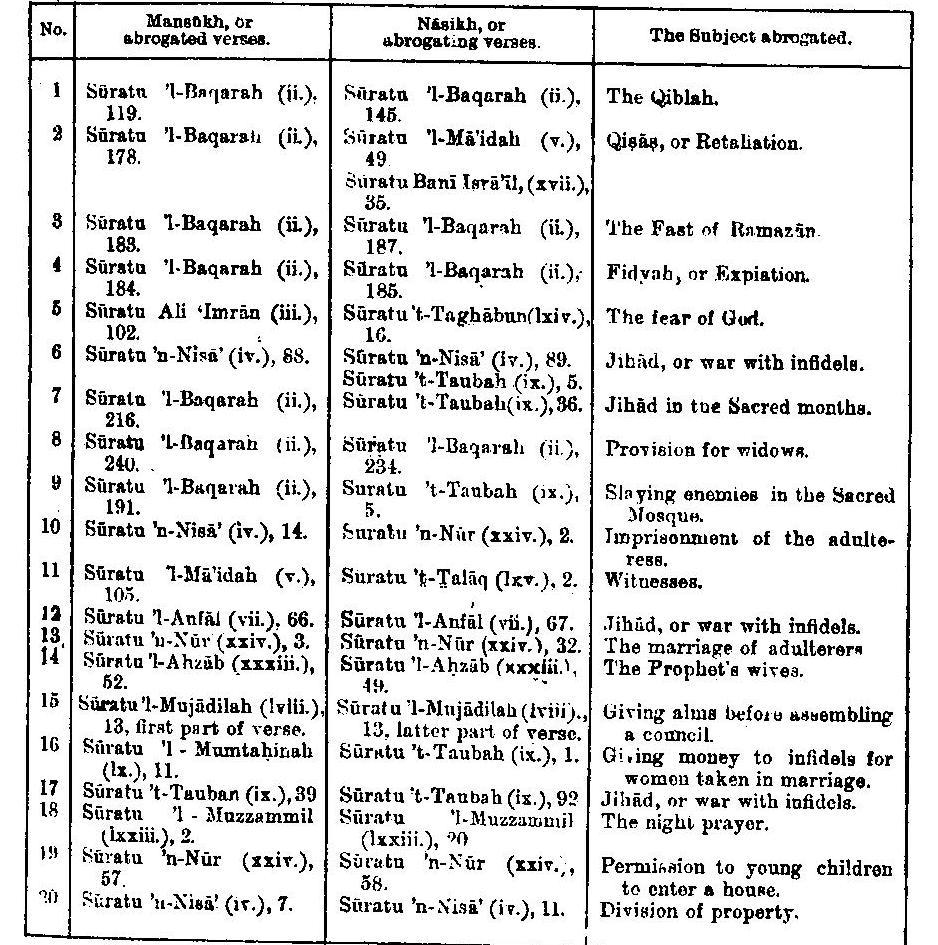
521
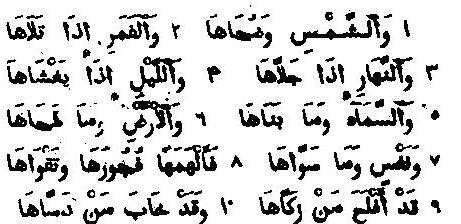
2 By the, Moon when she followeth him!
3 By the Day when it revealeth his glory!
4 By the Night when it enshroudeth him -!
5 By the Heaven and Him who built it!
6 By the Earth and Him who spread it forth.
7 By a soul and Him who balanced it,
8 And breathed into it its wickedness and its piety,
522
10 And undone is he who hath corrupted it!
2 Bey dem Mond der ihr folget immer;
3 Bey dem Tag der sie zeigt in vollem glanz;
4 Bey der Nacht, die sie vertinstert ganz;
5 Bey den Himmeln und deu der sie gemacht;
6 Bey der Erde und dem der sie schuf eben;
7 Bey der Seele und dem der sie Ins gleichgewicht gebracht
8 Bey dem der ihr das bewussusen des guten und böser gegeben,
9 Selig wer seine Seele reinigt ;
10 Wer dieselbe verdunklet wird auf ewig gepeinigt.
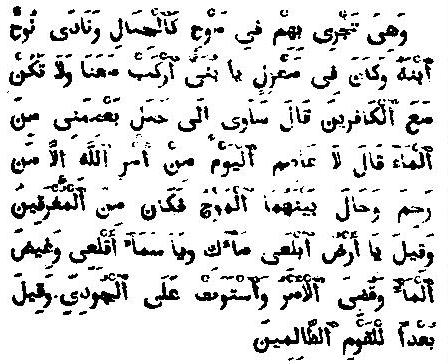
"And Noah called to his son - for he was apart-
"'Embark with us, O my child! and stay not with the unbelievers.'
"He said,' I will betake myself to a mountain that shall save me from the water.'
"He said. 'None shalt be saved this day from God's decree, save him on whom shall have mercy.'
"And a wave passed between them and he was drowned.
"And it was said, 'O earth! swallow up thy water! and O heaven! Withhold thy rain!
And, the water abated, and God's decree was fulfilled, and the ark rested on al-Judi.
"And it was said.' A vaunt, ye tribe of tribe of the wicked!'"
Az-Zamakhsahri, A.H. 604.
At-Tafsiru 'l-Kabir A.H 606.
Ibnu 'I-Arabi A.H. 628.
Al-Baizawi, A.H. 685.
Al-Mudarik, A.H. 701.
Husain, A.H. 900.
Al-Jalalan, A.H. 864, A.H. 911.
Al-Mazhari A.H. 1225.
'Azizi, A.H. 1239.
At-Tafsir 'l-Kabir by Saiyid Muhammad al-Razi, 39 volumes, A.H. 606.
As-Safi, A.H.668.
As—Sirru 'l-Wajiz, A.H. 715.
Sidrau 'l-Mustaba by Mir Bakir. A.H. 1041.
AI-Burhan, by Saiyid Hasham, A.H, 1160.
 an annotated text of the Qur'an, published by order and at the cost of the Empress Catherine II of Russia, at St. Petersburgh in 1787, 1 vol. in folio. This edition was reprinted at St. Petersburgh in 1790, 1793, 1796, and 1798, and without any change at Kasan in 1803, 1809, and 1839. Another edition, in two vols., 4to. without notes, was published at Kasan, 1817, reprinted 1821 and 1843, and a third edition, in 6 vols. 8 vo., at the same place, 1819.
523
524
525
526
527
528
Bi-siqti 'l-liwa baina 'd-dakhuli wa-haumali
Li-ma nasajat-ha min junubin wa-sham'ali


Yas'alu aivana vaumu 'l-giyaman
529
Wa-khasafa 'l-qamar
Wa-jumi'a 'sh-shamsu wa 'I-qamar
Yaqulu 'l-insanu yauma'izin aina 'l-mafarr.
he asketh, "When this Day of Resurrection?"
When the eye-sight shall be dazzled
And the moon shall be darkened,
and the sun and the moon shall be together,
On that day man shall cry, "Where is there a place to flee to?")
Ha rabbi ha nazirah,
Wa-wujuhin yauma'izin basirah
Tazannu an yuf'als bi-ha faqirah
Kalla iza balaghati 't-taraqiya
Wa-qila man raq
Wa-zanna annahu 'l-firaq
Wa 'l-taffati 's-saqu bi 's-seq
Ila rabbi-ka yanma'izini 'l-masaq.
Out-looking towards Their lord:
And faces on that day shall be dismal.
As if they thought that some calamity would therein befall them.
Assuredly when the soul shall come up to the breast-bone,
And there shall be a cry, ' Who is the magician to restore him.?"
And the man feeleth that the time if his departure is come,
And when one leg shall be enlaced with the other,
To thy Lord on that day shall he be driven on.)
 which conveys the idea of "beating," and serves in Arabic grammars like the Greek
  , to form paradigms, by way of a wholesome admonition, I suppose, to the youthful student. The first of these three consonants can only remain quiescent, i.e. vowel-less, if it is preceded by a vowel,
as in the imperative i-zrib
, to form paradigms, by way of a wholesome admonition, I suppose, to the youthful student. The first of these three consonants can only remain quiescent, i.e. vowel-less, if it is preceded by a vowel,
as in the imperative i-zrib  "beat thou," where the root appears' as a syllable, or in the aorist ya-zribu "he beats or will beat," where it takes together with the final u a dissylabic form. If we leave the second consonant quiescent and pronounce the first with a, we have zarb, with the nominative termination zarbun
  the verbal noun "beating" or infinitive "to beat." Vocalizing both the first letters, we may obtain zarib, the active participle "beating," or zurub plural of the last mentioned zarb with the nominative termination zaribun
  and zurubun
  . If we read all
three consonants with vowels, it may be zaraba
. If we read all
three consonants with vowels, it may be zaraba  "he did beat," or zaraba
 "they did beat". Taking, again the two forms zaraba, "he did beat," and ya-zribu, "he beats or will beat," a simple change of vowels suffices to transform the active into the passive zuriba "he was beaten," and yuzrabu "he is beaten or will be beaten" Lastly, it must be noticed, that the distinction between the two fundamental tenses of the Arabic verb rests on the principle that the affixes, representing the personal pronouns, are in the preterite placed at the end, in the aorist at the beginning of the root in the zarab-na, "we did beat," but na-zribu, 'we beat or will beat.
530
 "Zaid beating"; of the second: zaraha zaidun
  "(there) did beat Zaid." The constituent parts of the nominal sentence, which we would call subject and predicate are termed mubtada', "incipient," and khabar, "report," meaning that which is enounced or stated or stated of the subject. The khabar need not be an attributive, as in the sentence given above, but it may be another clause, either nominal or verbal, and if it is the former, its own mubtada' admits even of a third clause as a second ,khabur for its complement. The subject of the verbal sentence is called agent, or fa'il,, and, as mentioned before, follows the verb, or fi'l, in the nominative.

 . Lit. "The Exalted Reading"
 Lit. "Approaching near." Heb.
  karban. A term used in the Qur'an and in the Traditions for a sacrifice or offering. Surah v. 30: "Truly when they (Cain and Abel) offered an offering [SACRIFICE.]
 . "An hour which is near." A term used for the Day of Resurrection and Judgment.
 . The word used in the Traditions and in Muhammadan history for Constantinople (See hadisu 't-Tirmizi.) Istambul
  , is
, is
531
 lit. "A stake, an axis, a pivot." The highest stage of sanctity amongst Muslim saints. A higher position than that of ghaus. According to the Kosh shafu 'l-Istilahat, a qutb is one who has attained to that degree of sanctity which is a reflection of the heart of the Prophet himself. Qutbu 'd-Din, "the axis of religion," a title given to eminent Muslim divines. [FAQIR.]
Answering Islam Home Page