
JABALU MUSA
The Mount of Moses; Mount Sinai. It is called in the Qur'an, Surah ii, 60, at-Tur, "The Mountain."
AL-JABARIYAH 
Lit. "The Necessitarians." A sect of Muhammadans who deny free agency in man.
they take their denomination from Jabr, which signifies "necessity or compulsion;" because they hold man to be necessarily and inevitably constrained to act as he does by force of God's eternal and immutable decree. This sect is distinguished by two species, some being more rigid and extreme in their opinion, who are thence called pure Jabariyahs; and others, more moderate, who are therefore called middle Jabiriyahs. The former will not allow men to be said either to act, or to have any power at all, either operative or acquiring, asserting that men can do nothing, but produces all his actions be necessity, having neither power, nor will, nor choice, and more than an inanimate agent. They also declare that rewarding and punishing are also the effects of necessity and the same they say of the imposing of commands. This was the doctrine of the Jahmiyahs, the followers of Jahm ibn Sufwan, who likewise held that Paradise and Hell will vanish, or be annihilated, after those who are destined thereto respectively shall have entered them, so that at last there will remain no existing being besides God, supposing those words of the Qur'an which declare that the inhabitants of Paradise and Hell shall remain therein for ever to be hyperbolical only, and intended for corroboration, and not to denote an eternal duration in reality. The moderate Jabariyahs are they who ascribe some power to man, but such a power as hath no influence on the action; for as to those who grant the power of man to have a certain influence on the action, which influence is called Acquisition, some will not admit them to be called Jabriyahs, though others reckon those also to be called middle Jabriyahs, and to contend for the middle opinion between absolute liberty, who attribute to man acquisition, or concurrence, in producing the action, whereby he gaineth commendation or blame (yet without admitting it to have any influence on the action), and, therefore, make the Asharians a branch of this sect. (Sale's Koran, Introd.)
JABARUT 
The possession of power, or omnipotence. One of the mystic stages of the Sufi. [SUFIISM.]
JABBAR 
Omnipotent; an absolute sovereign. Al-Jabbr, "The Absolute." One of the ninety-nine names or attributes of God.
Surah lix. 23: "The King, the Holy, the Peaceful, the Faithful, the Protector, the Mighty, the Absolute, the Great.
JABIL 
The Angel of the Mountains; mentioned in the Shi'ah work Hayatu 'l-Qulub. (Merrick's ed. p. 128.)
JABIR 
The son of a poor citizen of al-Madinah, slain at Uhud. He embraced Islam and accompanied Muhammad in numerous battles. He lived to a great age, for he died at al-Medinah A.H. 78, aged 94 years.
JABR 
A Christian servant of a family from Hazramaut - a convert to Islam - accused by the Quraish with having instructed the Prophet.
Surah xvi. 105: "We knew that they said 'It is only some mortal that teaches him.' The tongue of him they incline towards is barbarous, this is plain Arabic."
Husain says Jabr was one of the Ahlu 'l-Kitab, and was well read in the Taurat and Injil, and Muhammad used to hear him read these books as he passed his house.
JACOB Arabic Ya'qub 
The son of Isaac; an inspired prophet. There are frequent but brief allusions to the Patriarch Jacob in the Qur'an in connection with Abraham and Isaac. The story of his journey to Egypt will be found in the account of Joseph as given in the XIIth Surah of the Qur'an. [JOSEPH.]
A brief reference to his death is made in Surah ii. ch. 127: -
"Were ye present when Jacob was at the point of death? When he said to his sons 'Whom will ye worship when I am gone? They said, 'We will worship thy God and the God of thy fathers Abraham and Ismael and Isaac, one God, and to Him are we surrender (Muslims).' That people have now passed away, they have the reward of their deeds and ye shall have the meed of yours: but of their doings ye shall not be questioned. They say, moreover, 'Become Jews or Christians that ye many have the true guidance.' Say: Nay! The religion of Abraham, the sound in faith and not one of those who join gods with God!
JADD 
A term used in Muhammadan law for either a paternal or
a maternal grandfather. The word has also the meaning greatness, majesty, as in Surah xxii. 3: "May the Majesty of our Lord be exalted." [GRANDFATHER.]
JA'FAR 
A son of Abu Talib and a cousin to Muhammad. He was a great friend to the poor, and was called by Muhammad Abu 'l-Masakin, "the father of the poor." He fell bravely at the battle of Mu'tah, A.H. 8.
JA'FARU SADIQ 
Abu 'Abdi'llah Ja'far ibn Muhammad ibn 'Ali ibn al-Husain ibn 'Ali ibn Abi Talib, was one of the twelve persons who, according to the Shi'ahs, are considered the rightful Imams [SHI'AH]. He was surnamed as-Sadiq, "The Veracious," on account of his uprightness of character. He was a learned man, and his pupil, Abu Musa, is said to have composed a work of two thousand pages containing the problems of his master Ja'faru 's-Sadiq. Ja'far was born A.H. 80, and died A.H. 148, and was buried in the cemetery al-Baki' at al-Madinah.
JAGIR  Persian Ja,
"A place;" Gir, "Occupying." A tenure common under the Muhammadan Government, in which the public revenues of a given tract of land were made over to a servant of the State, together with the powers requisite to enable him to collect and appropriate such revenue, and administer the general government of the district. The assignment was either conditional or unconditional; in the former case, some public service, as the levy and maintenance of troops, or other specified duty, was engaged for: the latter was left to the entire disposal of the grantee. The assignment was either for a stated term, or, more usually, for the lifetime of the holder, lapsing, on his death, to the State, although not unusually renewed to his heir, on payment of a nazarana, or fine, and sometimes specified to be a hereditary assignment, without which specification it was held to be a life-tenure only. (Ben. Reg, xxxvii, 1723, cl. 15) A Jagir was also liable to forfeiture on failure of performance of the conditions on which it was granted, or on the holder's incurring the displeasure of the Emperor. On the other hand, in the inability of the State to vindicate its rights, a Jagir was sometimes converted into a perpetual and transferable estate; and the same consequence has resulted from the recognition of sundry Jagir as hereditary by the British Government after the extinction of the Native Governments by which they were originally granted; so that they have now come to be considered as family properties, of which the holders could not be rightfully dispossessed, and to which their legal heirs succeed, as a matter of course, without fine or nazarana, such having been silently dispense with. (Wilson's Glossary of Indian Terms.)
JAHANNAM  [HELL.]
JAHL  .
.
"Ignorance." A term used by theologians for an ignorance of religious truths, which they say is of two kinds: Jahl-i-Basit, simple ignorance; and Jahl-i-Murakkab, or complicated ignorance, or confirmed error.
JAIFAR  .
.
A king of 'Uman to whom Muhammad sent a despatch inviting him to Islam, which event led eventually to the conversion of that province.
"On his return from the seige of Tayif, towards the close of the eight year of the Hegira, Mahomet sent Amru with a despatch to Jeyfar, King of Oman, summoning him and his brother to make profession of the true faith. At first they gave answer 'that they would be the weakest among the Arabs, if they made another man possessor of their property.' But as Amru was about to depart, they repented, and , calling him back, embraced Islam. The people followed their example, and without demur paid their tithes to Amru, who continued till the Prophet's death to be his representative in Oman." (Muir's Life of Mahomet, new ed. p. 471.)
JAIHUN  .
.
The river Jihon, or Bactrus, said to one of the rivers of Eden. [EDEN.]
JA'-I-NAMAZ  .
.
Persian. "The place of prayer." A term used in Asia for the small mat or carpet on which a Muslim prays. It is called in Arabic Sujjadah and Musalla.
The carpet is about five feet in length, and has a point or Qiblah worked in the pattern to mark the place for prostration.
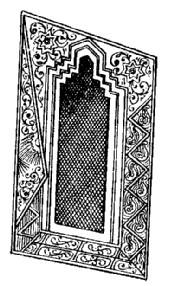
A JA-I-NAMAZ, OR PRAYER CARPET, AS USED IN PESHAWAR.
JAIYID 
Pure money: current coin. A term used in Muslim law. (Hidayah, vol. iii. p. 152.)
JALAL 
Being glorious or mighty. Zu 'l-Jalal. "The Glorious One," is an attribute of God. See Qur'an, Surah lv. 78: "Blessed be the name of thy Lord who is possessed of glory and honor."
Al-Jalal is a term used by Sufi mystics to express that state of the Almighty which places Him beyond the understanding of His creatures. ('Abdu 'r-Razzaq's Dictionary of Sufi Terms.)
AL-JALALAN 
"The two Jalals." A term given to two commentators of the name of Jalalu 'd-din, whose joint work is called the Tafsiru 'l-Jalalain; the first half of which was compiled by the Shaikh Jalalu'd-din al-Mahalli, died A.H. 864, and the rest by Jalalu 'd-din as-Suyuti, died A.H. 911.
Jalalu 'd-din as Suyuti was a prolific author. Grammar, rhetoric, dogmatical and practical theology, history, criticism, medicine, and anatomy, comprise some of the subjects on which he wrote. His Itqan, which is an explanatory work on the Qur'an, has been published by the Asiatic Society of Bengal, and edited by Dr. Sprenger (A.D. 1857), and his History of the Temple of Jerusalem has been translated by the Rev. James Reynolds for the Oriental Translation Society (A.D. 1836). [JERUSALEM.]
JA'LU 'L-JAUF 
Another name for Dumatu 'l-Jandal, a place near Tabuk. [DUMAH.]
JALUT  [GOLIATH.]
JAMRAH 
Lit. "Gravel, or small pebbles." The three pillars at Mina, at which the Makkan pilgrims throw seven pebbles. They are known as al-Ula, the first; al-Wusta, the middle; and al-'Aqibah, the last. According to Muslim writers these pillars mark the successive spots where the Devil, in the shape of an old Shaikh, appeared to Adam. Abraham, and Ishmael, and was driven away by the simple process which Gabriel taught them of throwing seven small pebbles. The Jamratu 'l-Aqibah, is known as the Shaitanu 'l-Kabir, or the "Great Devil."
Captain Burton, in his El Medinah and Mecca, vol. ii, 227 says: -
"The Shaitanu 'l-Kabir is a dwarf buttress of rude masonry, about eight feet high by two and a half broad, placed against a rough wall of stones, at the Meccan entrance to Mina. As the ceremony of 'Ramy', or Lapidation, must be performed on the first day by all pilgrims between sunrise and sunset, and as the fiend was malicious enough to appear in a rugged pass, the crowd makes the place dangerous. On one side of the road, which is not forty feet broad, stood a row of shops, belonging principally to barbers. On the other side is the rugged wall of the pillar with shameful frieze of Bedouins and naked boys. The narrow space was crowded with pilgrims, all struggling like drowning men to approach as near as possible to the Devil."
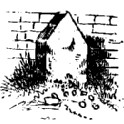
THE SHAITAKU 'L-KABER. (Burton.)
(2) Jamrah also means a "live coal," and is an astronomical or meteorological term used to signify the infusion of vital heat into the elements in spring, or rather, at the end of winter. According to this theory there are three Jamarat: one, the infusion of heat into the air, occurs thirty days before the vernal equinox; the second, affecting the waters, seven days later; and the third, vivifying the earth, sixteen days before the equinox. (Catafago's Dictionary, in loco.)
JAM'U 'L-JAM 
Lit., "The plural of a plural." A term used by the Sufi mystics for the high position of the Perfect Man or al-Insunu 'l-Kamil.
JANAB 
"Majesty." A term of respect used in India in addressing a person of rank or office, whether Native or European. Janab-i-ali, "Your high eminence."
JANABAH 
A state of uncleanliness. The Niddah, or separation, of Leviticus xii. 5. The menses, coitus, childbirth, pollutio nocturna contact with the dead, or having performed the offices of mature, place the person in a state of Janabah or separation. [PURIFICATION.]
JANAZAH, JINAZAH 
A term used both for the bier, and for the funeral service of a Muslim, also for the corpse itself. [BURIAL.]
JANN 
The father of the Jinn. [JINN.]
JANNAH 
pl. Jannat. Lit. "A garden." (1) A term used for the regions of celestial bliss. [PARADISE.] (2) A term used by Sufi mystics to express different stages of the spiritual life Jannatu 'l-Af'al, the paradise of works, or that enjoyment which is derived from sensual pleasures, such as eating, drinking, & c.; Jannatu 'l-Wirasah the paradise of inheritance, which is a disposition like that of the saints and prophets; Jannatu 's-Sifat, the paradise of attributes, becoming like God; Jannatu 'z-Zat, the paradise of essence, being united with God (i.e. absorption into the divine essence). ("abda 'r-Razzaq's Dictionary of Sufi Terms.)
JANNATU 'ADN 
The Gardens of Eden. (Surah ix. 78, et alias.) [PARADISE.]
JANNATU 'L-FIRDAUS 

The Garden of Eternity. (Surah xxv. 16.) [PARADISE.]
JANNATU 'L-MA'WA 
The Gardens of Refuge. (Surah xxxii. 19.) [PARADISE.]
JANNATU 'N-NA'IM 

The Garden of Delight. (Surah v. 70.) [PARADISE.]
JAR MULASIQ 
"A nest-door neighbor." A term used in Muhammadan law for a joint proprietor in a house, or room or wall of the house. (Hidayah, vol. iii. p. 565.)
JARR 
"Dragging." A degree of chastisement practiced according to Muhammadan law, namely, by dragging the offender to the door and exposing him to scorn. (Hamilton's Hidayah, vol. ii. p. 76.)
AL-JASIYAH 
Lit. "The Kneeling." A title given to the XLVth Surah of the Qur'an, in which the expression occurs (verse 26):-
"And God;s is the kingdom of the Heavens and of the Earth; and on the day when the Hour shall arrive, on that day shall the despisers perish. And thous shalt see every nation kneeling; to its own book shall every nation be summoned: - 'This day shall ye be repaid as ye have wrought.'"
JASULIQ 
An Arabicized word from the Greek  . The Catholicos, or Primate of the Christians. In the Ghiyasu 'l-Lughah he is said to be the chief of the Christians, and under him is the Mitran (Metropolitan), and then the Usquf (Bishop), and then Qasis (Presbyter), and then the Shammas (Deacon).
Mr. Lane, in his Dictionary, gives the Order of Bitraq (Patriarch) as under the Jasuliq, which term we understand to mean, in Muhammadan works, none other than the Patriarch e.g. of Jerusalem, or Antioch, &c.
JAWAMI'U 'L-KALIM 

Lit. "Comprehending many significations." A title given to the Qur'an and to certain traditions, because it is related that the Prophet said that has been revealed to me which comprehends many significations (Kashfu'l-Istilahat, in loco.)
JAZ'AH 
A female camel in her fifth year. The proper age for a camel given in zakat or legal alms for camels from sixty-one to seventy-five in number. [ZAKAT.]
JAZBAH 
"Attraction." A term used by the Sufi mystics to express a yearning after the Divine Being. The nearer approach of man to his Maker through God's grace. ('Abdu 'r-Razzaq's Dictionary of Suri Terms.)
JEDDAH Arabic Jiddah 
The principal seaport of Arabia, and one of the Miqat or stages where the Makkan pilgrims put on the Ihra, or the pilgrim's robe. It is also celebrated as the place of Eve's sepulcher. She is said to measure 80 paces from waist to heel. (Burton.)
JEHOVAH Heb. 
In the Old Testament it is usually with the vowel points of  but when the two occur together, the former is pointed
  , that is, with the vowels of
  , as in Obad, i. 1 Heb. iii. 19. The LXX, generally render it by
  , the vulgate by Dominus; and in this respect they have been followed by the A.V. where it is translated "The Lord." The true pronuncation of this name, by which God was known to the Hebrews, has been entirely lost, the Jews themselves scrupulously avoiding every mention of it, and substituting in its stead one or other of the words with whose proper vowel-points it many happen to be written. This custom, which had its origin in reverence, and has almost degenerated into a superstition, was founded upon an erroneous rendering of Lev. xxiv. 16, "He that blasphemeth the name of God shall surely be put to death"; from which it was inferred that the mere utterance of the name constituted a capital offence. In the Rabbinical writings it is distinguished by various euphemistic expressions; as simply "the name", or "the name of four letter" (the Greek tetragrammaton); "the great and terrible name"; "the peculiar name," i.e. appropriated to God alone ; "the separate name," i.e. either the name which is separated or removed from human knowledge, or, as some render, "the name which has been interpreted or revealed." (Professor W.A. Wright, M.A., Smith's Dictionary of the Bible in loco.)
This superstitious reverence for the word Jehovah must have been the origin of the Ismu 'l-A'zam, or "exalted name," which Muhammad is related to have said was know only to God and His prophets; but which, he said, occurs in one of three verses in the Qur'an, namely: Suratu 'l-Baqarah ii. 256: "God! (Allah) there is no God but He (Hu) the Living One (al-Haiy), the Self-Subsisting One (al-Qaiyum)"; or, in the Suratu Ali 'Imran iii. 1, which contains the same words; or, in the Suratu Ta Ha xx. 110: "Faces shall be humbled before the Living One (al-Haiy), the Self-Subsistent One (al-Qaiyum).
Some European scholars (see Catafago's Arabic Dictionary) have fancied that Yahuh  , or Yahovah of the Hebrews, is identical with the ejaculation of the Muslim devotee, Ya Ha, "O He!" (i.e. God). Al-Baizawi says the word Hu (better Huwa), i.e. HE (God), may be the Ismu 'l-A'zam, or Exalted Name of the Almighty, especially as it occurs in two of the verses of the Qur'an indicated in two of the verses of the Qur'an indicated by Muhammad, namely, Surahs ii. 356, iii. i. [HUWA, GOD.]
JEJEMIAH Arabic Armiya. 
The prophet is not mentioned in the Qur'an, but Muslim historians say he was contemporary with Ma'add, the son of 'Adnan, the renowned ancestor of Muhammad. The Katibu 'l-Waqidi says: "God watched over 'Adnan's son Ma'add, who was by the command of the Lord taken by Armiya and Abrakha (Jeremiah and Baruch) into the land of Harram and nurtured safely." According to the Ghiyasu 'l-Lughah, he is the same as al-Khizr. [AL-KHIZR.]
JERUSALEM
Arabic al-Baitu 'l-Muqaddas  , "the Holy House," or Baitu 'l-Maqdis
  , "the House of the Sanctuary"; Aurashalim
  ; Iliya
  , i.e. Aelia Capitolina.
In the Qur'an Jerusalem is never mentioned by name, and in the Traditions and other Muslim works, it si always called al-Baitu 'l-Muqaddas, "the Holy House," as referring to the Temple of Jerusalem, or Iliya. The allusion to it in the Qur'an, are as follows:-
Surah ii. 55 (where God, after giving the manna and quails, is represented as saying to the children of Israel): "Enter the city and eat therefrom as plentifully as ye wish." Al-Baizawi the commentator says this city was the Baitu 'l-Maqdis (Jerusalem), or Ariha (Jericho).
Surah ii. 261: "Like his who passed by a city when it was desolate, and as he walked over its roofs, said, How will God revive this after its destruction?" Commentators way Elias or al-Khizr visited the city of Jeruslaem after its destruction by Nebuchadnezzar.
Surah xxx. opens with a reference to the Persians conquering Syria and taking Jerusalem.
In Surah xvii. 1, Muhammad is represented as having taken his flight from Makkah to Jerusalem. "Celebrated be the praises of Him who by night took his servant from the Masjidu 'l-Haram (the Sacred Mosque), the precinct of which we have blessed."
And in Surah l., 40, one of the signs of the approach of the last day will be: "The crier (to prayer) shall cry from the near place" (i.e. a place from which all men shall hear). Husain says this "near place" is the Temple at Jerusalem.
A curious account of Jerusalem and its temple, the Masjids 'l-Aqsa, or Distant Mosque (so called because it is a distant object of pilgrimage), has been written by Jalalu 'd-din as-Suyuti, one of the commentators on the Qur'an, known as the Jalalan. It was written in the year A.H. 848, A.D. 1444, and the special object of the book appears to be to exalt the merits of Jerusalem as a place of prayer and pilgrimage. [For an account of the Temple, see MASJIDU 'L-AQSA.] He says Jerusalem is specially honored as being the scene of the repentance of David and Solomon. The place where God sent His angel to Solomon, announced glad tidings to Zacharias and John, showed David a plan of the Temple, and put all the beasts of the earth and the fowls of the air in subjection to him. It was at Jerusalem that the prophets sacrificed; that Jesus was born and spoke in the cradle; and it was at Jerusalem that Jesus ascended to heaven; and it will be there that He will again descend. Gog and Magog shall subdue every place on the earth but Jerusalem, and it will be there that God Almighty will destroy them. It is in the holy land of Jerusalem that Adam and Abraham, and Isaac and Mary are buried. And in the last days there will be a general flight to Jerusalem, and the Ark and the Shechinah will be again restored to the Temple. There will al mankind be gathered at the Resurrection for judgement, and God will enter, surrounded by His angels, into the Holy Temple, when He comes to judge the earth. (See Reynold's Translation, p. 16.)
The peculiar reference paid to the Sacred Rock (as-Sakhrah) seems to be one of the many instances of afterthought and addition to Islam since the time of Muhammad. Mu'awiyah seems to have encouraged it in order to direct the affections and fanaticism of his subjects into a new channel, and to withdraw their exclusive attention from Makkah and al-Madinah, where the rival family of 'Ali resided.
In the same book there is a desultory account of the taking of Jerusalem by the Khalifah 'Umar.
After the conclusion of the battle of Yarmuk (Hieromax), the whole army of the Muslims marched into the territory of Palestine and Jordan. Then they closely besieged the city. The conquest was attended with difficulty until the arrival of the Khalifah 'Umar with four thousand horses. He came upon the holy place on the eastern side, and then encircled the city. They fought for a long time, until at last the inhabitants sent a party to the wall with a flag of truce, asking for a parley. The Patriarch (Sophronius) then demanded the safe conduct of a messenger to 'Umar. The envoy came without hindrance and requested 'Umar to make peace and accept tribute.
Jalaludin gives a copy of the treaty which the Muslims compelled the people of Jerusalem to sign. It reads as follows:-
"In the name of God, the Merciful and Compassionate! This is the writing from the Christians of the Holy City to 'Umar ibn al-
Khattab, the Commander of the Faithful. When you came down upon as, we asked of you a capitulation for ourselves and our possessions, and our children, and the people of our religion; and we have stipulated with you, that we shall not be polluted by interruption in our places of worship, or whatever chapels, or churches, or cells, or monasteries of monks, may be therein who may have the impress of Muslims (by long residence), and that we will not prohibit the Muslims from entering them, by night or by day; and that we will open the gates wide to passengers and to travelers; and if any Muslim passing by shall take up his lodging with us three nights, we shall give him food, and not entertain in our churches a spy, nor conceal him unknown to the Muslims; and not teach our children the Qur'an; and not publically exhibit the Associating or Christian religion, and not beg any one to embrace it and not hinder anyone of our relations from entering the Muslim religion, if he will, and that we should honor the Muslims and make much of them, and place them in our assemblies, if anyone of them will, and give them the chief seats, and not imitate them in our dress, neither in girdles, nor in the turban, nor the slipper, nor the parting of the hair, and never write in their language, nor call ourselves by their surnames; and that we should never ride upon great saddles, nor suspend our swords by belts, and never accept arms (the bow, sword, and club), nor carry them with us; and that we should never engrave upon our signet rings in the Arabic language; and that we should not sell vine, and that we should shave the front of our heads, and tie up our dress, wherever we may be, and not wear wide girdles at our waist; and that we should never publically exhibit the cross upon our churches, nor expose our crosses, nor ever inscribe them in the path of the Muslims, nor in their market places, and never strike our bells the (quick) stroke, nor raise our voices over the dead, nor publically expose the lights, or anything else, in the roads and markets of the Muslims, and never receive any slave who has drawn upon himself familiarity with Muslims, and never look upon them in their houses."
We learn moreover, from the same authority, as follows: -
"When 'Umar ratified the treaty, he added thereto,- 'And that we will not strike anyone of the Muslims. We stipulate this with you for ourselves and the people of our religion; and we accept these terms of capitulation: and if we subsequently violate a point of that which we have stipulated, upon our lives be it, and let there be no faith with us and may it be allowed you to do to us whatever is lawful against rebellious and revolting subjects.'" (Hist. of Jerusalem, by Jalau 'd-din, Reynold's Translation.)
There were withing the city 12,000 Greeks and 50,000 natives, and the Khalifah 'Umar insisted that all the Greeks depart within three days, and that the natives should pay tribute. Five dinars were imposed upon the rich, four upon the middle classes, and three upon the lower classes; very old and very young persons paid nothing.
When 'Umar entered the Holy City, his first object was to find the Sacred Rock (as-Sakhrah), the site of the Masjidu 'l-Aqsa, to which Muhammad said he was carried on Buraq on the night of Mi'raj [MIRAJ.], and he therefore requested the Patriarch to direct him to the spot. They first went to the Church of the Resurrection and the Patriarch said, "This is the Mosque of David." But 'Umar said, "Thou hast spoken falsely , for the Apostle of God (Muhammad) described the place to me, and it was not like this. They then went to the church on Zion, and the Patriarch said, "This is the Mosque of David." But 'Umar said, "Thou hast spoken falsely." And in this manner the Patriarch took 'Umar to every church in the city. At last they came to a gate, which is now called Babu 'l-Muhammad or the gate of Muhammad, and clearing away the filth on the steps, they came to a narrow passage and the Khalifah, creeping on his knees, came to the central sewer. Here, standing up 'Umar looked at the rock (as-Sakhrah), and then exclaimed, "By Him in whose hand is my life, this is the palce which the Apostle of God (upon whom be peace and blessing) described to us." 'Umar then ordered a mosque to be built thereon. And 'Abdu 'l-Malik ibn Marwan built the mosque of the Baitu 'l-Muquddas (now known as the Mosque of 'Umar). He spent upon it the produce of seven years' tax upon Egypt. He began it in A.H. 69 and finished it in A.H. 72.
Some authority quoted by Jalul 'd-din says the Holy City did not cease to be in the hands of the Muslims from its surrender to 'Umar until the year A.H. 491, when it was taken by the Franks, who killed therein a vast number of Muslims in the space of seven days. In the Masjidu 'l-Aqsa alone, they killed 70,000, and they took from as-Sakhrah the vessels of gold and silver and the wealth which was preserved in the strong boxes. "But." he adds, "salahu 'd-din (Saladin) was raised up for the complete deliverance of the Holy City; for he was the most renowned of Lions, and the very brightness of Fire."
(For a further account of the taking of the city by Saladin, see Reynold's translation of Jalalu 'd-din's History of the Temple of Jerusalem, p. 1999.)
A.D.
33. The crucifixion, death, resurrection, and ascension of Jesus Christ at Jerusalem.
43. St. Paul's first visit to Jerusalem after his conversion to Christianity.
69. Taken by Titus.
136. The Emperor Hadrian bestows on the city the name of Aelia Capitolina
A.D.
(This name is used by Jalalu 'd-din in his book, A.D. 1444.)
386. Jerusalem under Christian rule, the Martyrion and the Church of the Resurrection built.
614. The city invested and taken by the Persians under Chosroes II. (See Qur'an Surah xxx.)
621. The era of the flight of Muhammad.
628. The Emperor Heraclius enters Jerusalem in triumph.
687. The Patriarch Sophronius surrenders the Holy City to the Khalifah 'Umar. Liberty of worship secured to the Christians in churches which already existed, but they are prohibited the erection of new churches. A mosque built on the reputed site of Jacob's vision, now known as the mosque of 'Umar. Said to be on the site of the temple called by Muslims Masjidu 'l-Aqsa, the Remote Mosque, or as-Sakhrah, the rock.
800. Ambassadors sent by the Emperor Charlemagne to distribute alms in the Holy City. The Khalifah Harun ar Rashid sends back as a present to the Emperor the keys of Calvary and the Holy Sepulchre.
820. Held for a time by the rebel chief Tamum Abu Harab.
969. Falls into the hands of the Fatimate Khalifah Mu'izz. The Church of the Holy Sepulchre burnt.
1035. The pilgrimage of Robert of Normandy.
1054. The pilgrimage of Lietbert of Cambray.
1065. The pilgrimage of the German bishops.
1077. Jerusalem pillaged by the army of Malik Shah.
1084. The Turkoman chief Urtek becomes ruler of the Holy City. The Christians suffer.
1098. The city retaken by the Fatimate Khalifah.
1099. 40,000 Crusaders appear before its walls. The city taken by the Crusaders. 10,000 Muslims slain. Godfrey of Bouillin made King. (For eighty years the city remained in the hands of the Christians.)
1187. Retaken by Saladin (Salahu 'd-din), the Muslim general.
1219. Ceded to the Christians by virtue of a treaty with the Emperor Frederick II.
1289. Taken by the Muslims.
1243. Again ceded to the Christians.
1244. The Christians defeated at Gaza, and Jerusalem occupied by the Muslims.
1277. Nominally annexed to the kingdom of Sicily.
1517. Becomes part of the Empire of the Ottoman Sultan Selim I.
1542. Sultan Sulaiman I. builds the present walls.
1832. Muhammad 'Ali Pasha of Egypt takes the city.
1840. Restored to the Sultan of Turkey [AS-SAKHRAH, MASJIDU 'L-AQSA.]
JESUS CHRIST Arabic 'Isa 'l-Masih  . In the Qur'an, the Lord Jesus Christ is spoken of under the following names and title:-
(1) 'Isa  , "Jesus." Al-Baizawi says it is the same as the Hebrew Ishu',
  , and derived from al-'ayus, "white mingle with red," without however, explaining this derivation.
(2) 'Isa ibn Mayam  "Jesus the son of Mary," from whom He was born by the power of God.
(3) Al-Masih  , "the Messiah." Surah iii. 40: "His name shall be Messiah Jesus." Al-Kamalan, the commentators, say he is called al-Masih either because he was both blessed and anointed by the angel Gabriel, or because whomsoever Jesus touched was healed.
(4) Kalimatu'llah  , "the Word of God." Surah iv. 160: "His word." Husain says by this expression is meant he who was born at the express fiat of god. (Surah xix. 36: "He says only to it BE and it is.")
(5) Qaulu 'l-Haqq  . "The Word of Truth." Surah xix. 35. Some commentators take the expression qaulu 'l-haqq as referring to the statement made being "the word of truth," whilst others take it as referring to Christ Himself. "The Word of Truth."
(6) Ruhun min Allah  , "A Spirit from God." Surah iv. 169: "A Spirit for Him." Al-Baizawi says it is a spirit which proceedeth from God. The title Ruhu 'llah is the special Kalimah for Jesus Christ. [PROPHETS.]
(7) Rasulu 'llah  , "The Messenger of God." Surah iv. 169. It is the same title as Muhammad assumed for himself, i.e. the Prophet, the Apostle, or Messenger of God.
(8) 'Abdu 'llah  , "The Servant of God." Surah xix. 31: "Verily, I am the servant of God."
(9) Nabiyu'llah  , "The Prophet of God." Surah xix 31: "He hath made me a Prophet."
(10) Wajihun fi 'd-bunya wa 'l-akhirah 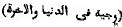 , "Illustrious in this world and in the next," namely, as al-Baizawi explains it, "in this world as a Prophet, in the next as an intercessor." Surah iii. 40.
In order to present the somewhat incoherent narrative of the Qur'an as a systematic form, we shall arrange its history of the Lord Jesus into (1) The Annunciation of the Virgin, (2) The Birth of Jesus, (3) His Miracles, (4) His Mission, (5) His Crucifixion, (6) His Divinity and Sinlessness, (7) The Trinity, (8) His Second Coming (as taught in the Traditions), (9) His Exaltation in Heaven. From a perusal of
these selections it will be seen that Muhammad taught that Jesus was miraculously born of the Virgin Mary, who was the sister of Aaron and the daughter of 'Imran, near the trunk of a palm tree. That the Jews charged the Virgin with being unchaste; but the babe, speaking in his cradle, vindicated his mother's honor. That Jesus performed miracles, giving life to a clay figure of a bird, healing the blind, curing the leper, quickening the dead, and bringing down a table from heaven "as a festival and a sign." That he (Jesus) was specially commissioned as the Apostle or Prophet of God to confirm the Law and to reveal the Gospel. That he proclaimed his mission with many manifest signs, being strengthened by the Holy Spirit. That he foretold the advent of another Prophet, whose name should be Ahmad. That the Jews intended to crucify him, but God deceived them, for they did not crucify Jesus, but only his likeness. That he is now in one of the stages of celestial bliss. That after he left this earth his disciples disputed amongst themselves, some calling him a God, and making him one of a Trinity of the "Father, the Mother, and the son." That he will come again at the last day, and will slay Antichrist, kill all the swine, break the Cross, remove the poll-tax from the infidels. That he will reign as a just king for forty-five years, marry, and have children, and die and be buried near Muhammad at al-Madinah, between the graves of Abu Bakr and 'Umar.
Surah iii. 37-42: "And remember when the angels said, 'O Mary! Verily hath God chosen thee, and purified thee, and chosen thee above the women of the worlds! O Mary! Be devout towards thy Lord, and prostrate thyself and bow down with those who bow.' This is one of the announcements of things unseen by thee: To thee, O Muhammad! do we reveal it; for thou wast not with them when they cast lots with reeds which of them should rear Mary: nor wast thou with them when they disputed about it. Remember when the angel said, "O mary! Verily God annnounceth to thee the Word from Him: His name shall be Messiah Jesus the son of Mary, illustrious in this world, and in the next, and one of those who have near access to God; and he shall speak to mean alike when in the cradle and when grown up; and he shall be one of the just.' She said, 'How, O my Lord? Shall I have a son, when man hath not touched me?' He said, 'Thus: God will create what He will; when He decreeth a thing He only saith, "Be," and it is.' And He will teach him the Book, and the Wisdom, and the Law, and the Evangel; and he shall be an apostle to the children of Israel."
Surah xix. 16-21: "And make mention in the Book, of Mary, when she went apart from her family, eastward, and took a veil to shroud herself from them: and We sent Our spirit to her, and he took before her the form of a perfect man. She said: 'I fly for refuge from thee to the God of Mercy! If thou fearest Him, begone from me.' He said: 'I am only a messenger of they Lord, that I may bestow on thee a holy son.' She said: 'How shall I have a son, when man hath never touched me? And I am not unchaste.' He said: 'So shall it be. Thy Lord hath said: "Easy is this with me; and we will make him a sign to mankind and a mercy from us. For it is a thing decreed."'"
[In the earlier part of Surah iii. the Virgin Mary is spoken of as the daughter of 'Imran. Commentators say that 'Imran died before Mary was born. In the traditions it is stated "that the only two persons born into the world who have not been touched by the Devil are Mary and her son Jesus." Thus teaching not only the Immaculate Conception of Mary, but also of her mother. "When she went eastward"; Husain says, she went out of her house in an eastward direction, in order to perform her ablutions, when Gabriel appeared to her.]
Surah xix. 22-34: "And she conceived him, and retired with him to a far-off place. And the throes came upon her by the trunk of a palm. She said: 'Oh, would that I had died ere this, and been a thing forgotten, forgotten quite!' And one cried to her from below her: 'Grieve not thou, thy Lord hath provided a streamlet at they feet: - And shake the trunk of the palm-tree toward thee; it will drop fresh ripe dates upon thee. Eat then and drink, and be of cheerful eye; and shouldst thou see a man, say, - Verily, I have vowed abstinence to the God of mercy. - To no one will I speak this day.' Then came she with the babe to her people, bearing him. They siad, 'O May! Now hast thou done a strange thing! O sister of Aaron! Thy father was not a man of wickedness, not unchaste thy mother.' And she made a sign to them, pointing towards the babe. They said, 'How shall we speak with him who is in the cradle, an infant?' It said, 'Verily, I am the servant of God: He hath given me the Book, and He hath made me a prophet; and He hath made me blessed wherever I may be, and hath enjoined me prayer and almsgiving so long as I shall live; and to be dutiful to her that bare me: and he hath not made me proud, deprave. And the peace of God was on me the day I was born, and will be the day I shall die, and the day I shall be raised to life."
Surah xxiii. 52: "And we appointed the Son and his Mother for a sign; and we prepared an abode in a lofty spot, quiet and watered with springs."
[Professor Wahl understand this last verse to refer to Paradise, but the Muslim commentators all refer it to the place of abode; and al-Baizawi and Hussain say it was either in Jerusalem, or Damascus, or Ramleh! Hussain says Jesus was born in Bethlehem. The expression "O sister of Aaron," as applied to the Virgin Mary, suggests an anachronism
of some consequence, but the commentators get over the difficulty. The Kamalar say it is a figurative expression implying that she was pure and righteous like a sister of Aaron. But al-Baizawi says it means that she was of the tribe of Aaron. European authors suggest that there was a confusion between Miriam the Virgin and Miriam the sister of Moses. Al-Baizawi says: "The palm to which she fled , that she might lean on it in her travail, was a withered trunk, without any head or verdure; and this happened in the winter season, notwithstanding which, it miraculously supplied her with fruits for her refreshment, as is mentioned immediately." Mr. Sale says: "It has been observed, that the Mohammedan account of the delivery of the Virgin Mary very much resemble that of Latona, as described by the poets, not only in this circumstance of their laying hold on a palm-tree (though some say Latona embraced an olive-tree, or an olive and a palm, or else two laurels), but also in that of their infants speaking; which Apollo is fabled to have done in the womb." (See Homer, Hymn. in Apoll. ; Callimach, Hymn. in Delum..)
Surah iii. 43-46: "And He will teach him the Book, and the Wisdom, and the Law, and the Evangel; and he shall be an apostle to the children of Israel. 'Now have I come,' he will say, 'to you with a sign from your Lord: Out of clay will I make for you, as it were, the figure of a bird: and I will breathe into it, and it shall become, by God's leave, a bird. And I will heal the blind, and the leper; and by God's leave will I quicken the dead; and I will tell you what ye eat, and what ye store up in your houses! Truly in this will be a sign for you, if ye are believers.' And when Jesus perceived unbelief on their part, He said, 'Who my helpers with God?' The apostles said, We will be God's helpers! We believe in God, and bear thou witness that we are Muslims. O our Lord! We believe in what thou hast sent down, and we follow the apostle; write us up, then, with those who bear witness to him.'"
[The commentators al-Jalalan say Jesus made for his disciples a bat, for it is the most perfect of birds in make, and it flew while they looked at it; but when it had gone out of their sight, it fell down dead. That he cured in one day fifty thousand persons, and that he raised Lazarus ('Azar) from the dead; also Shem, the son of Noah, who had been dead 4,000 years, but he died immediately; also the son of an old woman, and the daughter of a tax-collector.]
Surah v. 112-115: "Remember when the Apostles said: 'O Jesus, Son of Mary! Is thy Lord able to send down a furnished table to us out of Heaven?' He said: 'Fear God if ye be believers.' They said: 'We desire to eat therefrom, and to have our hearts assured; and to know that thou hast indeed spoken truth to us, and to be witnesses thereof.' Jesus, Son of Mary, said: 'O God our Lord! Send down a table to us out of Heaven, that it may become a recurring festival to us, to the first of us and to the last of us, and a sign from thee; and do thou nourish us, for thou art the best of nourishers.' And God said: 'Verily, I will cause it to descend unto you; but whoever among you after that shall disbelieve, I will surely chastise him with a chastisement wherewith I will not chastise any other creature.
[Mr. Sale, in his commentary on this miracle, says (quoting from al-Baizawi):- "This miracle is thus related by the commentators. Jesus having, at the request of his followers, asked it of God, a red table immediately descended in their sight, between two clouds, and was set before them. Where-upon he rose up, and having made the ablution, prayed, and then took off the cloth which covered the table, saying, 'In the name of God, the best provider of food!' What the provision were, with which this table was furnished, is a matter wherein the expositors are not agreed. One will have them to be nine cakes of bread and nine fishes; another, bread and flesh; another, all sort of food, except flesh; another, all sort of food except bread and flesh; another, all except bread and fish; another, one fish, which had the taste of all manner of food; and another, fruits of paradise; but the most received tradition is, that when the table was uncovered, there appeared a fish ready dressed, without scales or prickly fins, dropping with fat, having salt place at its head, and vinegar at its tail, and round it all sorts of herbs, except leeks, and five loaves of bread, on one of which there were olive; on the second, honey; on the third, butter; on the fourth, cheese; and on the fifth, dried flesh. They add, that Jesus, at the request of the apostles, showed them another miracle, by restoring the fish to life, and causing its scales and fins to return to it; at which the standers-by, being affrighted, he caused it to become as it was before: that one thousand three hundred men and women, all afflicted with bodily infirmities or poverty, ate of these provisions, and were satisfied, the fish remaining whole as it was at first; that then the table flew up to heaven in the sight of all; and everyone who had partaken of this food were delivered from their infirmities and misfortunes; and that it continued to descent for forty days together, at dinner-time, and stood on the ground till the sun declined, and was then taken up into the clouds. Some of the Mohammedan writers are of opinion that this table did not really descend, but that it was only a parable; but most think the words of the Koran are plain to the contrary. A further tradition is, that several men were changed into swine for disbelieving this miracle, and attributing it to magic art; or, as others pretend, for stealing some of the victuals from off it."]
Surah lvii. 26, 27: "And of old sent we Noah and Abraham, and on their seed conferred the
gift of prophecy, and the Book; and some of them we guided aright; but many were evil doers. Then we caused our apostles to follow in their footsteps; and we caused Jesus the son of Mary to follow them; and we gave him the Evangel and we put into the hearts of those who followed him kindness and compassion; but as to the monastic life, they invented it themselves. The desire only of pleasing God did we prescribe to them, and this they observed not as it ought to have been observed; but to such of them as believed gave we their reward, though many of them were perverse."
Surah v. 50, 51: "And in the footsteps of the prophets caused we Jesus, the son of Mary, to follow, confirming the law which was before him; and we gave him the Evangel with its guidance and light, confirmatory of the preceding Law: a guidance and warning to those who fear God:- And that the people of the Evangel may judge according to what God hath sent down therein. And whose will not judge by what God hath sent down - such are the perverse."
Surah ii. 81: "Moreover, to Moses gave we 'the Book,' and we raised up apostles after him; and to Jesus, son of Mary, gave we clear proofs of his mission and strengthened him by the Holy Spirit. So oft then as an apostle cometh to you with that which your souls desire not, swell ye with pride, and treat some as imposters, and slay others?"
Surah ii. 254: "Some of the apostles we have endowed more highly than others: Those to whom God hath spoken. He hath raised to the loftiest grade, and to Jesus, son of Mary we gave manifest signs, and we strengthened him with the Holy Spirit. And if God had pleased, they who came after them would not have wrangled, after the clear signs had reached them. But into disputes they fell; some of them believed, and some were infidels; yet if God had pleased, they would not have thus wrangled; but God doth what he will."
Surah lxi. 6: "And remember when Jesus the son of Mary said, 'O children of Israel! Of a truth I am God's apostle to you to confirm the law which was given before me, and to announce an apostle that shall come after me whose name shall be Ahmad! But when he (Ahmad) presented himself with clear proofs of his mission, they said, 'This is manifest sorcery!"
Surah vi. 85: "And Zachariah, John, Jesus, and Elias: all were just persons."
Surah iv. 157: " And there shall not be one of the people of the Book but shall believe in him (Jesus) before his death, and in the day of judgment he shall be a witness against them."
Surah iii. 44: "And I have come to attest the law which was before me; and to allow you part of that which had been forbidden you; and I come to you with a sign from your Lord; Fear God, then, and obey me; of a truth God is my Lord, and your Lord: Therefore worship Him. This is a right way."
Surah iii. 47-50: "And the Jews plotted, and God plotted; But of those who plot is God the best. Remember when God said, 'O Jesus! Verily I will cause thee to die, and will take thee up to myself and deliver thee from those who believe not; and I will place those who follow thee above those who believe not, until the Day of Resurrection. Then, to me it your return, and wherein ye differ will I decide between you. And as to those who believe not, I will chastise them with a terrible chastisement in this word and in the next; and none shall they have to help them.' But as to those who believe, and do the things that are right, He will pay them their recompense. God loveth not the doers of evil."
Surah iv. 155, 156: "And for their unbelief [are the Jews cursed] - and for their having spoken against Mary a grievous calumny. - And for their saying 'Verily we have slain the Messiah, Jesus the son of Mary, an Apostle of God.' Yet they slew him not, and they crucified him not, but they had only his likeness. And they who differed about him were in doubt concerning him: No sure knowledge had they about him, but followed only an opinion, and they really did not slay him,but God took him up to Himself. And God is Mighty, Wise!"
[Sale, in his notes on the Qur'an, says "The person crucified some will have to be a spy that was sent to entrap him; others that it was one Titian, who by direction of Judas entered in at a sindow of the house where Jesus was, to kill him; and others that it was Judas himself, who agreed with the rulers of the Jews to betray him for thirty pieces of silver, and led those who were sent to take him. They add that Jesus after his crucifixion in effigy was sent down again to the earth to comfort his mother and disciples and acquaint them how the Jews were deceived, and was then taken up a second time into heaven. It is supposed by several that this story was an original invention of Mohammed's; but they are certainly mistaken: for several sectaries held the same opinion long before his time. The Basilidians, in the beginning of Christianity, denied that Christ himself suffered, but [asserted] that Simon the Cirenean was crucified in his place. The Corinthians before them, and the Carpocratians next (to name no more of those who affirmed Jesus to have been a mere man), did believe the same thing, that it was not himself, but one of his followers, very like him, that was crucified. Photius tells us that he read a book entitled The Journey of the Apostles, relating the acts of Peter, John, Andrew, Thomas, and Paul; and among other things contained therein this was one, that Christ was not crucified, but another in his stead, and that therefore he laughed at his crucifiers, or those who thought they had crucified him." The "Cross of Christ" is the missing link in the Muslim's creed, for we have in Islam the great
anomaly of a religion which rejects the doctrine of a sacrifice for sin, whilst its great central feast is a Feast of Sacrifice. It is related by the Muslim historian al-Waqidi, that Muhammad had such repugnance to the sign of the cross that he destroyed everything brought to his house with that figure upon it.]
Surah xix. 35, 36: "That is Jesus, the son of Mary, the word of truth (Qaulu 'l-Haqq), whereon ye do dispute! God could not take to Himself a son! Celebrated be His praise! When He decrees a matter He only say to it 'BE,' and it is; and verily God is my Lord and your Lord, so worship Him: this is the right way. But the sects have differed among themselves."
Surah iii. 51, 52: "These signs, and this wise warning do we rehearse to thee. Verily, Jesus is as Adam in the sight of God. He created Him of dust: He then said to him, 'Be,' - and he was."
Surah xliii. 57-65: "And when the Son of Mary was set forth as an instance of divine power, lo! Thy people cried out for joy thereat: And they said, "Are our god or is he the better?' They put this forth to thee only in the spirit of dispute. Yea. They are a contentious people. Jesus is no more than a servant whom we favored, and proposed as an instance of divine power to the children of Israel; and if we pleased, we could from yourselves bring forth Angels to succeed you on earth; and he shall be a sign of the last hour; doubt not then of it, and follow ye me: this is the right way; and let not Satan turn you aside from it, for he is your manifest foe. And when Jesus came with manifest proofs, he said, 'Now am I come to you with wisdom; and a part of those things about which ye are at variance I will clear up to you; fear ye God, therefore, and obey me. Verily, God is my Lord and your Lord; wherefore, worship ye him: this is a right way.' But the different parties fell into disputes among themselves; but woe to those who thus transgressed, because of the punishment of an afflictive day!"
Surah ix. 30: "The Jews say Ezra is the Son of God; and the Christians say that the Messiah is the Son of God; that is what they say with their mouths imitating the sayings of those who misbelieve before - God fight them! - How they lie!"
Surah iii. 72, 73: "And some truly are there among them who torture the Scriptures with they tongues, in order that ye may suppose it to be from the Scripture, yet it is not from the Scripture. And they say, 'This is from God'; yet it is not from God; and they utter s lie against God, and they know they do so. It beseemeth not a man, that God should give his the Scriptures and the Wisdom, and the gift of prophecy, and that then he should say to his followers, 'Be ye worshipers of me, as well as of God'; but rather, 'Be ye perfect in things pertaining to God, since ye know the Scriptures, and have studied deep.'"
Surah v. 19: "Infidels now are they who say, 'Verily God is Messiah Ibn Maryam (son of Mary)! SAY: And who could aught obtain from God, if he chose to destroy the Messiah Ibn Maryam, and his mother, and all who are on the earth together?'"
There is a remarkable Hadis related by Anas, which inadvertently proves that, whilst Muhammad admitted his own sinfulness, as well as that of other prophets, he could not charge our Lord with sin. It is as follows: "The Prophet of God said, 'In the Day of Resurrection Muslims will not be able to move, and they will be greatly distressed, and will say, "Would to God that we had asked Him to create someone to intercede for use, that we might be taken from this place, and be delivered from tribulation and sorrow?" Then these men will go to Adam, and will say,"Thou art the father of all men. God created thee with His hand, and made thee a dweller in Paradise, and ordered His angels to prostrate themselves before thee, and taught thee the names of all things. Ask grace for us we pray thee!" And Adam will say, "I am not of that degree of eminence you suppose, for I committed a sin in earing of the grain which was forbidden. Go to Noah, the Prophet, he was the first who was sent by God to the unbelievers on the face of the earth." Then they will go to Noah and ask for intercession, and he will say, "I am not of that degree which ye suppose." And he will remember the sin which he committed in asking the Lord for the deliverance of his son (Hud), not knowing whether it was a right request or not; and he well say, "Go to Abraham, who is the Friend of God." Then they will go to Abraham, and he will say, "I am not of that degree which ye suppose." And he will remember the three occasions upon which he told lies in the world; and he well say, "Go to Moses, who is the servant to whom God gave His law, and whom He allowed to converse with Him." And they will go to Moses, and Moses will say, "I am not of that degree which ye suppose." And he will remember the sin which he committed in slaying a man, and he will say, "Go to Jesus, He is the servant of God, the Apostle of God, the Spirit of God, and the Word of God." Then they will go to Jesus, and He will say, "Go to Muhammad who is a servant, whose sins God has forgiven both first and last." Then the Muslims will come to me, and I will ask permission to go into God's presence and intercede for them.'" (Mishkat, book xxiii. ch. xii.)
[In dealing with Muhammadans the Christian missionary must not treat their system as though the teachings of Islam were precisely those of the modern Socinians (we speak of the modern Socinians, for both the Socini, uncle and nephew, admitted the miraculous conception of Christ, and said he ought to be worshiped.) Islam admits of the miraculous conception of Christ, and that He is the "Word" which God "conveyed
into Mary"; and whilst the other five great prophets are but "the chosen," "the preacher," "the friend," "the converser with," and "the messenger of" God, Jesus is admitted to be the "Spirit of God." he is the greatest miracle worker of all the prophets; and whilst Muhammad is dead and buried, and saw corruption, all Muslim divines admit that Jesus "saw no corruption," and still lives with a human body in Paradise.
Moreover, it is said in the Hadis that the Haqiqatu'l-Muhammadiyah or the Nur-i-Muhammad, "the essence, or light of Muhammad," was created before all things which were made by God. They pre-existence of the divine "Word which was made flesh and dwelt among us" is not, therefore an idea foreign to the Muslim mind.]
Surah v. 76-69: "They misbelieve who say, 'Verily, God is the Messiah, the son of Mary'; but the Messiah said, 'O children of Israel! Worship God, my Lord and your Lord; verily, he who associates aught with God, God hath forbidden him Paradise, and his resort is the Fire, and the unjust shall have none to help them. They misbelieve who say, 'Verily God is the third of three, for there is no God but one; and if they do not desist from what they say, there shall touch those who misbelieve amongst them grievous woe. Will they not turn again towards God and ask pardon of Him? For God is forgiving and merciful.' The Messiah, the son of Mary, is only a prophet! Prophets before him have passed away; and his mother was a confessor; they used both to eat food. See how we explain to them the signs, yet see how they turn aside!"
Surah iv. 169: "O ye people of the Book! Overstep not bounds in your religion; and of God, speak only truth. The Messiah, Jesus, son of Mary, is only an apostle of God, and His Word which he conveyed into Mary, and a Spirit from Him. Believe, therefore, in God and His apostles, and say not, 'Three': (i.e. there is a Trinity) - Forbear - it will be better for you. God is only one God! Far be it from His glory that He should have a son! His, whatever is in the Heavens, and whatever is in the Earth! And God is a sufficient Guardian."
Surah v. 116, 117: "And when God shall say - 'O Jesus, Son of Mary: hast thou said unto mankind - "Take me and my mother as two Gods, besides God?"' He shall say - 'Glory be unto Thee! It is not for me to say that which I know to be not the truth; had I said that, verily thou wouldest have known it: Thou knowest what is in me, but I know not what is in Thee; for Thou well knowest things unseen! I spake not to them aught but that which thou didst bid me - "Worship God, my Lord and your Lord", and I was a witness against them so long as I was amongst them: but when Thou didst take me away to Thyself Thou wert the watcher over them, for Thou art witness over all.'"
[From the text of the Qur'an it appears that Muhammad thought the Holy Trinity of the Christians consisted of the Father, the Son, and the Virgin; and historians tell us that there existed in Arabia a sect called the Collyridians, who considered they Virgin Mary a divine person, and offered in worship to her a cake called Collyria; it, is, therefore, not improbable that Muhammad obtained his perverted notion of the Holy Trinity from the existence of this sect. From the expression "they both ate food," we must conclude that Muhammad had but a sensuous idea of the Trinity in Unity, and had never been instructed in the orthodox faith with reference to his dogma.
Al-Baizawi (A.H. 685), in his commentary on Surah iv. 169, says: "Say not there are Three," that is, "Do not say there are three Gods," namely Allah and al-Masih and Maryam; or "Do not say God is Three," meaning that there are Three Aqanim  or Essences
- Ab (Father), Ibn (Son), and Ruhu'l-Quds (Holy Spirit) and interpreting it thus: Ab the Zat or Essence; Ibn, the 'Ilm or Knowledge; and Ruhu 'l-Qud, the Hayat or Life of God.
Husain (A.H. 900) quotes al-Baizawi, and offers no opinion of his own.
The Jalalan (A.H. 911) say "Three" means Allah and 'Isa and his Mother.
The word generally used by Muhammadan writers for the Trinity is at-Taslis  [TRINITY.]
The Qur'an has no definite teaching on the subject, but the Traditions have. See Mishkaru 'l-Masabih, book xxiii. ch. vi.)
Abu Hurairah relates that the Prophet said, "I swear by God, it is near, when Jesus, son of Mary, will descend from the heavens, upon your people, a just king, and he will break the cross, and will kill the swine, and will remove the poll-tax from the enfranchised; and there will be great wealth in his time, so much that nobody will accept of it; and in that time, one prostration in prayer will be better than the world and everything in it."
And Abu Hurairah said, "If ye doubt about this coming to pass, then read this verse (Surah iv. 157), and there shall not be one of those who have received the Scriptures who shall not believe in Him (Jesus) before His death."
Abu Hurairah again relates that the Prophet said, "I swear by God, Jesus son of Mary will come down, a just king; he will kill the swine, and break the cross, and remove the poll-tax from the enfranchised; and camels will not be rode in his time on account of the immensity of wealth, and man's being in want of nothing; and verily enmity, hatred and malice will go from man; and verily, Jesus will call people to wealth, and nobody will take it."
Jabir relates that the Prophet said: "A section of my people will always fight for the true religion, and will be victorious, unto the resurrection. Then Jesus, son of May will
come down; and the prince of my people will say to him, 'Come in front, and say prayers for us.' And he will say to him, "I shall not act as Imam, because some of you are princes over others.' And Jesus will say this from respect for my people."
'Abdu'llah ibn 'Amr relates that the Prophet said: "Jesus will come down to the earth and will marry and have children, and will stay on the earth forty-five years, and then die, and be buried in my place of burial; and I and Jesus shall rise up from one place, between Abu-Bakr and 'Umar." [HUJRAH.]
There is some difference of opinion as to where Jesus Christ now is. All Muslim divines agree that "he saw no corruption," but they differ as to the exact stage of celestial bliss in which he resides in the body. According to a tradition by Qatadah (Mishkat, book xxiv. ch. vii.), Muhammad said, on the night of the Mi'raj or celestial journey, he saw John and Jesus in the second heaven. The Jalalan agree with this tradition. But in the commentary known as the Jami'u 'l-Bayan (vol. i. 656) it is said he is in the third region of bliss; whilst some say he is in the fourth.
The disciples of Jesus are called in the Qur'an al-Hawariyun, a word which seems to be derived from an Ethiopic root, signifying "to send," but which al-Baizawi says means "white ones," and that it was given to the disciples of Jesus either because they were holy and sincere men or because they wore white clothes. It is noticeable that not one of the twelve apostles is mentioned by name in the Qur'an. In the story told of disciples visiting the city (or Antioch), three disciples are mentioned, and commentators say they were John, Jude, and Simon. [See Surah xxxvi. 13, 19 - HABIB THE CARPENTER.] John the Baptist and his father Zacharias are mentioned. (Surahs xix. 7, xxi. 90.)
JETHRO. [SHU'AIB.]
JEWELS. Arabic Jauhar  , pl. Jawahir.
According to the Hidayah a thief is liable to suffer amputation of the hand for stealing jewels, such as a ring set with emerald, ruby, or chrysolite, as such are rare articles, and are not held to be of an indifferent nature, neither are the undesirable. (Vol. ii. p. 93.)
, pl. Jawahir.
According to the Hidayah a thief is liable to suffer amputation of the hand for stealing jewels, such as a ring set with emerald, ruby, or chrysolite, as such are rare articles, and are not held to be of an indifferent nature, neither are the undesirable. (Vol. ii. p. 93.)
A sillim sale [SILLIM], or a sale in trust, of jewels and marine shells, is not lawful, because the unities of these vary in their value. (Vol. ii. p. 539.) In the partition of property, jewels must not be divided by the Qazi, but by mutual arrangement in the family, because of the great difference in the actual value of the jewels. (Vol. iv. 13.)
JEWS, JUDAISM. The Jews are mentioned in the Qur'an and Traditions under the names of Yahudi  , p,. Yahud, and Bani Isra'il
  , "Children of Israel." No distinction is made between Jews and Israelites. They are acknowledged to be a people in possession of a divine book, and are called Ahlu 'l-Kitab, or "people of the book." Moses is their special law-giver (Abraham not having been a Jew, but a "Hanif Muslim"); they are a people highly-favored of God, but are siad to have perverted the meaning of Scripture, and to have called Ezra "the Son of God." They have an intense hatred of all true Muslims; and, as a punishment for their sins, some of them in times past had been changed into apes and swine, and others will have their hands tied to their necks and be cast into the Fire at the Day of Judgment.
The following are the selections from the Qur'an relating to the Jews:-
Surah ii. 116: "O children of Israel! Remember my favor wherewith I have favored you, and that high above all mankind have I raised you."
Surah v. 48, 49: "Verily, we have sent down the law (Taurat) wherein are guidance and light. By it did the prophets who professed Islam judge the Jews; and the doctors and the teachers judged by that portion of the Book of God, of which they were the keepers and the witnesses. Therefore, O Jews! Fear not men but fear Me; and barter not away my signs for a mean price! And whoso will not judge by what God hath sent down - such are the Infidels. And therein have we enacted for them, 'Life for life, an eye for eye, and nose for nose, and ear for ear, and tooth for tooth, and for wounds retaliation': - Whoso shall compromise it as alms shall have therein the expiation of his sin; and whoso will not judge by what God hath sent down - such are the transgressors."
Surah iii. 60: "Abraham was not a Jew, nor yet a Christian. He was a Hanif Muslim, and not an idolater."
Surah ix. 30: "The Jews say, 'Ezra ('Uzair) is the son of God'; and the Christians say, 'The Messiah is a son of God.' Such the saying in their mouths! They resemble the saying of the infidels of old! God do battle with them! How are they misguided!"
Surah vi. 147: "To the Jews did we forbid every beast having an entire hoof, and of both bullocks and sheep we forbade them the fat, save what might be on their backs, or their entrails, and the fat attached to the bone. With this have we recompensed them, because of their transgression: and verily, we are indeed equitable."
Surah iv. 48, 49: "Among the Jews are those who displace the words of their Scriptures, and say, 'We have heard, and we have not obeyed. Hear thou, but as one that hearth not; and LOOK AT US'; perplexing with their tongues, and wounding the Faith by their reviling. But if they would say, 'We have heard, and we obey; hear thou, and REGARD US'; it were better for them, and more right. But God hath cursed them for their unbelief. Few only of them are believers!"
Surah ii 70-78: "Desire ye then that for your sakes the Jews should believe? Yet a
part of them heard the word of God, and then, after they had understood it, perverted it, and knew that they did so. And when they fall in with the faithful, they say, 'We believe': but when they are apart one with another, they say, 'Will ye acquaint them with what God hath revealed to you, that they may dispute with you about it in the presence of your Lord?' Understand ye their aim? Know they not that God knoweth what they hide, as well as what they bring to light? But there are illiterates among them who are not acquainted with the Book, but with lies only, and have but vague fancies. Woe to those who with their own hands transcribe the Book, corruptly, and then say, 'This is from God,' that they may sell it for some mean price! Woe then to them for that which their hands have written! And, Woe to them for the gains which they have made!"
Surah v. 64-69: "SAY: O people of the Book! Do ye not disavow us only because we believe in God, and in what He hath sent down to us, and in what He hath sent down aforetime, and because most of you are doers of ill? SAY: Can I announce to you any retribution worse that that which awaiteth them with God? They whom God hath cursed and with whom He hath been angry - some of them hath changed into apes and swine; and they who worship Tagut are in evil plight; and have gone far astray from the right path! When they presented themselves to you they said, 'We believe'; but Infidels they came in unto you, and Infidels they went forth! God well knew what they concealed. Many of them shalt thou see hastening together to wickedness and malice, and to eat unlawful things. Shame on them for what they have done! Had not their doctors and teachers forbidden their uttering wickedness, and their eating unlawful food, bad indeed would have been their doings! 'The hand of God,' say the Jews, 'is chained up.' Their own hands shall be chained up - and for that which they have said shall they be cursed. Nay! Outstretched are both His hands! At His own pleasure does He bestow gifts. That which hath been sent down to thee from they Lord will surely increase the rebellion and unbelief of many of them; and we have put enmity and hatred between them that shall last till the day of the Resurrection. Oft as they kindle a beacon fire for war shall God quench it! And their aim will be to abet disorder on the earth; but God loveth not the abettors of disorder."
Nearly all the leading scripture characters connected with Old Testament history are either mentioned by name in the Qur'an or are referred to in the Traditions and commentaries.
(a) In the Qur'an we have Adam (Adam), Abel (Habil), Cain (Qabil), Enoch (Idris), Noah (Nuh), Abraham (Ibrahim), Lot (Lut), Isaac (Ishaq), Ishmael (Ism'il), Jacob (Ya'qub), Joseph (Yusuf), Job (Aiyub), Moses (Musa), Aaron (Harun), Korah (Qarun), Pharaoh (Fir'aun), Haman (Haman), David (Da'ud), Goliath (Jalut), Solomon (Suaiman), Saul (Talut), Jonah (Yunus), Elisha (Al-yasa').
(b) In the Traditions and in the earliest commentaries on the Qur'an, are mentioned: Eve (Huwwa), Hagar (Hajar), Nebuchadnessar (Bukhtnassar), Joshua (Yushar), Jeremiah (Armiya), Isaiah (Sha'ya), Benjamin (Binyamin), Ezekiel (Hizqil), Baalam (Bal'am), Daniel (Daniyal), Sarah (Sarah), and many others. But it is remarkable that after Solomon, there is no mention of the Kings of Israel and Judah.
(c) The chief incidents of Jewish history are recorded in the Qur'an with a strange and curious admixture of Rabbinical fable. The creation of the world, the formation of Adam and Eve, the fall, the expulsion from Eden, Cain and Abel's sacrifices, the death of Abel; Noah's preaching, the Ark built, the deluge, the tower of Babel; Abraham, the friend of God, his call from idolatry, Isaac, the son of promise, Sarah's incredulity, Hagar and Ishmael, the willingness of Abraham to sacrifice his son, Lot and the cities of the plain; Jacob and the tribes, Joseph sold into Egypt, Potiphar's wife, Joseph tempted, the dreams of the baker and butler, and of the king: Moses, his preservation in infancy, kills and Egyptian, flies to Midian, works miracles in the presence of Pharaoh, manna from heaven, the giving of the law, Aaron's rod, the golden calf, the passage of the Red Sea; Job's patience; Balaam cursing the Israelites; David's psalms, his sin and repentance; Solomon's wisdom, the Queen of Sheba, the building of the temple; Jonah's preaching, his escape from the fish: these and many other incidents, evidently taken from the Old Testament, and worked up into a narrative with the assistance of Talmudic interpretations, form the chief historical portion of the Qur'an.
(d) Many of the doctrines and social precepts of the Qur'an are also from Judaism. The Unity of God, the ministry of angels, the inspired law, the law of marriage and divorce, domestic slavery, the day of Sacrifice, prayer and ablution, the lex talionis, the degrees of affinity, the stoning of the adulterer, and many other injunctions, are precisely those of the Mosaic code, with some modifications to meet the requirements of Arabian social life.
Whilst, therefore, Muhammad took little of his religious system from Christianity, he was vastly indebted to Judaism both for his historical narratives and his doctrines and precepts. Islam is nothing more nor less than Judaism plus the Apostleship of Muhammad. The teachings of Jesus form no part of his religious system. [CHRISTIANITY.]
(e) The Quraish charged Muhammad with want of originality in his revelations. For even at the end of his career, and when he was uttering his latest Surahs, "they said, as out verses were rehearsed to them - 'This is nothing but tales of yore.'" (Surah viii. 31.) "And when it was said to them, What is it your Lord sent down? They said, 'Old folk's tales.'" (Surah xvi. 25) The
Quraish even charged him with having obtained assistance. "They said it is only some mortal who teaches him." And Muhammad admits there was someone who might be suspected of helping him, for he replies, "The tongue of him whom they lean towards is barbarous and this (Qur'an) is plain Arabic." (Surah xvi. 105.) Husain, the commentator, in remarking upon this verse, says, "It is related that there was a slave belonging to 'Amr ibn 'Abdi 'llah al-Hazrami, named Jabr (and according to some a second slave named Yasar), who used to read the Law and the Gospel, and Muhammad used, when he passed to stand and listen."
And the whole construction of the Qur'an bears out the supposition that its subject matter was received orally and worked into poetical Arabic by a man of genius. Whatever he may have heard from the readings of Jabr and Yasar of the text of the Old and New Testament scriptures, it is very evident that he obtained his explanations from one well versed in Talmudic lore. A Jewish Rabbi, Abraham Geiger, in A.D. 1833, wrote a prize essay in answer to the question put by the university: Inquiratur in fentes Alcorani seu legis Muhammedicae eos, qui ex Judaeismo derivandi sunt." His essay in reply is entitle, "Was hat Mohammed aus dem Judenthume aufgenommen?" In this treatise it is clearly demonstrated how much the whole system of Islam is indebted to Talmudic Judaism for its teachings. Its narratives, its doctrines, and its theological terms, are chiefly derided from those of the Talmud.
The works of Geiger, J.M. Arnold, Hershom, McCaul, Bishop Barclay, Deutsch, Lightfoot, Schottgen, Ugolini, Meuschen (which pending a complete translation of the Talmud, can be consulted), will upon comparison with the teachings of the Qur'an reveal how entirely Muhammad constructed his religious system on the lines of Talmudic Judaism. We are indebted to the late Dr. J.M. Arnold's Islam and Christianity, for the following review of the subject, he having largely availed himself of the facts given in Geiger's celebrated essay, already referred to.
The seven heavens and the seven earths which are held in the Talmud, have found their way into the Qur'an1. During the creation, God's glorious throne was placed in the air upon the water2. According to the Talmud, "the world is the sixtieth part of the garden, the garden is the sixtieth part of Eden"; and Muhammad states that the breath of the garden is that of heaven and earth3. Both in the Qur'an and Talmud we find seven hells as the appointed abode for the damned, and each hell has seven gates in both documents4. The entrance of Jahannam is marked, according to the Sukkah by two date trees, between which smoke issues, and the Qur'an speaks of a tree in hell [ZAQQUM] of which the damned are to eat and of which many terrible things are related.5 In the Talmud the prince of hell demands supply for his domain, and a similar request is made in the Qur'an6. Between the seven heavens and the seven hells is an intermediate place [A'RAF], for those who are too good to be cast into hell and too imperfect to be admitted into heaven7. This intermediate abode is, however, so narrow, that the conversations of the blessed and the damned on either side may be overheard. Again, the happiness of Paradise [PARADISE] is similarly described in both Talmud and Qur'an8; also the difficulty of obtaining it. The Talmud declares that it is as easy for an elephant to enter through the eye of a needle; the Qur'an substituting a camel for an elephant9. That the dead live in the sight of God is stated in both documents in the same terms, and that there is no admission to the actual presence of the Almighty before the Day of Judgment and the resurrection of the dead10. The signs of the last day as given in the Qur'an are borrowed equally from the Scriptures and the Talmud11. [RESURRECTION.]
The lengthened descriptions in the Qur'an of the future resurrection and judgment are also tinged with a Talmudic coloring. That they several members of the human body shall bear witness against the damned, and that idols shall share in the punishment of their worshipers, is stated in both the Talmud and Qur'an12. The time of the last judgment Muhammad declined to fix, resting upon the Jewish or Scriptural sentence, that "one day with God is like a thousand."13 The Jews, in speaking of the resurrection of the dead, allude to the sending down of rain; the Qur'an also affirms that this means of quickening the dead will be employed14. Further still, the Talmudic idea that the dead will rise in the garments in which they were buried, likewise has been adopted by Islam15. The Jewish opinion was that "all the prophets saw in a dark, but Moses in a clear mirror16." In the Qur'an, God sends down His angelic messenger, Gabriel, as "the Holy Ghost," with revelations; and this very
1 Chagiga, ix. 2.
2 Rashi on Gen. i. 2; and Surahs xi. 9; xxvii. 26; xxiii. 117; lxxxv. 15.
3 Thaanith, x.; Pesashim, xciv.; and Surah iii. 127.
4 Talmud Eurbin, xix. 1; Midrash on Ps. xi.; and Surah xv. 44.
5 Sukkah xxxvii.; and Surahs xxxvii. 60; aliv. 43.
6 Othioth by Rabbi Akiba, viii. 1; and Surah l. 29.
7 Midrash on Eccles. vii. 14; and Surah vii. 44-47.
8 Mishnah Aboth, iv. 17; and Surahs ix. 38; xiii. 26.
9 Surah vii. 38.
10 Surahs lxxv. 23; lxxxix. 27.
11 Surahs xxi. 104; xxxix. 67; xliv. 9; xvii. 60; xxi. 98; xxii. 2; xxvii. 89. Compared with Isa. xxiv. 4; Ezek. xxxviii, xxxix.
12 Chagiga, xxvi.; Thgaanith xi.; and Surahs xxiv. 24; xxxvi. 65; xli. 19; Sukkah, xxix.; and Surah xxi. 98.
13 Ps. xc. 4; Sanhedrin, xcv.2; and Surah xxii. 46; xxxii. 4; Exek. Xxxvii. 13; and Surah c. 9.
14 Thaanith, at the beginning; and Surahs vi. 95; xxx. 49; xxxvi. 33; xli. 39; xliii. 10.
15 Sanhedrin, xc. 2; Khethubhoth, cxi. 2.
16 Jebhamoth, xlix.; and Surah xliii. 50.
notion of Gabriel being considered the Spirit of God seems to be borrowed from the Jews1.
Again, the demonology of the Qur'an is chiefly taken from the Talmud. Three properties the demons have in common with angels, and three with men - they have wings like angels, they can fly from one end of the world to the other, and know things to come. But do they know future events? No, but they listen behind the veil. The three properties common with men are: they eat and drink, indulge in physical love, and die2. This Jewish idea was adopted in the Qur'an, and spun out ad libitum; for instance, whilst listening once to the angelic conversations, they were hunted away with stones. Their presence in places of worship is admitted both in the Talmud and the Qur'an; thus it happened that "when the servant of God stood up to invoke Him, the Jinns all but pressed on him in the crowd3." [GENII.]
Amongst the moral precepts which are borrowed from the Talmud, we may mention that children are not to obey their parents when the latter demand that which is evil4. Prayer may be performed standing, walking, or even riding5; devotions may be shortened in urgent cases, without committing sin6; drunken persons are not to engage in acts of worship7; ablutions before prayer are in special cases enforced, but generally required both in the Talmud and the Qur'an8 , each permit the use of sand instead of water [TAYAMMUM], when the latter is not to be procured9. The Talmud prohibits loud and noisy prayers, and Muhammad gives this short injunction: - "Cry not in your prayers";10; in addition to this secret prayer, public worship is equally commended. The Shema prayer of the Jews is to be performed "when one is able to distinguish a blue from a white thread," and this is precisely the criterion of the commencement of the fast in the Qur'an."11 [RAMAZAN.]
The following social precepts are likewise copied from Judaism: a divorced woman must wait three months before marrying again12 [DIVORCE]; mothers are to nurse their children two full years; and the degrees of affinity within which marriages are lawful13. [MARRIAGE.] The historical incidents which Muhammad borrowed from Judaism are embodied, regardless of the sources from which he gleaned them, and indifferent to all order or system. Ignorant of Jewish history, Muhammad appropriates none of the historical way-marks which determine the great epochs recorded in the Old Testament, but confines himself to certain occurrences in the lives of single individuals. At the head of the ante-diluvian patriarchs stands the primogenitor of the human race. In Surah ii. 28-83 we read, "When thy Lord said to the angels, Verily I am going to place a substitute on earth, they said, Wilt thou place there one who will do evil therein and shed blood? But we celebrate Thy praise and sanctify Thee. God answered, Verily I know that which ye know not; and He taught Adam the names of all things, and then proposed them to the angels, and said, Declare unto me the names of these things if ye say truth. They answered, Praise be unto Thee, we have no knowledge but what Thou teaches us, for Thou are knowing and wise. God said, O, Adam, tell them their names. And when he had told them their names, God said, Did I not tell you that I know the secrets of heaven and earth, and know that which ye discover, and that which ye conceal?" Let us examine whence the Qur'an obtained this information. "When God intended to create man, He advised with the angels and said unto them, We will make man in our own image (Gen i. 26). Then said they, What is man, that Thou rememberest him (Psalm viii. 5), what shall be his peculiarity? He answered, His wisdom is superior to yours. Then brought He before them cattle, animals, and birds, and asked for their names, but they knew it not. After man was created, He caused them to pass before Him, and asked for their names and he answered, This is an os, that an ass, this is a horse, and that a camel. But what is thy name? To me it becomes to be called 'earthly,' for from 'earth' I am created14." To this may be added the fable that God commanded the angels to worship Adam 15, which is likewise appropriated from Talmud writings. Some Jewish fables record that the angels contemplated worshiping man, but were prevented by God; others precisely agree with the Qur'an16, that God commanded the angels to worship man, and that they obeyed with the exception of Satan.
The Sunnah informs us that Adam was sixty yards high, and Rabinnical fables make his extend from one end of the world to the other; but upon the angels esteeming him a second deity, God put His hand upon him and reduced him to a thousand yards!17 [ADAM.]
The account given in the Qur'an of Cain's murder is borrowed from the Bible, and his conversation with Abel, before he slew him18, is the same as that in the Targum of Jerusalem, generally called pseudo-Jonathan. After the murder, Cain sees a raven burying
1 1 Kings xxii. 21.
2 Chagiga xvi. 1; and Surahs xv. 17, 34; xxxvii. 78; xxii. 5; xxxvii. 7; lxxii.
3 Surah xxii. 19.
4 Jebhamoth, vi.; and Surah xxix. 7.
5 Berachoth, x.; and Surahs ii. 230; iii. 188; x. 13.
6 Mishnah Berachoth, iv. 4; and Surah iv. 102.
7 Berachoth, xxxi. 2; and Surah iv. 46.
8 Mishnah Berachoth, iii. 4; and Surahs iv. 46; v. 9.
9 Berachoth, xlvi; and Surah v. 8.
10 Berachoth xxxi. 2; and Surah xvii. 110.
11 Mishnah Berachoth, i. 2; and Surah ii. 183.
12 Mishnah Jebhamoth, iv. 10; and Surah ii. 228.
13 Talmud Kethoboth, lx. 1; and Surahs ii. 233; xxxi. 13; xxiv. 31; Joseph., Antiq. ii. 9.
14 Midrash Rabbah on Leviticus, Parashah xix.; and Genesis, Parashah viii.; and Sanhedrin, xxxvliii.
15 Surahs vii. 10-26; xv. 28-44; xvi. 68-69; xviii. 48; xx. 115; xxxvii. 71-86.
16 Midrash of Rabbi Moses, examined by Zunz, p. 296.
17 Eisenmenger, Judenthum, vol. i. p. 365.
18 Surah v. 30.
another, and from this sight gains the idea of interring Abel. The Jewish fable differs only in ascribing the interment to the parents: "Adam and his wife sat weeping and lamenting him, not knowing what to do with the body, as they were unacquainted with burying. Then came the raven, whose fellow was dead; he took and buried it in the earth, hiding it before their eyes. Then said, Adam, I shall do like this raven, and, taking Abel's corpse, he dug in the earth and hid it." 1 The sentence following in the Qur'an - "Wherefore we commanded the children of Israel, that he who slayeth a soul, not by way of retaliation, or because he doth corruptly in the earth, shall be as if he had slain all mankind; but he who saveth a soul alive shall be as if he saved all souls alive," would have no connection with what precedes or follows, were it not for the Targum of Onkelos, in the paraphrase of Gen. iv. 10, where it is said that the blood of Cain's brother cried to God from the earth, thus implying that Abel's posterity were also cut off. And in the Mishnah Sanhedrin, we find the very words which the Qur'an attaches to the murder, apparently with sense or connection.2 [ABEL, CAIN.]
Noah stands forth as the preacher of righteousness, builds the ark, and is saved, with his family;3 his character is, however, drawn more from Rabbinical than Biblical sources. The conversations of Noah with the people, and the words with which they mocked him whilst building the ark4, are the same in the Talmudical writings as in the Qur'an; and both declare that the generation of the flood was punished with boiling water.5 [NOAH.]
The next patriarch after the flood is Hud, who is none other than Eder; another sample of the ignorance of Muhammad. In the days of Hud the tower is constructed; the "obstinate hero," probably Nimrod, takes the lead; the sin of idolatry is abounding; an idol is contemplated as the crowning of the tower; but the building is overthrown, the tribes are dispersed, and punished in this world and in the world to come.6 These particulars are evidently borrowed from scripture and Rabbinical writings. In the Qur'an, however, the dispersion is caused by a poisonous wind, and not by the confusion of tongues. The significance which the Qur'an gives to Hud is again in perfect accordance with Rabbinical Judaism: "Eber was a great prophet, for he prophetically called his son Peleg (dispersion), by the help of the Holy Ghost, because the earth was to be dispersed.7." Among the patriarchs, Abraham was most esteemed by Muhammad, as being neither Jew nor Christian, but a Muslim. That he wrote books is also the belief of the Jewish doctors.8 His attaining the knowledge of the true faith, his real to convert his generation; his destruction of the idols; the fury of the people; their insisting on his being burned, and his marvelous deliverance: all these particulars in the life of Abraham, as given by the Qur'an, are minutely copied from Jewish fictions. 9 [HUD, ABRAHAM.]
The Qur'an states that the angels whom Abraham received appeared as ordinary Arabs, and he was astonished when they declined to eat. According to the Talmud, they also "appeared to him no more than Arabs;"10 but another passage adds: "The angels descended and did eat. Are they, then, said to have really eaten? No! But they appeared as if they did eat and drink." As a proof of Muhammad's uncertainty respecting the history of Abraham, we add, that the doubt regarding their having a son in their old age is expressed in the Qur'an by Abraham instead of Sarah, and she is made to laugh at the promise of a son, before it was given. Again, the command to offer his son is given to Abraham before Isaac is born or promised, so that the son who was to be offered up could be none other than Ishmael, who was spoken of immediately before as the "meek youth!" Muhammadan divines are, however, not agreed whether Ishmael was to be offered up, although it is reported by some that the horns of the ram, which was sacrificed in his stead, were preserved at Makkah, his dwelling place! [ISHMAEL.] We may account for Muhammad's reckoning Ishmael among the prophets and the patriarchs, from his being considered the patriarch of the Arabs and the founder of the Ka'bah.
Among the sons of Jacob, Joseph occupies the pre-eminence. His history is mainly the same as in the Bible, embellished with the fabulous tradition of the Jews. Among these is the assumption that Joseph "would have sinned had he not seen the evident demonstration of his Lord." That this is borrowed is clear from the following fable: Rabbi Jochanan saith, "Both intended to commit sin: seizing him by the garment, she said, Lie with me.... Then appeared to him the form of his father at the window, who called to him Joseph! Joseph! The names of thy brothers shall be engraven upon the stones of the Ephod, also thine own; wilt thou that it shall be erased?"12 This is almost literally repeated by a Muslim commentary to the Surah xii. 24. The fable of Potiphar's wife inviting the Egyptian ladies to a feast, to see Joseph, because they had laughed at her, and of their being so overcome with admiration of Joseph13, that they accidentally cut their hands in eating fruit, is exactly so related in a very ancient Hebrew book, from which Muhammad doubtless derived it. The story about the garment being rent, and the setting
1 Pirke Rabbi Elieser, xxi.; and Surah v. 34.
2 Mishnah Sanhedrin, iv. 5.
3 Geiger's Essay, p. 109; and Surahs vii. 57; x. 72; xxii. 43; xxiii. 23; xxv. 39; xxvi. 105; xxix. 13; xxxvii. 73; liv. 9; lxxi. 1.
4 Sanhedrin, cviii.
5 Rosh Hashanah, xvi. 2; Sanhedrin, cviii.; and Surahs xi. 42; xxiii. 27.
6 Mishnah Sanhedrin, x. 3; and Surah xi. 63.
7 Seder Olam, quoted Midrash Jalkut, lxii.
8 The Jews ascribe to him the Sepher Jezirah.
9 Midrash Rabbah on Genesis, Parash. Xvii.
10 Kiddushim, lii.
11 Sotah, xxxvi. 2.
12 Surah xii. 26; and the Commentary of al-Farrar.
up of an evidence of guilt or innocence respecting it, is also borrowed, to the very letter from the same source1. In this Surah it is also stated, that "the devil made him (Joseph) forget the remembrance of his Lord," in perfect harmony with the Jewish tradition, "Vain speech tendeth to destruction; though Joseph twice urged the chief butler to remember him, yet he had to remain two years longer in prison2." The seeking protection from man is here represented as the instigation of Satan. [SATAN.]
The Qur'an causes Jacob to tell his sons to enter at different gates, and the same injunction is given by the Patriarch in the Jewish writings: "Jacob said to them, Enter not through one and the same gate3." The exclamation of the sons of Israel, when they found the cup in Benjamin's sack - ‘Has he stolen? So has his brother also" - are clearly a perversion of the words which the Jewish traditions put into their mouths: "Behold a thief, son of a female thief!" Referring to the stealing of the Seraphim by Rachel4. Muhammad again, acquaints us that Jacob knew by divine revelation that his son Joseph was still alive, and Jewish tradition enables us to point out whence he obtained the information. We read in the Midrash Jalkut, "An unbeliever asked our master, Do the dead continue to live? Your parents do not believe it, and will ye receive it? Of Jacob, it is said, he refused to be comforted; had he believed that the dead still lived, would he not have been comforted? But he answered, Fool, he knew by the Holy Ghost that he still really lived, and about a living person people need no comfort5."
Muhammad made but scanty allusions to the early patriarchs, Joseph only excepted; but concerning Moses, it was his interest to be more profuse in his communications, possibly from the desire to be considered like him, as he is generally thought to have taken that prophet as his model. Among the oppressions which Pharaoh exercised towards the Jews, are named his ordering their children to be cast into the water. Moses, the son of ‘Imran was put into an ark by his mother; Pharaoh's wife, observing the child, rescues him from death, and gives him back to his mother to nurse. When Moses was grown up, he sought to assist his oppressed brethren, and kills an Egyptian; being the next day reminded of this deed by an Hebrew, he flees to Midian, and marries the daughter of an inhabitant of that country6. When about to leave Midian, he sees a burning bush, and, approaching it, receives a call to go to Egypt to exhort Pharaoh, and perform miracles: he accepts the mission, but requests the aid of his brother Aaron7. Pharaoh, however remains an infidel, and gathers his sorcerers together who perform only inferior miracles; and, in spite of Pharaoh's threats, they become believers8. Judgment falls upon the Egytpians; they are drowned whilst the Israelites are saved9. A rock yields water. Moses receives the law10, and desires to see the glory of God11. During Moses' absence, the Israelites make a golden calf, which he destroys, and reducing it to powder, makes them drink it12. After this Moses chooses seventy men as assistants13. The spies sent to Canaan are all wicked with the exception of two: the people being deceived by them, must wander forty years in the desert14. Korah, on quarreling with Moses, is swallowed up by the earth14 [KORAH.] The marvelous journey of Moses with his servant is not to be emitted in this summary of events15. Among the detail deserve to be mentioned, that Haman and Korah were counselors of Pharaoh16. It is not surprising that Muhammad should associate Haman with Pharaoh as an enemy of the Jews, since he cared little when individuals lived, provided they could be introduced with advantage. Korah, according to Jewish tradition, was chief agent or treasurer to Pharaoh17. The ante-exodus persecution of the Jews is ascribed to a dream of Pharaoh18. This is in exact accordance with Jewish tradition, which, as Canon Churton remarks, has in part the sanction of Acts vii. and Hebrews xi., though not found in Exodus: "The sorcerers said to Pharaoh, A boy shall be born who will lead the Israelites out of Egypt. Then thought he, Cast all male children into the river, and he will be cast in among them19. The words (Exod. Xi. 7), "I will call one of the Hebrew women," produced the Rabbinical fiction, "Why just a Hebrew woman? This shows that he was handed to all the Egyptian women; but he would not drink, for God said, The mouth which shall once speak with me, should it drink what is unclean?20 This was too valuable for Muhammad to omit from the Qur'an21. Although it is nowhere said in the Bible that the sign of the leprous hand was wrought in the presence of Pharaoh, yet the Qur'an relates it as having there taken place22. And in this also it was preceded by Jewish tradition - "He put his hand into his bosom, and withdrew it leprous, white as snow; they also put their hands into their
1 Midrash Jalkut, cxivi.
2 Midrash Rabbah on Gen. xl. 14; Geiger, p. 146; and Surah xii. 42.
3 Midrash Rabbah on Genesis, Parash. xci.; and Surah xii. 67.
4 Midrash Rabbah xcii.; Gen. xxxi. 19; and Surah xii. 77.
5 Midrash Jalkut, cxliii.; and Surah xii. 86.
6 Surahs xx 37; xxviii. 2.
7 Surahs xx. 8; xxvi. 9; xxxviii. 29; lxxix. 15.
8 Surahs vii. 101; x. 76; xi. 99; xx. 50.
9 Surahs ii. 46; vii. 127; x. 90; xx. 79; xxvi. 52; xxviii. 40; xliii. 55.
10 Surah vii. 143.
11 Surahs vii. 135; ii. 52; ix. 152.
12 Surahs ii. 48; vii. 147; xx. 82.
13 Surah vii. 155.
14 Surah v. 23.
15 Surah ssviii. 16.
16 Surah xviii. 59.
17 Surah xxviii. 38; xxix. 38; xl 25; Midrash on Numbers, Parash. xiv.
18 Surah xxviii. 5.
19 Pirke Rabbi Elieser, xlviii.
20 Sotah xii. 2.
21 Surah xxiii. 11.
22 Surahs vii. 105; xxv. 32.
bosoms and withdrew them leprous, white as snow."1 Again, among Moses' own people, none but his own tribe believed him.2 This Muhammad doubtless inferred from the statement of the Rabbis: "The tribe of Levi was exempted from hard labor."3 Among the sorcerers of Egypt, who first asked for their wages, and then became believers, when their serpents were swallowed by that of Moses,4 Pharaoh himself was chief.5 Here, again, Muhammad is indebted to Judaism: "Pharaoh, who lived in the days of Moses, was a great sorcerer."6 In other places of the Qur'an, Pharaoh claims divinity,7 and Jewish tradition makes him declare: "Already from the beginning ye speak falsehood, for I am Lord of the world, I have made myself as well as the Nile"; as it si said of him (Ezek. xxix. 3), "Mine is the river, and I have made it."8 The Arab prophet was much confused with regard to the plagues; in some places he enumerates nine9, in others only five, the first of which is said to be the Flood!10 As the drowning in the Red Sea happened after the plagues, he can only allude to the Deluge.
The following somewhat dark and uncertain passage11 concerning Pharaoh has caused commentators great perplexity. It is stated that Pharaoh pursued the Israelites until actually drowning, when, confessing himself a Muslim, he was saved alive from the bottom of the sea, to be a "witness for ages to come."12 But we find that it is merely a version of a Jewish fable: "Perceive the great power of repentance! Pharaoh, King of Egypt, uttered very wicked words - Who is the God whose voice I shall obey? (Exod. v. 2). Yet as he repented, saying, ‘Who is like unto thee among the gods?’ (xv. 2) God saved him from death; for it saith, Almost had I stretched out my hands and destroyed; but God let him live, that he might declare his power and strength."13
As Jewish commentators add to Exod. xv. 27, where we read of twelve fountains being found near Elim, that each of the tribes a well,14 so Muhammad transposes the statement, and declares that twelve fountains sprang from the rock which had been smitten by Moses at Rephidim.15 The Rabbinical fable, that God covered the Israelites with Mount Sinai, on the occasion of the lawgiving,16 is thus amplified in the Qur'an: "We shook the mountain over them, as though it had been a covering, and they imagined that it was falling upon them; and we said, "Receive the law which we have brought unto you with reverence."17 The Qur'an adds that the Israelites, now demanding to see God, die, and are raised again.18 It will not be difficult to trace the origin of this figment. When the Israelites demanded two things from God - that they might see his glory and hear his voice - both were granted to them. Then it is added, "These things, however, they had not power to resist; as they came to Mount Sinai, and He appeared unto them, their souls escaped as He spake.' The Torah, however, interceded for them, saying, ‘Does a king give his daughter to marriage and kill his household? The whole world rejoices (at my appearance), and thy children (the Israelites) shall they die?’ At once their souls returned; therefore it is said, The doctrine of God is perfect, and brings back the soul."19 In the matter of the golden calf, the Qur'an follows as usual the fabulous account of the Rabbinical traditions. Both represent Aaron as having been nearly killed when at first resisting the entreaty of the people. The Sanhedrin relates: "Aaron saw Chur slaughtered before his eyes (who opposed them), and he thought, If I do not yield to them they will deal with me as they dealt with Chur."20 According to another passage in the Qur'an, an Israelite named as-Samiri enticed them, and made the calf.21 Like the wandering Jew in Christian fable, as-Samiri is punished by Moses with endless wandering, and he is compelled to repeat the words: "Touch me not."22 Jewish traditions make Mikah assist in manufacturing the idol calf;23 but Muhammad either derived as-Samiri from Samael, or, and the Samaritans are stated by the Arab writers to have said, "Touch me not," he may have considered as-Samiri as the author of the sect of the Samaritans. That the calf thus produced by as-Samiri from the ornaments of the people, lowed on being finished,24 is evidently a repetition of the following Jewish tradition: "The cal came forth (Exod. xxii, 24) roaring, and the Israelites saw it. Rabbi Jehud says, Samael entered the calf and roared to deceive the Israelites." The addition, that the tribe of Levi remained faithful to God, is both Scriptural and Rabbinical.25 The matter of Korah is honored with singular embellishment; for instance, Korah had such riches, that from ten to forty strong men were required to carry the keys of his treasures.26 Abu 'l-Fida says forty mules were required to convey the keys. Jewish tradition is still more extra-
1 Pirke Rabbi Elieser, xlviii.
2 Surah x. 23.
3 Midrash Rabbah, Parash. v.
4 Surahs vii. 11; xxvi. 40.
5 Surahs xx. 47; xxvi. 48.
6 Midrash Jalkut, clxxxii.
7 Surahs xxviii. 38; xliii. 50.
8 Rab. Exodus, Parash. v.
9 Surahs xvii. 103; xxvii. 112.
10 Surah vii. 130.
11 Surah x. 90.
12 See al-Baizawi, Husain, al-Jalalan, and others.
13 Pirke Rabbi Elieser, xliii; Midrash Jalkut, ccxxxviii.
14 Rashi on Exodus, xv. 27.
15 Canon Churton pointed out to Dr. J.M. Arnold that the statement of twelve streams flowing from the rock occurs in the Liturgy of St Thomas (vide Howard's Christ of St. Thomas, p. 224).
16 Aboda Sarah, ii. 2.
17 Surah vii. 170.
18 Surahs ii. 52; iv. 152.
19 Aboda Sarah, ii. 2.
20 Sanhedrin, v.; and Surah vii. 150.
21 Surah xx. 87, 90, 96.
22 Surah xx. 97.
23 Rashi to Sanhedrin, ci. 2.
24 Pirke Rabbi Elieser, clix.; and Surah vii. 147; xx. 90.
25 Pirke Rabbi Eliser, xlv; and Surah vii. 159; see Exodus xxxii. 26.
26 Surah xxvii. 76.
vagant: "Joseph buried three treasures in Egypt, one of which became known to Korah. Riches are turned to destruction to him that possesses them (Eccles. v. 12), and this may well be applied to Korah. The keys to the treasures of Korah made a burden for 300 white mules1."
The accusation from which God cleared his servant Moses, of which the Qur'an makes mention, was occasioned by Korah. "Abu Alish says it refers to Korah hiring a harlot to reproach Moses before all the people, upon which God struck her dumb, and destroyed Korah, which cleared Moses from the charge2." This is unquestionably an amplification of the following passage: "Moses heard, and fell on his face. What was it he heard? That they accused him of having to do with another man's wife3." Others conceive the unjust charge from which Moses cleared, to have been that of murdering Aaron on Mount Hor, because he and Eleazar only were present when Aaron died! That they had recourse to Jewish tradition, will appear from the subjoined extract: "The whole congregation saw that Aaron was dead; and when Moses and Eleazar came down from the mountains, the whole congregation saw that Aaron was dead; and when Moses and Eleazar came down from the mountain, the whole congregation gathered together, asking, Where is Aaron? But they said, He is dead. How can the Angel of Death touch a man, by whom he was resisted and restrained, as it is said, He stood between the dead and the living, and the plague was stayed? If ye bring him, it is well; if not, we will stone you. Moses prayed, Lord of the World, remove from me this suspicion! Then God opened and showed them Aaron's body." And to this the passage applies: "The whole congregation saw," &c. (Numb. xx. 29, 75.) [MOSES.]
The time of the Judges is passed over un-noticed, and from the manner in which the election of a king is introduced4, it would appear that Muhammad was ignorant of the long interval between Moses and Saul5. [SAUL.] Of David's history, only his victory over Goliath and his fall through Bathsheba are recorded. [DAVID.] The Traditions make mention of the brevity of his slumbers, and the commentators of the Qur'an affirm the same: "The Apostle of God said David slept half the night; he then rose for a third part, and slept again, a sixth part." This is derived from the Rabbis, who assert that the king slept only for the term of "sixty breathings.6" Of the wisdom of Solomon, the Qur'an makes particular mention; and to support the statement, adds that he understood the language of birds; this was also the opinion of the Jewish doctors. The winds, or more probable spirits, obeyed him; and demons, birds, and beast formed part of his standing army 7. Jewish commentators record that "demons of various kinds and evil spirits were subject to him 8. The story of the Queen of Sheba, and the adventures of the lapwing 9, are only abridgements from Jewish traditions. With regard to the fable, that demons assisted Solomon in the building of the Temple, and being deceived, continued it after his death, we may here add that Muhammad borrowed it directly from the Jews 10. When Solomon became haughty, one of his many demons ruled in his stead, till he repented. The Sanhedrin also refers to this degradation: "In the beginning Solomon reigned also over the upper worlds"; as it is said, "Solomon sat on the throne of God"; after that only over his staff, as it is said, "What profit hath a man of all his labor?" And still later, "This is my portion of all my labor 11." On repenting, he maimed his horses, considering them a useless luxury. In the Talmud and the Scriptures, we find allusion to his obtaining them as well as to their being prophibited 12. [SOLOMON.]
Elijah is among the few characters which Muhammad notices after Solomon; nothing indeed, is mentioned of his rapture to heaven, yet he is considered a great prophet 13. Among the Jews, Elijah appears in human form to the pious on earth, he visits them in their places of worship, and communicates revelations from God to eminent Rabbis. In the character Elijah also appears in Muslim divinity. [ELIJAH.] Jonah is the "man of the fish"14; Muhammad relates his history in his usual style, not omitting his journey to Nineveh, or the gourd which afforded him shade. [JONAH.] Job, too, with his suffering and cure is noticed 15 [JOB.]; also the three men who were cast into a burning fiery furnace 16 (Dan. iii. 8); the turning back of the shadow of degrees on the occasion of Hezekiah's recovery 17.
(See Arnold's Islam and Christianity, Longmans, London, 1874; p. 116 seqq. Dr. J.M. Arnold gives in many instances the original Hebrew of his quotations from the Talmud.)
In the Qur'an there are several Hebrew and Talmudic terms which seem to indicate that its author had become familiar with Talmudic teaching. The following are the most noticeable:-
(1) The Qur'an  , from qara'; "to read," Heb.
  , and equivalent to
  , "reading." See Neh. viii. 8: "And caused them to understand the reading"
1 Pirke Rabbi Elieser, xlv.
2 Al-Farrar on Surah xxxiii. 69.
3 Pirke Rabbi Elieser, xlv.
4 Surah ii. 257; "Dost thou not look at a crowd of the children of Israel after Moses' time, when they said to a prophet of theirs, Raise up for us a king, and we will fight in God's way."
5 Muhammad ascribes to Saul what the Scriptures relate to Gideon. Judges vii. 5.
6 See Berachoth.
7 Surahs xxi. 81; ssvii. 15; xxiv. 11; xxxviii. 35.
8 The second Targum on Esther i. 2.
9 Dr. J.M Arnold gives a translation of the story from the Targum. (See Islam and Christianity, p. 146.)
10 Gittin, lxviii; and Surah xxxiv.
11 Sanhedrin, xx.; also Mid. Tab. on Numbers, Parash, xi.
12 Sanhedrin, xxi.; and Surah xxxviii. 29.
13 Surah vi. 85; xxxvii 123, 130.
14 Surah vi. 85; x. 98; xxi. 87; lxviii. 48.
15 Surah xxi. 83; xxxviii. 40.
16 Surah lxxxv. 4.
17 Surah xxv. 47; and Kings xx.9.
(2) The Masdni,  , "repetitions," Surah xv. 86, which is the Talmudic
  .
.
(3) The Taurat,  used for the Books of Moses, the Heb.
  of the Old Testament.
(4) The Shechinah, or Sakinah,  Surah ii. 249: "The sign of his kingdom is that there shall come to you the ARK (Tabut), and the SHECHINA (Sakinah) in it from the Lord." Heb.
  . A term not used in the Bible, but used by the Rabbinical writers to express the visible presence of God between the Cherubim on the Mercy seat of the Tabernacle.
(5) The Ark, Tabut,  . In Surah ii. 249, for the Ark of the Covenant, and in Surah xx. 39, for Noah's Ark. The Heb.
  (which is used in the Bible for Noah's Ark and the ark of bulrushes) and not the Heb.
  ; the former being Rabbinical.
(6) Angel, Malak,  , Heb.
  , an angel or messenger of God.
(7) Spirit, Ruh,  , Heb.
  . A term used both for the angel Gabriel and for Jesus Christ.
(8) The Sabbath Sabt,  . Surah vii. 164; ii. 62. Heb.
(9) Jahannam  hell,
hell,  . The Rabbinical
  , and not the
  of the Old Testament. The final letter
  proves that it was adopted from the Talmudic Hebrew and not from the Greek.
JIBRA'IL  The angel Gabriel. [GABRIEL.]
JIBT  An idol of the Quraish mentioned in the Qur'an, Surah iv. 54: "They (certain renegade Jews) believe in jibt and Taghut, and say of the infidels, "These are guided in a better path than those who hold the faith." The Jalalan say certain Jews used to do homage to these idols in order to please the Quraish.
JIHAD  Lit. "An effort, or a striving." A religious war with
those who are unbelievers in the mission of Muhammad.. It is an incumbent religious duty,
established in the Qur’an and in the Traditions as a divine institution, and enjoined
specially for the purpose of advancing Islam and of repelling evil from Muslims.
Lit. "An effort, or a striving." A religious war with
those who are unbelievers in the mission of Muhammad.. It is an incumbent religious duty,
established in the Qur’an and in the Traditions as a divine institution, and enjoined
specially for the purpose of advancing Islam and of repelling evil from Muslims.
When an infidel’s country is conquered by a Muslim ruler, its inhabitants are offered three alternatives:--
(1) The reception of Islam, in which case the conquered become enfranchised citizens of the Muslim state.
(2) The Payment of a poll-tax (Jizyah), by which unbelievers in Islam obtain protection, and become Zimmis, provided they are not the idolaters of Arabia.
(3) Death by the sword, to those who will not pay the poll tax.
Sufi writers say that there are two Jihads: al-Jihadu ‘l-Akbar, or "the greater warfare," which is against one’s own lusts; and al-Jihadu ‘l-asghar, or "the lesser warfare," against infidels.
The duty of religious war (which all commentators agree is a duty extending to all time) is laid down in the Qur’an in the following verses, and it is remarkable that all the verses occur in the al-Madinah Surahs, being those given after Muhammad had established himself as a paramount ruler and was in a position to dictate terms to his enemies.
Surah ix.5,6: "And when the sacred months are passed, kill those who join other gods with God wherever ye shall find them; and seize them, besiege them, and lay wait for them with every kind of ambush: but if they shall convert, and observe prayer and pay the obligatory alms, then let them go their way, for God is Gracious, Merciful. If any one of those who join gods with God ask an asylum of thee, grant him an asylum, that he may hear the Word of God, and then let him reach his place of safety. This, for that they are people devoid of knowledge."
Surah ix. 29: "Make war upon such of those to whom the Scriptures have been given as believe not in God, or in the last day, and who forbid not that which God and His Apostle have forbidden, and who profess not the profession of the truth, until they pay tribute (Jizyah) out of hand, and they be humbled."
Surah iv. 76-79: "Let those then fight on the path of God, who exchange this present life for that which is to come; for whoever fighteth on God’s path, whether he be slain or conquer, we will in the end give him a great reward. But what hath come to you that ye fight not on the path of God, and for the weak among men, women, and children, who say, ‘O our Lord! Bring us forth from this city whose inhabitants are oppressors; give us a champion from Thy presence; and give us from thy presence a defender.’ They who believe, fight on the path of God; and they who believe not, fight on the path of Tagut: Fight therefore against the friends of Satan. Verily the craft of Satan shall be powerless! Hast thou not marked those to who it was said, ‘Withhold your hands awhile from war; and observe prayer, and pay the stated alms.’ But when war is commanded them, lo! A portion of them fear men as with the fear of God, or with a yet greater fear, and say: "O our Lord! Why has Thou commanded us war? Couldst thou not have given us respite till our not distant end?’ Say: Small the fruition of this world; but the next life is the true good for him who feareth God! And ye shall not be wronged so much as the skin of a date-stone."
Surah ii.214, 215: "They will ask thee con-
cerning war in the Sacred Month. Say: To war therein is bad, but to turn aside from the cause of God, and to have no faith in Him and in the Sacred Temple, and to drive out its people, is worse in the sight of God; and civil strife is worse than bloodshed. They will not cease to war against you until they turn you from your religion, if they be able: but whoever of you shall turn from his religion and die an infidel, their works shall be fruitless in this world, and in the next: they shall be consigned to the fire; therein to abide for aye. But they who believe, and who fly their country, and fight in the cause of God may hope for God’s mercy: and God is Gracious, Merciful.
Surah viii. 39-42: "Say to the infidels: If they desist from their unbelief, what is now past shall be forgiven them; but if they return to it, they have already before them the doom of the ancients! Fight then against them till strife be at an end, and the religion be all of it God’s. If they desist, verily God beholdeth what they do: but if they turn their back, know ye that God is your protector: Excellent protector! excellent helper! And know ye, that when ye have taken any booty, a fifth part belongeth to God and to the Apostle, and to the near of kin, and to orphans, and to the poor, and to the wayfarer.
Long chapters in the Traditions are devoted to the subject of Jihad (see Sahihu ‘lBukhari and Sahihu Muslim, Arabic editions, Babu ‘l-Jihad) from which the following are quotations of the sayings of the Prophet:--
"God is sponsor for him who goeth forth to fight on the road of God (Sabilu ‘llah). If he be not killed, he shall return to his house with rewards and booty, but if he be slain, he shall be taken to Paradise."
"I swear by God I should like to be killed on the road of God, then be killed and brought to life again, then killed again and then brought to life again, so that I may obtain new rewards every time."
"Guarding the frontiers of Islam for even one day is worth more than the whole world and all that is in it."
"The fire of hell shall not touch the legs of him who shall be covered with the dust of battle in the road of God."
He who assists another with arms to fight in the way of God, is as the champion, and is a sharer of the rewards. And he who stayeth behind to take charge of the family of a warrior is even as a champion in war."
"This religion will ever be established, even to the Day of Resurrection, as long as Muslims fight for it."
"In the last day the wounds of those who have been wounded in the way of God will be evident, and will drop with blood, but their smell will be as the perfume of musk."
"Being killed in the road of God covers all sins, but the sin of debt."
"He who dies and has not fought for the religion of Islam, nor has even said in his heart, ‘Would to God I were a champion that could die in the road of God,’ is even as a hypocrite."
"Fighting in the road of God, or resolving to do so, is a divine duty. When your Imam [leader] orders you to go forth to fight, then obey him."
The following is the teaching of the Hanafi school of Sunnis on the subject of Jihad, as given in the Hidayah, vol. Ii. P. 140:--
"The sacred injunction concerning war is sufficiently observed when it is carried on by any one party or tribe of Muslims, and it is then no longer of any force with respect to the rest. It is established as a divine ordinance, by the word of God, who said in the Qur’an, ‘Slay the infidels,’ and also by a saying of the Prophet, ‘War is permanently established until the Day of Judgment’ (meaning the ordinance respecting war). The observance, however, in the degree above mentioned, suffices, because war is not a positive injunction, as it is in its nature murderous and destructive, and is enjoined only for the purpose of advancing the true faith or repelling evil from the servants of God; and when this end is answered by any single tribe or party of Muslims making war, the obligation is no longer binding upon the rest, in the same manner as in the prayers for the dead-(if, however, no one Muslim were to make war, the whole of the Muslim, would incur the criminality of neglecting it) – and also because if the injunction were positive, the whole of the Muslims must consequently engage in war, in which case the materials for war (such as horses, armour, and so forth) could not be procured. Thus it appears that the observance of war as aforesaid suffices, except where there is a general summons (that is, where the infidels invade a Muslim territory, and the Imam for the time being issues a general proclamation requiring all persons to go forth to fight), for in this case war becomes a positive injunction with respect to the whole of the inhabitants, whether men or women, and whether the Imam be a just or an unjust person; and if the people of that territory be unable to repulse the infidels, then war becomes a positive injunction with respect to all in that neighbourhood; and if these also do not suffice it, then comes a positive injunction with respect to the next neighbours; and in same manner with respect to all the Muslims from east to west.
"The destruction of the sword is incurred by infidels, although they be not the first aggressors, as appears from various passages in the traditions which are generally received to this effect."
"It is not incumbent upon infants to make war, as they are objects of compassion; neither is it incumbent upon slaves or women, as the rights of the master, or of the husband, have precedence; nor is it so upon the blind, the maimed, or the decrepid, as such are incapable. If, however, the infidels make an attack upon a city or territory, in this case the repulsion of them is incumbent upon all Muslims, insomuch that a wife may go forth without consent of her husband, and a slave without the leave of his master, because war then becomes a positive injunction;
and possession, either by bondage or by marriage, cannot come in competition with a positive injunction, as in prayer (for instance) or fasting. This is supposing a general summons; for without that it is not lawful for a woman or slave to go forth to make war without the consent of the husband or master, as there is in this case no necessity for their assistance, since others suffice, and hence no reason exists for destroying the right of the husband or master on that account. If there be any fund in the public treasury, so long as the fund lasts any extraordinary exaction for the support of the warriors is abominable, because such exaction resembles a hire for that which is a service of God as much as prayer or fasting, and, hire being forbidden in these instances, so is it in that which resembles them. In this case, moreover, there is no occasion for any extraordinary exactions, since the funds of the public treasury are prepared to answer all emergencies of the Muslims, such as war, and so forth. If, however, there be no funds in the public treasury, in this case the Imam need not hesitate to levy contributions for the better support of the warriors, because in levying a contribution the greater evil (namely, the destruction of the person) is repelled, and the contribution is the smaller evil, and the imposition of a smaller evil to remedy a greater is of no consequence. A confirmation of this is found in what is related of the Prophet, that he took various articles of armour, and so forth, from Safwan and ‘Umar; in the same manner also he took property from married men, and bestowed it upon the unmarried, in order to encourage them and enable them to go forth to fight with cheerfulness; and he also used to take the horses from those who remained at home, and bestowed them upon those who went forth to fight on foot. When the Muslims enter the enemy’s country and besiege the cities or strongholds of the infidels, it is necessary to invite them to embrace the faith, because Ibn ‘Abbas relates of the Prophet that he never destroyed any without previously inviting them to embrace the faith. If, therefore, they embrace the faith, it is unnecessary to war with them, because that which was the design of the war is then obtained without war. The Prophet, moreover, has said we are directed to make war upon men only until such time as they shall confess, ‘There is no God but one God.’ But when they repeat this creed, their persons and properties are in protection (aman). If they do accept the call to the faith, they must then be called upon to pay jizyah, or capitation tax, because the Prophet directed the commanders of his armies so to do, and also because by submitting to this tax war is forbidden and terminated upon the authority of the Qur’an. (This call to pay capitation tax, however, respects only those from whom the capitation tax is acceptable, or, as to apostates and the idolaters of Arabia, to call upon them to pay the tax is useless, since nothing is accepted from them but embracing the faith, as it is thus commanded in the Qur’an). If those who are called upon to pay capitation tax consent to do so, they then become entitled to the same protection and subject to the same rules as Muslims because ‘Ali had declared infidels agree to a capitation tax only in order to render their blood the same as Muslims’ blood, and their property the same as Muslims’ property.
"It is not lawful to make war upon any people who have never before been called to the faith, without previously requiring them to embrace it, because the Prophet so instructed his commanders, directing them to call the infidels to the faith, and also because the people will hence perceive that they are attacked for the sake of religion, and not for the sake of taking their property, or making slaves of their children, and on this consideration it is possible that they may be induced to agree to the call, in order to save themselves from the troubles of war.
"If a Muslim attack infidels without previously calling them to the faith, he is an offender, because this is forbidden; but yet if he do attack them before thus inviting them and slay them, and take their property, neither fine, expiation, nor atonement are due, because that which protects (namely, Islam) does not exist in them, nor are they under protection by place (namely the Daru ‘l-Islam, or Muslim territory), and the mere prohibition of the act is not sufficient to sanction the exaction either of fine or of atonement for property; in the same manner as the slaying of the women or infant children of infidels is forbidden, but if, notwithstanding, a person were to slay such, he is not liable to a fine. It is laudable to call to the faith a people to whom a call has already come, in order that they may have the more full and ample warning; but yet this is not incumbent, as it appears in the Traditions that the Prophet plundered and despoiled the tribe of al-Mustaliq by surprise, and he also agreed with Asamah to make a predatory attack upon Qubna at an early hour, and to set it on fire, and such attacks are not preceded by a call. (Qubna is a place in Syria: some assert it is the name of a tribe).
"If the infidels, upon receiving the call, neither consent to it nor agree to pay capitation tax, it is then incumbent on the Muslims to call upon God for assistance, and to make war upon them, because God is the assistant of those who serve Him, and the destroyer of His enemies, the infidels, and it is necessary to implore His aid upon every occasion; the Prophet, moreover, commands us so to do. And having so done, the Muslims must then with God’s assistance attack the infidels with all manner of warlike engines (as the Prophet did by the people of Ta’if), and must also set fire to their habitations (in the same manner as the Prophet fired Baweera), and must inundate them with water and tear up their plantations and tread down their grain because by these means they will become weakened, and their resolution will fail and their force be broken; these means are, therefore, all sanctified by the law."
"It is no objection to shooting arrows or other missiles against the infidels that there may chance to be among them a Muslim in the way either of bondage or of traffic, because the shooting of arrows and so forth among the infidels remedies a general evil in the repulsion thereof from the whole body of Muslims, whereas the slaying of a Muslim slave or a trader is only a particular evil, and to repel a general evil a particular evil must be adopted, and also because it seldom happens that the strongholds of the infidels are destitute of Muslims, since it is most probable that there are Muslims residing in them, either in the way of bondage or of traffic, and hence, if the use of missile weapons were prohibited on account of these Muslims, war would be obstructed. If the infidels in time of battle should make shields of Muslim children, or of Muslims, who are prisoners in their hands, yet there is no need on that account to refrain from the use of missile weapons, for the reason already mentioned. It is requisite, however, that the Muslims in using such weapons aim at the infidels, and not at the children or the Muslim captives, because, as it is impossible in shooting to distinguish precisely between them and the infidels, the person who discharges the weapon must make this distinction in his intention and design by aiming at the infidels, and not at the others, since this much is practicable, and the distinction must be made as far as is practicable."
"There is also neither fine nor expiation upon the warriors on account of such of their arrows or other missiles as happen to hit the children or the Muslims, because the war is in observance of a divine ordinance, and atonement is not due for anything which may happen in the fulfillment of a divine ordinance, for otherwise men would neglect the fulfillment of the ordinance from an apprehension of becoming liable to atonement. It is otherwise in the case of a person eating the bread of another when perishing for hunger, as in that instance atonement is due; although eating the bread of other people, in such a situation, be a divine ordinance, because a person perishing for hunger will not refrain from eating the provision of another, from the apprehension of atonement, since his life depends upon it; whereas war is attended with trouble and dangerous to life, whence men would be deterred, by apprehension of atonement, from engaging in it. There is no objection to the warriors carrying their Qur’ans and their women along with them, where the Muslim force is considerable, to such a degree as to afford a protection from the enemy, and not to admit of any apprehension from them, because in that case safety is most probable, and a thing which is most probable stands and is accounted as a thing certain. If the force of the warriors be small (such as is termed a Sarriyah) so as not to afford security from the enemy, in this case their carrying their women or Qur’ans along with them is reprobated, because in such a situation taking those with them is exposing them to dishonour; and taking the Qur’an with them, in particular, is exposing it to contempt, since infidels scoff at the Qur’an, with a view of insulting the Muslims; and this is the true meaning of the saying of the Prophet, ‘Carry not the Qur’an along with you into the territory of the enemy’ (that is, of the infidels). If a Muslim go into an infidel camp under a protection, there is no objection to his taking his Qur’an along with him, provided these infidels be such as observe their engagements, because from these no violence is to be apprehended.
"It is lawful for aged women to accompany an army, for the performance of such business as suits them, such as dressing victuals, administering water, and preparing medicines for the sick and wounded; but with respect to young women, it is better that they stay at home, as this may prevent perplexity or disturbance. The women, however, must not engage in fight, as this argues weakness in the Muslims. Women, therefore, must not take any personal concern in battle unless in a case of absolute necessity; and it is not laudable to carry young women along with the army, either for the purpose of carnal gratification, or for service; if, however, the necessity be very urgent, female slaves may be taken, but not wives. A wife must not engage in a fight but with the consent of her husband, nor a slave but with the consent of his owner (according to what was already stated, that the right of the husband and the master has precedence), unless from necessity where an attack is made by the enemy.
"It does not become Muslims to break treaties or to act unfairly with respect to plunder or to disfigure people (by cutting off their ears and noses, and so forth); for as to what is related of the Prophet, that he disfigured the Oorneans, it is abrogated by subsequent prohibitions. In the same manner it does not become Muslims to slay women or children, or men aged, bedridden, or blind, because opposition and fighting are the only occasions which make slaughter allowable (according to our doctors), and such persons are incapable of these. For the same reason also the paralytic are not to be slain, nor those who are dismembered of the right hand, or of the right hand and left foot. Ash-Shafi’I maintains that aged men, or persons bedridden or blind may be slain because, (according to him) infidelity is an occasion of slaughter being allowable, and this appears in these persons. What was before observed, however, that the paralytic or dismembered are not to be slain, is in proof against him, as infidelity appears in these also, yet still they are not slain, whence it is evident that mere infidelity is not a justifiable occasion of slaughter. The Prophet, moreover, forbade the slaying of infants or single persons, and once, when the Prophet saw a woman who was slain, he said, ‘Alas! This woman did not fight, why, therefore, was she slain?’ But yet, if any of these persons be killed in war, or if a woman be a queen or chief, in this case it is allowable to slay them, they being qualified
to molest the servants of God. So, also, if such persons as the above should attempt to fight, they may be slain, for the purpose of removing evil, and because fighting renders slaying allowable.
"A lunatic must not be slain unless he fight, as such a person is not responsible for his faith, but yet where he is found fighting it is necessary to slay him, for the removal of evil. It is also to be observed that infants or lunatics may be slain so long as they are actually engaged in fight, but it is not allowed to kill them after they are taken prisoners, contrary to the case of others, who may be slain even after they are taken, as they are liable to punishment because they are responsible for their faith.
"A person who is insane occasionally stands, during his lucid intervals, in the same predicament as a sane person."
It is abominable in a Muslim to begin fighting with his father, who happens to be among the infidels, nor must he slay him, because God has said in the Qur’an, ‘Honour thy father and they mother,’ and also because the preservation of the father’s life is incumbent upon the son, according to all the doctors, and the permission to fight with him would be repugnant to that sentiment. If, also, the son should find the father, he must not slay him himself, but must hold him in view until some other come and slay him: for thus the end is answered without the son slaying his father, which is an offence."
"If, however, the father attempt to slay the son, insomuch that the son is unable to repel him but by killing him, in this case the son need not hesitate to slay him, because the design of the son is merely to repel him, which is lawful; for if a Muslim were to draw his sword with a design of killing his son, in such a way that the son is unable to repel him but by killing him, it is then lawful for the son to slay his father, because his design is merely repulsion. In a case, therefore, where the father is an infidel, and attempts to slay his son, it is lawful for the son to slay the father in self-defence a fortiori."
"If the Imam make peace with aliens, or with any particular tribe or body of them, and perceive it to be eligible for the Muslims, there need be no hesitation, because it is said in the Qur’an: ‘If the infidels be inclined to peace do ye likewise consent thereto,’ and also because the Prophet in the year of the punishment of Eubea, made a peace between the Muslims and the people of Mecca for the space of ten years; peace, moreover is war in effect where the interest of the Muslims requires it, since the design of war is the removal of evil, and this is obtained by means of peace: contrary to where peace is not to the interest of the Muslims, for it is not in that case lawful, as this would be abandoning war both apparently and in effect. It is here, however, proper to observe that it is not absolutely necessary to restrict a peace to the term above recorded (namely, ten years), because the end for which peace is made may be sometimes more effectually obtained by extending it to a longer term. If the Imam make peace with the aliens for a single term (namely, ten years), and afterwards perceive that it is most advantageous for the Muslim’s interest to break it, he may in that case lawfully renew the war after giving them due notice, because, upon a change of the circumstances which rendered peace advisable, the breach of peace is war, and the observance of it a desertion of war, both in appearance and also in effect, and war is an ordinance of God, and the forsaking of it is not becoming (to Muslims). It is to be observed that giving due notice to the enemy is in this case indispensably requisite in such a manner that treachery may not be induced, since this is forbidden. It is also requisite that such a delay be made in renewing the war with them, as may allow intelligence of the peace being broken off to be universally received among them, and for this such a time suffices as may admit of the king or chief of the enemy communicating the same to the different parts of their dominion, since by such a delay the charge of treachery is avoided."
"If the infidels act with perfidy in a peace, it is in such case lawful for the Imam to attack them without any previous notice, since the breach of treaty in this instance originates with them, whence there is no occasion to commence the war on the part of the Muslims by giving them notice. It would be otherwise, however, if only a small party of them were to violate the treaty by entering the Muslim territory and there committing robberies upon the Muslims, since this does not amount to a breach of treaty. If, moreover, this party be in force so as to be capable of opposition, and openly fight with the Muslims, this is a breach of treaty with respect to that party only, but not with respect to the rest of their nation or tribe, because, as this party have violated the treaty without any permission from their prince, the rest are not answerable for their act; whereas if they made their attack by permission of their prince, the breach of treaty would be regarded as by the whole, all being virtually implicated in it.
"If the Imam make peace with the aliens in return for property, there is no scruple; because since peace may be lawfully made without any such gratification it is also lawful in return for a gratification. This, however, is only where the Muslims stand in need of the property thus to be acquired; for if they be not in necessity, making peace for property is not lawful, since peace is a desertion of war both in appearance and in effect. It is to be observed that if the Imam receive this property by sending a messenger and making peace without the Muslim troops entering the enemy’s territory, the object of disbursement of it is the same as that of jizyah or capitation-tax; that is, it is to be expended upon the warriors and not upon the poor. If, however, the property be taken after the Muslims have invaded the enemy in this case it is as plunder, one-fifth going to
the Imam and the remainder to be divided among the troops, as the property has in fact been taken by force in this instance. It is incumbent on the Imam to keep peace with apostates, and not to make war upon them, in order that they may have time to consider their situation, since it is to be hoped that they may again return to the faith. It is, therefore, lawful to delay fighting with them in a hope that they may again embrace Islam; but it is not lawful to take property from them. If, however, the Imam should take property from them, it is not incumbent upon him to return it, as such property is not in protection. If infidels harass the Muslims, and offer them peace in return for property, the Imam must not accede thereto as this would be a degradation of the Muslim honour, and disgrace would be attached to all the parties concerned in it; this, therefore, is not lawful except where destruction is to be apprehended, in which case the purchasing a peace with property is lawful, because it is a duty to repel destruction in every possible mode."
[For Khalifah 'Umar's treatment of the garrison of Jerusalem when captured, see the treaty given in the article JERUSALEM.]
JIHAZ 
(1) The wedding trousseau of a Muhammadan wife. Those vestments and furniture which a bride brings to her husband's house, and which ever remain the property of the wife. (Hidayah, vol. iii. p. 100.) The word is also used for the shroud of a dead Muslim.
JINAYAH 
pl. Jinayat. The legal term for all offences committed against the person, such as murder, wounding, drowning, &c.
JIRAN  [GENII.]
"Neighbors. "If a person make a bequest to his neighbors (jiran) it includes, according to some doctors, all those house which are within forty cubits of his house in every direction. Some say it is forty houses on either side of his." [See Bailie's Digest of Imamiyah Law, pp. 216, 246.) [NEIGHBORS.]
JIRJIS 
George, St. George of England. The author of the Ghiyasu 'l-Lughah says the "Jirgis Baqiya is the name of the prophet who was on several occasions killed by his own people, and was again raised to life by God, and over and over again instructed and preached the way of God. He is called Baqiya on account of his being raised up from the dead." This seems to be a wild and exaggerated account of the story of George of Cappadocia, who suffered death in the first year of the reign of Julian. It is a mystery how this George ever was admitted into the Christian Calendar at all, and still more marvelous how he became a Muhammadan prophet as well as the patron saint of England. Jalalu 'd-din as Suyuti, in his History of the Temple of Jerusalem, says Jirjis was at Damascus in the time of Mu'awiyah the Khalifh. [AL-KHIZR.]
JIZYAH 
The capitation tax, which is levied by Muhammadan rulers upon subjects who are of a different faith, but claim protection (aman). It is founded upon a direct injunction of the Qur'an: "Make was upon such of those, to whom the Scriptures have been given, as believe not in God or in the last day and forbid not that which God and his Apostles have forbidden and who profess not the profession of truth until they pay tribute (jizyah) out of their hand, and they be humbled.
According to the Hidayah (vol. ii. p. 211), jizyah is of two kinds: that which is established voluntarily, and that which is enforced. The usual rate is one dinar for every male person, females and children being exempt according to Abu Hanifah, but included by Ash Shafi'i. It should be imposed upon Jews, and Christians, and Magians, but it should not be accepted from the Arabian idolators, or from apostates, who should be killed. But from idolators of other countries than Arabia it may be accepted. It should not be levied upon some monks, or hermits, or paupers, or slaves. He who pays the capitation tax and obtains protection from the Muhammadan state is called a zimmi.
JOB Arabic Aiyub 
Mentioned in the Qur'an as a prophet and an example of patience.
Surah xxi. 83, 84: "And remember Job: when he cried to his Lord, 'Truly evil hath touched me: but Thou art the most merciful of those who show mercy.' So we heard him, and lightened the burden of his woe; and we gave him back to his family, and as many more with them - a mercy from us, and a memorial for those who serve us."
Surah xxxviii. 40-44: "And remember our servant Job when he cried to his Lord. 'Verily, Satan hath laid on me disease and pain.' 'Stamp,' said we 'with thy foot. This is to wash with; cool and to drink.' And we gave him back his family and as many more with them in our mercy; and for a monition to men of judgement. And we said, 'Take in thine hand a rod, and strike with it, nor break then oath.' Verily we found him patient! How excellent a servant, one who turned to us, was he!"
Surah iv. 161: "And we have inspired thee as we inspired.....Jesus and Job and Jonah, and Aaron and Solomon."
Surah vi. 84: "And we have guided....David and Solomon, and Job, and Joseph."
Mr. Sale, following the commentators al-Jalalan and al-Baizawi, says: "The Muhammadan writers tell us that Job was of the race of Esau, and was blessed with a numerous family and abundant riches, but that God proved him by taking away all that he had, even his children, who were killed by the fall of a house: notwithstanding which he continued to serve God and to return Him
thanks as usual; that he was then struck with a filthy disease, his body being full of worms and so offensive that as he lay on the dunghill none could bear to come near him: that his wife, however (whom some call Rahmeh the daughter of Ephraim the son of Joseph, and other Makhir the daughter of Manasses), attended him with great patience, supporting him with what she earned by her labor; but that the devil appearing to her one day, after having reminded her of her past prosperity, promised her that if she would worship him he would restore all they had lost; whereupon she asked her husband's consent who was so angry at the proposal, that he swore, if he recovered, to give his wife a hundred stripe; and that after his affliction his wealth increased, his wife also becoming young and handsome again, and bearing him twenty-six sons. Some, to express the great riches which were bestowed on Job after his sufferings, say he had two threshing floors, one for wheat and the other for barley, and that God sent two clouds, which rained gold on the one and silver on the other till they ran over. The traditions differ as to the continuance of Job's calamities: one will have it to be eighteen years: another, thirteen; another, three; and another, exactly seven months and seven hours.
JOHN BAPTIST Arabic Yahya 
Mentioned three times in the Qur'an.
The XIXth Surah opens with an account of the Birth of John the Baptist:-
"A recital of thy Lord's mercy to his sevant Zacharias; when he called upon his Lord with secret calling, and said: 'O Lord, verily my bones are weakened, and the hoar hairs glisten on my head, and never, Lord, have I prayed to Thee with ill success. But now I have fears for my kindred after me; and my wife is barren; give me, then a successor as Thy special gift, who shall be my heir and an heir of the family of Jacob: and make him Lord, pleasing to Thee. 'O Zacharias! Verily we announce to thee a son - his name John: that name We have given to none before him.' He said: 'O my Lord! How when my wife is barren shall I have a son, and when I have now reached old age, failing in my powers? He said: 'So shall it be. Thy Lord hath said, Easy is this to me, for I created thee aforetime when thou wast nothing.' He said: 'Vouchsafe me, O my Lord! A sign.' He said: 'Thy sign shall be that for three nights, though sound in health, thou speakest not to man.' And he came forth from the sanctuary to his people, and made signs to them to sing praises morn and even. We said: 'O John! Receive the Book with purpose of heart': - and We bestowed on him wisdom while yet a child; and mercifulness from Ourself, and purity; and pious was he, and duteous to his parents; and not proud, rebellious. And peace was on the day he was born, and the day of his death, and shall be on the day when he shall be raised to life!"
Surah xxi. 89: "And Zacharias: when he called upon his Lord saying, 'O my Lord, leave me not childless: but there is no better heir than Thyself." So we heard him and gave him John, and we made his wife fit for child-bearing. Verily, these vied in goodness, and called upon us with love and fear, and humbled themselves before us."
Surah vi. 85: "And we guided.....
Zacharias, and John, and Jesus, and Elias, all righteous ones."
JOKING Arabic Mizah 
It is said Muhammad was fond of jesting, but Ibn 'Abbas relates that the Prophet said, "Do not joke with your brother Muslim to hurt him."
Anas relates that the prophet said to an old woman, "No old woman will enter Paradise." The old woman said "Why?" And the Prophet said, "Because it is written in the Qur'an (Surah lvi. 35) 'We have made them virgins.' There will be no old women in heaven." (Mishkat, book xxii. ch. xii.)
JONAH Arabic Yunus 
Mentioned in the Qur'an as a prophet, and as Sahibu 'l-Hut and Zu 'n-Nun, "he of the Fish."
Surah xxxvii. 139-148: "Jonas, too, was one of the Apostles (mursalin), when he fled unto the laden ship, and lots were case, and he as doomed, and the fish swallowed him, for he was blameworthy. But had he not been of those who praise Us, in its belly had he surely remained, till the day of resurrection. And we cast him on the bare shore - and he was sick; - and we caused a gourd-plant to grow up over him, and we sent him to a hundred thousand persons, or even more, and because they believed, we continued their enjoyments for a season."
Surah lxviii. 49050: "Patiently then await the judgement of thy Lord, and be not like him who was in the fish (Sahibu 'l-Hut), when in deep distress he cried to God. Had not favor from his Lord reached him, cast forth would he have been on the naked shore, overwhelmed with shame: but his Lord chose him and made him of the just."
Surah x. 98 (called the Suratu Yunus), "Verily they against whom the decree of thy Lord is pronounced, shall not believe, even though every kind of sign come unto them till they behold the dolorous torment! Were it otherwise, any city, had it believed, might have found its safety in it faith. But it was so, only with the people of Jonas. When they believed, we delivered them from the penalty of shame in this world, and provided for them for a time. But if thy Lord had pleased, verily all who are in the earth would have believed together. What! Wilt thou compel men to become believers?"
Surah vi 86: "We guided.... Ishmael and Elisha, and Jonah, and Lot."
Surah xxi. 87: "And Zu 'n-Nun (he of the fish), when he went on his way in anger, and thought that we had no power over him. But in the darkness he cried, "There is no
God bu Thou: Glory be unto Thee! Verily, I have been one of the evil doers'; so we heard him and rescued him from misery; for thus rescue we the faithful."
[Sale, i his Note on the Qur'an, quoting from al-Jalalan and al-Baizawi, say: "When Jonah first began to exhort the people to repentance, instead of hearkening to him, they used him very ill, so that he was obliged to leave the city, threatening them at his departure that they should be destroyed within three days, or , as others say, within forty. But when the time drew near, and they saw the heavens overcast with a black cloud which shot forth fire and filled the air with smoke and hung directly over the city, they were in a terrible consternation, and getting into the field, with their families and cattle, they put on sackcloth and humbled themselves before God, calling aloud for pardon and sincerely repenting of their past wickedness. Whereupon God was pleased to forgive them, and they storm blew over. It is said that the fish, after it had swallowed Jonah, swam after the ship with its head above water, that the prophet might breathe, who continued to praise God till the fish came to land and vomited him out. Some imagine Jonah's plant to have been a fig; and others, the moz (or banana), which bears very large leaves and excellent fruit, and that this plant withered the next morning, and that Jonah being much concerned at it God made a remonstrance to him in behalf of the Ninevites, agreeably to what is recorded in Scripture."]
JORDAN
Arabic, Ardan, Urdunn  . Referring to Surah iii, 39, the legend is that the priest threw lots, by casting arrows into the river Jordan, as to which should take charge of the Virgin Mary after the Annunciation. "Thou wert not by them when they threw their lots which of them should take care of Mary, nor wert thou by them when they did dispute."
JOSEPH
Arabic, Yusuf  . The son of Jacob, and according to the Qur'an, an inspired prophet. (Suahs vi. 84; xl. 36.)
The account of Joseph occupies a whole chapter in the Qur'an, entitle the Chapter of Yusuf (Surah xii.). Al-Baizawi says that certain Jews instigated the Quraish to inquire of Muhammad the story of Joseph and his family going into Egypt, and that in order to prove the truth of his mission, God sent Muhammad this chapter, the Suratu Yusuf, from heaven. The same writer says it is a most meritorious chapter, for whosoever shall read it and teach it to others shall have an easy death. (See al-Baizawi in loco.)
The story of Yusuf wa Zutaikhah is one of the most popular love songs in the East. It was produced in Persian verse by Nuru 'd-din 'Abdu 'r-Rahman ibn Ahmad Jami, A.H. 898. And the Sahikh Hamdu'llah ibn Shamsi 'd-din Muhammad (A.H. 909), rendered it into Turki verse.
The author of the Akhlaq-i-Jaladi says: "We have it amongst the sayings of Muhammad that women should be forbidden to read or listen to the history of Joseph (as told in the Qur'an), lest it lead to their swerving from the rule of chastity." (Thompson's edition.)
We give the account as told in the Qur'an, with the commentators' remarks in italics, as rendered by Mr. Lanes in his Selections from the Kuran (new ed. by Mr. S. Lane Poole) the account of Joseph's temptation, which Mr. Lane omits, being added from Rodwell's translation in the Qur'an:-
Remember, when Joseph said unto his father, O my father, verily I saw in sleep eleven stars and the sun and the moon: I saw them making obeisance unto me. He replied, O my child, relate not thy vision to thy brethren, lest they contrive a plot against thee, knowing its interpretation to be that they are the stars and that the sun is thy mother and the moon thy father for the devil is unto man a manifest enemy. And thus, as thou sawest, thy Lord will choose thee, and teach thee the interpretation of events, or dreams, and will accomplish his favor upon them by gift of prophecy, and upon the family of Jacob, as He accomplished it upon thy fathers before. Abraham and Isaac; for thy Lord is knowing and wise. - Verily in the history of Joseph and this brethren are signs to the inquirers. - When they (the brethren of Joseph) said one to another, Verily Joseph and his brother Benjamin are dearer unto our father than we and we are a number of men; verily our father is in manifest error; slay ye Joseph or drive him away into a distant land; so the face of your father shall be directed alone unto you, regarding no other, and ye shall be after it a just people: - a speaker among them, namely Judah, said, Slay not Joseph, but three him to the bottom of the well; then some of the travelers may light upon him, if ye do this . And they were satisfied therewith. They said, O our father, wherefore dost thou not intrust us with Joseph, when verily we are faithful unto him? Send him with us tomorrow into the plain, that he may divert himself and sport; and we will surely take care of him.
-He replied, Verily your taking him away will grieve me, and I fear lest the wolf devour him while ye are heedless of him. They said, Surely if the wolf devour him, when we are a number of men, we shall in that case be indeed weak. So he sent him with them. And when they went away with him, and agreed to put him at the bottom of the well, they did so. They pulled off his shirt, after they had beaten him, and had treated him with contempt and had desired to slay him; and they let him down; and when he had arrived half-way down the well they let him fall, that he might die; and he fell into the water. He then betook himself to a mass of rock; and they called to him; so he answered them, imagining that they would have mercy upon him. They however desired to crush him with a piece of rock; but Judah prevented them. And We said unto him by revelation, while he was in the well (and he was seventeen years of age, or less), to quiet
his heart, Thou shalt assuredly desire unto them his their action, and they shall not know thee at the time. And they came to their father at nightfall weeping. They said , O our father, we went to run races, and left Joseph with our clothes, and the wolf devoured him; and thou wilt not believe us, though we speak truth. And they brought false blood upon his shirt. Jacob said unto them, Nay, your minds have made a thing seem pleasant unto you, and ye have done it; put patience is seemly, and God's assistance is implored with respect to that which ye relate.
"And travelers came on their way from Midian to Egypt, and alighted near the well; and they sent their drawer of water, and he let down his bucket into the will; so Joseph caught hold upon it, and the man drew him forth; and when he saw him, he said, O good news! This is a young man! - And his brethren thereupon knew his case: wherefore they came unto him, and they concealed his case, making him as a piece of merchandise; for they said, He is our slave who hath absconded. And Joseph was silent, fearing lest they should slay him. And God knew that which they did. And they sold him for a mean price [for] some dirhams counted down, twenty, or two-and-twenty; and they were indifferent to him. The travelers then brought him to Egypt, and he who had bought him sold him for twenty deenars and a pair of shoes and two garments. And the Egyptian who bought him, namely Kitfeer (Qitfir or Itfir), said unto his wife Zeleekha (Zalikha), Treat him hospitably; peradventure he may be advantageous to us or we may adopt his as a son. For he was childless. And thus We prepared an establishment for Joseph in the land of Egypt, to teach him the interpretation of events, or dreams; for God is well able to effect His purpose; but the greater number of men, namely, the unbelievers, know not this. And when he had attained his age of strength (thirty years, or three-and-thirty), We bestowed on him wisdom and knowledge in matters of religion, before he was sent as a prophet; for thus do We recompense the well-doers." (Surah xii. 4-22.)
"And she in whose house he was, conceived a passion for him, and she shut the doors and said, 'Come hither.' He said, 'God keep me! Verily, my lord hath given me a good home; and the injurious shall not prosper.'
"But she longed for him; and he had longed for her had he not seen a token from his lord. Thus we averted evil and defilement from him, for he was one of our sincere servants.
"And they both made for the door, and she rent his shirt behind; and at the door they met her lord. 'What,' said she, 'shall be the recompense of him who would do evil to the family, but a prison or a sure punishment?'
"He said, 'She solicited me to evil' And a witness out of her own family witnessed.
If his shirt be rent in from she speaketh truth, and he is a liar.
"'But if his shirt be rent behind, she lieth and he is true.'
"And when his lord saw his shirt torn behind, he said, 'This is one of your devices! Verily your devices are great!
"Joseph! Leave this affair. And thou O wife, ask pardon for thy crime, for thou hast sinned.'
"And in the city, the women said, 'The wife of the Prince hath solicited her servant: he hath fired her with his love: but we clearly see her manifest error.'
"And when she heard of their cabal, she sent to them and got ready a banquet for them, and gave each one of them a knife, and said, 'Joseph shew thyself to them.' And when they saw him they were amazed at him and cut their hands and said, 'God keep us! This is no man! This is no other than a noble angel!'
"She said, 'This is he about whom ye blamed me. I wished him to yield to my desires, but he stood firm. But if he obey not my command, he shall surly be cast into prison, and become one of despised.'
"He said, 'O my Lord! I prefer the prison to compliance with their bidding; but unless thou turn away their snares from me, I shall play the youth with them, and become one of the unwise.'
"And his Lord heard him and turned aside their snares from him: for He is the Hearer, the Knower." (Rodwell, Sura xii. 23-24.)
"Then it seemed good unto them, after they had seen the signs of his innocence, to imprison him. They will assuredly imprison his for a time, until the talk of the people respecting him cease. So they imprisoned him. And there entered with him into the prison two young men, servants of the king, one of whom was his cup-bearer and the other was his victualer. And they found that he interpreted dreams; wherefore one of them, namely the cup-bearer, said, I dreamed that I was pressing grapes: and the other said, I dreamed that I was carrying upon my head some bread, whereof the birds did eat: acquaint us with the interpretation thereof; for we see thee to be one of the beneficent. - He replied, There shall not come unto you any food wherewith ye shall be fed in a dream, but I will acquaint you with the interpretation thereof when ye are awake, before the interpretation of it come unto you. This is a part of that which my Lord hath taught me. Verily I have abandoned the religion of a people who believe not in God and who disbelieve in the world to come; and I follow the religion of my fathers, Abraham and Isaac and Jacob. It is not fit for us to associate anything with God. This knowledge of the unity hath been given us of the bounty of God towards us and towards mankind; but the greater number of men are not thankful. O ye two companions (or inmates) of the prison, are sundry lords better, or is God, the One, the Almighty? Ye worship not, beside Him, aught save names which ye and your fathers have given to idols, concerning which God hath not sent down any convincing
proof. Judgment belongeth not [unto any] save unto God alone. He hath commanded that ye worship not any but Him. This is the right religion; but the greater number of men know not. O ye two companions of the prison, as t one of you namely, the cup-bearer, he will serve wine unto his lord as formerly; and as to the other, he will be crucified, and the birds will eat from off his head. - Upon this they said, We creamed not aught. He replied, The thing is decreed concerning which ye [did] ask a determination, whethe ye have spoken truth or have lied. And he said unto him whom he judged to be the person who should escape of them two, namely the cup-bearer, Mention me unto thy lord, and say unto him, In the prison is a young man imprisoned unjustly. - And he went forth. But the devil caused him to forget to mention Joseph unto his lord: so he remained in the prison some years: it is said, seven; and it is said twelve.
"And the king of Egypt, Er Reiyan the son of El-Weleed (Raiyan ibn al-Walid al-'Imliqi) said, Verily I saw in a dream seven fat kine which seven lean kine devoured, and seven green ears of corn and seven other ears dried up. O ye noble, explain unto me my dream, if ye interpret a dream. - They replied, These are confused dreams, and we know not the interpretation of dreams. And he who had escaped, of the two young men namely the cup-bearer, said (for he remembered after a time the condition of Joseph), I will acquaint you with the interpretation thereof; wherefore send me. So they sent him: and he came unto Joseph, and said, O Joseph, O thou of great veracity, give us an explanation respecting seven fate kine which seven lean kine devoured, and seven green ears of corn and other seven dried up, that I may return unto the men (the king and his companions) that they might know the interpretation thereof. He replied, Ye shall sow seven years as usual: (this is the interpretation of the seven fat kine;) and what ye reap do ye leave in its ear, lest it spoil; except a little, whereof ye shall eat. Then there shall come, after that, seven grievous [years]; (this is the interpretation of the seven lean kine:) they shall consume what ye shall have provided for them, of the grain sown in the seven years of plenty, except a little which ye shall have kept. Then there shall come, after that, a year wherein men shall be aided with rain, and wherein they shall press grapes with other fruits. - And the king said, when the messenger came unto him and acquainted him with the interpretation of the dream, Bring unto me him who hath interpreted it." (Surah xii. 35-50.)
"And when the messenger came to Joseph, he said, "Go back to thy lord, and ask him what meant the women who cut their hands, verily my lord knoweth the snare they laid.' Then, said the Prince to the women, 'What was your purpose when ye solicited Joseph?' They said, 'God keep us! We know not any ill of him.' The wife of the Prince said, 'Now doth the truth appear. It was I who would have led him into unlawful love, and he is assuredly one of the truthful.' 'This,' said Joseph, 'that my lord may learn that I did not in his absence play him false, and that God guideth not the machinations of deceivers. Yet do I not absolve myself: verily the heart is prone to evil, save those on which my Lord has mercy. Lo! My Lord is Gracious, Forgiving, Merciful.' And the King said, 'Bring him to me: I will take him for my special service.'" (Rodwell, Surah xii. 50-54.)
"And when he had spoken unto him, he said unto him, Thou art this day firmly established with us, and intrusted with our affairs. What then seest thou fit for us to do? - He answered, Collect provision, and sow abundant seed in these plentiful years, and store up the grain in its ear: then the people will come unto thee that they may obtain provision from thee. The king said, And who will act for me in this affair? Joseph said, Set me over the granaries of the land; for I am careful and knowing. - Thus did We prepare an establishment for Joseph in the land, that he might take for himself a dwelling therein wherever he pleased. - And it is related that the king crowned him, and put a ring on his finger, and instated him in the place of Kitfeer, whom he dismissed from his office; after which, Kitfeer died, and thereupon the king married him to his wife Zeleekha, and she bore him two sons. We bestow our mercy on whom We please, and We cause not the reward of the well-doers to perish: and certainly the reward of the world to come is better for those who have believed and have feared."
And the years of scarcity began, and afflicted the land of Canaan and Syria, and the brethren of Joseph came, except Benjamin to procure provision, having heard that the governer of Egypt gave food for its price. And they went in unto him, and he knew them; but they knew him not; and they spake unto him in the Hebrew language; whereupon he said, as one who distrusted them, What hath brought you to my country? So they answered, For corn. But he said, Perhaps ye are spies. They replied, God preserve us from being spies! He said, Then whence are ye? They answered, From the land of Canaan, and our father is Jacob, the prophet of God. He said, And hath he sons besides you? They answered, Yea; we were twelve; but the youngest of us went away and perished in the desert, and he was the dearest of us unto him; and his uterine brother remained, and he retained him that he might console himself thereby for the loss of the other. And Joseph gave orders to lodge them, and to treat them generously. And when he had furnished them with their provision, and given them their full measure, he said, Bring me your brother from you father, namely, Benjamin, that I may know your veracity in that ye have said. Do ye not see that I give full measure, and that I am the most hospitable of the receivers of guest? But if ye bring him not, there shall be no measuring of corn for you from me, nor shall ye approach me. - They replied, We will solicit his father for him, and
we will surely perform that. And he said unto his young men, Put they money, which they brought as the price of the corn, in their sacks, that they many know it when they have returned to their family: peradventure they will return to us; for they will not deem it lawful to keep it. - And when they returned to their father, they said, O our father, the measuring of corn is denied us if thou send not our brother unto him; therefore send with us our brother, that we may obtain measure; and we will surely take care of him. He said, Shall I trust you with him otherwise than as I intrusted you with his brother Joseph before? But God is the best guardian, and He is the most merciful of those who show mercy. - And when they opened their goods, they found their money had been returned unto them. They said, O our father, what desire we of the generosity of the king greater than this? This our money hath been returned unto us; and we will provide corn for out family, and will take care of our brother, and shall receive a camel-load more, for our brother. This is a quantity easy unto the king, by reason of his munificence. - He said, I will by no means send him with you until ye give me a solemn promise by God that ye will assuredly bring him back unto me unless on inevitable and insuperable impediment encompass you. And they complied with his desire. And when they had given him their solemn promise, he said, God is witness of what we say. And he sent him with them; and he said, O my sons, enter not the city of Misr by one gate; but enter by different gates; lest the evil eye fall upon you. But I shall not avert from you, by my saying this, anything decreed to befall you from God: I only say this from a feeling of compassion. Judgment belongeth not unto any save unto God alone. On Him do I rely, and on Him let those rely who rely.
"And when they entered as their father had commanded them, separately, it did not avert from them anything decreed to befall them from God, but only satisfied a desire in the soul of Jacob, which he accomplished; that is the desire of averting the evil eye, arising from a feeling of compassion; and he was endowed with knowledge, because We had taught him: but the grater number of men, namely the unbelievers, know not God's inspiration of his saints. And when they went in unto Joseph, he received unto him (or pressed unto him) his brother. He said, Verily, I am thy brother: therefore be not sorrowful for that which they did from ency to us. And he commanded him that he should not inform them, and agree with him that he should employ a stratagem to retain him with him. And when he had furnished them with their provision, he put the cup, which was a measure made of gold set with jewels, in the sack of his brother Benjamin. Then a crier cried, after they had gone forth from the chamber of Joseph, O company of travelers, ye are surely thieves. They said (and turned unto them), What is it that ye miss? They answered, We miss the kng's measure; and to him who shall bring it shall be given a camel-load of corn, and I am surety for it, namely the load. They replied, By God! Ye well know that we have not come to act corruptly in the land, and we have not been thieves. The crier and his companion said, Then what shall be the recompense of him who that stolen it, if ye be liars in your saying, We have not been thieves, - and it be found among you? They answered, His recompense shall be that he in whose sack it shall be found shall be made a slave; he, the thief, shall be compensation for it; namely, for the thing stolen. Such was the usage of the family of Jacon. Thus do We recompense the offenders who are guilty of theft. - So they turned towards Joseph, that he might search their sacks. And he began with their sacks, and searched them before the sack of his brother Benjamin, lest he should be suspected. Then he took it forth (namely the measure) from the sack of his brother. Thus saith God, did We contrive a stratagem for Joseph. It was not lawful for him to take his brother as a slave for theft by the low of the king of Egypt (for his recompense by his law was beating, and a fine of twice the value of the thing stolen; not the being made a slave), unless God had pleased, by inspiring him to inquire of his brethren and inspiring them to reply according to their usage. We exalt unto degrees of knowledge and honor whom We please, as Joseph; and there is who is knowing about everyone else endowed with knowledge.- They said, If he steal, a brother of his hath stolen before; namely Joseph; for he stole an idol of gold belonging to the father of his mother, and broke it, that he might not worship it. And Joseph concealed it in his mind, and did not discover it to them. He said withing himself, Ye are in a worse condition than Jospeh and his brother, by reason of your having stolen your brother from your father and having treated him unjustly; and God well knoweth what ye state concerning him. - They said, O prince, verily he hath a father, a very old man, who loveth him more than us, and consoleth himself by him for the loss of his son who hath perished, and the separation of him grieveth him; therefore take one of us as a slave in his stead; for we see thee [to be one] of the beneficent. He replied, God preserve us from taking [any] save him in whose possession we found our property; for then (if we took another), we [should be] unjust.
And when they despaired of obtaining him, they retired to confer privately together. The chief of them in age (namely Reuben, or in judgment, namely, Judah), said, Do ye not know that your father that obtained of you a solemn promise in the name of God, with respect of your brother, and how ye formerly failed of your duty with respect to Joseph? Therefore I will by no means depart from the land of Egypt until my father give me permission to return to him, or God decide for me by the delivery of my brother; and He is the best, the most just, of those who decide. Return ye to your father, and say, O our father verily thy son hath committed theft, and we
here not testimony against him save according to that which we knew of a certainty, by our seeing the cup in his sack; and we were not acquainted with what was unseen by us when we gave the solemn promise; had we known that he would commit theft, we had not taken him. And send thou, and ask the people of the city in which we have been (namely, Misr) and the company of travelers with whom we have arrived (who were a people of Canoun): and we are surely speakers of truth - So they returned to him, and said unto him those words. He replied, Nay, your minds have made a thing seem pleasant unto you, and ye have done it (he suspected them, on account of their former conduct in the case of Joseph): but patience is seemly: peradventure God will bring them back (namely Joseph and his brother) unto me, together; for He is the Knowing with respect to my case, the Wise in His acts. And he turned from them, and said, O! My sorrow for Joseph! And his eyes became white in consequence of mourning, and he was oppressed with silent grief. They said, By God, thou wilt not cease to think upon Joseph until thou be at the point of death, or be of the number of the dead. He replied, I only complain of my great and unconcealable great and my sorrow unto God; not unto any beside Him; for He it is unto whom complaint is made with advantage; and I know by revelation from God what ye know not; namely, that the dream of Joseph was true, and that he is living. Then he said, O my sons, go and seek news of Joseph and his brother; and despair not of the mercy of God; for none despaireth of the mercy of God except the unbelieving people.
"So they departed towards Egypt, unto Joseph; and when they went in unto him, they said, O Prince, distress (that is hunger) hath affected us and our family, and we have come with paltry money (it was base money, or some other sort): yet give us full measure, and be charitable to us, by excusing the badness of our money; for God recompenseth those who act charitably. And he had pity upon them, and compassion affected him, and he lifted up the curtain that was between him and them: then he said unto them in reproach, Do ye know what ye did unto Joseph, in beating and selling and other actions, and his brother, by your injurious conduct to him after the separation of his brother, when ye were ignorant of what would be the result of the case of Joseph? They replied, after they had recognized him (desiring confirmation). Art thou indeed Joseph? He answered, I am Joseph, and this is my brother. God hath been gracious unto us by bringing us together; for whosoever feareth God and is patient [will be rewarded]: God will not suffer the reward of the well-doers to perish. They replied, By God, verily God hath preferred thee above us, and we have been indeed sinners. He said, There shall be no reproach cast on you this day: God forgive you; for He is the most merciful of those that show mercy. And he asked them respecting his father; so they answered, His eyes are gone. And he said, Go ye with this my shirt (it was the shirt of Abraham, which he wore when he was cast into the fire; it was on his, that is, Joseph's neck, appended as an amulet, in the well; and it was from paradise: Gabriel commanded him to send it, and said, In it is its odour, that is, the odour of paradise, and it shall not be cast upon any one afflicted with a disease but he shall be restored to health), and cast it, said Joseph, upon the face of may father: he shall recover his sight; and bring unto me all your family.
- And when the company of travelers had gone forth from El-'Areesh of Egypt, their father said, unto those who were present of his offspring, Verily I perceive the smell of Joseph (for the zephyr had conveyed it to him, by permission of Him whose name be exalted, from the distance of three days' journey, or eight, or more): were it not that ye thing I dote, ye would believe me. They replied, By God, thou art surely in thine old error. And when the messenger of good tidings (namely, Judah) came with the shirt (and he had borne the bloody shirt; wherefore he desired to rejoice him, as he had grieved him), he cast it upon his face, and he recovered his sight. Thereupon Jacob said, Did I not say unto you. I know, from God, what ye know not? They said, O our father, ask pardon of our crimes for us; for we have been sinners. He replied, I will ask pardon for you of my Lord: for He is the Very forgiving, the Merciful.- He delayed doing so until the first appearance of the dawn, that the prayer might be more likely to be answered, or, as some say, until the night of [that is, preceeding] Friday.
"They then repaired the Egypt, and Joseph and the great men came forth to meet them; and when they went in unto Joseph, in his pavilion or tent, he received unto him (or pressed unto him) his parent (his father and his mother and his maternal aunt), and said unto them, Enter ye Misr, if God please, in safety. So they entered; and Joseph seated himself upon his couch, and he caused his parents to ascend upon the seat of state, and they (that is, his parents and his brethren) fell down, bowing themselves unto him (bending, but not putting the forehead) upon the ground: Such being their mode of obeisance in that time. And he said, O my father, this is the interpretation of my dream of former times; my Lord hath made it true; and He hath shown faovur unto me, since He took me forth from the prison (he said not, from the well - from a motive of generosity, that his brethren might not be abashed), and hath brought you from the desert, after that the devil had excited discord between me and my brethren; for my Lord is gracious unto whom He pleaseth; for He is the Knowing, the Wise. - And his father resided with him four and twenty years, or seventeen; and the period of his separation was eighteen, or forty, or eighty years. And death came unto him; and thereupon he charged Joseph that he should carry him and bury him by his fathers. So he went himself and buried him. Then he returned to Egypt and remained after him three and twenty years; and when his case was ended, and he knew that he should not last upon earth, and his soul desired the lasting
possession, he said, Oh my Lord. Thou hast given me dominion and taught me the interpretation of events (or dreams). Creator of the heavens and the earth. Thou art my guardian in this world and in the world to come. Make me to die a Muslim, and join me with the righteous among my forefathers . And he lived after that a week, or more, and died a hundred and twenty years old. And the Egyptians disputed concerning his burial; so they put him in a chest of marble, and buried him in the upper part of the Nile, that the blessing resulting from him might be general to the tracts on each side of it. Extolled be the perfection of Him to whose dominion there is no end! (Surah xii. 54 to the end.)
For the Talmudic origin of this account, see JUDAISM.
JOSHUA Arabic Yusha'  .
.
Son of Nun. Not mentioned by name in the Qur'an, but is most probably "the servant" mentioned in Surah xviii. 59: "When Moses said to his servant, 'I will not stop until I reach the confluence of the two seas, or for years I will journey on.'" (Vide al-Baizawi in loco.) Some say he is the Zu 'l-Kifl of Surah xxi 85. [ZU 'L-KIFL.]
JUBAIR  .
.
Jubair ibn Mut'im an-Naufali. One of the Companions, and acknowledged as a traditionist by al-Bukhari and Muslim. He was one of the most learned of the Quraish chiefs. Died at Makkah A.H. 54. Ibn Jubair, his son, was an Imam of great renown, he died A.H. 99.
JUBBU 'L-HUZN  .
.
"The pit of sorrow," which Muhammad said was a desert in hell, from which hell itself calls for protection, and which is reserved for readers of the Qur'an who are haughty in their behavior. (Mishkat, book ii. ch. iii.)
JUDGE Arabic Qazi  .
.
A magistrate or judge appointed by the ruler of a Muhammadan country. He should be an adult, a free man, a Muslim, sane, and un-convicted of slander (qazf). It becomes a Muslim not to covet the appointment of Qazi, for the Prophet has said: "Whoever seeks the appointment of Qazi shall be left alone, but to him who accepts the office on compulsion, an angel shall descend and guide him." (Mishkat, book xvi. ch iii.)
The Qazi must exercise his office in some public place, the chief mosque being recommended, or, if in his own house, he should see that the public have free access. He must not accept any presents except from relatives and old friends, nor should he attend feasts and entertainments given by others than his relatives and friends. In addition to his duties as magistrate, it is his duty to attend funerals and weddings, and when present it is his right and office to perform the ceremonies. A woman may exercise the office of a Qazi, except in the administration of punishment (hadd) or retaliation (qisas). (Hidayah, vol. ii. p. 613.)
JUDGMENT-DAY Arabic Qayimah  . [RESURRECTION.]
AL-JUDI  .
.
Mount Ararat, upon which the ark of Noah rested. Mentioned in the Qur'an, Surah xi. 46: "And it (the ark) settled on al-Judi."
Judi is a corruption apparently for Mount Giordi, the Gordyoei of the Greeks, situated between Armenia and Mesopotamia.
Ainsworth, in his Travels in the Track of the Ten Thousand, says tradition still points to Jabal Judi as the scene of the event, and maintains the belief that fragments of the ark exist on the summit.
Whiston, in his History of Armenia, p. 361, says Araratia is the name of a province and not a mountain in Armenia.
JU'L  .
.
The hire or reward of labor. An extraordinary pay or donation. In the language of the law, a reward for bringing back a fugitive slave.
JUMADA 'L-UKHRA 
 .
.
The sixth month of the Muhammadan year. [MONTHS.]
JAMADA 'L-ULA  .
.
The fifth month of the Muhammadan year. [MONTHS.]
JUM'AH  .
.
[FRIDAY.]
JUNUB  .
.
Lit. "One who is separated." The unclean. A person who is in a state of uncleanness [JANABAH] whereby he or she cannot perform any religious act or join in religious assemblies. [PURIFICATION.]
JURF  .
.
Lit. "A wasted river-bank." A place three miles from al-Madinah, celebrated in Muhammadan history.
JUSTIFIABLE HOMICIDE
The Muhammadan law on the subject is as follows:-
"If any person draw a sword upon a Muslim he (the Muslim) is at liberty to kill him in self-defence, because the Prophet has said, 'He who draws a sword upon a Muslim renders his blood liable to be shed with impunity'; and also, because a person who thus draws a sword is a rebel, and guilty of sedition; and it is lawful to slay such, God having said, in the Qur'an, 'Slay those who are guilty of sedition, to the end that it may be prevented.' Besides, it is indispensably requisite that a man repel murder from himself and as, in the present instance, there is no method of effecting this but by slaying the person, it is consequently lawful so to do. If however, it be possible to effect the self-defence without slaying the person, it is not lawful to slay him. It is written in the Jama Sagheer (al-Jani'u 's-Saghir), that if a person strike at another with a sword, during either night or day, or lift a club against another in the night in a city, or in the day-time in the highway out of the city; and the person so threatened kill
him who thus strikes with the sword, or lifts the club, nothing is incurred; because, as striking with a sword affords no room for delay or deliberation, it is in this case necessary to kill the person in order to repel him; and although, in the case of a club, there be more room for deliberation, yet in the night-time assistance cannot be obtained, and hence the person threatened is in a manner forced, in repelling the other's attack, to kill hem. (And so likewise where the attack is made during the day-time in the highway, as there assistance cannot readily be obtained). Where, therefore, a person thus slays another, the blood of the slain is of no account. If a lunatic draw a sword upon a person, and the person slay him, the fine of blood is due from his property, and does not fall upon his Akilas (Aqilah). As-Shafi'i maintains that nothing whatever is incurred in this instance. In the same manner also, if an infant draw a sword and make an attack upon a person, or if an animal attack anyone, and the person so attacked slay the infant, or the animal, a fine is due on account of the infant, or the value on account of the animal, according to Abu Hanifah, but not according to ash-Shafi'i.
"If a person draw a sword upon another, and strike him, and then go away, and the person struck, or any other, afterwards kill this person, he is liable to retaliation. This is where the striker retires in such a way as indicates that he will not strike again, for as, upon his so retiring, he no longer continues an assailant, and the protection of his blood (which had been forfeited by the assault) reverts, retaliation is consequently incurred by killing him.
"If a person come in the night to a stranger, and carry off his goods by theft, and the owner of the goods follow and slay him, nothing whatever is incurred, the Prophet having said, 'Ye may kill in preservation of your property.' It is to be observed, however, that his is only where the owner cannot recover his property but by killing the thief; for if he know that upon his calling out the thief would relinquish the goods, and he notwithstanding neglect calling out, and slay him, retaliation is incurred upon him, since he in this case slays the person unrighteously." (Hidayah, vol. iv. p. 291.)
JUWAIRIYAH 
One of Muhammad's wives. She was the daughter of the chief of the Bani 'l-Mustaliq. She survived the Prophet some years.
Sir William Muir writes (Life of Mahomet new ed. p. 309): "The captives of the Bani Mustalick having been carried to Madina with the rest of the booty, men from their tribe soon arrived to make terms for their release. One of them was Juweiria, a damsel about twenty years of age, full of grace and beauty, the daughter of a chief, and married to one of her own tribe. She fell to the lot of a citizen, who, taking advantage of her rank and comeliness, fixed her ransom at nine ounces of gold. Despairing to raise so large a sum, she ventured into the presence of the Prophet, while seated in the apartment of Ayesha, and pleaded for some remission of the heavy price demanded for her freedom. Ayesha no sooner saw that she was fair to look upon, and or a sprightly winning carriage, than her jealousy prognosticated what was about to come to pass. Mahomet listened to her supplications. 'Wilt thou hearken,' he said, 'to something better than that thou askest of me?' Surprised by his gentle accents, she inquired what that might be: "Even that I should pay thy ransom, and marry thee myself!' The damsel forthwith expressed her consent, the ransom was paid, and Mahomet, taking her at one to wife, built a seventh house for her reception. As soon as the marriage was noised abroad, the people said that the Bani Mustalick having now become their relatives, they would let the rest of the prisoners go free as Juweiria's dower; 'and thus no woman, said Ayesha, telling the story in after days, 'was ever a greater blessing to her people than this Juweiria.'"
JUZ' 
One of the thirty portions into which the Qur'an is divided. [SIPARA.]
Hughes' Dictionary of Islam
Answering Islam Home Page