
IBAHIYAH
A sect of libertines who consider all things lawful.
IBAQ 
The absconding of slaves. The fugitive slave being termed abiq, or, if he be an infant, zall, or the strayed one. The restorer of a fugitive slave is entitled to a reward of forty dirhams, but no forward is given for the restoration of a starved infant slave. [SLAVERY.]
IBAZIYAH 
A sect of Muslims founded by ‘Abdu ‘llah ibn Ibaz, who said that if a man commit a kabirah or great sin, he is an infidel, and not a believer. Kitabu ‘t-Ta'rifat, in loco)
IBLIS  [DEVIL.]
IBN ‘ABBAS 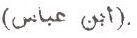
‘Abdu ‘llah, the eldest son of ‘Abbas and a cousin of Muhammad. One of the most celebrated of the Companions, and the relator of numerous traditions. It is said that the angel Gabriel appeared to him, when he was only ten years old, and revealed to him the meaning of the Qur'an, which accounted for his intimate acquaintance with the letter and meaning of the book. He was called Tarjumenu ‘l-Qur'an, or the interpreter of the Qur'an." He was appointed Governor of al-Basrah by the Khalifah ‘Ali, which office he held for some time. He returned to the Hijaz and died at at-Taif A.H. 68. (A.D. 687), aged 72 years.
IBN HANBAL 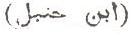
The Imam Abu ‘Abdi ‘llah Ahmad ibn Hanbal, the founder of the fourth orthodox sect of the Sunnis was born at Baghdad A.H. 164, A.D. 780, where he received his education under Yazid ibn Harun and Yahya ibn Sa'id. On ash-Shafi'i coming to Baghdad (A.H. 195). Ibn Hanbal attended the lectures delivered there by that doctor, and was instructed by him in the traditions. In process of time he acquired a high reputation from his profound knowledge of both the civil and spiritual law, and particularly for the extent of his erudition with respect to the precepts of the Prophet of which it is said that he could repeat above a million. His fame began to spread just at the time when the disputes ran highest concerning the nature of the Qur'an, which some held to have existed from eternity, whilst others maintained it to be created. Unfortunately for Ibn Hanbal the Khalifah al-Mu'tasim was of the latter opinion to which this doctor refusing to subscribe, he was imprisoned and severely scourged by the Khalifah's order.
For this hard usage, indeed, he afterwards received some satisfaction from al-Mutawakkil, the son of al-Mu'tasim, who, upon succeeding to the throne, issued a decree of general toleration, leaving every person at liberty to judge for himself upon this point. This tolerant Khalifah set the persecuted doctor at liberty, receiving him at his Court with the most honorable marks of distinction, and offering him a compensatory present of 1,000 pieces of gold, which, however, he refused to accept. After having attained the rank of Imam, he retired from the world, and led a recluse life for several years. He died in A.H. 241 (A.D. 855), aged 75. He obtained so high a reputation for sanctity, that his funeral was attended by a train of 800,000 men, and 60,000 women; and it is asserted as a kind of miracle, that on the day of his decrease no fewer than 20,000 Jews and Christians embraced the faith. For about a century after his death, the sect of Ibn Hanbal were numerous and even powerful; and uniting to their zeal a large proportion of fanaticism, became at length so turbulent and troublesome as to require the strong arm of Government to keep them in order. Like most other fanatical sects, they dwindled away in process of time, and are now to be met with only in a few parts of Arabia. Although orthodox in their other tenets, there was one point on which they differed from the rest of the Muslims; for they asserted that God had actually set Muhammad upon his throne, and constituted him his substitute in the government of the universe; an assertion which was regarded with horror, as an impious blasphemy, and which brought them into great disrepute. This, however, did not happen until many years after Ibn Hanbal's decrease, and is in no degree attributed to him. He published only two works of note: One entitled the Musnad, which is said to contain above 30,000 traditions selected from 760,000; and another, a collection of apothegms, or proverbs, containing many admirable precepts upon the government of the passions. He had several eminent pupils particularly Ism'il al-Bukhari and Muslim Ibn Da'ud. His authority is but seldom quoted by any of the modern commentators on jurisprudence.
The modern Wahhabis are supposed to follow (to some extent) the teachings of Ahmad ibn Hanbal.
IBN KHALLIKAN 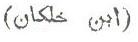
The well-known Muhammadan biographer. He drew his descent from a family of Balkh. He was born at Arbelah, but resided at Damascus, where he filled the office of chief Qazi, and died A.D. 681 (A.D. 1282). His biographical dictionary has been translated into English by Baron de Slane. (Paris 1843.) The biographical notes in the present work are chiefly from Ibn Khallikan's work.
IBN MAJAH 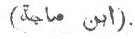
Abu ‘Abdi ‘llah Muhammad Ibn Yazid Ibn Majah al-Qazwini was maulawi of the tribe of Rabi'ah, and a celebrated Hafiz of the Qur'an, and is known as the compiler of the Kitabu'e Sunan, or "Book of Traditions." This work
is counted one of the six Sahihs, or authentic collections of Hadis. Born A.H. 209 (A.D. 824). Died A.H. 273 (A.D. 886).
IBN MAS'UD 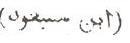
‘Abdu ‘llah ibn Mas'ud, "a companion" of considerable note. One of the illustrious "ten" (‘AAsharah Mubashsharah) to whom Muhammad gave an assurance of Paradise. He was present at the battle of Badr and subsequent engagements. Died at al-Madinah A.D. 32 aged 60.
IBN MALJAM 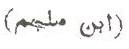
The Muslim who slew the Kahlifah ‘Ali. The author of the Hayatu ‘l-Qulub (Merrick's Translation, p. 204) says when ‘Ali was martyred by Ibn Muljam his celestial likeness (i.e. in the 'Alamu ‘l-Misal) appeared wounded also; wherefore angels visit the similitude morning and evening and curse the name of Ibn Muljam.
IBN SAIYAD 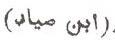
A mysterious personage who lived in the time of Muhammad, and who was mistaken by some people for ad Dajjalu ‘l-Masih, or the Anti-Christ. ‘Abdu ‘l-Haqq says some say he was a Jew of al-Madinah named ‘Abdu ‘llah.
Ibn ‘Umar relates that the Prophet went to Ibn Saiyad, accompanied by a party of his companions, and found him playing with boys; and at this time he had nearly reached puberty; and Ibn Saiyad had no intimation of the coming of the Prophet and the companions, till the Prophet struck him upon the back, and said, "Do you bear witness that I am the Prophet of God?" The Ibn Saiyad looked at the Prophet and said, "I bear witness that you are the Prophet of the illiterate." After that he said to the Prophet, "Do you bear witness that I am the Prophet of God?" Then the Prophet pressed him with both his hands and said, "I believe in God and His Prophets": and then said to Ibn Saiyad, "What do you look at?" He said, "Sometimes a person comes to me telling the truth; and sometimes another person telling lies; like as magicians to whom devils bring truth and falsehood." The Prophet said, "The Devil comes to you and brings you news, false and true." After that, the Prophet said, ‘Verily, I have concealed a revelation from you" (which was the one in which there is mention of the smoke); and Ibn Saiyad said, "Is it the one with the smoke?" Then the Prophet said, "Begone! You cannot surpass your own degree!" Ibn ‘Umar said, "O Prophet of God! Do you permit me to strike off Ibn Saiyad's head?" He said, "If Ibn Saiyad be Dajjal, you will not be able to kill him, because Jesus will be his slayer; and it he is not Dajjal there can be no good in your killing him." After this the Prophet and Ubaiy ibn Ka'b al Ansari went towards some date trees belonging to Ibn Saiyad and the Prophet hid himself behind branches, to listen to what he would say before Ibn Saiyad discovered him. And at this time Ibn Saiyad was lying upon his bed, with a sheet over his face, talking to himself; and his mother saw the Prophet standing behind the branches of the trees, and said to her son, "Muhammad is standing." At this he became silent; and the Prophet said, "Had not his mother informed him he would have said something to have discovered what he is. Then the Prophet repeated, "Praised be God, by that which is worthy of him"; and then mentioned Dajjal and said, "Verily, I fear for you from Dajjal; there is no Prophet but he alarmed his people about him. Verily, Noah frightened his people about Dajjal; but I will tell you a thing in the matter of Dajjal, which no Prophet ever told his people; know that he is blind, and that verily God is not blind."
Abu Sa'id al-Khudri says: "Ibn Saiyad asked the Prophet about the earth of Paradise; and he said, ‘The earth of Paradise is in whiteness like flour twice sifted and in smell like pure musk.' And I accompanied Ibn Saiyad from al-Madinah to Makkah; and he said to me, ‘What trouble I have experienced from people's supposing me Dajjal! Have you not heard, O Ibn Saiyad, the Prophet of God say, "Verily Dajjal will have no children? And I have; and verily, the Prophet has said, "Dajjal is an infidel," and I am a Muslim'; and the Prophet said, "Dajjal will neither enter al-Madinah nor Makkah"; and verily, I am going from al-Madinah and intend going to Makkah.' After that, Ibn Saiyad said, in the latter part of his speech, ‘Beware; I swear by God, I know the place of Dajjal's birth, and where he stays; and I know his father and mother.' Then this made me doubtful; and I said, ‘May the remainder of your days be lost to you.' A person present said to Ibn Saiyad, ‘Would you like to be Dajjal?' He said, ‘If I possessed what Dajjal is described to have, such as the power of leading astray, I should not dislike it."
Ibn ‘Umar says: "I met Ibn Saiyad when he had swollen eyes, and I said, ‘How long has this been?' He said, ‘I do not know.' I said, ‘Do not know, now that your eyes are in your head?' He said, ‘If God pleased He could create eyes in your limbs, and they would not know anything about it; in this manner also; man is so employed as to be insensible to pains.' Then Ibn Saiyad made a noise from his nose, louder than the braying of an ass.' (Mishkat, book xxiii. ch. v.)
IBN ‘UMAR 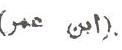
Abu ‘Abdi ‘r-Rahman ‘Abdu ‘llah, son of ‘Umar the celebrated Khalifah, was one of the most eminent of the "Companions" of Muhammad. He embraced Islam with his father when he was only eight years old. For a period of sixty years he occupied the leading position as a traditionist, and al-Bukhari, the collector of traditions says the most authentic are those given on the authority of Ibn ‘Umar. He died at Makkah A.H. 73 (A.D. 692), aged 84 years.
IBRAHIM 
The patriarch Abraham. [ABRAHAM.]
IBRAHIM 
The infant son of Muhammad by his slave girl, Mary the Copt. Born A.H. 8, died A.H. 10 (A.D. 631).
ID 
[FESTIVAL.]
IDAN 
The Dual of ‘Id, a festival. The two festivals, the ‘Idu ‘l-Fitr, and the ‘Idu ‘l-Axha.
IDDAH 
Lit. "Number." The term of probation incumbent upon a woman in consequence of a dissolution of marriage, either by divorce or the death of her husband. After a divorce or the period is three months, and after the death of her husband, four months and ten days, both periods being enjoined by the Qur'an (Surah lxv. 4 ii. 234.)
IDGAH 
Lit. "A place of festival." A Persian term for the musalla, or praying-place, set apart for the public prayers said on the two chief festivals, viz. ‘Idu ‘l-Fitr, and ‘Idu ‘l-Azha. [‘IDAN.]
IDIOTS
Arabic majnun  , pl. majanin. Mr. Lane, in his Modern Egyptians, vol. i. p. 288, says:-
"An idiot or a fool is vulgarly regarded by them as a being whose mind is in heaven, while his grosser part mingles among ordinary mortals; consequently he is considered an especial favorite of heaven. Whatever enormities a reputed saint may commit (and there are many who are constantly infringing precepts of their religion), such acts do not affect his fame for sanctity; for they are considered as the results of the abstraction of his mind from worldly things; his soul, or reasoning faculties, being wholly absorbed in devotion, so that his passions are left without control. Lunatics who are dangerous to society are kept in confinement; but those who are harmless are generally regarded as saints. Most of the reputed saints of Egypt are either lunatics, or idiots, or imposters."
IDOLATRY
The word used in the Qur'an for idolatry is shirk  , and for an idolater , mushrik
  , pl. mushrikun. In theological works the word wasani
  is used for an idolater (wasan, and idol), and 'ibadatu ‘l-ausan
  for idolatry.
In one of the earliest Surahs of the Qur'an (when chronologically arranged), lii. 35-43, idolatry is condemned in the following language:-
"Were they created by nothing? Or were they the creators of themselves?"
"Created they the Heaven and Earth? Nay, rather, they have no faith."
"Hold they thy Lord's treasures? Bear they the rule supreme?"
"Have they a ladder for hearing the angels? Let anyone who hath heard them bring a clear proof of it."
"Hath God daughters and ye son?"
"Asketh thou pay of them? They are themselves weighed down with debts."
"Have they such a knowledge of the secret things that they can write them down?"
"Desire they to lay snares for thee? But the snared one shall be they who do not believe."
"Have they any God beside God? Glory be to God above what they join with Him."
But they are, in a later Surah (nearly the last), ix. 28 declared unclean, and forbidden to enter the sacred temple at Makkah. That was after Muhammad had destroyed the idols in his last pilgrimage to the Sacred House.
"O Believers! Only they who join gods with God are unclean! Let them not, therefore, after this their year, come neat the sacred temple. And if ye fear want, God, if He please, will enrich you of His abundance: for God is Knowing, Wise."
In a Surah given about the same time (iv. 51, 116), idolatry is declared to be the unpardonable sin:-
"Verily, God will not forgive the union of other gods with Himself! But other than this will He forgive to whom He pleaseth. And he who uniteth gods with God hath devised a great wickedness."
"God truly will not forgive the joining other gods with Himself. Other sins He will forgive to whom He will; but he who joineth gods with God, hath erred with far-gone error."
Nor is it lawful for Muslims to pray for the souls of idolaters, as is evident from Surah ic. 114:
"It is not for the prophet or the faithful to pray for the forgiveness of those, even though they be of kin, who associate other beings with God, after it hath been made clear to them that they are to be inmates of Hell."
"For neither did Abraham ask forgiveness for his father, but in pursuance of a promise which he had promised to him; but when it was shewn him that he was an enemy to God he declared himself clear of him. Yet Abraham was pitiful, kind."
Sir William Muir says (Int. p. ccxii.) that "Mahomet is related to have said that Amr son of Lohai (the first Khozaite king, A.D. 200) was the earliest who dated to change the ‘pure religion of Ishmael,' and set up idols brought from Syria. This, however, is a mere Muslim conceit. The practice of idolatry thickly overspread the whole peninsula from a much more remote period."
From the chapters from the Qur'an, already quoted, it will be seen that from the very first Muhammad denounced idolatry. But the weakness of his position compelled him to move cautiously. The expressions contained in the al-Madinah Surahs, given when Muhammad could not enter Makkah, are much more restrained than those in the Surahs given after the capture of Makkah and the destruction of the idols of the Ka'bah.
At an early period (about the fifth year) of his mission, Muhammad seems to have contemplated a compromise and reconciliation with Makkan idolatry. Sir William Muir.
(quoting from at-Tabari, pp. 140-142, and Katibu ‘l-Waqidi, p. 40), says:-
"On a certain day, the chief men of Mecca, assembled in a group beside the Kaaba, discussed, as was their wont, the affairs of the city. Mahomet appeared and, seating himself by them in a friendly manner, began to recite in their hearing Sura liii. The chapter opens with a description of the first visit of Gabriel to Mahomet, and then unfolds a second vision of that angel, in which certain heavenly mysteries were revealed. It then proceeds:-
And see ye not Lat and Ozza.
And Manat the third besides?
"When he had reached this verse, the devil suggested to Mahomet an expression of thoughts which had long possessed his soul, and put into his mouth words of reconciliation and compromise, the revelation of such as he had been yearning that God might sent unto his people, namely:-
These are the exalted females.
And verily their intercession is to be hoped for.
"The Coreish were astonished and delighted with this acknowledgment of their deities; and as Mahomet would up the Sura with the closing words,-
Wherefore bow down before God, and serve Him, the whole assembly prostrated themselves with one accord on the ground and worshiped. Walid alone, unable from the infirmities of age to bow down, took a handful of earth and worshiped, pressing it to his forehead.
"And all the people were pleased at that which Mahomet had spoken, and they began to say, ‘Now we know that it is the Lord alone that giveth life and taketh it away, that createth and supporteth. And as for these our goddesses, make intercession with Him for us; wherefore, as thou hast conceded unto them a portion, we are content to follow thee."
"But their words disquieted Mahomet, and he retired to his house. In the evening Gabriel visited him, and the Prophet (as was his wont) recited the Sura unto him. And Gabriel said, ‘What is this that thou hast done? Thou hast repeated before the people words that I never gave unto thee.' So Mahomet grieved sore, and feared the Lord greatly; and he said, ‘I have spoken of God that which he hath not said.' But the Lord comforted His Prophet, and restored his confidence, and canceled the verse, and revealed the true reading thereof (as it now stands), namely:-
And see ye not Lat and Ozza
And Manat the third besides?
What! Shall there be male progeny unto you, and female unto him?
That were indeed an unjust partition!
They are naught but names, which ye and your fathers have invented, &c.
"Now when the Coreish heard this, they spoke among themselves, saying, ‘Mahomet hath repented his favorable mention of the rank of our goddesses with the Lord. He hath changed the same, and brought other words instead.' So the two Satanic verses were in the mouth of every one of the unbelievers, and they increased their malice, and stirred them up to persecute the faithful with still greater severity." (Sir W. Muir's Life of Mahomet, new ed. 86, seqq.)
The Commentators do not refer to this circumstance, and pious Muhammadans would reject the whole story, but, as Sir W. Muir says, "the authorities are too strong to be impugned."
These narratives of at-Tabari and the secretary of al-Waqidi are fully borne out in the facts of Muhammad's subsequent compromise with the idolatrous feelings of the people; for whilst he removed the images from the Ka'bah, he at the same time retained the black stone as an object of superstitious reverence, and although he destroyed Isaf and Na'ilah, the deities of as-Sara and al-Marwab, he still retained the "running to and fro," and the "stoning of the pillars," as part of the sacred rites of what was intended to be a purely theistic and iconoclastic system. The most singular feature in the fetishism of Arabia was the adoration paid to unshapen stones, and Muhammad found it impossible to construct his religion without some compromise with the popular form of idolatry. It is a curious circumstance that so much of the zeal and bigotry of the Wahhabi puritans is directed against the shirk, or idolatry, of the popular veneration for tombs and other objects of adoration, and yet they see no objection to the adoration of the black stone, and those other strange and peculiar customs which form part of the rites of the Makkan pilgrimage.
IDOLS
Arabic wasan  , pl. ausan, also sanam
  , pl. asnam, both words being used in the Qur'an. Ten of the idols of ancient Arabia are mentioned by name in the Qur'an, viz:-
Surah iv. 52: "Hast thou not observed those to whom a part of the Scriptures hath been given? They believe in al-Jibt and at-Taghut, and say of the infidels, ‘These are guided in a better path than those who hold the faith.'"
Surah liii. 19: :Have ye considered al-Lat, al-‘Uzza, and Manat the third?"
Surah lxxi. 21 : "They have plotted a great plot and siad, ‘Ye shall surely not leave your gods: ye shall surely neither leave Wadd, nor Suwa', nor Yaghus, nor Ya'uq, nor Nasr and they led astray many."
Al-Jibt and at-Taghut (the latter also mentioned in Surah ii. 257, 259) were according to Jalalu ‘d-din, two idols of the Quraish whom certain renegade Jews honored in order to please the Quraish.
Al-Lat was the chief idol of the Banu Saqif at at-Ta'if. The name appears to be the feminine of Allah, God.
Al-‘Uzza has been identified with Venus, but it was worshiped under the form of an acacia tree, and was the deity of the Banu Ghatafan
Manat was a large sacrificial stone worshiped by the Banu Khuza'ah and Banu Huzail.
The five idols, Wadd, Suwa', Yaghus, Ya'uq, and Nasr, the commentators say, were originally five persons of eminence in the time of Adam, who after their deaths were worshiped in the form of idols.
Wadd was worshiped by the Banu Kalb in the form of a man, and is said to have represented heaven.
Suwa' was a female deity of the Banu Hamdan.
Yaghus was a deity of the Banu Mazhij and in the form of a lion.
Ya'uq was an idol of the Banu Murad in the shape of a horse.
Nasr was, as its name implies, an image of an eagle, and worshiped by Himyar.
It is said (according to Burkhardt, p. 164) that at the time of Muhammad's suppression of idol worship in the Makkan temple, there were not fewer than 360 idols in existence.
The chief of the minor deities was Hubal, an image of a man, and said to have been originally brought from Syria. Other well-known idols were Isaf, an idol on Mount as-Safa, and Na'ilah, an image on Mount al-Marwah, as part of the rites of the pilgrimage, the Prophet not being able to divert entirely the regard of the people for them.
Habhah was a large sacred stone on which camels were sacrificed, and the Hajaru ‘l-Aswad, or Black Stone, was an object, as it still is; of idolatrous worship. In the Ka'bah there were also images representing Abraham and Ishmael, each with divining arrows in his hand.
The statement, made by some writers, that the image or picture of Jesus and Mary had a place in the Ka'bah, seems to be without any authority.
Although Herodotus does not refer to the Ka'ban, yet he mentions as one of the chief divinities of Arabia Alilat, which is strong evidence of the existence of an idol called al-Lat at that time as an object of worship. (Herod. iii. 8) [IDOLATRY.]
IDRIS
 A prophet mentioned twice in the Qur'an, about whose identity there is some discussion.
Surah xix. 57: "Commemorate Idris in the Book; verily he was a man of truth and a Prophet; and we raised him to a lofty place."
Surah xxi. 85: "And Ishmael, and Idris, and Zu ‘l-Kifl - all steadfast in patience."
Al-Baizawi says Idris was of the posterity of Shis (Seth) and a forefather of Noah, and his name was Uhnukh (Enoch, Heb.  , Consecrated). He was called Idris from dars to instruct from his knowledge of divine mysteries and thirty portions of God's sacred scriptures were revealed to him. He was the first person who learned to write, and he was the inventor of the science of astronomy and arithmetic.
Husain says, "In the Jami'u ‘l-Usul, it is written that Idris was born one hundred years after the death of Adam."
The Jalalan say the meaning of the words in the Qur'an, "we raised him to a lofty place" is that he giveth either in the fourth heaven, or in the sixth or seventh heaven, or that he was raised up from the dead and taken to Paradise.
The Kamalan say, "In the book called the Rauzatu ‘l-Ahbab, Ibn Jarir relates that Idris was the special friend of one of the angels of heaven, and that this angel took him up into the heavens, and when they arrived in the fourth heaven, they met the Angel of Death. The angel asked the Angel of Death how many years there were remaining of the life of Idris; and the Angel of Death said, ‘Where is Idris; and the Angel of Death said, ‘Where is Idris for I have received orders to bring death to him?' Idris then remained in the fourth heaven, and he died in the wings of his angel friend who had taken him from earth."
Some of the Commentators think Idris and Elijah (Ilyas) are the same persons. But the accounts given seem to identify him with Enoch.
'IDU ‘L-AZHA
 Vulg. Id-i-Zuha. "The feast of sacrifice." Called also Yaumu'n Nahr; Qurban-‘Id; Baqarah ‘Id (i.e. the cow festival); and in Turkey and Qgypt 'Idu Bairam. It is also called the 'Idu ‘l kabir, the great festival, as distinguished from the 'Idu ‘l-Fitr, which is called the minor festival, or al-‘Idu-saghir.
It is celebrated on the tenth day of Zu ‘l-Hijjah, and is part of the rites of the Makkah pilgrimage, although it is observed as well in all parts of Islam both as a day of sacrifice and as a great festival. It is founded on an injunction in the Qur'an, Surah xxii. 33-38.
"This do. And they who respect the symbols of God; perform an action which proceedeth from piety of heart."
"Ye may obtain advantages from the cattle up to the set time for signing them; then the place for sacrificing them is at the ancient House."
"And to every people have we appointed symbols, that they may commemorate the name of God over the brute beasts which He hath provided for them. And you God is the one God. To Him, therefore, surrender yourselves: and bear thou good tidings to those who humble themselves, -"
"Whose hearts, when mention is made of God, thrill with awe; and to those who remain steadfast under all that befalleth them, and observe prayer, and give alms of that with which we have supplied them."
"And the camels have we appointed to you for the sacrifice to God; much good have ye in them. Make mention, therefore, of the name of God over them when ye slay them, as they stand in a row; and when they are fallen over on their sides, eat of them, and feed him who is content and asketh not, and him who asketh. Thus have We subjected them to you, to the intent ye should be thankful."
"By no means can their flesh reach unto God, neither their blood; but piety on your part reacheth Him. Thus hath He subjected them to you, that ye might magnify God for His guidance; moreover, announce glad tidings to those who do good deeds."
The institution of the sacrifice was as follows: A few months after the Hijrah, or flight from Makkah, Muhammad, dwelling in al-Madinah, observed that the Jews kept, on the tenth day of the seventh month, the great fast of the Atonement. A tradition records that the Prophet asked them why they kept this fast. He was informed that it was a memorial of the deliverance of Moses and the children of Israel from the hands of Pharaoh. "We have a greater right in Moses than they," said Muhammad, so he fasted with the Jews and commanded his followers to fast also. This was at the period of his mission when Muhammad was friendly with the Jews of al-Madinah, who occasionally came to hear him preach. The Prophet also occasionally attended the synagogue. Then came the change of the Qiblah from Jerusalem to Makkah, for the Jews were not so ready to change their creed as Muhammad had at first hoped. In the second year of the Hijrah, Muhammad and his followers did not participate in the Jewish fast, for the Prophet now instituted the ‘Idu'l-Azha. The idolatrous Arabs had been in the habit of making an annual pilgrimage to Makkah at this season of the year. The offering of animals in sacrifice formed a part of the concluding ceremony of that pilgrimage. That portion - the sacrifice of animals - Muhammad adopted in the feast which now, at al-Madinah, he substituted fro the Jewish fast. This was well calculated to attract the attention of the Makkans and to gain the goodwill of the Arabs. Muhammad could not then make the pilgrimage to Makkah, for as yet there was a hostile feeling between the inhabitants of the two cities; but on the tenth day of the month Zu ‘l-Hijjah, at the very time when the Arabs at Makkah were engaged in sacrificing victims, Muhammad went forth from his house at al-Madinah, and assembling his followers instituted the ‘Idu ‘l-Azha. Two young kids were brought before him. One he sacrificed and said: "O Lord! I sacrifice this for my whole people, all those who bear witness to Thy unity and to my mission. O Lord! This is for Muhammad and for the family of Muhammad."
There is nothing in the Qur'an to connect this sacrifice with the history of Ishmael, but it is generally held by Muhammadans to have been instituted in commemoration of Abraham's willingness to offer up his son as a sacrifice. And Muhammadan writers generally maintain that the son was Ishmael and not Isaac, and that the scene took place on Mount Mina near Makkah, and not in the land of Moriah, as is stated in Genesis.
The following is the account given by Muhammadan writers: - "When Ibrahim (the peace of God be upon him) founded Makkah, the Lord desired him to prepare a feast for Him. Upon Ibrahim's (the friend of God) requesting to know what He would have on the occasion, the Lord replied, ‘Offer up thy son Isma'il.' Agreeably to God's command he took Isma'il to the Ka'bah to sacrifice him, and having laid him down, he made several ineffectual strokes on his throat with a knife, on which Isma'il observed, ‘Your eyes being uncovered, it is through pity and compassion for me you allow the knife to miss; it would be better if you blindfolded yourself with the end of your turban and then sacrificed me.' Ibrahim acted upon his son's suggestion and having repeated the words, 'Bi-smi ‘llahi, allahu akbar' (i.e. ‘In the name of God! God is great!'), he drew the knife across his son's neck. In the meanwhile, however, Gabriel had substituted a broac-tailed sheep for the youth Isma'il, and Ibrahim unfolding his eyes observed, to his surprise, the sheep slain, and his son standing behind him." (See Qisasu‘l-Ambiya.)
It is a notable fact that whilst Muhammad professed to abrogate the Jewish ritual, and also ignored entirely the doctrine of the Atonement as taught in the New Testament, denying even the very fact of our Saviour's crucifixion, he made the "day of sacrifice" the great central festival of his religion.
There is a very remarkable Hadis, related by ‘Ayishah, who states that Muhammad said, "Man hath not done anything on the ‘Idu'l-Azha more pleasing to God than spilling blood; for verily the animal sacrificed will come, on the day of resurrection, with its horns, its hair, and its hoofs, and will make the scale of his (good) actions heavy. Verily its blood reacheth the acceptance of God, before it falleth upon the ground, therefore, be joyful in it." (Mishkat, book iv. ch. xlii; sec. 2.)
Muhammad has thus become a witness to the doctrine of the Christian faith that "without shedding of blood, there is no remission." The animal sacrificed must be without blemish, and of full age; but ut may be either a goat, a sheep, a cow, or a camel.
The religious part of the festival is observed as follows: - The people assemble in the morning for prayer, in the ‘Idgah, or place erected outside the city for these special festival prayers. The whole congregation then standing in the usual order, the Imam takes his place in front of them and leads them in two rak'ahs of prayer. After prayers the Imam ascends the mimbar or pulpit and delievers a Khutbah, or oration, on the subject of the festival.
We are indebted to Mr. Sell for the following specimen of the Khutbah:-
"In the name of God, the Compassionate, the Merciful."
"God is Great. There is no God but God. God is Great! God is Great and worthy of all praise. He is Holy. Day and night we should praise Him. He is without partner, without equal. All praise be to Him. Holy is He, Who makes the rich generous, Who provides the sacrifice for the wise. He is Great, without an equal. All praise be to
Him. Listen! I testify that there is no God but God. He is alone, without partner. This testimony is as bright as the early dawn, as brilliant as the glorious feast day. Muhammad is His servant who delivered His message. On Muhammad and his family, and on his Companions may the peace of God rest. On you who are present, O congregation of Muslimin, may the mercy of God for ever rest. O servants of God! Our first duty is to fear God and to be kind. God has said, ‘I will be with those who fear Me and are kind.'
"Know, O servants of God! That to rejoice on the feast day is the sign and mark of the pure and good. Exalted will be the rank of such in Paradise, especially on the day of resurrection will they obtain dignity and honor. Do not on this day foolish acts. It is no time for amusements and negligence. This is the day on which to utter the praises of God. Read the Kalimah, the Takbir, and Tamhid. This is a high festival season and the feast of sacrifice. Read not the Takbiru ‘t-Tashriq. God is great! God is great! There is no God but God! God is great! God is great! All praise be to Him! From the morning of the ‘Arafah, after every farz rak'ah, it is good for a person to repeat the Takbiru ‘t-Tashriq. The woman before whom is a man as Imam, and the traveler whose Imam is a permanent resident, should also repeat the Takbir. It should be said at each Namaz until the Salatu ‘l-Asr of the Feast day (10th). Some, however, say that it should be recited every day till the afternoon of the thirteenth day, as these are the days of the Tashriq. If the Imam forgets to recite, let not the worshiper forget. Know, O believers, that every free man who is a Sahib-i-Nisab should offer sacrifice on this day, provided that this sum is exclusive of his horse, his clothes, his tools, and his household goods and slaves. It is wajib for everyone to offer sacrifice for himself, but it is not a wajib order that he should do it for his children. A goat, a ram, or a cow, should be offered in sacrifice for every seven persons. The victim must not be one-eyed, lame, or very thin."
"If you sacrifice a fat animal it will serve you well, and carry you across the Sirat. O Believers, thus said the Prophet, on whom be the mercy and peace of God, ‘Sacrifice the victim with your own hands, this was the Sunnah of Ibrahim, on whom be peace.'"
"In the Kitabu Zadi ‘t-Taqwa it is said that, on the ‘Idu ‘l-Fitr and the ‘Idu ‘l-Azha, four nafl rak'ahs should be said after the farz Namaz of the ‘Id. In the first rak'ah after the Suratu ‘l-Fathihah recite the Suratu ‘l-A'la (Surah xxvii); in the second, the Suratu ‘sh-Shams (Surah xci.); in the third, the Suratu ‘z-Zuha (Surah xciii.); in the fourth, the Suratu ‘l-Ikhlas (cxii.)."
"O Believers, if ye do so, God will pardon the sins of fifty years which are past and of fifty years to come. The reading of these Surahs is equal, as an act of merit, to the reading of all the books God has sent by His prophets."
"May God include us amongst those who are accepted by Him, who act according to the Law, whose desire will be granted at the Last Day. To all such there will be no fear in the Day of Resurrection; no sorrow in the examination at the Day of Judgment. The best of all books is the Qur'an. O Believers! May God give to us and to you a blessing forever, by the grace of the Noble Qur'an. May its verses be our guide, and may its wise mention of God direct us aright. I desire that God may pardon all believers, male and female, and Muslimin and the Muslimat. O believers, also seek for pardon. Truly God is the Forgiver, the Merciful, the Eternal King, the Compassionate, the Clement. O believers, the Khutbah is over. Let all desire that on Muhammad Mustafa the mercy and peace of God may rest."
The Khutbah being ended, the people all return to their homes. The head of the family then takes a sheep, or a cow, or a goat, or camel, and turning its head towards Makkah says:
"In the name of the great God."
"Verily, my prayers, my sacrifice, my life, my death, belong to God, the Lord of the worlds. He has no partner: that is what I am bidden: for I am first of those who are Muslim (i.e. resigned)."
And then he slays the animal. The flesh of the animal is then divided into three portions, one third being given to relations, one third to the poor, and the remaining third reserved for the family. Quite apart from its religious ceremonies, the festival is observed as a great time of rejoicing, and the holiday is kept for two or three days in a similar way to that of the minor festival or the ‘Idu ‘l-Fitr. [HAJJ, ISHMAEL, SACRIFICE.]
'IDU ‘L-FITR
 Lit., "The Festival of the Breaking of the Fast." It is called also 'Idu Ramazan, the 'Idu ‘s-Sadaqah (Feast of Alms), and the 'Idu ‘s-saghir (Minor Festival). It commences as soon as the month's fast in Ramazan is over, and consequently on the first day of the month of Shawwal. It is specially a feast of alms-giving. "Bring out your "alms," said Ibn ‘Abbas, "for the Prophet has ordained this as a divine institution, one Sa' of barley or dates, or a half Sa' of wheat: this is for every person, free or bond, man or woman, old or young, to purify thy fast (i.e. the month's fast just concluded) of any obscene language, and to give victuals to the poor." (Mishkat, book vi. ch. iii.)
On this festival the people, having previously distributed the alms which are called the Sadaqatu ‘l-Fitr, assemble in the vast assembly outside the city in the Idgah, and, being led by the Imam, recite two rak'ahs of prayer. After prayers the Imam ascends the mimbar, or pulpit, and delivers the khutbah, or oration. We are indebted to Mr. Sell for the following specimen of one of these sermons:-
"In the name of God, the Compassionate, the Merciful."
"Holy is God who has opened the door of mercy for those who fast, and in mercy and kindness has granted them the right of an entrance into heaven. God is greater that all. There is no God save Him. God is great! God is great! And worthy of praise. It is of His grace and favor that He rewards those who keep the fast. He has said: ‘I will give in the future world houses and palaces, and many excellent blessings to those who fast. God is great! God is great! Holy is He who certainly sent the Qur'an to our Prophet in the month of Ramazan, and who sends angels to grant peace to all true believers. God is great! And worthy of all praise. We praise and thank Him for the ‘Idu ;l-Fitr, that great blessing; and we testify that beside Him there is no God. He is alone. He has no partner. This witness which we give to His Unity will be a cause of our safety here, and finally gain us an entrance to Paradise. Muhammad (on whom be the mercy and peace of God) and all famous prophets are his slaves. He is the Lord of genii and of men. From Him comes mercy and peace upon Muhammad and his family, so long as the world shall last. God is greater than all. There is none beside Him. God is great! God is great! And worthy of praise. O company of Believers, O congregation of Muslims, the mercy of the True One is on you. He says that this Feast day is a blessing to you, and a curse to the unbelievers. Your fasting will not be rewarded, and your prayers will be stayed in their flight to heaven until you have given the sadaqah. O congregation of Believers, to give alms is to you a wajib duty. Give to the poor some measures of grain or it money equivalent. Your duty in Ramazan was to say the Tarawih prayers, to make supplication to God, to sit and mediate (i'tikaf) and to read the Qur'an. The religious duties of the first ten days of Ramazan gain the mercy to God, those of the second ten merit His pardon; whilst those of the last ten save those who do them from the punishment of hell. God has declared that Ramazan is a noble month, for is not one of its nights, the Lailatu ‘l-Qadr, better than a thousand months? On that night Gabriel and the angels descended from heaven: till the morning breaks it is full of blessing. Its eloquent interpreter, and its clearest proof is the Qur'an, the Word of God most Gracious. Holy is God who says in the Qur'an: ‘This is a guide for men, a distinguisher between right and wrong.' O Believers, in such a month be present, obey the order of your God, and fast; but let the sick and the travelers substitute some other days on which to fast, so that no days be lost, and say: ‘God is great! And praise Him. God has made the fast easy for you. O Believers, God will bless you and us by the grace of the Holy Qur'an. Every verse of it is a benefit to us and fills us with wisdom. God is the Bestower, the Holy King, the Munificent, the Kind, the Nourisher, the Merciful, the Clement."
The Khutbah being ended, the whole congregation raise their hands and offer a manajat for the remission of sins, the recovery of the sick, increase of rain, abundance of corn, preservation from misfortune, and freedom from debt. The Imam then descends to the ground, and makes further supplication for the people, the congregation saying "Amin" at the end of each supplication. At the close of the service the members of the congregation salute and embrace each other, and offer mutual congratulations, and spend the rest of the day in feasting and merriment.
Mrs. Meer Hasan Ali, in her Observations of the Musalmans of India, says:-
"The assemblies of the ladies on this feastival are marked by all the amusements and indulgence they can possibly invent or enjoy in their secluded state. Some receiving, others paying visits in covered conveyances; all doing honor to the day, by wearing their best jewellery and most splendid dress. The Zananah rings with festive songs and loud music, the cheerful meeting of friends, the distribution of presents to dependants, and remembrances to the poor; all is life and joy, cheerful bustle and amusement, on this happy day of festival, when the good lady of the mansion sits in state to receive presents from inferior and to grant proofs of her favor to others."
Mr. Lane, in his Modern Egyptians, vol. ii, p. 238, thus describes the ‘Idu ‘l-Fitr, as kept in Egypt:-
"Soon after sunrise on the first day, the people having all dressed in new, or in their best clothes, the men assemble in the mosques, and perform the prayers of two rak'ahs, a Soonneh ordinance of the ‘eed; after which, the Khateeb delivers an exhortation. Friends, meeting in the mosque, or in the street, or in each other's houses, congratulate and embrace and kiss each other. They generally visit each other for this purpose. Some, even of the lower classes, dress themselves entirely in a new suit of clothes, and almost everyone wears something new, if it be only a pair of shoes. The servant is presented with at least one new article of clothing by the master, and receives a few piaster from each of his master's friends, if they visit the house; or even goes to those friend to congratulate them, and receives his present; if he have served a former master, he also visits him, and is in like manner rewarded for his trouble; and sometimes he brings a present of a dish of sweet cakes, and obtains, in return, money of twice the value, or more. On the days of this ‘eed, most of the people of Cairo eat salted fish, and thin, folded pancakes, and a kind of bun. Some families also prepare a dish consisting of stewed meat, with onions, and a quantity of treacle, vinegar, and coarse flour; and the master usually procures dried fruits, such as nuts, raisins, &c., for his family. Most of the shops in the metropolis are closed, except those at which eatables and sherbet are sold; but the streets present a gay appearance, from the crowds of passenger in their holiday clothes
"On one or more days of this festival, some or all of the members of most families, but chiefly the women, visit the tombs of their relatives. This they also do on the occasion of the other grand festival. [‘IDU ‘L-AZHA.] The visitors, or their servants, carry palm branches, and sometimes sweet basil, to lay upon the tomb, which they go to visit. The palm-branch is broken into several pieces on the tomb."
"Numerous groups of women are seen on these occasions, bearing palm-branches, on their way to the cemeteries in the neighborhood of the metropolis. They are also provided, according to their circumstances, with cakes, bread, dates, or some other kind of food, to distribute to the poor who resort to the burial-ground these days. Sometimes tents are pitched for them; the tents surround the tomb which is the object of the visit. The visitors recite the Fat'hhah, or, of they can afford it, employ a person to recite first the Soorat Ya'-Seen, or a larger portion of the Kuran. Often a khutmeh (or recital of the whole of the Quran) is performed at the tomb, or in the house, by several fickees. Then men generally return immediately after these rites have been performed, and the fragments or leaves of the palm-branch laid on the tomb; the women usually go to the tomb early in the afternoon; some of them (but these are not generally esteemed women of correct conduct), if they have a tent, pass the night in it, and remain until the end of the festival, or until the afternoon of the following Friday; so too, do the women of a family possessed of a private, enclosed burial-ground, with a house within it, for there are many such enclosures, and not a few with housed for the accommodation of the females in the midst of the public cemeteries of Cairo. Intrigues are said to be not uncommon with the females who spend the night in tents among the tombs. The great cemetery of Bab en-Nusr, in the desert tract immediately on the north of the metropolis, presents a remarkable scene on the two ‘eeds. In a part next the city-gate from which the burial-ground takes its name, many swings and whirligigs are erected, and several large tents, in some of which dancers, reciters of Aboo-Zyed, and other performers, amuse a dense crowd of spectators; and throughout the burial-ground are seen numerous tents for the reception of the visitors of the tombs. About two or three days after the ‘eed above described, the ‘Kisweh,' or covering of the Kaabah, which is sent annually with the great caravan of pilgrims, is conveyed in procession from the citadel of the metropolis, where it is manufactured at the Sooltan's expense, to the mosque of the Hbasaneyn, to be sewed together and lined, preparatively to the approaching pilgrimage." [KISWAH.]
The visiting of tombs on the occasion of the two festivals is not a custom in India. It is generally done in the Muharram, both by the Sunnis and the Shi'ahs.
'IFFAH
 "Chastity, continence, purity." Ahlu'iffah, "those who are chaste."
'IFRIT
 A demon, or class of demons, mentioned in the Qur'an (Surah xxvii. 39). They are said to be giants, and very malicious. The ghosts of the wicked dead are sometimes called by this name. [GENII.]
'IFTAR
 Lit.. "Breaking." Breaking the month's fast on the evening of ‘Idu ‘l-Fitr, that is, at the first sight of the new moon, after sunset. It is also used for breaking the fast every evening after sunset during the month of Ramazan. It is, according to the example of the Prophet, to break the fast by eating either dates or salt.
IHDAD
 The period of mourning observed by a widow for her husband, namely, four months and ten days. [MOURNING.]
IHLAL
 Lit. "Raising the voice." A term used for the Talbiyah. [TALBIYAH.]
IHRAM
 Lit. "Prohibiting." The pilgrim's dress, and also the state in which the pilgrim is held to be from the time he assumes this distinctive garb until he lays it aside. It consists of two new white cotton cloths, each six feet long by three and a half broad. One of these sheets, termed rida' is thrown over the back, and, exposing the arm and shoulder, is knotted at the right side in the style called wishah. The other, called izar, is wrapped round the loins from the waist to the knee, and knotted or tucked in at the middle.
In the state of ihram, the pilgrim is forbidden the following actions: connection with or kissing women, covering the face, perfumes, hunting or slaying animals, anointing the head with oil, cutting the beard or shaving the head, coloring the clothes, washing the head or beard with marsh mallows, cutting the nails, plucking a blade of grass, cutting a green tree. But although the pilgrim is not allowed to hunt or slay animals, he may kill the following noxious creatures: a lion, a biting dog, a snake or scorpion, a crew, a kite, and a rat. For each offence against the rules of ihram, special sacrifices are ordained, according to the offence. [HAJJ.]
IHSAN
 Lit. "To confer favors, or to perform an action in a perfect manner." A term used in the Traditions for the sincere worship of God. Muhammad said Ihsan was "both to worship God as if thou sawest Him, and to remember that God seest thee." (Mishkat, book i. ch. i. pt. 1.) The word is used in this sense by the Sufi mystics. (‘Abdu ‘r-Razzaq's Dict. Of Sufi Terms.)
IHSAN
 Lit. "Keeping a wife secluded." A legal term for a married man. (Hutounh vol. ii, p. 49)
IHSARU ‘L-HAJJ 
The hindering of the Pilgrimage. For example: If a pilgrim be stopped on his way by any unforseen circumstance, such as sickness or accident, he is required to send an animal to be sacrificed in the Sacred City. (Hidayah, Arabic ed. vol. i. p. 184.) This injunction is founded upon the teaching of the Qur'an, Surah ii. 193. "And if he be prevented; then send whatever offering shall be easiest: and shave not your heads until the offering reach the place of sacrifice. But whoever among you is sick, or hath an ailment of the head, must expiate by fasting, or alms, or a victim for sacrifice. And when ye are secure (from hindrances) then he who delights in the visitation (‘Umrah) of the holy place until the Pilgrimage, shall bring whatever offering shall be the easiest. But he who that nothing to offer shall fast three days in the Pilgrimage and seven days when ye return; they shall be ten days in all."
IHTIKAR 
Hoarding up grain with the object of raising the price. Used for monopoly of all kinds. Abu Hanifah restricts its use to a monopoly of the necessaries of life. It is strictly forbidden by Muhammad, who is related to have said: "Whoever monopoliseth is a sinner"; "Those who bring grain to a city to sell at a cheap rate are blessed, and they who keep it back in order to sell at a high rate are cursed." (Mishkat, book xii. ch. viii.)
IHTILAM 
Pollution nocturna; after which ghusl, or legal bathing, is absolutely necessary. [PURIFICATION.]
IHTIMAM 
"Superintendence; care." The trust or jurisdiction of a landowner over certain portions of land.
IHYAU ‘L-MAWAT 
Lit. "The revival of dead lands." A legal term for the cultivation of wastes.
IHZAR 
A summons citing to appear before a Qazi or Judge.
IJAB 
The first proposal made by one of the parties in negotiating or concluding a bargain. [MARRIAGE.]
IJARAH 
Price, hire, wages, rent, profit, emolument, according to the subject to which it applies. [HIRE.]
IJMA 
The third foundation of Islam. It literally means "collecting," or "assembling," and in Muslim divinity it expresses the unanimous consent of the Mujtahidun (learned doctors); or, as we should call it, "the unanimous consent of the Fathers." A Mujtabid is a Muslim divine of the highest degree of learning, a title usually conferred by Muslim rulers. [MUJTAHID.] There are three foundations of Ijma': (1) Ittifaq-i-Qauli, unanimous consent expressed on declaration of opinion; (2) Ittifaq-i-Fi'li expressed in unanimity of practice; (3) Ittifaq-i-Sakula, when the majority of the Mujtahidun signified their tacit assent to the opinion or the minority by "silence" or non-interference.
The Mujtahidun capable of making Ijma' must be "men of learning and piety, not heretics or fools, but men of judgment."
There is great diversity of opinion as to up to what period in the history of Islam Ijma' can be accepted. Some doctors assert that only the Ijma' of the Mujtahidun who were Ashab (companions); others, that of those who were not only "companions" but "descendants" of the "Prophet", can be accepted: whilst others accept the Ijma' of the Ansars (helpers), and of the Muhajirun (fugitives), who were dwellers in al-Madinah with Muhammad. The majority of learned Muslim divines, however, appear to think that Ijma' may be collected in every age, although they admit that, owing to the numerous divisions which have arisen amongst Muhammadans, it has not been possible since the days of the Taba'u t-Tabisin (i.e. the followers of the followers of the Companions).
The following is considered to be the relative value of Ijma' : -
That of the Ashab (companions) is equal to Hadis Mutawatir. That which was decided afterwards, but in accordance with the unanimous opinion of the Ashab, is equal to Hadi-i-Khabar-i-Mashhur, and that upon which there was diversity of opinion amongst the Ashab, but has since been decided by the later Mujtahidun is equal to Hadis-i-Khabar-i-Wahid. (See Syud Ahmad Khan's Essay.)
Some European writers confuse the term Ijma' with Ijtihad is the deduction made by a single Muhrahid, whilst Ijam' is the collective opinion of a council of Mujtahidun, or enlightened doctors.
Amongst the Shi'ahs, there are still Mujtahidun whose Ijma' is accepted, but the Sunnis have four orthodox schools of interpretation, named after their respective founders - Hanafi, Shafa'i, Malaki, and Hambali. The Wahhabis for the most part reject Ijma' collected after the death of "the Companions."
It will be easily understood what a fruitful source of religious dissension and sectarian strife this third foundation of the rule of faith is. Divided as the Christian Church is by its numerous sects, it will compare favorably with Muhammadanism even in this respect. Muhammad it is related, prophesied that, as the Jewish Church had been divided into seventy-one sects! And the Christians into seventy-two! So his followers would be divided into seventy-three sects! But every Muslim historian is obliged to admit that they have far exceeded the limits of Muhammad's prophecy; for according to ‘Abdu ‘l-Qadir al-Jilani, there are at least 150.
IJTIHAD 
Lit. "Exertion." The logical deduction on a legal or theological question by a Mujtahid or learned and enlightened doctors, as distinguished from Ijma', which is the collective opinion of a council of divines.
This method of attaining to a certain degree of authority in searching into the principles of jurisprudence is sanction by the Tradition: -
"The Prophet wished to send a man named Mu'az to al-Yaman to receive some money collected for alms, which he was then to distribute to the poor. On appointing him he said: ‘O Mu'az, by what rule will you act?' He replied, ‘By the Law of the Qur'an.' ‘But if you find no direction therein?' ‘Then I will act according to the Sunnah of the Prophet.' ‘ but what if that fails?' ‘Then I will make an Ijtidhad, and act on that.' The Prophet raised his hands and said, ‘Praise be to God who guides the messenger of His Prophet in what He pleases.'"
The growth of this system of divinity is traced by a Sunni writer, Mirza Qasim Beg, Professor in the University of St. Petersburg (extract from which are given in Sell's Faith of Islam), as follows: -
1. God, the only legislator, has shown the way of felicity to the people whom He has chosen, and in order to enable them to walk in that way He has shown to them the precepts which are found partly in the eternal Qur'an, and partly in the sayings of the Prophet transmitted to posterity by the Companions and preserved in the Sunnah. That way is called the Sharia'ah (law). The rules thereof are called Ahkam (commandments).
2. The Qur'an and the Sunnah, which since their manifestation are the primitive sources of the orders of the Law, form two branches of study, viz. ‘Ilm-i-Tafsir, or the interpretation of the Qur'an, and ‘Ilm-i-Hadi, or the study of Tradition.
3. All the orders of the Law have regard either to the actions (Din), or to the belief (Iman) of the faithful (Mukallif).
4. As the Qur'an and the Sunnah are the principal sources from whence the precepts of the Sahri'ah have been drawn, so the rules recognized as the principal elements of actual jurisprudence are the subject of ‘Ilm-i-Fiqh, or the science of Law.
Fiqh in its root signifies "conception, comprehension." Thus Muhammad prayed for Ibn Mas'ud: "May God make him comprehend (Faqqaha-hu), and make him know the interpretation of the Qur'an." Muhammad in his quality of Judge and chief of the Believers decided, without appeal or contradiction, all affairs of the people. His sayings served as a guide to the Companions. After the death of the Prophet the first Khalifahs acted on the authority of the Traditions, meanwhile the Qur'an and the Sunnah, the principal elements of religion and legislation, became little by little the subject of controversy. It was then that men applied themselves vigorously to the task of learning by heart the Qur'an and Traditions, and then that jurisprudence became a separate science. No science had as yet been systematically taught, and the early Musalmans did not possess books which would serve for such teaching. A change soon, however, took place. In the year in which the great jurisconsult of Syria died (A.H. 80), Nu'man ibn Sabit, surnamed Abu Hanifah, was born. He is the most celebrated of the founder of the schools of jurisprudence, a science which ranks first in all Muslim seats of learning. Until that time and for thirty years later the learned doctors had all their knowledge by heart, and those who possessed good memories were highly esteemed. Many of them knew by heart the whole Qur'an with the comments made on it by the Prophet and by the Companions; they also knew the Traditions and their explanations, and all the commands which proceed from the Qur'an and the Sunnah. Such men enjoyed the right of Mujtahidun. They transmitted their knowledge to their scholars orally. It was not till towards the middle of the second century of the Hijrah that treatises on the different branches of the Law were written, after which six schools (Mazhabs) of jurisprudence were formed. The founders (all Imams of the first class) were Abu Hanifah, the Imamu ‘l-A'zam or greatest Imam (A.H. 150), Sufyan as-Sauri (A.H. 161), Malik (A.H. 179), ash-Shagi'i (A.H. 204), Ibn Hanbal (A.H. 241), and the Imam Dawud az-Zahiri (A.H. 270). The two sects founded by as-Sauri and az-Zahiri became extinct in the eighth century of the Hijrah. The other four still remain. These men venerated one another. The younger ones speak with great respect of the elder. Thus ash-Shafi'i says: "No one in the world was so well versed in jurisprudence as Abu Hanifah was, and he who has read neither his works nor those of his disciples knows nothing of jurisprudence." Ibn Hanbal, when sick, wore a shirt which had belonged to ash-Shafi'i, in order that he might be cured of his malady; but all this did not prevent them starting schools of their own, for the right of Ijtihad is granted to those who are real Mujtahidun.
There are three degrees of Ijtihad:
1. Ijtihad f i'sh-Shar', absolute independence in legislation.
2. Ijtihad f i ‘l-Mazhab, authority in the judicial systems founded by the Mujtahidun of the first class.
3. Ijtihad f i'l-Masa il, authority in cases which have not been decided by the authors of the four systems of jurisprudence.
The first is called a complete and absolute authority, the second relative, the third special.
Absolute independence in legislation is the gift of God. He to whom it is given when seeking to discover the meaning of the Divine Law is not bound to follow any other teacher. He can use his own judgment. This gift was bestowed on the jurisconsults of the first, and to some of the second and third centuries. The Companions, however, who were closely connected with the Prophet, having transmitted immediately to their posterity the treasure of legislation, are looked upon as Mujtahidun of much higher authority than those of the second and third centuries. Thus Abu Hanifah says: "That which comes to us
from the Companions is on our head and eyes (i.e. to be received with respect); as to that which comes from the Tabi'un, they are men and we are men."
Since the time of the Tabi'un this degree of Mujtahid has only been conferred on the six great Imams before mentioned. Theoretically any Muslim can attain to this degree, but it is one of the principles of jurisprudence that the confirmation of this rank is dependent on many conditions, and so no one now gains the honor. These conditions are: -
1. The knowledge of the Qur'an and all that is related to it; that is to say, a complete knowledge of Arabic literature, a profound acquaintance with the orders of the Qur'an and all they sub-divisions, their relationship to each other and their connection with the orders of the Sunnah. The candidate should know when and why each verse of the Qur'an was written, he should have a perfect acquaintance with the literal meaning of the words, the speciality or generality of each clause, the abrogating and abrogated sentences. He should be able to make clear the meaning of the "obscure" passages (Mutashabih), to discriminate between the literal and the allegorical, the universal and the particular.
2. He must know the Qur'an by heart with all the Traditions, or at least of three thousand of them.
3. He must have a perfect knowledge of the Traditions, or at least of three thousand of them.
He must know their source, history, object, and their connection with the laws of the Qur'an. He should know by heart the most important Traditions.
4. A pious and austere life.
5. A profound knowledge of all the sciences of the Law.
Should anyone now aspire to such a degree another condition would be added, viz.:-
6. A complete knowledge of the four schools of jurisprudence.
The obstacles, then, are almost insurmountable. On the one hand, there is the severity of the ‘Ulama', which requires from the candidate things almost impossible; on the other, there is the attachment of the ‘Ulama' to their own Imams, for should such a man arise no one is bound not to listen to him. The Imam Ibn Hanbal said: "Draw your knowledge from whence the Imams drew theirs, and do not content yourself with following others, for that is certainly blindness of sight." Thus the schools of the four Imams remain intact after a thousand years have passed, and so the ‘Ulama' recognize since the time of these Imams no Mujtahid of the first degree. Ibn Hanbal was the last.
The rights of the man who attained to this degree were very important. He was not bound to be a disciple of another , he was a mediator between the Law and his followers, for whom he established a system of legislation, without anyone having the right to make any objection. He had the right to explain the Qur'an, the Sunnah, and the Ijma', according as he understood them. He used the Prophet's words, whilst his disciples only used his. Should a disciple find some discrepancy between a decision of his own Imam and the Qur'an or Traditions, he must abide by the decision of the Imam. The Law does not permit him to interpret after his own fashion. When once the disciple has entered the sect of one Imam he cannot leave it an join another. He loses the right of private judgment, for only a Mujtahid of the first class can dispute the decisions of one of the Imams. Theoretically, such Mujtahidun may still arise; but, as we have already shown, practically they do not.
This degree has been granted to the immediate disciples of the great Imams who have elaborated the systems of their masters. They enjoyed the special consideration of the contemporary ‘Ulama', and of their respective Imams who in some cases have allowed them to retain their own opinion. The most famous of these men are the two disciples of Abu Hanifah, Abu Yusuf, and Muhammad ibn al-Hasan. In a secondary matter their opinion carries great weight. It is laid down as a rule that a Muftu may follow the unanimous opinion of these two even when it goes against that of Abu Hanifah.
This is the degree of special independence. The candidates for it should have a perfect knowledge of all the branches of jurisprudence according to the four schools of the Arabic language and literature. They can solve case which come before them, giving reasons for their judgment, or decide on cases which have not been settled by previous Muhtahidun; but in either case their decisions must always be in absolute accordance with the opinions of the Mujtahidun of the first and second classes, and with the principles which guided them. Many of these men attained great celebrity during their lifetime, but to most of them this rank is not accorded till after their death. Since their Imam Qazi Khan died (A.H. 592), no one has been recognized by the Sunnis as a Mujtahid even of the third class.
There are three other inferior classes of jurist, called Muqallidun, or followers of the Mujtahidun; but all that the highest in rank amongst them can do is to explain obscure passages in the writings of the older juriconsults. By some of the ‘Ulama', they are considered to be equal to the Mujtahiun of the third class. If there are several conflicting legal opinions on any point, they can select one opinion on which to base their decision. This a mere Qazi cannot do. In such a case he would have to refer to these men or to their writings for guidance. They seem to have written commentaries on the legal systems without originating anything new. The author of the Hidayah, who lived at the end of the sixth century, was a Muqallid.
IKHLAS 
Lit. "Sincerity." (1) A theological term, implying that a Mus-
lim performs his religious acts in the sight of God alone, and not to be seen of men. (2) Al-Iklas, the title of the CXIIth Surah of the Qur'an. A chapter which occurs in the daily prayer, and reads thus: -
Professor Palmer says this chapter is generally known as al-Ikhlas, "clearing oneself," i.e. of belief in any but one God.
IKRAH 
[COMPULSION.]
'IKRIMAH 
Lit. "A hen pigeon." The son of Abu Jahl ibn Hisham. A "companion" of the Prophet. He embraced Islam after the final taking of Makkah. For some years he and his father, Abu Jahl, were determined opponents of Islam. He was one of the heroes of the Quraish at the battle of Bade, and commanded the left wing of the Quraish army at Uhud. He opposed the Prophet's advance on Mekkah, and on defeat fled to Jiddah, intending to escape to Africa, but he was brought back by his wife to Makkah, and received pardon from Muhammad, and embraced Islam. He became one of Abu Bakr's generals, and died in his reign.
'IKRIMAH 
Abu ‘Abdi ‘llah ‘Ikrimah ibn ‘Abdi'illah, was a slave belonging to Ibn ‘Abbas. His master took great pains to teach him the Qur'an and the Traditions, and consequently he is known as a traditionist of some note. His master, Ibn ‘Abbas died without giving him his liberty, and ‘Ali the son of Ibn ‘Abbas sold him to Khalid ibn Yazid for four thousand dinars. But ‘Ikrimah went to ‘Ali and said, "You have sold your father's learning for four thousand dinars!" Upon this, ‘Ali, being ashamed, obtained Khalid's consent to annul the bargain, and he granted ‘Ikrimah his liberty. He died A.H. 107 (A.D. 725), aged 84.
ILA' 
A form of divorce in which a man makes a vow that he will not have connection with his wife for not less than four months and observes it inviolate. The divorce is thereby effect ipso facto, without a decree of separation from the judge. See Qur'an, Suratu ‘l-Baqarah, ii. 226: "Those who swear off from their woman, the must wait four months; but is they break their vow, God is forgiving and merciful."
Sulaiman ibn Yasar says: "I was in company with about ten of the Prophet's Companions, and every one said, "A man who swears that he will not go near his wife for four months shall be imprisoned until he return to her, or he shall divorce her.'" (Mishkat, book xiii. ch. xiii.)
ILAH 
An object of worship or adoration; i.e. a god, or deity. The term Allah, "God," being Ilah with the definite article  al, i.e. ilah "the God."
ILAHI 
From Ilah, "God." (1) That which is diving e.g. ad-dinu ‘l-Ilahi, the divine religion. (2) Ilahi is also used for the era instituted by the Emperor Akbar, commencing with the first year of his reign, A.H. 963, A.D. 1556. Although found on the coins of Akbar and his immediate successors, it never obtained currency, and is now obsolete.
I'LAN 
Publishing the notice of marriage by sending messengers to the houses of friends. A custom which is founded upon the express injunction of the Prophet, as reported by ‘Ayishah: "Give notice of marriages, perform them in mosques, and beat drums for them." (Mishkat, book xiii. ch. iv. pt. 2.)
ILHAM 
[INSPIRATION.]
AL-ILHAMU ‘R-RABBANI 
[INSPIRATION.]
ILLEGITIMATE CHILDREN
An illegitimate child, Arabic waladu ‘z-zina'  , has legally no father, and a putative father is, therefore, excluded from the custody of such a child. The child only inherits from its mother and the mother's relations, who in return inherit from him. (Tagore Law Lectures 1873, pp. 123, 488.)
ILLIYUN 
The seventh stage of celestial bliss. Also the register in which the good deeds of Muslims are said to be written. See Suratu ‘t-Tatfif, lxxxiii. 18: "The register of the righteous is in ‘Illiyun." See also Mishkat, book v. ch. iii. pt. 3: "The angels follow it (the soul) through each heaven, and the angels of one region pass it on to the next until it reaches the seventh heaven, when God says, ‘Write the name of my servant in 'Illiyun, and return him to the earth, that is, to his body which is buried in the earth."
ILM 
Lit. "To know; knowledge." In Muslim theology, the word 'Ilm is always used for religious knowledge. ‘Abdu ‘l-Haqq says it is the knowledge of religion as expressed in "the Book" (Qur'an) and the "Sunnah" (Traditions), and is of two kinds, 'Ilmu ‘l-Mabadi, elementary knowledge, or that relating to the words and sentences of the Qur'an and Hadis; and 'Ilmu ‘l-Maqasad, perfected knowledge, or that relating to faith and works, as taught in the Qur'an and Hadis. There is also 'Ilmu ‘l-Mukashafah, revealed knowledge, or that secret knowledge, or light, which shines into the heart of the pious Muslim, whereby he becomes enlightened as to the truths of religion. This spiritual knowledge is also called 'Ilmu ‘l-Haqiqah, or the knowledge of the truth. It is related (Mishkat, book ii. ch. i. Arabic ed.) that the Prophet said ‘Ilm is of three kinds, viz. Ayatu ‘l-Muhkam, Sunnatu ‘l-Qaim, and Farizatu ‘l-Adil, and that whatever is beyond these three is not necessary. The learned doctors explain these terms as fol-
lows: Ayatu ‘l-Muhkam, the established text of verses of the Qur'an; Sunnatu ‘l-Qa im, the correct Ahadis or Traditions; and Farizatu ‘l-Adi', the lawful interpretation of the Qur'an and the Traditions.
The acquisition and the imparting of religious knowledge is very highly commended by Muhammad (see Mishkatu ‘l-Masabih, in loco.) -
"The desire of knowledge is a divine commandment for every Muslim, and to instruct in knowledge those who are unworthy or it is like putting pearls, jewels, and gold on the necks of swine."
"Whoever is asked about the knowledge which he hath, and concealeth it, will be reined with a bridle of fire on the Day of Resurrection."
"There are two avaricious persons that are never satisfied: one of them in knowledge, the more he attains the more he desires; the other of the world, with the things of which he is never satisfied."
"That person who will pursue the road of knowledge, God will direct him to the road of Paradise; and verily the angels spread their arms to receive him that seeketh after knowledge, and everything in heaven and earth will ask grace for him. Verily the superiority of a learned man over a worshiper is like that of the full moon over all the stars."
'ILMU ‘L-ADAB 
The science of Philogoy. In Hajji Khalfah, Lexicon, vol. i. p. 215, quoted by Lane, it is "the science by which one guards against error in the language of the Arabs, with respect to words and with respect to writing.
The science of polite writing is classed under twelve heads: 1. lughah, lexicology; 2. sa if, accidence; ishtiqaq, derivation; 4. nuhw, syntax; 5. ma'ani, sense of meaning; 6. hayan, eloquence; 7. 'aruz, prosody; 8. qaf iyah, rhyme; 9. rasmu ‘l-khatt, calligraphy; 10. qarz-ush-shi'i, versification; 11. insha u n'-nasr prose composition; 12. muhazarah, dictation. These sections are regarded as distinct sciences.
'ILMU ‘L-AKHLAQ 
Ethics, morals. The best-know works on the subject are the Persian works - the Akhlaq-i-Jalali by Faqir Jam Muhammad, A.H. 908, which has been translated into English, with references and notes by W.F. Thompson, Esq. (London, 1839); the Akhlaq-i-Nasari, by Nasiru ‘d-din at-Tusi, A.H. 672; and the Akhlaq-i-Muhsini by the Maulawi Husain al-Kausifi (Husain the commentator), A.H. 910.
'ILMU ‘L-AKTAF 
The science of divining by the shoulder-blades of sheep. It was the custom of the ancient Arabs to place the shoulder-bone of a sheep in the sun, and to examine it, in the same way as by the science of palmistry (Kashfu ‘z-Zunun, in loco.)
'ILMU ‘L-AQA'ID 
[‘ILMU ‘L-KALAM.]
'ILMU ‘L-ASMA 
The knowledge of the names, titles or attributes of God. [GOD, ZIKR, SUFIISM.]
'ILMU ‘L-BATIN 
The mystic science; the same as Tasawwuf. [SUFIISM.]
'ILMU ‘L-FALAK 
The science of Astronomy. According to the Muhammadans the earth is the centre of the astronomical system. The seven planets which are called the nujumi, ‘s-saiyarat or wandering stars as distinguished from fixed stars, are 1. Qamar, Moon; 2. 'Utarid, Mercury; 3. Zuhrah, Venus; 4. Shams, Sun; 5. Mirrikh, Mars; 6. Mustari, Jupiter; 7. Zuhal, Saturn.
The Arabian arrangement of the planets is that of Ptolemy, who placed the earth in the centre of the universe, and the nearest to it the moon, whose synodic revolution is the shortest of all, being performed in 29 ½ days. Next to the moon he placed Mercury, who returns to him conjunctions in 116 days. After Mercury followed Venus, whose periodic time is 584 days. Beyond Venus he placed the sun, then Mars, next Jupiter, and lastly Saturn, beyond which are the fixed stars.
The signs of the zodiac (mintaqalu ‘l-buruq) are called : 1. Hamal, Ram; 2. Saur, Bull; 3. Jauza, Twins; 4. Saratan, Crab; 5. Asad, Lion; 6. Sunbalah (lit. and ear of corn). Virgin; 7. Mizan, Scales; 8. Aqrab, Scorpion; 9. Qaus (bow), Archer; 10. Jady (he goat), Capricaorn; 11. Dalw (watering-pot). Aquarius; 12. Hul, Fish.
'ILMU ‘L-FARA'IZ 
The law of inheritance [INHERITANCE.]
'ILMU ‘L-FIQH 
Jurisprudence; and the knowledge of all subjects connected with practical religion. In the first place, Fiqh deals with the five pillars of practical religion; 1. the recital of the creed; 2. prayer; 3. Fasting; zakat or almsgiving; 5 hajj or pilgrimage; and in the second place with all questions of jurisprudence such as marriage, divorce, inheritance, sale, evidence, slavery, partnership, warfare, &c. &c.
The chief Sunni works on the subject are: Of the Hanafi sect, the Hidayah, the Fataw'a-i-‘Alamqui, the Darru ‘l-Mukhhtar, and Raddu ‘l-Muhtar; of the Shafi'i and Malaki sects, the Kitabu ‘l-Anwar, the Muharrar, and the Ikhtilaju'l-A'immah. The best-known Shi'ah works on jurisprudence are the Shara'i'u ‘l-Islam, the Mafatih, and the Jami'u ‘sh-Shatai.
'ILMU ‘L-HADIS 
The science of the Traditions i.e. the various canons which have been established for ascertaining the authenticity and genuineness of the Hadis or Traditions. The Nukhbatu ‘l-Fikar, with its commentary the Nuzhatu ‘n-Nazar by Shaliabu ‘d-din Ahmad al-‘Asqalani (Lee's ed, Calcutta, 1862), is a well-known work on the subject.
'ILMU ‘L-HANDASAH 

The science of Geometry.
'ILMU ‘L-HIKMAH 
Also 'Ilmu ‘l-Falsafah  . [PHILOSOPHY.]
'ILMU ‘L-HISAB 
Arithmetic.
'ILMU ‘L-ILAHIYAT 
A knowledge of divinity. [THEOLOGY.]
'ILMU ‘L-INSHA 
The art of literary composition. [INSHA'.]
'ILMU ‘L-JABR 
Algebra.
'ILMU ‘L-KAFF 
The science of palmistry said to have been practiced by Daniel.
'ILMU ‘L-KALAM 
Scholastic theology. It is also known as 'Ilmu ‘l-Aqa'id, the science of the articles of belief. The author of the Kashfu ‘z-Zunun defines it as "the science whereby we are able to bring forward proofs of our religious belief", and it includes the discussion of the nature of the existence and the attributed of God.
Ilmu'l-Kalam is the discussion of all subjects connected with the six articles of the Muslim Creed: 1. the Unity of God; 2. the Angels; 3. the Books; 4. the Prophets; 5. the Day of Judgment; 6. the Decrees of God, as distinguished from al-Fiqh, which is an exposition of the five foundations of practical religion – 1, recital of the Creed; 2, prayer; 3, fasting; 4, zakat; 5, hajj.
The most celebrated works on the subject of ‘Aqa'id or ‘Ilmu ‘l-Kalam are: Shathu ‘l-‘Aqa'id, by the Maulawi Mas'ud. Sa'du ‘d-din at-Taftazani, A.H. 792; the Sharhu ‘l-Muwaqif, by Saiyid Sharif Jurjani.
'ILMU ‘L-LUGHAH 
Lexicography. [ARABIC LEXICONS.]
'ILMU ‘L-MANTIQ 
Logical Science. [LOGIC.]
'ILMU ‘L-MASAHAH 
Mensuration.
'ILMU ‘L-MILAHAH 

The nautical art. The science of making and navigating ships.
'ILMU ‘L-MUSIQA 
The science of Music. [MUSIC.]
'ILMU ‘L-USUL 
The science of the "roots", or fundamentals of the religion of Muhammad, namely, of the Qur'an, Ahadis, Ijma', and Qiyas. The science of exegesis, or the rules of interpretation of these four roots of Islam. An explanation of the methods of this science will be found in the article on the QUR'AN, Sect. Viii., the same principles applying to the other three fundamentals.
The best know works on the "Ilmu ‘l-Usu are the Manar, by ‘Abdu ‘llah ibn Ahmad an-Nasafi, A.H. 719, and its commentary, the Nuru ‘l-Anwar; also at-Tanqih, by ‘Ubaidu ‘llah ibn Mas'ud, A.H. 747, with its commentary, at-Tauzih, by the same author, and a super-commentary, the Talwihu ‘t-Tauzih, by Sa'du ‘d-din Mas'ud ibn ‘Umar at-Taftazani, A.D. 792.
AL-'ILMU ‘L-YAQIN 
Certain knowledge; demonstration; a religious life; a knowledge of the truth.
'ILMU ‘N-NABATAT 
Botany. The knowledge of the use of herbs.
'ILMU ‘N-NUJUM 
Astrology. "The science by which are discovered the events both of the present and of the future by means of the position of the stars. (Kashfu ‘z-Zunun, in loco) [ASTROLOGY.]
'ILMU ‘R-RAML 
Geomancy. A pretended divination by means of lines on the sand (raml). It is said to have been practiced as a miracle by six prophets, viz. Adam, Idris, Luqman, Armiya, (Jeremiah), Sha'ya' (Isaiah), Daniel. (See Kashfu ‘z-Zunu, in loco.)
'ILMU ‘R-RIYAZAH 
Mathematics. The author of the Kashfu ‘z-Zunun says the science of Riyazah is divided into four sections: 1, hadasah, geometry; 2, hi'ah, astronomy; 3, hisab, arithematic; 4, musiqa, music.
'ILMU ‘SH-SHI'R 
[POETRY.]
'ILMU ‘S-SIHR 
The science of magic. [MAGIC.]
'ILMU ‘S-SIMIYA 
Natural magic, chiromancy, palmistry.
AL-'ILMU ‘T-TABI'I 
Natural philosophy.
AL-'ILMU ‘T-TAJWID 
called also 'Ilmu ‘l-Qira'ah. The science of reading the Qur'an correctly. The most popular work on the subject is al-Muqaddamatu ‘l-Jazariyah, by the Shaikh Muhammad ibn Muhammad al-Jazari (A.H. 833).
'ILMU ‘T-TASAWWUF 

The mystic or contemplative science. [SUFIISM.]
'ILMU ‘T-TASHRIH 
The science of anatomy.
'ILMU ‘T-TAWARIKH 

or 'Ilmu ‘t-Ta'rikh. Chronology, history. For a complete list of Muhammadan histories of an early date, see Kashfu ‘z-Zunun, in loco.
'ILMU ‘T-TIBB 
The science of Medicine. For a list of medical books of an early date, see Kashfu ‘z-Zunun, in loco.
ILQA 
Lit. "Injecting; infusing." A theological term used for the
teaching of the heart by the power of God. Inspiration of soul in that which is good.
IMAGES
It is unlawful for a Muhammadan to have an image of any kind in his house. (Mishkat, book xx. ch. v. ) [PICTURES, IDOLS.]
IMAM 
One whose leadership or example is to be followed. A pattern; a model; and example of evil. The term is used in the Qur'an in these senses.
Surah ii. 118: "Verily I have set thee (Abraham) as an Imam (or a leader) for mankind."
Surah xvii. 73: "The day when we will call al men by their Imam (or leader)."
Surah xxxvi. 11: "Everything we have set down in a clear model."
Surah xv. 79: "They (Sodom and Midian) are an obvious example."
Surah xxv. 74: "Make us a model to the pious."
Muhammadans use the term in the following senses: -
(1) The Imam, or Khalifah, of the Muslim people. The author of the Hidayah says, by the rightful Imam is understood a person in who all the qualities essential to magistracy are united, such as Islamism, freedom, sanity of intellect, and maturity of age, and who has been elected into his office by any tribe of Muslims, with their general consent; whose view and intention is the advancement of the true religion, and the strengthening of the Muslims, and under whom the Muslims enjoy security in person and property; one who levies title and tribute according to the law; who, out of the public treasury, pays what is due to learned men preachers, qazis, muftis, philosophers, public teachers, and so forth; and who is just in all his dealing with Muslims; for whoever does not answer this description is not the right Imam, whence it is not incumbent to support such a one, but rather it is incum-
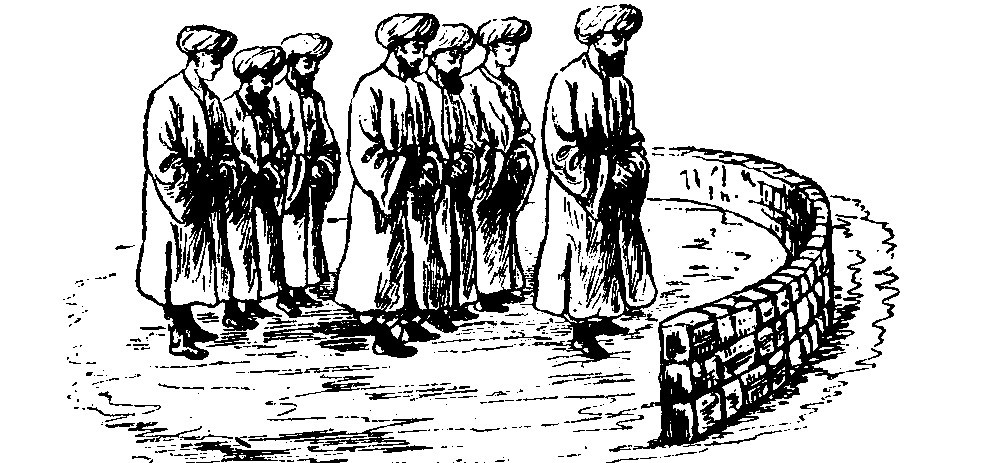
bent to oppose him, and make was upon him until such time as he either adopt a proper mode of conduct, or be slain; as is written in the Ma'dinu ‘l-Haqa'iq, copied from the Fawa'id. (Hidayah, col. ii. p. 248.)
For a discussion of this meaning of the title, refer to the article on KHALIFAH, which is the term used for the Imam of the Sunni Muslims.
(2) The Shi'ahs apply the term Imam to the twelve leaders of their sect whom they call the true Imams [SHI'AH], and not using the term Khalifah for this office as the Sunnis do. The Shi'ah traditions are very wild on the subject of the Imamate, and contrast unfavorably with those of the Sunnis.
In the Hayatu ‘l-Qulub (Merrick's edition, p. 208), Muhammad is said to have related: "On the night of the ascension, the Most High commanded me to inquire of the past prophets for what reason they were exalted to that rank, and they all testified, We were raised up on account of you prophetical office, and the Imamate of ‘Ali ibn Abi Talib, and of the Imams of your posterity. A divine voice then commanded, ‘Look on the right side of the empyrean,' I looked and saw the similitude of ‘Ali and al-Hasan, and al-Husain, and ‘Ali ibn al-Husain (alias Zainu ‘l-Abidin), and Muhammad al-Baqir, and Ja'far as-Sadiq, and Musa al-Kazim, and ‘Ali ibn Musa ar-Rize, and Muhammad at-Jaqi, and ‘Ali an-Naqi, and al-Hasan al-‘Askari, and al-Mahdi, all performing prayers in a sea of light. These, said the Most High, are my proofs, vicegerents, and friends, and the last of them will take vengeance on my enemies."
(3) The Imam, or leader, of any system of theology or law. Abu Hanifah and the other three doctors of the Sunnis are called Imams, and so are other leading doctors of divinity.
The term is still used for a religious leader. For example, the head of the Wahhabis on the North-West frontier of India is called the Umam and so is the chief of Najd.
(4) The Imam or leader of prayers in any Masjid. Mr. Sale says it answers to the Latin Antistes. Each mosque, however, small, has its Imam, or priest, who is supported by endowments. The office is not in any sense a sacerdotal one, the Imam, not being set apart with any ceremony, as in the case of a Christian presbyter, nor the office being hereditary, as in the case of the Hindu Brahmins. The position of the Imam in this sense is not unlike the sheliach, or legatus of the Jewish synagogue, who acted as the delegate of the congregation, and was the chief reader of prayers, in their name. But quite independent of the duly appointed minister of a mosque, who is responsible for its service, and receives its revenues, no congregation of Muslim worshipers can assemble without one of the party taking the lead in the prayers by standing in front, and who is said "to act as Imam" for the assembly.
The rules laid down on this subject, as given in the Traditions, are as follows (Mishkat, book iv. ch. xxvii., xxviii):-
Abu Sa'id al-Khudri says the Prophet said: ‘When there are three persons, one of them must act as Imam and the other two follow him, and the most worthy of them to act as such is he who repeats the Qur'an best."
Abu Ma'sud al-Ansari says the Prophet said" "Let him act as Imam to a congregation who knows the Qur'an thoroughly; and if all present should be equal in that respect, then let him perform who is best informed in the rules of prayer; and if they are equal in this respect also, let him act as Imam who has fled for the sake of Islam, and if equal in this likewise, let that person act who is oldest; but the governed must not act as Imam to the governor."
Abu Harauah relates that the Prophet said: "When any of you acts as Imam to others, he must be concise in his prayers because there are decrepit, aged, and sick persons amongst them, and when any one of you says his prayers alone, he may be as prolix as he pleases. [MASJID.]
IMAM-BARAH 
A building in which the festival of the Muharram is celebrated, and service held in commemoration of the deaths of ‘Ali and his sons, al-Hasan and al-Husain. At other times, the tazias, or shrines, are preserved in it; some times it is used as the mausoleum of the founder of the family. [MUHARRAM.]
IMAMIYAH 
Lit. "The followers of the Imam." The chief sect of the Shi'as, namely, those who acknowledge the twelve Imams. [SHI'AH.]
IMAM MUBIN 
"The clear prototype or model." The expression occurs twice in the Qur'an, Surah xxxvi. 11. "Everyone we do set down in a clear prototype (f i Lmamin Mubinin). Here it appears to be used for the Qur'an as an inspired record. Surah xv. 79, "Verily they became both, Sodom and Midian, a clear example." (labi Imamin Muhinin). Muhammadan teachers use the word for the Lahsau ‘l-Mahfuz or the Tablet of Decrees.
AL-IMAMU ‘L-MAHDI 

Lit. "The well-guided Leader." Umm Salmah relates that the Prophet said, "Strife and disputations will be created among men when a Khalifah shall die and this shall be in the last days. And a man of the people of al-Madinah will come forth and will flee from al-Madinah to Makkah, and the men of Makkah will come and try to make him Imam by flattery, but he will not be pleased. Then men shall acknowledge him as Imam. Then an army from Syria shall advance against him and this army shall be engulphed in an earthquake at Bada'ab, between Makkah and al-Madinah. Then when the people shall see this the Abdai, i.e. the Substitutes or good people [ABDAI.] will come from Syria, and a multitude from al-Iraq. And after that a man shall be born of the Quraish, of the tribe of Kalb, who will also send an army against him i.e. al-Mahdi; but he shall be victorious. Then he will rule people according to the laws of Muhammad and will give strength to Islam upon the earth, and he will remain on the earth seven years. Then he will die, and Muslims will say prayers in his behalf."
The Shi'ahs believe that al-Mahdi has already come and is still concealed in some part of the earth. For they suppose him to be the last of the twelve Imams, named Muhammad ‘Abdu ‘l-Qasim [SHI'AHS.], who will again appear in the last days. The Shi'ahs say that Muhammad said, "O ye people, I am the Prophet and ‘Ali is my heir, and from us will descend al-Mahdi, the seal of the Imams, who will take vengeance on the wicked." (Harjatu'l Quiub, p. 342.)
I'MAN, IMAN 
"Faith, which according to the Mohammadan doctors, is the belief of the heart and the confession of the lips to the truth of the Muslim religion. Faith is of two kinds: I'man Mujmal, or the simple expression of faith in the teaching og the Qur'an and the Ahadis, or Traditions; and I'man Mufassal, or a formal declaration of belief in the six articles of the Muslim Creed: 1. in God; 2, the Angels of God,; 3. the Books of God; 4. the Prophets of God; 5. the Day of Judgment; 6. Predestination to good and evil. In the Traditions, I'man includes practice (‘Amal), and all that belongs to the religious life of the Muslim. It is related (Mishkat, book i. ch. i.) That Muhammad said, "That person has tasted the sweets of faith who is pleased with God as his Lord; with Islam as his religion, and with Muhammad as the Prophet of God. And again (ib.), "The most excellent faith is to love him who loves God, and to hate
him who hates God, to keep the tongue employed in repeating the name of God [ZIKR.], and to do unto men as you would wish them to do unto you, and to reject for others what you would reject yourself.
Salvation by faith without works is clearly taught (Mishkat, book i. ch. i.) by Muhammad e.g "When anyone of you shall have believed truly and sincerely, then whatever good action that person may do will be rewarded from ten to seven hundred fold, and every sin he may commit will be expiated one by one before he dies." Good works, however, are the test of faith. A man asked the Prophet what was the sign whereby he might know the reality of his faith. He said, "If thou dost derive pleasure from the good that thou hast done, and art grieved for the evil which thou hast committed, then thou art a true believer." (Mishkat, book i. ch. i). Some of the Prophet's friends came to him and said, "Verily, we find in our minds such wicked propensities, that we think it even a sin to speak of them." The Prophet said, "Do you find them really bad?" They said, "Yes." He said, "This is evidence of faith." By which he meant, if the man had not faith, he would not have felt the wickedness of his heart.
IMLIQ 
The grandson of Shem, the son of Noah. The progenitor of the ‘Amaliqah, the Amalekites of scripture. They are said to be some of the earliest inhabitants of Makkah and al-Madinah.
IMMACULATE CONCEPTION
of the Virgin Mary. This doctrine was asserted by Muhammad (Mishkat, book i. ch. iii. pt. 1). The Prophet said, "There is not of the sons of Adam, except Mary and her Son, one born but is touched by the Devil at the time of his birth, and the child makes a loud noise from the touch.
When or where the doctrine of the Immaculate Conception was first taught is quite unknown. Perrene says that some writers have ascribed its origin to France, and he himself is of opinion that it came from the East, and was recognized in Naples in the ninth century. (Blunt's Dictionary of Doctrinal and Historical Theology, in loco.)
The doctrine of the Immaculate Conception was finally imposed as an Article of Faith in the Romish Church by Pius IX., Dec. 8th, 1854.
IMMODESTY
[MODESTY.]
IMPOSTURE
The Quraish charged Muhammad, at the early period of his preaching, with imposture. The following Surahs were given in answer to these charges:-
Surah xxv. 5-7: "Those who misbelieve say, "This is nothing but a lie which he has forged; and another people hath helped him at it"; but they have wrought an injustice and a falsehood. And they say, "They are old folk's sales which he has got written down while they are dictated to him morning and evening. Say He sent it down who knows the secrets of the heaven and earth."
Surah lxix. 40-41: "Verily it is the speech of a noble Apostle and it is not the speech of a poet - little is it you believe!"
"And it is not the speech of a soothsayer - little is it that ye mind! It is a revelation from the Lord, the Lord of all the worlds."
IMPOTENCY
Arabic 'Ananah  'Inninah
  . Both according to Sunni and Shi'ah law it cancels the marriage contract, but the decree of the Qazi is necessary before it can take effect. [DIVORCE.]
IMPRISONMENT
Arabic Sijn  , Habs
  . According to the Hanafi school of jurisprudence, the person upon whom punishment or retaliation is claimed, must not be imprisoned until evidence be given either by two people of unknown character (that is, of whom it is not known whether they be just or unjust), or by one just man who is known to the Qazi; "because the imprisonment, in this case, is founded on suspicion, and suspicion cannot be confirmed but by the evidence of two men of unknown character, or of one just man. It is otherwise in imprisonment on account of property; because the defendant, in that instance, cannot be imprisoned but upon the evidence of two just men; for imprisonment on such an account is a grievous oppression, and, therefore, requires to be grounded on complete proof. In the Mabsut, under the head of duties of the Qazi, it is mentioned that, according to the two disciples, the defendant, in a case of punishment for slander, or of retaliation, is not to be imprisoned on the evidence of one just man, because, as the exaction of bail is in such case (in their opinion) lawful, bail is. Therefore to be taken from him. When a claimant establishes his right before the Qazi, and demands on him the imprisonment of his debtor, the Qazi must not precipitately comply, but must first order the debtor to render the right; after which, if he should attempt to delay the payment in a case where the debt due was contracted for some equivalent (as in the case of goods purchased for a price, or of money, or of goods borrowed on promise of a return), the Qazi must immediately imprison him, because the property he received is a proof of his being possessed on wealth. In the same manner, the Qazi must imprison a refractory defendant who has undertaken an obligation in virtue of some contract, such as marriage or bail, because his voluntary engagement in an obligation is an argument of his possession of wealth, since no one is supposed to undertake what he is not competent to fulfill.
A husband may be imprisoned for the maintenance of his wife, because in withholding it he i s guilty of oppression; but a father cannot be imprisoned for a debt due to
his son, because imprisonment is a species of severity which a son has no right to be the cause of inflicting on his father; in the same manner as in cases of retaliation or punishment. If, however, a father withhold maintenance from an infant son, who has no property of his own, he must be imprisoned; because this tends to preserve the life of the child. (Hidayah, vol. ii.)
IMRAN
According to Muhammadan writers the name of two different persons. The one the father of Moses and Aaron, and the other the father of the Virgin Mary. Christian writers imagine that the Qur'an confounds Mary, the mother of Jesus, with Mary or Maryam, the sister of Moses and Aaron. The verses are as follows: -
Surah iii. 30 : "Verily, above all human beings did God choose Adam and Noah, and the family of ‘Imran, the one the posterity of the other; and God hearth and knoweth. Remember when the wife of ‘Imran said, ‘O my Lord, I vow to Thee what is in my womb, for Thy special service.... And I have named her Mary, and I commend her and her offspring to Thy special protection."
Surah lxvi. 12: "And Mary the daughter of ‘Imran, ever virgin, and into whose womb We breathed Our spirit."
Surah xix. 29: "‘O sister of Aaron! Thy father was not a wicked man, nor unchaste thy mother.' And she made a sign unto them pointing towards the babe."
Al-Baizawi the commentator, says the ‘Imran first mentioned in Surah iii. is the father of Moses, and the second father of Mary the Virgin. He attempts to explain the anachronism in Surah xix. by stating the (1) Mary is called the sister of Aaron by way of comparison; (2) or because she was of the Levitical race; (3) or, as some have said, there was a man of the name of Aaron, renowned either for piety or wickedness, who lived at the time and she is said, by way of derision, to be like him!
IMSAK
Lit. "Keeping back." The word occurs only once in the Qur'an, Surah ii. 228: "Divorce (may happen) twice; then keep them in reason or let them go in kindness."
The word is used in theological works for being miserly in charity, and in giving in God's service, in opposition to Infaq.
IN'AM
A gift; a benefaction in general. A gift by a superior to an inferior. In India, the term is especially applied to grants of land held rent-free, and in hereditary and perpetual occupation; the tenure came in time to be qualified by the reservation of a portion of the assessable revenue, or by the exaction of all proceeds exceeding the intended value of the original assignment; the term also vaguely applied to grants of rent-free land without reference to perpetuity or any specified conditions. The grants are also distinguished by their origin from the ruling authorities, or from the village communities, and are again distinguishable by peculiar reservations, or by their being applicable to different objects.
Sanad-i-In'am is a grant emanating from the ruling power of the time of the grant, free from all Government exactions, in perpetuity, and validified by a Sanad, or official deed of grant; it usually comprises land included in the village area, but which is uncultivated, or has been abandoned; and it is subject to the village functionaries.
Nisbat-i-In'am (from nisbah, "a portion"), are lands granted rent-free by the village out of its own lands; the loss or deduction thence accruing to the Government, assessment being made good by the village community. (Wilson's Glossary of Indian Terms.)
INCANTATION
[DA'WAH, MAGIC.]
INCENSE
Arabic Bakhur  Luban
Luban  . Heb.
  in Isaiah xliii. 23, &c. The use of incense forms no part of the religious customs of the Muslim, although its use as a perfume for a corpse is permitted by the Traditions. It is, however, much used as an offering at the shrines of the Muhammadan saints, and forms an important item in the so-called science of Da'wah. [DA'WAH..]
INFANTS The Religion of.
The general rule is that the religion of an infant is the same as that of its parents. But where one of the parents is a Muhammadan, and the other of a different persuasion (as a Jew or a Christian), the infant must be accounted a Muhammadan, on the principle that where the reasons are equally balanced, the preference is to be given to that religion. (Hidayah, vol. i. p. 177. Sharif iyah, Appendix No. 71. Baillio's Inheritance, p. 28.)
INFANT SALVATION
The author of Durru ‘l-Mukhtar, vol. i. p. 891, says: Abu Hanifah gave no answer to the question whether the infants of mushrikun (those who associate another with God) will have to answer for themselves in the Day of Judgment or not; or whether they will inherit the Fire (i.e. Hell), or go to Paradise (hannah) or not. But Ibn al-Humam has said, the learned are not agreed upon these questions, and it is evident that Abu Hanifah and others are at a loss to answer them; and, moreover, there are contradictory traditions recorded regarding them. So it is evident that in the matter of salvation, they (the infants) will be committed to God, and we are not able to say anything regarding this matter. Muhammad ibn al-Hasan (the disciple of Abu Hanifah), has said, "I am certain God will not commit anyone to the punishment (of hell) until he has committed sin." And Ibn Abi Sharif (a disciple of Ibn al-Hasan), syas the Companions were silent regarding the question of the future of infants; but it is related by the Imam Nawawi (commentator on the Sahih Muslim) that there are three views regarding the salvation of infants. Some say they will go to hell, some do not venture an opinion on the
subject, and some say they will enter Paradise; and the last view he considers the correct one, in accordance with the tradition which says, "Every child is born according to the law of God."
INFAQ
Lit. "Givinb forth: expending." The word occurs once in the Qur'an, Surah xvii. 102: "Did ye control the treasuries of the mercy of my Lord, then ye would hold them through fear of expending (infaq), for man is ever niggardly."
The word is used for giving in charity and in God's service, in opposition to imsak.
INFIDEL
There are several words used for those in a state of infidelity: 1. kafir  , one who hides or denies the truth; 2. mushrik
  , one who gives companions to God; 3. mulhid
  , one who has deviated from the truth; 4, zandiq
  , an infidel or zend-worshiper; 5, muhafiq
  , one who secretly disbelieves in the mission of Muhammad; 6, murtadd
  , an apostate from Islam; 7, dahri
  , an atheist; 8, wasaniy
  , a pagan or idolater.
AL-INFITAR
"The cleaving asunder." The title of the LXXXIInd Surah of the Qur'an, in which the word occurs. Zamakhshari, according to Savary, says that "the Muslims who shall recite this chapter shall receive a divine favor for every drop of water that drops from the clouds, and another for each grave on the face of the earth."
INHERITANCE
Arabic Fara'iz  , Miras
  . The law of inheritance is called 'ilmu ‘l-fara'iz, or 'ilm-i-miras. The verses in the Qur'an upon which the law of inheritance is founded are called Ayatu ‘l-Mawaris, the Verse of Inheritance; they begin at the 12th verse of Suratu ‘n-Nisa', or the Ivth chapter of the Qur'an, and are as follows:-
"With regard to your children, God commandeth you to give the male the portion of two females; and if they be females more than two, then they shall have two-thirds of that which their father hath left; but if she be an only daughter, she shall have the half; and the father and mother of the deceased shall each of them have a sixth part of what he hath left, if he have a child; but if he have no child, and his parents be his heirs, then his mother shall have the third; and if he have brethren, his mother shall have the sixth, after paying the bequests he shall have bequeathed his debts. As to your fathers, or your children, ye know not which of them is the most advantageous to you. This is the law of God. Verily, God is Knowing, Wise!"
"Half of what you wives leave shall be yours, if they have no issue; but if they have issue, than a fourth of what they leave shall be yours, after paying the bequests they shall bequeath, and debts.
"And your wives shall have a fourth part of what ye leave, if ye have no issue; but if ye have issue, then they shall have an eighth part of what ye leave, after paying the bequests ye shall bequeath, and debts."
"If a man or woman make a distant relation their heir, and he or she have a brother or a sister, each of these two shall have a sixth; but if there are more than this, then shall they be sharers in a third, after payment of the bequests he shall have bequeathed, and debts."
"Without loss to any one. This is the ordinance of God, and God is Knowing, Gracious!"
The earliest authority in the Traditions on the subject of inheritance is Zaid ibn Sabit, and the present law is chiefly collected from his sayings, as recorded in the Hadis. There are no very important differences between the Sunni and Shia'h law with reference to this question. The highest authority amongst the former is the book as-Sirajiyah, by Siraju ‘d-din Muhammad, A.H. 6000, which has been published with a commentary entitle Mamzuj, by Sir W. Jones, Calcutta, 1792.
The Shi'ah law of inheritance will be found in the Mafatih and the Jami'u ‘sh-Shatat.
The property of a deceased Muslim is applicable, in the first place, to the payment of his funeral expenses; secondly, to the discharge of his debts; and, thirdly, to the payment of legacies as far as one-third of the residue. The remaining two-thirds, with so much of the third as is not absorbed by legacies are the patrimony of the heirs. A Muhammadan is therefore disabled from disposing of more than a third of his property by will. (See As-Sirajiyah.)
The clear residue of the estate after the payment of funeral expenses, debt, and legacies, descends to the heirs; and among these the first are persons for whom the law has provided certain specific shares or portions, and who are thence denominated Sharers, or zau ‘l-furuz.
In most cases there must be a residue after the shares have been satisfied; and this passes to another class of persons who from that circumstance may be termed Residuaries, or 'asabah.
It can seldom happen that the deceased should have no individual connected with him who would fall under these two classes; but to guard against this possible contingency, the law has provided another class of persons, who, though many of them may be nearly related to the deceased, by reason of their remote position with respect to the inheritance, have been denominated Distant kindred, or zawu ‘l-arham.
"As a general rule", says Mr. Ameer Ali, "the law of succession, both among the Shiahs (Shi'ahs) and the Sunnis, proceeds on the assumption of intestacy. During his lifetime a Mussulman has absolute power over his property, whether it is ancestral or self-acquired, or whether it is real or personal. He may dispose of it in whatever way he likes. But such dispositions in order to be valid and effective are required to have operation given
is them during the lifetime of the owner. If a gift be made, the subject matter of the gift must be made over to the donee during the lifetime of the donor; he must, in fact, divest himself of all proprietary rights in it, and place the donee in possession. To make the operation of the gift dependent upon the donor's death, would invalidate the donation. So also in the case of endowments for charitable ir religious purposes. A disposition in favor of a charity, in order to be valid, should be accompanied by the complete divestment of all proprietary rights. As regards testamentary dispositions the power is limited to one-third of the property provided it is not in favor of one who is entitled to share in the inheritance. For example, the proprietor may devise by will one-third of his property to a stranger; should the devise, however, relate to more than one-third, or should it be in favor of an heir, it would be invalid."
"This restriction on the testamentary powers of a Mussulman, which is not without analogy in some of the Western systems, leads to the consequence that, as far as the major portion of the estate and effects of a deceased propositus is concerned, the distribution takes place as if he had died intestate."
"Intestacy is accordingly the general rule among the Mussulmans; and as almost in every case there are more heirs than one entitled to share in the inheritance of the deceased, it is important to bear in ming the points of contact as well as of divergence between the Shiah and the Sunni schools."
"As regards the points of contact, it may be stated generally that both the Sunnis and the Shiahs are agreed on the principle by which the individuals who are entitled to an inheritance in the estate of the deceased can be distinguished from those who have no right. For example, a Mussulman upon his death may leave behind him a numerous body of relations. In the absence of certain determinate rules, it would be extremely difficult to distinguish between the inheriting and the non-inheriting relations. In order to obviate this difficulty and to render it easy to distinguish between the two classes of heirs, it is recognized by both the schools as a general rule, and one capable of universal application, that when a deceased Mussulman leaves behind him two relations, one of whom is connected with him through the other, the former shall not succeed whilst the intermediate person is alive. For example, if a person on his death leave behind him a son and the son's son, this latter will not succeed to his grandfather's estate while his father is alive. The other rule, which is also framed with the object of discovering the heirs of a deceased individual, is adopted with some modification by the two schools. For example, on the succession of male agnates, the Sunnis prefer the nearer in degree to the more remote, whilst the Shiahs apply the rule of nearness or propinquity to all cases, without distinction of class or sex. If a person die leaving behind him a brother's son, and a brother's grandson, and his own daughter's son, among the Sunnis, the brother's son being a male agnate and nearer to the deceased than the brother's grandson, takes the inheritance in preference to the others, whilst among the Shiahs, the daughter's son being nearer in blood, would exclude the others." (Personal Law, by Ameer Ali, p. 41.)
The law of inheritance, even according to Muslim doctors of law, is acknowledged to be an exceedingly difficult object of study; it will, therefore, be impossible to follow it out in all its intricacies, but we give a carefully drawn table by Mr. A. Ramsey on the Sunni law, and a more simple one on Shi'ah inheritance by Mr. Ameer Ali.
* Are always entitle to some shares.
+ Are liable to exclusion by others who are nearer
# Denotes those who benefit by the return
* 1st degree FATHER. (A) - As mere sharer, when a son or a son's son, how low soever, he takes 1/6. (B) - As mere residuary, when no successor but himself, he takes the whole; or with a sharer, not a child or son's child, how low soever, he takes what is left by such sharer. (C) - As sharer and residuary, as when there are daughters and son's daughter, but no son or son's son, he, as sharer takes 1/6; daughter takes 1/2, or two or more daughters, 2/3; son's daughter 1/6; and father the remainder as residuary.
+ 2nd degree. TRUE GRANDFATHER. i.e. father's father, his father and so forth, into whose line of relationship to deceased no mother enters, is excluded by father, and excludes brothers and sisters; comes into father's place when no father, but does not, like father, reduce mother's share to 1/3 of residue nor entirely exclude paternal grandmother.
+ 3rd degree HALF BROTHER BY SAME MOTHER take, in the absence of children, or son's descendants, and father and true grandfather, one 1/6, two or more between them 1/3. R.
4th degree DAUGHTERS; when no sons, take, one 1/2; two or more, 2/3 between them: with sons become residuaries and take each half a son's share. R.
+ 5th degree SON'S DAUGHTERS; take as daughters, when there is no child; take nothing when there is a son or more daughters than one; take 1/6 when only one daughter; are made residuaries by brother or male cousin how low soever. R.
* 6th degree MOTHER; takes 1/6, when there is a child or son's child, how low soever, or two or more brothers or sisters of whole or half blood; takes 1/2, when none of these; when husband or wife and both parents, takes 1/3 of remainder after deducting their shares, the residue going to father; if no father, but grandfather, takes 1/3 of the whole. R.
7th degree TRUE GRANDMOTHER, i.e. father's or mother's mother, how high soever; when no mother, takes 1/6; if more than one, 1/6 between them. Paternal grandmother is excluded by both father and mother; maternal grandmother by mother only. R.
+ 8th degree FULL SISTERS, take as daughters when no children, son's children, how low soever, father, true grandfather or full brother; with full brother, take half share of male; when daughters or son's daughters, how low soever, but neither sons, nor sons' sons nor father, nor true grandfather, nor brothers, the full sisters take as residuaries what remains after daughter or son's daughter have had their share. R.
+ 9th degree HALF SISTERS BY SAME FATHER: as full sisters, when there are none, with one full sister, take 1/6; when two full sisters, take nothing unless they have a brother who makes them residuaries and then they take half a male's share. R.
+ 10th degree. HALF SISTERS BY MOTHERS ONLY: when no children or son's children how low soever, or father or true grandfather, take, one 1/6; two of more 1/3 between them. R.
* 11th degree HUSBAND: if no child or son's child, how low soever, takes 1/2; otherwise 1/4.
* 12th degree WIFE: if no child or son's child, how low soever, takes 1/4; if otherwise, 1/6. Several widows share equally.
COROLLARY. - All brothers and sisters are excluded by son, son's son, how low soever, father or true grandfather. Half brothers and sisters, on father's side, are excluded by these and also by full brother. Half brothers and sisters on mother's side are excluded by any child or sons child, or son's child, by father and true grandfather.
A. - RESIDUARIES IN THEIR OWN RIGHT, being males into whose line of relationship to the deceased no female enters.
1. Son.
2. Son's son.
3. Son's son's son.
4. Son of No. 3
4A. Son of No. 4.
4B. And so on, how low soever.
5. Father.
6. Father's father.
7. Father of No. 6.
8. Father of No. 7
8A. Father of No. 8.
8B. And so on, how low soever.
9. Full brother.
10. Half brother by father.
11. Son of No. 9.
12. Son of No. 10
11A. Son of No. 11.
12A. Son of No. 12.
11B. Son of No. 11A.
12B. Son of No. 12A.
And so on, how low soever.
13. Full paternal uncle by father.
14. Half paternal uncle by father.
15. Son of No. 13.
16. Son of No. 14.
15A. Son of No. 15.
16A. Son of No. 16.
And so on, how low soever.
17. Father's full paternal uncle by father's side.
18. Father's half paternal uncle by father's side.
19. Son of No. 17.
20. Son of No. 18.
19A Son of No. 19.
20A Son of No. 20.
And so on, how low soever.
21. Grandfather's full paternal uncle by father's side.
22. Grandfather's half paternal uncle by father's side.
23. Son of No. 21.
24. Son of No. 22.
23A. Son of No. 23.
24A. Son of No. 24.
And so on, low soever
N.B. - a. A nearer Residuary in the above Tables is preferred to and excludes a more remote.
B. Where several Residuaries are in the same degree, they take per capita, not per stripes, i.e. they share equally.
G. The whole blood is preferred to and excludes the half blood at each stage.
B. - RESIDUARIES IN ANOTHERS RIGHT, being certain females, who are made residuaries by males parallel to them; but who, in the absence of such males, are only entitled to legal shares. These female Residuaries take each half as much as the parallel male who makes them Residuaries.
1. Daughter made Residuary by son.
2. Son's daughter made Residuary by son's son.
3. Full sister made Residuary by full brother.
4. Half sister by father made Residuary by her brother.
C. RESIDUARIES WITH ANOTHER, being certain females who become residuaries with other females.
1. Full sisters with daughters or daughter's sons.
2. Half sisters by father.
N.B. - When there are several Residuaries of different kinds or classes, e.g. residuaries in their own right and residuaries with another, propinquity to deceased gives a preference; so that the residuary with another when nearer to the deceased that the residuary himself, is the first.
If there be Residuaries and no Sharers, the Residuaries take all the property.
If there be Sharers, and no Residuaries, the Sharers take all the property by the doctrine of the "Return." Seven persons are entitled to the Return. 1st, mother; 2nd, grandmother; 3rd, daughter; 4th, son's daughter; 5th, full sister; 6th, half sister by father; 7th, half brother of sister by mother.
A posthumous child inherits. There is no presumption as to commorients, who are supposed to die at the same time unless there be proof otherwise.
If there be neither Sharers nor Residuaries, the property will go to the following class (Distant Kindred).
CLASS I.
Descendants: Children of daughters and son's daughters.
1. Daughter's son.
2. Daughter's daughter.
3. Son of No. 1.
4. Daughter of No. 1
5. Son of No. 2.
6. Daughter No. 2, and so on, how low soever, and whether male or female.
7. Son's daughter's son.
8. Son's daughter's daughter.
9. Son of No. 7.
10. Daughter of No. 7
11. Son of No. 8.
12. Daughter of No. 8, and so on, how low soever, and whether male or female.
N.B. - (a) - Distant kindred of the first class take according to proximity of degree; but, when equal in this respect, those who claim through an heir, i.e. sharer or residuary, have a preference over those who claim through one not an heir.
(B) - When the sexes of their ancestors differ, distribution is made having regard to such difference of sex, e.g. daughter of daughter's son gets a portion double that of son of daughter's daughter, and when the claimants are equal in degree, but different in sex, males takes twice as much as females.
13. Maternal grandfather.
14. Father of No. 13, fathers of No. 14, and so on, how high soever (i.e. all false grandfathers.
15. Maternal grandfather's mother.
16. Mother of No. 15, and so on, how high soever (i.e. all false grandmothers).
N.B. - Rules (a) and (B), applicable to class 1, apply also to class 2. Further (G) when the sides of relation differ, the claimant by the paternal side gets twice as much as the claimant by the maternal side.
17. Full brother's daugther and her descendants.
18. Full sister's son.
19. Full sister's daughters and their descendants, how low soever.
20. Daughter of half brother by father, and her descendants.
21. Son of half sister by father.
22. Daughter of half sister by father, and their descendants, how low soever.
23. Son of half brother by mother.
24. Daughter of half brother by mother and their descendants, how low soever.
25. Son of half sister by mother.
26. Daughter of half sister by mother, and their descendants, how low soever.
N.B. - Rules (a) and (B) applicable to class 1, apply also to class 3. Further (G) when two claimants are equal in respect of proximity, one who claims through a residuary is preferred to one who cannot so claim.
27. Full paternal aunt and her descendants.*
28. Half paternal aunt and her descendants. *
29. Father's half brother by mother and his descendants. *
30. Father's half sister by mother and her descendants. *
31. Maternal uncle and his descendants. *
32. Maternal aunt and her descendants. *
* Male of female, and how low soever.
N.B. (E) - The sides of relation being equal, uncles and aunts of the whole blood are preferred to those of the half, and those connected by same father only, whether males or females, are preferred to those connected by the same mother only. (N) Where sides of relation differ, the claimant by paternal relation gets twice as much as the claimant by maternal relation. (T) Where sides and strength of relation are equal, the male gets twice as much as the female.
GENERAL RULE. - Each of these classes excludes the next following class.
IV. - SUCCESSOR BY CONTRACT OR MUTUAL FRIENDSHIP.
V. - SUCCESSOR OF ACKNOWLEDGED KINDRED.
VI. - UNIVERSAL LEGATE.
VII. - PUBLIC TREASURY.
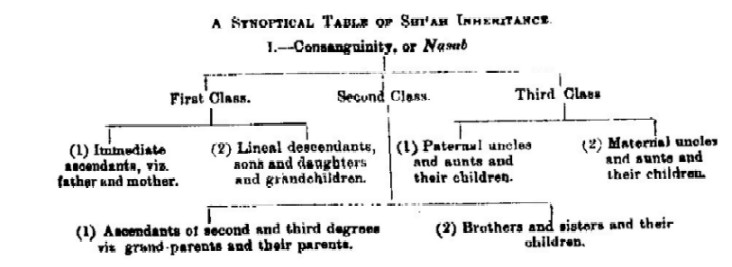
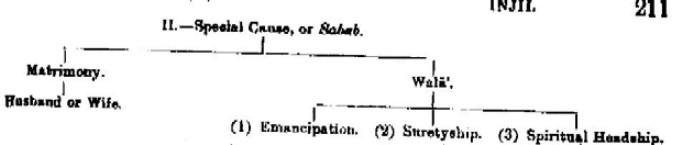
[For the Muhammadan law of inheritance in English, refer to Sir William Jones' translation of the Sirajiyah (Calcutta, A.D. 1792), reprinted by Mr. Almaric Ramsey, A.D. 1869. The Muhammadan Law of Inheritance, by Mr. N. B. E. Baillie, A.D. 1832; by Mr. S. G. Grady, A.D. 1869; also see Personal Law of the Muhammadans, by Mr. Ameer Ali, 1880. The Arabic works on the subject are: For Sunni law, as-Sirajiyah, ash-Sharif'iyah, Hidayah, Durru ‘l-Mukhtar; for Shia'ah law. Jami'u ‘sh-Shata, Mafatih, Shara'i'u ‘l-Islam, Irshad-i-Allamah.]
INHIBITION
Arabic hijr  which, in its primitive sense, means "interdiction or prevention." In the language of the law it signifies an interdiction of action with respect to a particular person; the causes of inhibition being three: infancy, insanity, and servitude.
The acts of an infant, i.e. one under puberty, and unlawful, unless sanctioned by his guardian. The acts of a lunatic who has no lucid intervals are not at all lawful; and so are those of a male or female slave. (Hidayah, iii. p. 468.)
INITIAL LETTERS of the Qur'an
[QUR'AN.]
INJIL  , Gr.
, Gr.  . Evangel. Injil is used in the Qur'an, and in the Traditions, and in all Muhammadan theological works of an early date, for the revelations made by God to Jesus. But in recent works it is applied by Muhammadans to the New Testament. The word occurs twelve times in the Qur'an, as in the following Surahs, which we have arranged chronologically, and not as they occur in the Qur'an. (It will be seen that the expression Injil is not mentioned in the earlier Surahs in article QUR'AN.)
Surah vii. 156: "Who follow the Apostle - the illiterate Prophet, whom they find written down with them in the Law (Taurat) and the Gospel (Injil)."
Surah iii. 2: "He has sent thee a book (i.e. the Qur'an) confirming what was before it, and has revealed the Law, and the Gospel before, for the guidance of men."
Surah iii. 43 "He will teach him the Book and Wisdom, and the Law and the Gospel."
Surah iii. 58: "Why do ye dispute about Abraham, when the Law and the Gospel were not revealed until after him."
Surah lvii. 27: "We gave him (Jesus) the Gospel, and we placed in the hearts of those who followed him kindness and compassion."
Surah xlviii. 29: "Their marks are in their faces from the effects of adoration: that is their similitude in the Law, and their similitude in the Gospel."
Surah ix. 112: "Promised in truth in the Law, in the Gospel, and in the Qur'an."
Surah v. 50: "We brought him (Jesus) the Gospel."
Surah v. 51: "Then let the people of the Gospel judge by what is revealed therein."
Surah v. 70: "And were they steadfast in the Law and in the Gospel?"
Surah v. 72: "Ye rest on nought until ye stand fast by the Law and the Gospel and what is revealed to you from your Lord."
Surah v. 110: "When I taught thee the Book, and Wisdom, and the Law, and the Gospel."
There are also allusions to the Christian Scriptures in the following verses:-
Surah xix. 31. (The infant Jesus said,) "Verily, I am the servant of God: He hath given me the book, and He hath made me a prophet."
Muhammad was much more indebted to Judaism than Christianity for the teaching he received, which enabled him to overthrow Arabian idolatry and to establish the worship of the One True God [CHRISTIANITY, JUDAISM], and consequently we find more frequent allusions to the Law of Moses than to the Gospel of Christ; and, as it has been already stated, the references to the Gospel as a revaltior are in the later Surahs. But in all references to the Injil as an inspired record, there is not one single statement to the effect that the Christians of Muhammad's day did not possess the genuine Scriptures. In Surah iv. 169, (which is an al0Madinah Surah), the Christians are charged with extravagance, or error in doctrine, but not with not possessing the true Gospels:-
"Ye people of the Book! Commit no extravagance in your religion; and say not of God other than the truth. For verily the Messiah, Jesus, the son of Mary, is an apostle of God, and His word which He placed in Mary, and a spirit from Him. Wherefore, believe in God, and in His apostle; and say not, - ‘the Trinity'; - refrain; it will be better for you. For verily God is one God; far exalted is He above the possibility that there should be unto Him progeny! To Him belongeth whatever is in the heavens and in the earth, and He sufficeth as a guardian."
In Surah lxi. 6, there is an appeal to the Gospel in support of Muhammad's mission, and the appeal is made without any doubt that he has referring to a genuine saying of Christ, well known to the Christians of that day. The verse is as follows:-
"When Jesus, the son of Mary, said: ‘O children of Israel! Verily, I am the apostle of God to you, verifying the law that was
before me, and giving you glad tidings of an apostle who shall come after me, whose name shall be Ahmed!' But when he did come to them with manifest signs, they said, This is manifest sorcery!"
The allusion is to the promise of the Paraclete in John xvi. 7, the Muslims declaring that the word  has been substituted for the Greek
  , the word Ahmad, which is equivalent to Muhammad, meaning "Praised." The charge which modern Muslims bring against the Christians of having either lost, or changed the original Scriptures, is treated under the head of CORRUPTION OF THE SCRIPTURES; but some curious statements on the subject will be found in an article in the Kashfu ‘z-Zunun. It is a Bibliographical Dictionary, compiled by Hajji Khalifah about 200 years ago. The statements in its article on INJIL are such a strange mixture of fact and fiction that we translate the article from the Arabic in extensor: -
"The Injil is a book which God revealed to ‘Isa ibn Maryam. In the work entitled al-Muwahib (by Shihabu ‘d-Din Ahmad al-Qastalani, died A.H. 923), it is recorded that the Injil was first revealed in the Syriac tongue, and has since been translated into seventeen languages. But in the Sahuhu ‘l-Bukhari (A.H. 256), in the story of Waraqah ibn Naufal, it is related that the Injil was revealed in Hebrew. According to Wahb ibn Munabbih, as quoted by Zamakhshari (A.H. 538) in the Kashshaf, the Injil was revealed to Jesus on the 13th day of the month of Ramazan, although some say it was on the 18th day of that month 1200 years after the revelation of the Zabur (Psalms) to Moses."
"It is a disputed question whether or not the Injil abrogates the Law of Moses (Taurat). Some say that Jesus was not a Sahibu ‘sh-Shari'ah (a law-giver); for it is said in the Injil: -

‘I am not come to abrogate (tabdil) the Law of Moses, but to fulfil it (takmil).'
"But al Baizawi (A.H. 685), in his commentary the Anwaru ‘t-Tanzil, seems to prove that the Law of Jesus does abrogate the Law of Moses Shar'u Musa), for there are certain things revealed to Jesus which were not revealed to Moses."
"At the commencement of the Injil is inscribed  , ‘In the name of the Father and of the Son.' &c. And the Injil, which is now in the hands of the Christians, is merely a history of the Christ (Siratu ‘l-Masih), collected by his four companions Matta, Luqa, Marqus and Yuhanna."
"In the book entitled the Tuhfatu ‘l-Adib fi Baddi ‘ala Ahli 's-Salib, or ‘A refutation of the servants of the Cross' (written by ‘Abdu'llah, a pervert from Christianity to Islam, A.H. 823), it is said that these four Companions are they who corrupted the religion of Jesus, and have added to it. And that they were not of the Hawariyun, or Apostles, mentioned in the Qur'an. Matta did not see Jesus until the year he was taken up to heaven; and after the Ascension of Jesus he wrote in the city of Alexandria, with his own hand, his Injil, in which he gives an account of the birth and life of Jesus, mentioning several circumstances which are not mentioned by others. Luga also did not see Jesus, but he was converted to Christianity by one Bulis (Paul), who was an Israelite, who himself had not seen Jesus, but was converted by Ananiya (Anamas). Marqus also did not see Jesus at all, but was converted to Christianity after the Ascension of Jesus by the Apostle Bitru, and received the Injil (Gospel) from that Apostle in the city of Rome. And his Gospel in many respects contradicts the statements of the other three. Yuhanna was the son of the sister of Maryam, the mother of Jesus, and the Christians assert that Jesus was present at the marriage of Yuhanna, when Jesus changed the water into wine. It was the first miracle performed by Jesus."
"When Yuhanna saw the miracle, he was converted to Christianity, and left his wife and followed Jesus. He was the writer of the fourth Injil (Gospel). It was written in Greek, in the city of Ephesus. These are the four persons who altered and changes the true Injil, for there was only one Injil revealed to Jesus, in which there was no contradiction or discrepancy. These people have invented lies concerning God and His Prophet Jesus, upon who be peace, as it is a well known fact, although the Christians (Nasara) deny it. For example, Marqus has written in the first chapter of his Gospel that in the book of the Prophet Isaiah it is said by God, ‘I have sent an angel before thy face, namely, before the face of Jesus whereas the words are not in the book of Isaiah but in that of Malachi." [See mark i. 2. In the Received Version the words are "in the Prophets"; but in the Revised Version we have "in Isaiah the prophet."]
"Again, it is related by Matta, in the first or rather thirteenth chapter of his Gospel [sic; see, however, Matt. xii. 40], that Jesus said, ‘My body will remain in the belly of the earth three days and three nights after my death, just as Jonas was in the whale's belly;' and it is evident it was not true, for Matta agrees with the three other writers of the Gospels that Jesus died in the sixth hour on Friday, and was buried in the first hour of the night on Saturday and rose from the dead early on Sunday morning, so that he remained in the belly of the earth one day and two nights. So there remains no doubt that the writers of the Gospels told the un-truth. For neither Jesus said of himself nor did God in his Injil say of him, that Jesus will be killed or buried in the earth, for God has said (i.e. in the Qur'an, Surah iv. 156), They slew him not, for certain! Nay, God raised him up unto Himself.' For this cause there were various divisions amongst the
Christians. Other circumstances similar to these are mentioned in the Tuhfatu ‘l-Adib. Then there are the fundamental rules and doctrines (al-Qawa'id), upon which the Christians are, with very few exceptions, universally agreed, namely: (1) At-Tughti (Baptism); (2) Faith in the Taslis, or Trinity; (3) the Incarnation of the Uqnum (i.e. the essence) of the Son in the womb of Mary; (4) a belief in the Fitrah (i.e. the Holy Communion); (5) the Confession of all sins to the Priest Qis'is). These five foundations also are full of falsehood, corruption, and ignorance."
"In the work entitled al-Insanu ‘l-Kamil (written by the Shaikh Abdu ‘l-Karim ibn Ibrahim al-Jili, lived A.H. 767-811) it is said that when the Christians found that there was at the commencement of the Injil the superscription  i.e. ‘in the name of the Father and Son,' they took the words in their natural meaning, and [thinking it ought to be ab, father, Umm, mother, and Ibn, son] understood by Ab, the Spirit, by Umm, Mary, and by Ibn, Jesus; and on this account they said, Salisu Salasatin, i.e. ‘(God is) the third of three.' (Surah v. 77.) But they did not understand that by Ab is meant God Most High, by Umm, the Mahiyatu ‘l-Haqa'iq, or ‘Essence of Truth' Quidditas veritatum), and by Ibn, the Book of God, which is called the Wujudu ‘l-Mutlaq, or ‘Absolute Existence,' being an emanation of the Essence of Truth, as it is implied in the words of the Qur'an, Surah xiii. 9: ‘And with his is the Ummu ‘l-Kitab, or the Mother of the Book.'"
AL-INSAN 
"Man." The title of the LXXVIth Surah of the Qur'an, called also Suratu ‘d-Dahr, both words occurring in the first verse: "Did there not pass over man (insan) a long space of time (dahr) during which he was a thing not worthy of remembrance."
Some take these words to be spoken of Adam, whose body, according to tradition, was first a figure of clay, and was left for forty years to dry, before God breathed into it; but others understand them of man in general and of the time he lies in the womb. (See al-Baizawi, in loco.)
AL-INSANU ‘L-KAMIL 

"The perfect man." A term used by the Sufi mystics for one in whom are combined all the attributes of divinity and of humanity. (Kitabu ‘t-Ta'rifat, in loco). Also title of a mystic work by ‘Abdu ‘l-Karim ibn Ibrahim al-Jili (lived A.H. 767-811).
INSHA 
Lit. "Constructing; raising-up." The term is particularly applied to literary compositions and forms of letter-writing.
Mr. Lane, in his Modern Egyptians, vol. 1, p. 272, mentions the Shaikh of the great Mosque, the Azhar, as the author of a collection of Arabic letters on various subjects, which are intended as models of epistolary style, such a collection being called an Irsha.
INSHA'A ‘LLAHUTA ‘ALA 

"If it should please God Almighty." A very frequent ejaculation amongst Muslims. [ISTIENA'.]
AL-INSHIRAH 
"Expanding." The title of the XCIVth Surah of the Qur'an, which opens with the words "Have we not expanded thy breast." It is supposed to allude to the opening of Muhammad's heart in his infancy, when it is said to have been taken out and cleansed of original sin. (See al-Baizawi, in loco.)
INSOLVENCY
of a debtor is established by a judicial decree; and after such a declaration a bequest by such a person is void. If, however, the creditors relinquish their claim the bequest is then valid. (Hidayah, iv. p. 475.)
INSPIRATION
Arabic wahy  . According to the Nuru ‘l-Anwar; by Shaikh Jiwan Ahmad (A.H. 1130), inspiration is of two kinds. Wahy zahir, external inspiration, or Wahy batin, internal inspiration.
I. - External Inspiration is of three kinds: -
(1) Wahyu Qur'an, or that which was received from the mouth of the angel Gabriel, and reached the ear of the Prophet, after he knew beyond doubt that it was the angel who spoke to him. This is the only kind of inspiration admitted to be in the Qur'an. It is sometimes called the Wahy mattu.
(2) Ishratu ‘l-Malak, or that which was received from the angel but not, by word of mouth, as when the Prophet said, "the Holy Ghost has breather into my heart."
(3) Ilham or Wahyo qalb; or that which was made known to the Prophet by the "light of prophecy." This kind of inspiration is said to be possessed by Walis or saints, in which case it may be either true or false.
II. - Internal Inspiration is that which the Prophet obtained by thought and analogical reasoning, just as the Mujtahidun, or enlightened doctors of the law obtain it. It is the belief of all orthodox Muslims that their Prophet always spoke on matters of religion by the lower forms of inspiration (i.e. Isharatu l-Malak, Ilham, or Wahyu qalb); and consequently a Hadis is held to be inspired in as great a degree, although not in the same manner as the Qur'an itself. The inspiration of the Hadis is called the Wahy ghair matlu. (See Nuru ‘l-Anwar, p. 181; Mishkat, book i. ch. vi. pt. 2.)
Suratu ‘n-Najm, liii. 2. "You lord (sahib) erreth not, nor is he led astray, neither speaketh he from impulse."
According to the strict Muhammadan doctrine, every syllable of the Qur'an is of a directly divine origin, although wild rhapsodical Surahs first composed by Muhammad (as xci, c, ciii) do not at all bear marks of such an assumption, and were not probably intended to be clothed in the dress of a message from the Most High, which cha-
-racterizes the rest of the Qur'an. But when Muhammad's die was cast (the turning point in his career) of assuming that Great Name as the speaker of His revelations, then these earlier Surahs also came to be regarded as emanating directly from the Deity. Hence it arises that Muhammadans rigidly include every word of the Qur'an, at whatever stage delivered, in the category of Qala ‘llahu, or "This saith the Lord," and it is one of their arguments against our Christian scriptures that they are not entirely cast in the same mould - not exclusived oracles from the mouth, and spoken in the person of God. (Muir's Life of Mahomet.)
The following is a description of inspiration as given by Ibn Khaldun, "The sign that a man is inspired," he says, "is, that he is at times completely absent, though in the society of others. His respiration is stentorious and he seems to be in a cataleptic fit, or in a swoon. This, however, is merely apparent; for in reality such an ecstasis is an absorption into the invisible world; and he has within his grasp what he alone is able to conceive, which is above the conception of others. Subsequently these spiritual visions descend and become perceptible to the faculties of man. They are either whispered to him in a low tone, or an angel appears to him in human shape and tells him what he brings from God. Then the ecstasies ceases, and the prophet remembers what he has heard."
INTELLECT Arabic 'aql  , fahm
  , idrak
The Faqir Jani Muhammad ibn As'ad, in his work the Akhlaq-i-Jalali, says: "The reasonable mind has two powers, (1) the power of perceiving, and (2) the power of impelling; and each of these powers has two divisions: in the percipient power, 1st, and observative intellect, which is the source of impression from the celestial sources, by the reception of those ideas which are the materials of knowledge; 2nd, an active intellect, which, through thought and reflection, is the remote source of motion to the body in its separate actions. Combined with the appetent and vindictive powers, this division originates the occurrence of many states productive of action or impact, as shame, laughing, crying; in it operation on imagination and supposition, it leads to the accession of ideas and arts in the partial state; and in its relation with the observative sense and the connection maintained between them, it is the means of originating general ideas relating to actions, as the beauty of truth, the odiousness of falsehood, and the like. The impelling power has likewise tow divisions: 1st, the vindictive power, which is the source of forcibly repelling what is disagreeable; 2nd, the appetent power, which is the source of acquiring what is agreeable." (Thompson's ed. p. 52.)
INTERCALATION of the Year.
Arabic nasi. The privilege of commuting the last of the three continuous sacred months for the one succeeding it, the month Safar in which case Muharram became secular, and Safar sacred. M Caussin de Perceval supposes that this innovation was introduced by Qusaiy, an ancestor sixth in ascent from Muhammad, who lived in the middle of the fifth century. Dr. Sprenger thinks that intercalation in the ordinary sense of the word was not practiced at Makkah, and that the Arab year was a purely lunar one, performing its cycle regularly, and losing one year in every thirty-three.
The custom of nasi' was abolished by Muhammad, at the farewell pilgrimage, A.H. 10, as is stated in the Qur'an, Surah ix. 36, 37: -
"Twelve months is the number of months with God, according to God's book, since the day when He created the heavens and the earth: of these four are sacred; this is the right usage. But wrong no yourselves therein; attack those who join gods with God in all, as they attack you in all: and know that God is with those who fear Him."
"To carry over a sacred month to another, is only a growth of infidelity. The Infidels are led into error by it. They allow it one year, and forbid it another, that they may make good and number of months which God hath hallowed, and they allow that which God hath prohibited."
INTELLECT
Arabic fa'ah  . There is a general belief amongst Muhammadans that their Prophet is a living intercessor for them at the throne of God; but the Wahhabis state that the intercession of their Prophet will only be by the permission (Izn) of God at the last day, and that there is no intercession for sins until the Day of Judgement. The teaching of the Qur'an and the Traditions seems to be in favor of this view.
Surah ii. 256: "Who is he that can intercede with Him but by His own permission?"
Surah xix. 90: "None shall meet (in the Day of Judgement) with intercession save he who hath entered into covenant with the God of mercy."
Surah xx. 108: "No intercession shall avail on that day, save his whom the Merciful shall allow, and whose words He shall approve."
Surah xxiv. 22: "No intercession shall avail with him but that which He Himself alloweth."
Surah xxxix. 45: "Intercession is wholly with God."
Surah xxviii. 38 : "On the day whereon the spirit (Ruh) and the angels shall stand ranged in order they shall not utter a word, save he whom the God of mercy permits, and who shall say what is right."
The statements of Muhammad, as contained in the Traditions, are as follows: -
"He is most fortunate in my intercession in the Day of Judgement, who shall have said from his heart, without any mixture of hypocrisy, ‘There is no deity but God.'"
"I will intercede for those who shall have committed great sins."
"Three classes will intercede on the Day of Judgement, the Prophets, the Learned, the Martyrs." (Mishkat, book xxxiii. ch. xii.)
The author of the Sharh-i-Muwaqif says (p. 588): According to the Sunnis, the intercession of Muhammad is specially for those who have committed great sins (ahlu ‘l-kaba'ir), for the purpose of removing punishment; for Muhammad has said, "My intercession is for those who have committed great sins." But the Mu'tazilahs say the intercession of Muhammad is for the increase of merit, and not for the prevention of punishment; for it is said in the Qur'an, Surah ii. 45: "Fear the day wherein no soul shall pay recompense for another soul. Nor shall intercession be accepted for it, nor shall compensation be taken from it, nor shall they be helped."
INTERMEDIATE STATE
The state of the soul between the time of death and the resurrection is generally expressed by the term 'Alam- i-Barzakh, for an explanation of which refer to the article BARZAKH. Sufi writers use the term "Alam-i-Arwah, "The world of spirits."
From the Traditions it would appear that Muhammad taught that the intermediate state is not one of unconsciousness. To the wicked it is certainly not; but inasmuch as the Muslim is encouraged to "sleep like the bridegroom," it may be inferred that the intermediate state of the Muslim is held to be one of absolute repose." [PUNISHMENTS OF THE GRAVE.]
INZAR 
Listening or lending an ear to the bankrupt's statement or petition.
INZI'AJ 
Lit. "Being disturbed and moved from its place." A term used by the Sufi mystics for the movement and excitement of the heart in the direction of God, through the effect either of a sermon, or of music and singing. (‘Abdu ‘r-Razzaq's Dict. Of Suf'i Terms.).
IQALAH 
"Cancelling." In law, the canceling or dissolution of sale, or any other contract.
IQAMAH 
Lit. "Causing to stand." A recitation at the commencement of the stated prayers when said in a congregation, after the worshipers have taken up their position. It is the same as the I'zan, with the addition of the sentence. "Verily prayers are now ready" (Qad qamati ‘s-salat). The sentences are, however, recited singly by all the sects except the Hanafis who give it exactly as the I'zan. It is not recited by the Imam, but by the person who stands behind him, who is called the Muqtadi, or "follower." In large mosques it is usual for the Mu'azzin, or caller to prayer, to take this office. But in his absence the person who happens to be behind the Imam recites the Iqamah. {IMAM.]
IQRAR 
Acknowledgment, confession.
(1) A legal term used for the avowal of the right of another upon one's self in sales, contracts, and divorce. (2) A theological term used for a confession of the Muslim faith, or a confession of sin. (3) Iqrar-namah salasi, a deed of arbitration by a third party. (5) Iqrar ‘amm, a public acknowledgment.
IQTIZA 
Lit. "Demanding." A term used in the exegesis of the Qur'an for sentence which demand certain conditions, e.g. Surah iv. 94: "Whoso killeth a Mu'min (a believer) by mischance shall be bound to free a slave." Here the condition demanded is that the slave shall be the property of the person who frees him, and if he have not a slave to free, then some other expiation is required.
IRADAH 
Purpose, will, intention. (1) A word used for the intention or will of man. (2) Iradatu ‘llah, the will of God. (3) According to the Sufi mystics, it is "a flame of love in the heart which desires God and longs to be united with Him. (‘Abdu ‘r-Razzaq's Dict. Of Suf'i Terms.).
IRAM 
A place mentioned in the Qur'an, Surah lxxxix. 6: "Iram of the columns, the like of which has not been created in these land."
It is related that ash-Shaddad, the son of ‘Ad, ordered the construction of a terrestrial paradise in the desert of ‘Adan, ostensibly to rival the celestial one, and to be called Iran after his great grandfather. On going to take possession of it, he and all his people were struck dead by a noise from heaven and the paradise disappeared.
AL-IRAQ 
Lit. "A side, or shore." A country frequently mentioned in the Traditions, which extends from ‘Abbadan to al-Mausil in length, and from al-Qadisiyah to Halwan in breadth. Said to be so named because it was on the "shore" of the rivers Tigris and Euphrates. Its principal cities were al-Basrah and al-Kufah, and were called al-‘Iraqan, or the Two ‘Iraqs.
'IRBAN 
Earnest money paid in any legal transaction.
IRHAS 
Lit. "Laying the Foundation." A term used for any wonder wrought in behalf of a Prophet before he assumes the prophetic office: for example, the existence of a light on the forehead on Muhammad's ancestors is an Irhas (Kitabu ‘t-Ta'rifat).
IRON Arabic al-Hadid  . The title of Surah lvii. in the Qur'an, in the 25th verse of which it is said: "We (God) sent down iron, in which both keen violence and advantages to men." Zamakhshari says that Adam brought down with him from Paradise
five things made of iron, viz. an anvil, a pair of tongs, two hammers, a greater and lesser, and a needle.
IRTIDAD 
[APOSTASY.]
'ISA 
The name given to Jesus in the Qur'an and all Muhammadan writings. [JESUS CHRIST.]
ISAAC Arabic Ishaq 
The son of Abraham. He is mentioned in the Qur'an as specially the child of promise, and a gift from God to Abraham; and also as an inspired prophet.
Surah xxi. 72: "And We (God) gave him (Abraham) Isaac and Jacob as a farther gift: and we made them all righteous."
Surah xix. 50: "And when he had separated himself from them and that which they worshiped beside God, we bestowed on him Isaac and Jacob; and each of them we made a prophet."
"And we bestowed gifts on them in our mercy, and gave them the lofty tongue of truth."
The birth of Isaac as a child of promise to Abraham is related in Surah xi. 72-77:-
"And our messengers came formerly to Abraham with glad tidings. ‘Peace', said they. He said, ‘Peace,' and tarried not, but brought a roasted calf."
"And when he saw that their hands touched it not, he misliked them, and grew fearful of them. They said, ‘Fear not, for we are sent to the people of Lot.'"
"His wife was standing by and laughed; and we announced Isaac to her; and after Isaac, Jacob."
"She said, ‘Ah, woe is me! Shall I bear a son when I am old, and when this my husband is an old man? This truly would be a marvelous thing.'
"They said, ‘Marvellest thou at the command of God? God's mercy and blessing be upon you, O people of this house; praise and glory are His due?"
"And when Abraham's fear had passed away, and these glad tidings had reached him, he pleaded with us for the people of Lot. Verily, Abraham was right kind, pitiful, relenting."
Abraham's willingness to offer up his son is told in the Qur'an, and from the text there would seem little doubt but Isaac was intended, although al-Baizawi and many commentators declare it was Ishmael. The account runs thus (Surah xxxvii. 97-113):-
"And he siad, ‘Verily, I repair to my Lord who will guide me."
"O Lord give me a son, of the righteous."
"We announced to him a youth of meekness."
"And when he became a full-grown youth, his father said to him, ‘My son, I have seen in a dream that I should sacrifice thee; therefore, consider what thou seest right'".
"He said, ‘My father, do what thou art bidden; of the patient, if God please, shalt thou find me'".
"And when they had surrender them to the will of God, he laid him down upon his forehead."
"We cried unto him, ‘O Abraham'!"
"‘Now hast thou satisfied the vision. See how we recompense the righteous."
This was indeed the test.
"And we ransomed his son with a costly victim."
"And we left this for him among posterity."
"‘PEACE BE UPON ABRAHAM!'"
"Thus do we reward the well-doers."
"For he was of our believing servants."
"And we announced Isaac to him - a righteous prophet -
And on him and on Isaac we bestowed our blessing. And among their offspring were well-doers, and others, to their own hurt undoubted sinners."
The feast sacrifice, the ‘Idu ‘l-Azha, is said to have been instituted in commemoration of this event. [‘IDU ‘L-AZHA.]
Syud Ahmad Khan Bahadur, in his Essays on Arabia, remarks that learned Muhammadan theologians distinctly say it was Isaac and not Ishmael who was to have been offered up; but our researches scarcely confirm the learned Syud's statement. Isma'il al-Bukhari, no mean authority, says it was Ishmael, and so does al-Baizawi.
The weight of traditional authority seems to be in favor of Isaac, and so does the text of the Qur'an, which we have explained in the account of Ishmael; and yet amongst both the Sunnis and the Shi'ahs the opinion is now almost universal that it was Ishmael. [ISHMAEL.]
ISAIAH Arabic Sha'ya' 
The name is not mentioned in the Qur'an, but al-Baizawi, the commentator, in remarking on Suratu ‘l-Mi'raj, xvii. 4: - "We decreed to the children of Isra'il in the Book, ‘Ye shall verily do evil in the earth twice,'" - says the two sins committed by the Israelites were first the murder of Sha'ya'ibn Amsiya (i.e. Isaiah, son of Amoz) or Armiya (i.e. Jeremiah); and the second, the murder of Zakaria and John the Baptist, and the intention of killing Jesus.
I'SAR 
Honoring another above oneself. Thinking of another's gain rather than one's own. The highest form of human friendship.
'ISHA 
The Night Prayer. The liturgical prayer recited after the night has well set in. [PRAYER.]
ISHAQ 
[ISAAC.]
ISHAQIYAH 
A Shi'ah sect founded by a person named Ishaq, who held that the Spirit of God existed in the Khalifah ‘Ali.
ISHARARU ‘L-MALAK 

[INSPIRATION.]
ISHMAEL Arabic Isma'il 
The eldest son of Abraham, by his "wife" Hagar [HAJAR.]
(1) The progenitor of the Arabian race, and, according to the Qur'an, an inspired prophet. Surah xix. 55._
"And commemorate Ishmael in ‘the Book;' for he was true to his promise, and was an Apostle, a prophet;
"And he enjoined prayer and almsgiving on his people, and was well-pleasing to his Lord."
(2) Said to have assisted his father in the construction of the Ka'bah. Surah ii. 119, 121:-
"And remember when we appointed the Holy House as man's resort and safe retreat, and said, ‘Take ye the station of Abraham for a place of prayer.' And we commanded Abraham and Ishmael, ‘Purify my house for those who shall go in procession round it, and those who shall abide there for devotion, and those who shall bow down and prostrate themselves.'"
"And when Abraham, with Ishmael, raised the foundations of the House, they said, ‘O our Lord! Accept it from us; for Thou are the Hearer, the Knower.'"
(3) Also mentioned in six other places.
Surah ii. 134: "Do ye say that Abraham and Ishmael, and Isaac and Jacob, and the Tribes were Jews, or Christians?"
Surah iii. 78: "And what was revealed to Abraham and Ishmael and Isaac and Jacob and the Tribes."
Surah iv. 161: "And we inspired Abraham and Ishmael and Isaac and Jacob and the Tribes."
Surah vi. 86: "And Ishmael and Elisha, and Jonah, and Lot."
Surah xxi. 85: "And Ishmael, and Idris, and Zu ‘l-Kifl, all these were of the patient."
Surah xxxviii. 48: "And remember Ishmael, and Elisha, and Zu ‘l-Kifl, for each was righteous."
(4) According to the Old Testament, Ishmael had twelve sons, and Muhammadan tradition also agrees with this: -
Genesis xxv. 12: "Now these are the generations of Ishmael, Abraham's son, whom Hagar the Egyptian, Sarah's handmaid, bare unto Abraham. And these are the names of the sons of Ishmael, according to their generations; the first-born of Ishmael, Nebajoth; and Kedar, and Adbeel, and Mibsam, and Mishma, and Dumah, and Massa, and Hadar, and Tema, and Jetur, and Naphish, and Kedemah. These are the sons of Ishmael, and these are the names by the castles, twelve princes according to their nations."
The names of these sons of Ishmael can still be distinguished amongst the tribes, the names of which occur in Muhammadan history: Nebajoth (Nabayus), the founder of the Nabathean nation, who succeeded the Idumeans in Arabia, and were an important people in Northern Arabiz. Kedar (Qaidar) was also a famous tribe, so famous that the Badawis of the desert applied the name to all Jews. Dumah is still preserved in the name Dumatu ‘l-Jandal. Tema corresponds with Taimah, and Jetur with the Jadur of modern Arabia. Muhammad is said to have been descended from Ishmael's second son Kedar (Qaidar), through one named ‘Adnan. The period between ‘Adnan and Ishmael is doubtful. Some reckon forty generations, others only four. Umm Salmah, one of the Prophet's wives, said ‘Adnan was the son of ‘Adad, the son of Humaisa, son of Nabat, son of Ishmael. (See Abu ‘l-Fida, p. 62.) Muslim historians, however, admit that the pedigree of Muhammad beyond ‘Adnan is uncertain; but they are unanimous in tracing his descent to ‘Adnan in the following line: (1) Muhammad, (2) ‘Abdu'llah, (3) Abu Muttalib, (4) Hashim, (5) ‘Abdu Manaf, (6) Qusaiy, (7) Kilab, (8) Murrah, (9) Ka'b, (10) Luwaiy, (11) Ghalib, (12) Fihr, (13) Malik, (14) An-Nazr, (15) Kinanah, (16) Khuzaimah, (17) Mudrikah, (18) Al-Ya's, (19) Muzar, (20) Nizar, (21) Ma'add, (22) ‘Adnan.
Syud Ahmad Khan Bahadur traces the descent of Muhammad to Kedar, the son of Ishmael, and the view is one in accordance with that of most Muslim writers. In the time of Isaiah the two chief Arabian tribes seem to have been the descendants of Nebajoth and Kedar. (See Isaiah lx. 7.) "All the flocks of Kedar shall be gathered unto thee, the rams of Nebajoth shall minister unto thee."
(5) The account of Hagar leaving Abraham's home is given in numerous traditions. But there are two traditions given by Ibn ‘Abbas, and recorded in the Sahih of al-Bukhari, which are the foundation of Muhammadan history on the subject. We give them as they have been translated by Syud Ahmad Khan, and afterwards append the Scripture narrative, which can be compared with the traditions of Islam:-
For reasons known only to Abraham and his wife, Sarah, the former took Ishmael, his son, and the boy's mother (Hagar), and left his country.
And they had with them a skin full of water.
Ishmael's mother drank from out the skin, suckling he child.
Upon her arriving at the place where Mecca now stands, she placed the child under a bush.
Then Abraham returned to come back to his wife, and the mother of Ishmael followed him.
Until she reached Keda.
And she called out, "O Abraham, with whom leavest thou me?"
He answered, "With God."
She replied, "I am satisfied with my God."
Then she returned, and commenced drinking out of the out of the skin, and suckled her infant until the water was consumed.
And she thought that if she went and looked around, she might, perhaps, see someone; and she went.
She ascended Mount Safa, and looked around to see whether or not there was anyone in sight; then hastily returning through the wilderness, she ascended the mountain of Marva.
Then she said, "I must now go and see how my child is." And she went, and saw that he was at the point of death; but not being able to compose her mind, she said, "If I go and look around, peradventure I may see someone." And accordingly she ascended the mountain of Safa, but could descry no one."
And this she repeated seven times.
She then said: "It will be better for me to go and see my child." But she suddenly heard a voice.
And see replied, "Kindly assist me, if you have any compassion."
The angel was Gabriel.
The narrator of the tradition, stamping the earth with his foot, said, this was exactly what the angel did, and that water issued from the spot; and she began to widen the hole.
It is related by Ibn ‘Abbas, that the Prophet said that had she (Hagar) allowed the water to remain in its former state, the water would then have continued issuing forth forever.
She used to drink that water and suckle her child.
Abraham brought with him his wife (Hagar) and his son (Ishmael),
Whom she (Hagar) suckled.
And they both placed the child close by the spot where the Kaaba now stands under a bush.
Near the well of Zamzem, near the lofty side of the temple - and in those days Mecca was uninhabited and without water - and they deposited the child in the above place.
And Abraham place beside them a bag full of dates,
And a skin full of water.
Then returned Abraham, and Ishmael's mother ran after him,
And said, "Abraham, whither goest thou and wherefore leavest thou me here?
"In this wilderness, where there is no one to pity me, neither is there anything to eat?" This she repeated several times, but Abraham hearkened not unto her. Then she asked him, "Has God commanded thee to do this?"
He answered, "Yes."
"Then," said she, "God will cause no harm to come unto me."
Thereupon she returned back.
And Abraham went away, and when he reached Saneoa, he could not see those he had left behind him.
Then he turned towards Mecca, and prayed thus: "O Lord, I have caused some of my offspring to settle in an unfruitful valley, near thy holy house, O Lord, that they may be constant in prayer. Grant, therefore, that the hearts of some men may be affected with kindness towards them; and do thou bestow on them all sorts of fruits, that they may give thanks."
And the mother of Ishmael began to suckle her child, and to drink water out of the skin until it was emptied.
And she and her son felt thirsty. And when she saw that her child was suffering from thirst, she could not bear to see it in such a plight and retired, and reached the mountain of Safa, that was near, and ascending it, looked at the plain in the hope of seeing someone; but, not perceiving anyone, she came down from the mountain.
When she reached the desert, she girded up her loins and ran as one mad, until she crossed the desert, and ascended Mount Marva; but she could not see anyone.
She repeated the same seven times.
It is related by Ibn ‘Abbas, that the Prophet said that this was the origin of the custom of true believers running between these mountains during the Haj.
And when she ascended the Marva mountain, she heard a voice.
She was startled thereat; and upon hearing it again, she said, "Wherefore callest thou on me? Assist me if thou canst."
She then saw an angel near the Zamzem.
He (the angel) made a hollow place, either by his foot or with his wing, and the water issued forth; and the mother of Ishmael commenced widening it.
She filled the skin with water, which came out of it as from a fountain.
It is related by Ibn ‘Abbas that the Prophet said, "May God bless the mother of Ishmael. Had she left the Zamzem as it was, or had she not filled her skin with water, then the Zamzem would always have remained an overflowing fountain."
Then she drank the water, and suckled her child.
The account as given in the Bible, Genesis xxii. 9, is as follows:-
"And Sarah saw the son of Hagar the Egyptian, which she had borne unto Abraham, mocking. Wherefore she said unto Abraham, Cast out this bondwoman and her son; for the son of this bondwoman shall not be heir with my son, even with Isaac. And this thing was very grievous in Abraham's sight, because of his son. And God said unto Abraham, Let it not be grievous in thy sight because of the lad, and because of they bondwoman; in all that Sarah hath said unto thee, hearken unto her voice; for in Isaac shall thy seed be called. And also of the son of the bondwoman will I make a nation, because he is thy seed. And Abraham rose up early in the morning, and took bread, and a bottle of water, and gave it unto Hagar, putting it on her shoulder, and the child, and sent her away; and she departed, and wandered in the wilderness of Beersheba. And the water was spent in the bottle, and she cast the child under one of the shrubs. And she went, and set her down over against him a good way off, as it were a bow shot; for she said, Let me not see the death of the child. And she say over against him, and lifted up her voice, and wept. And God heard the voice of the lad, and the angel of God called to Hagar out of heaven, and said unto her,
What aileth thee, Hagar? Fear not; for God hath heard the voice of the lad where he is. Arise, lift up the lad, and hold him in thine hand, for I will make him a great nation, and God opened her eyes, and she saw a well of water; and gave the lad drink. And God was with the lad; and he grew, and dwelt in the wilderness, and became an archer. And he dwelt in the wilderness or Paran; and his mother tookhim a wife out of the land of Egypt."
With reference to the above account, as given in Holy Scripture, Syud Ahmad Khan remarks: -
"Notwithstanding the perfect coincidence of the facts taken from the Scriptures with those from the Koran, as above shown, there are nevertheless, three very important questions which suggest themselves respecting Ishmael's settlement."
"First. Where did Abraham leave Ishmael and his mother after expelling them from his home?"
"Secondly. Where did Ishmael and Hagar settle after their wanderings in the desert?"
"Thirdly. Was it in the very spot where they had rested for the first time, or in some other place?"
"The Koran mentions nothing on the subject; but there are some local traditions, and also a few Hadeeses, which treat of it, the latter, however, by reason of their not possessing sufficient authority, and from their not being traced up to the Prophet, are as little to be relied on as the former. The local traditions being deemed unworthy of credit, from their mixing up together occurrences that had happened on various and different occasions, we do not think it necessary to dwell on the first question more than has been done by the Scriptures themselves, which say the "He (Abraham) sent her (Hagar) away; and she departed, and wandered in the wilderness of Beersheba.'"
"As for the two remaining questions, although the language of Scriptures is not very clear - since, in one place it says, "And he (Ishmael) grew, and dwelt in the wilderness, and became an archer' (Gen. xxi. 20), and in another, ‘He (Ishmael) dwelt in the wilderness of Paran' (Gen. xxi. 21), passages which would certainly lead us to infer that Ishmael had changed the place of his abode; yet, as no Christian commentator represents him as having removed from one place to another, and as, moreover, neither the religious nor the local traditions of the Mohammadans in any way confirm the above, it may be safely asserted that Ishmael and his mother did not change the place where they swell, and that by the word ‘wilderness' alone the sacred writer meant the wilderness of Paran. The solving of the whole question depends, therefore, upon ascertaining and fixing the position of the said wilderness of Paran, where Ishmael is said to have settled."
"Oriental geographers mention three places as known by the appellation of Paran. First, that wilderness wherein the city of Mecca now stands, and the mountains in its vicinity; secondly, those mountains and a village which are situated in Eastern Egypt, or Arabia Petræa; and thirdly, a district in the province of Samarcand."
(6) Al-Baizawi says it was Ishmael, and not Isaac, whom Abraham was willing to offer up as a sacrifice; but this view is nether supported by the text of the Qur'an nor by the preponderance of traditional testimony. If we compare Surah xi. 74: "And We announced Isaac (as the child of promise) to her," with Surah xxxvii. 99: "We announced (as a child of promise) to him a youth of meekness; and when he became a full-grown youth, his father said to him, ‘My son, I have seen in a dream that I should sacrifice thee'" - there can be no doubt in any candid mind that, as far as the Qur'an is concerned, Isaac and not Ishmael is intended. [ISAAC.]
The two commentators al-Kamalan quote a number of traditions on the subject. They say Ibn ‘Umar, Ibn ‘Abbas Hasan, and ‘Abdu‘llah ibn Ahmad, relate that it was Isaac; whilst Ibn Mas'ud, Mujahid, ‘Ikrimah, Qatadah, and Ibn Ishaq say it was Ishmael. But whatever may be the real facts of the case, it is certain that popular tradition amongst both the Sunnis and Shi'ahs assigns the honor to Ishmael, and believe the great Festival of Sacrifice, the ‘Idu ‘l-Azha, to have been established to commemorate the event. [‘IDU ‘L - AZHA.]
The author of the Shia'ah word, the Hayatu ‘l-Qulub (Merrick's ed. p. 28) says: "On a certain occasion when this illustrious father (Abraham) was performing the rites of the pilgrimage at Mecca, Abraham said to his beloved child, ‘I dreamed that I msut sacrifice you; now consider what is to be done with reference to such an admonition.' Ishmael replied, ‘Do as you shall be commanded of God. Verify your dream. You will find me endure patiently.' But when Abraham was about to sacrifice Ishmael, the Most High God made a black and white sheep his substitute, a sheep which had been pasturing forty years in Paradise, and was created by the direct power of God for this event. Now every sheep offered on Mount Mina, until the Day of Judgement is a substitute, or a commemoration of the substitute for Ishmael."
The idea is universal amongst Muhammadans that the incident took place on Mount Mina near Makkah, and not in the "land of Moriah," as stated in Genesis xxii. 3. (For a discussion on the site of Mount Moriah, see Mr. George Grove's article in Smith's Dict. of the Bible.)
Sir William Muir says (Life of Mahomet, new ed. p. xvii.): "By a summary adjustment, the story of Palestine became the story of the Hejaz. The precincts of the Kaaba were hallowed as the scene of Hagar's distress, and the sacred well Zamzem as the source of her relief. The pilgrims hasted to and fro between Safa and Marwa in memory of her hurried steps in search of water. It was Abraham and Ishmael who built the (Meccan) temple, placed in it the black stone, and
established for all mankind the pilgrimage to Arafat. In imitation of him it was that stones were flung by pilgrims at Satan; and sacrifices were offered at Mina in remembrance of the vicarious sacrifice by Abraham instead of his son. And thus, although the indigenous rites may have been little if at all altered, by the adoption of the Abrahamic legends, they came to be viewed in a totally different light, and to be connected in the Arab imagination with something of the sanctity of Abraham, the Friend of God. The gulf between the gross idolatry of Arabia and the pure theism of the Jews was bridged over. Upon this common ground Mahomet took his stand, and proclaimed to his people a new and a spiritual system, in accents to which all Arabia could respond. The rites of the Kaaba were retained, but stripped by him of every idolatrous tendency: and they still hang, a strange unmeaning shroud, around the living theism of Islam."
ISHQ
"Love." A word used by mystic writers to express a divine love. The word, however, preferred by orthodox Muslim writers for the love of God, or love to God, is hubb 
ISLAM
Resignation to the will of God. The word generally used by Muhammadans themselves for their religion. ‘Abdu ‘l-Haqq says it implies submission to the divine will; and Muhammad explained it to mean the observance of the five duties: (1) Bearing witness that there is but on God; (2) Reciting the daily prayers; (3) Giving the legal alms; (4) Observing the Ramazan or month's fast; (5) Making the pilgrimage to Makkah once in a lifetime.
In the Qur'an the word is used for doing homage to God. Islam is said to be the religion of all prophets from the time of Abraham, as will appear from the following verses (Surah iii. 78, 79): - "SAY: We believe in God and in what hath been sent down to Abraham, and Ishmael, and Isaac, and Jacob, and the Tribes, and in what was given to Moses, and Jesus and the Prophets from their Lord. We make no difference between them, and to Him are we resigned (i.e. Muslims). Whose desireth any other religion than Islam, that religion shall never be accepted of Him, and in the next world he shall be lost."
There are three words used by Muhammad writers for religion, namely Din Millah, and Mazhab; and in the Kitabu ‘t-Ta'rifat, the difference implied in these words is said to be as follows: - Din, as it stands in its relation to God, e.g. Dinu'llah the religion of God; Millah, as it stands in relation to a prophet of lawgiver, e.g. Millatu Ibrahim, the religion of Abraham; and Mazhab, as it stands in relation to the divines of Islam e.g. Mazhab Hanafi, the religion or religious teaching of Abu Hanifah. The expression Din, however, is of general application. [RELIGION.]
Those who profess the religion of Islam are called Musalmans, Muslims, or Mu'mins.
Ahlu ‘l-Kitab, "the people of the Book", is used for Muhammadans, Jews, Christians.
ISM
A sin; anything forbidden by the law.
ISMAH
Lit. "Keeping back from sin." The continence and freedom from sin which Muhammadans say was the state of each Prophet, and which is that of infant children.
ISMA'IL
[ISHMAEL.]
ISMA'IL
The name of the angel who is said to have accompanied the angel Gabriel in his last visit to the Prophet of his death-bed. He is said to command one hundred thousand angels. (Mishkat, book xxiv. ch. x. pt. 3.)
ISMA'ILIYAH
A Shi'ah sect who said that Isma'il ibn Ja'far as-Sadiq was the true Imam and not Musa al-Kazinn and who held that God was neither existent nor non-existent, nor intelligent nor unintelligent, nor powerful nor helpless, &c.; for, they said, it is not possible for any thing or attribute to be associated with God, for He is the maker of all things, even of names and attributes. (Kitabu ‘t-Ta'rifat, in loco.)
ISM-I-JALALI
Any of the attributes of God which express His power and greatness, e.g. al-Hakim, the Judge; al-Adil, the Just; al Kabir, the Great. [GOD.]
ISM-I-JAMALI
Any of the attributes of God which express His mercy or condescension e.g. ar-Rahim, the Compassionate; as0Sami, the Hearer; al Hafiz, the Guardian.
ISM-I-SIFAH
Name of a divine attribute.
AL-ISMU ‘L-A'ZAM
The exalted name of God, which is generally believed to be known only to the Prophets. Muhammad is related to have said that it occurs in either the Suratu ‘l-Baqarah, ii, 256: "God (Allah) there is no God but He (Hu) the Living (al-Haiy), the Self-subsistent (al-Qaiyum)"; or in the Suratu ‘Ali ‘Imran, iii 1, which contains the same words; or in the Suratu Ta Ha, xx 110: "Faces shall be humbled before the Living (al-Haiy) and the Self-subsistent (al-Qaiyum)."
It is therefore generally held to be either Allah, or Hu, or al-Haiy, or al-Qaiyum.
It is very probable that the mysterious title of the Divine Being refers to the great name of Jehovah, the superstitions reverence for which on the part of the Jews must have been well known to Muhammad.
ISMU ‘Z-ZAT
Name of the Divine Essence; the essential name of God, i.e., Allah, or Hu, as distinguished from His attributes. [ALLAH.]
ISNA- ‘ISHARIYAH
Lit. "The twelve cans." Those Shi'ahs acknowledge the twelve Imams. [SHI'AH.]
ISQAT
[ABORTION.]
ISRA
[MI'RAJ.]
ISRAEL
Arabic Isre'il  The surname of Ya'qub (Jacob). Al-Baizawi says the meaning of Isr'il in Hebrew is Sufwatu ‘llah i.e. "the sincere friend of God"; or, as some say, Abdu'llah, "the servant of God. Banu Isra'il, "the children of Israel," is a term the frequently occurs in the Qur'an. The XVIIth chapter of the Qur'an, known as the Suratu ‘l-Mi'raj, is also called the Suratu Bani Isra'il.
ISRAF
Lit. "Wasting." Extravagance in religious duties i.e. doing more than is required by law.
ISRAFIL
The Arch-angel who will sound the trumpet at the Day of Resurrection. His name, however, does not occur in either the Qur'an, or the Traditions.
ISRAR
A word used by the Arabs for a horse pricking up his ears, and not obeying the rein. A term in Muhammadan theology for persisting in any sin, and being determined to commit the sin in future.
ISSUE OF BLOOD
Arabic Istihazah  [MUSTAHAZAH.]
ISTI'ANAH
Lit. "Seeking aid." Imploring help from God. The word occurs in the Suratu ‘l-Fatihah, or the first chapter of the Qur'an, which is part of the liturgical prayer:  waiyaka nasta'in "Of Thee only do we seek help."
ISTIBRA'
The purification of the womb. The period of probation, of one menses, to be observed after the purchase of a female slave (or in the case of a virgin under age), the period of one month before she is taken to her master's bed.
ISTIBSAR
A Book of Muhammadan traditions, received by the Shi'ahs, compiled by Shaikh Nasiru ‘d-Din Abu Ja'far Muhammad at-Tusi, A.H. 672.
ISTIDLAL
A term used in the science of exegesis for those sentences which require certain proofs. [QUR'AN.]
ISTIDRAJ
Lit. "Promoting by degrees, step by step." The word occurs in the Qur'an for an unbeliever being brought by degrees to hell and destruction.
Surah vii. 181: "They who say our signs are lies, We (God) will bring them down step by step from whence they know not."
Surah lxviii. 44: "We (God) will surely bring them down step by step from whence they do not know, and I (God) will let them have their way; for My device is sure."
(In this verse the sudden transition from the first person plural to the first person singular, for the Almighty, is peculiar; it is, however, of frequent occurrence in the Qur'an.)
ISTIGHFAR
Seeking forgiveness of God. It is related of Muhammad that he said:-
"I swear by God that I ask pardon of God, and repent before Him more than seventy times daily."
"O men, repent and turn to God, for verily I repent before Him one hundred times a day." (Mishkat, book x. ch. iii.)
ISTIHAZAH
The issue of blood of women; during which time they are ceremonially unclean. (Vide Mishkat, book iii. ch. xvi.)
ISTIHSAN
Lit. "Approving." A term used in the exegesis of the Qur'an and of the Hadis. It implies the rejection of Qiyas [QIYAS], and the admission of the law of expediency.
For example, it is a law of Islam that everything that is washed must be squeezed like a cloth; but, as it is impossible to squeeze a vessel, it is evident that it must be cleansed without squeezing. (Nuru ‘l-Anwar, p. 206.)
ISTIKHARAH
Lit. "Asking favors." A prayer for special favors and blessings, consisting of the recital of two rak'ah prayers. (Mishkat, book iv. ch. xl.)
Jabir says: "The Prophet taught the Istikharah, as he also did a chapter of the Qur'an; and he said, ‘When anyone of you intends doing a thing, he must perform two ark'ah prayers expressly for Istikharah, and afterwards recite the following supplication: O God, I supplicate Thy help, in Thy great wisdom; and I pray for ability through Thy power. I ask a thing of Thy bounty. Thou knowest all, but I do not. Thou arr powerful, and I am not. Thou knowest the secrets of men. O God! If the matter I am about to undertake is good for my faith, my life, and my futurity, then make it easy for me, and give me success in it. But it it is bad for my faith, my life, and my futurity, then put it away from me, and show me what is good, and satisfy me. And the person praying shall mention in his prayer the business which he has in hand.'"
This very simply and commendable injunction has, however, been perverted to superstitious uses.
Mr. Lane, in his Modern Egyptians, says:-
"Some persons have recourse to the Qur'an for an answer to their doubts. This they call making an "istikharah", or application for the favor of Heaven, or for direction in the right course. Repeating three times the opening chapter, the 112th chapter, and the fifty-eighth verse of the sixth chapter, they let the book fall open, or open it at random, and, from the seventh line of the right-hand page, draw their answer.
"The words often will not convey a direct answer, but are taken as affirmative or negative according as their general tenour is good or bad, promising a blessing, or denouncing a threat, &c. Instead of reading
the seventh line of this page, some count the number of letters kha and sheen which occur in the whole page; and if the kha's predominate, the inference is favorable. Kha represents kheyr, or good; sheen, shur or evil. There is another mode of istikharah; which is, to take hold of any two points of a sebhhah (or rosary), after reciting the Fat'hhah three times, and then to count the beads between these two points, saying, in passing the first bead through the fingers, ‘[I assert] the absolute glory of God;' in passing the second, ‘Praise be to God;' in passing the third, ‘There is no deity but God;' and repeating these expressions in the same order, to the last bead. If the first expression fall to the last bead, the answer is affirmative and favorable; if the second, indifferent; if the last, negative. This is practiced by many persons.
"Some again, in similar cases on lying down to sleep at night, beg of God to direct them by a dream; by causing them to see something white or green, or water, if the action which they contemplate be approved, or if they are to expect approaching good fortune; and if not, by causing them to see something black or red, or fire; they then recite the Fat'hhah ten times, and continue to repeat these words: ‘O God, favor our lord Muhammad!' - until they fall asleep." (Modern Egyptians, vol. i. 338.)
Amongst pious Muslims in Asia it is usual to recite the two rak'ah prayers before retiring to rest, in the hope that God will reveal His will in a dream during the night.
ISTILAD
Claim of offspring. A legal term signifying the act of a Muslim, having a child born to him of a female slave, which he acknowledges as his own, whereby the slave becomes free. (Hidayah, vol. i. p. 478.)
ISTILAH
Pl. Istilahat. A phrase; a term; idiom. A theological term.
The author of the Kitabu ‘t-Ta'rifat says it is the agreement of a tribe, or sect, or party, to give a special meaning to a word, ever and above that which it has in its literal sense, but which is in accordance with it.
ISTINJA'
Abstersion; concerning which there are most minute instructions in the Traditions and in other books of Muslim divinity. Such acts of cleansing must be performed with left hand, with not less than three handfuls of water, or with three of dry earth. (Mishkat, book ii. 1.)
ISTINSHAQ
The act of throwing water up into the nostrils, which is part of the religious ablution or wazu. [ABLUTION.]
ISTINSMAH
Lit. "Standing erect." A term (1) used by the Sufi mystics for rectitude of life, purity of life; (2) being constant in religion according to the rules of the Qur'an.
ISTIQBAL
Lit. "Going forth to meet." (1) A custom amongst Orientals of going out to meet a friend or guest on his arrival; (2) turning the face towards Makkah for prayer; (3) a coming era or period; the future.
ISTIRJA 
Lit. "Returning." A term used for the act of appealing to God for help in the time of affliction by repeating the following ejaculation from the Qur'an, Surah ii. 150: inna li'llahi was inna ilaihi raji'un, "Verily, we belong to God, and verily we shall return to God." this formula is used by Muhammadans in any danger or sudden calamity, especially in the presence of death.
ISTISHAB 
A law or injunction contained in a previous revelation (e.g. the Law of Moses) and not abrogated by the succeeding law-giver.
ISTISNA 
Lit. "Excepting or excluding." A term used for the custom of exclaiming, "If God will." It is in accordance with the injunctions of the Qur'an, Surah xviii. 23: "And never say of anything,'Verily, I am going to do that tomorrow,' without, ‘If God will.'" (Compare James iv. 15: "For ye ought to say, If the Lord will.")
ISTISQA 
Prayers for rain, consisting of two rak'ah prayers. (Mishkat, book iv. ch. liii.)
I'TAQ 
Lit. "Setting free." The manumission of slaves. [SLAVERY.]
ITFIR 
[POTIPHAR.]
I'TIKAF 
Seeking retirement in a mosque during the last ten days of the Fast of Ramazan; during which time the worshiper does no leave the place, except for necessary purposes. The time is spent in reciting the Qur'an and in performing the ceremony of Zikr, or the recital of the names and praises of the Deity.
'ITQ 
"Being free." In the language of the law it signifies the power given to a person by the extinction of bondage. Hence the emancipation of slave. (Hidayah, vol. i. p. 413.)
ITTIHAD 
Union; concord; intimate friendship. A term used by the Sufi mystics for "seeing the existence of all things visible as only existing in God." (‘Abdu ‘r-Razzaq's Dict. Of Sufi Terms.)
IZN 
Permission. [INTERCESSION.]
'IZRA'IL: 
The Angel of Death, or the Malaku ‘l-Maut, who comes to a man at the hour of death to carry his soul away from the body. See Qur'an, Surah xxxii. 11 : "The Angel of Death shall take you away, he who is given charge of you. Then unto your Lord shall ye return."
Muhammad is related to have said that when the Angel of Death approaches a believer he sits at his head and say, "O pure soul, come forth to God's pardon and pleasure!" And then the soul comes out as gently as water from a bag. But, in the case of an infidel, the Angel of Death sits at his head and say, "O impure soul, come forth to the wrath of God!" And then the Angel of Death draws it out as a hot spit is drawn out of wet wool. (Mishkat, book v. ch iii.)
Hughes' Dictionary of Islam
Answering Islam Home Page